
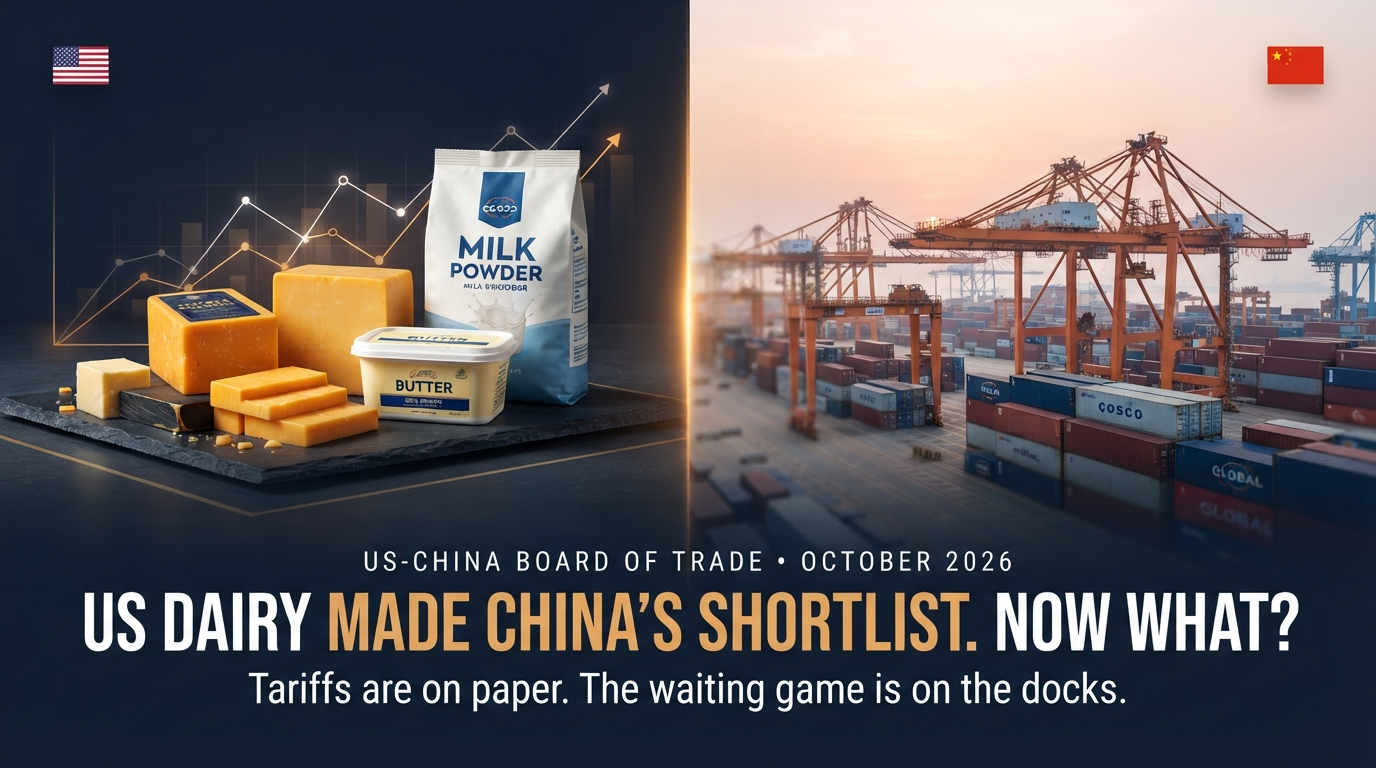

US dairy has made China’s $30 billion tariff-cut shortlist, but until those duties actually fall, exporters, processors and global buyers are stuck in a high-stakes waiting game.
That one sentence sums up where US-China dairy trade stands this October. There has been real progress on paper, with a new trade board, a list of products in line for lower tariffs and a longer truce. On the docks, nothing has changed yet. For anyone who buys, sells or prices dairy ingredients, the gap between those two things is where the risk and the opportunity sit.
What actually happened
In late September, Presidents Trump and Xi met in Washington and agreed three things that matter for dairy.
- The truce got longer. The tariff pause agreed in Busan in October 2025 was due to end on 10 November 2026. It now runs to 10 January 2027, and the suspension of the Section 301 shipping fees is extended with it.
- The Board of Trade got working rules. The board was created after the leaders’ May meeting in Beijing to manage trade in “non-sensitive” goods. It now has a mission, named leaders and a meeting schedule. USTR Jamieson Greer and Treasury Secretary Scott Bessent oversee it for the US, and Vice Premier He Lifeng for China.
- A “30-for-30” list was drafted. Each side recommended roughly $30 billion of goods for reduced tariffs. The US export list covers agricultural products, seafood, wood products, cosmetics and medical devices. Greer says it covers about 30% of US exports to China.
Dairy is on that list. CoBank analysts expect China to remove its 10% reciprocal tariff on a range of US farm goods, including butter, cheese and cream. Soybeans were notably left out, and the American Soybean Association has said it is disappointed.
Why “on the list” isn’t “in force”
The list is a set of recommendations for goods that could get better tariff treatment in the future. No implemented tariff schedule has been announced.
The US dairy groups are reacting accordingly:
- NMPF welcomed dairy’s inclusion. It also said retaliatory tariffs still put US dairy at a disadvantage while competitors gain share, and called for China’s dairy retaliation to be fully lifted.
- USDEC urged the board to move quickly to full elimination, not a partial trim. It also warned that any new port fees passed on to agricultural exporters could cancel out the gains.
In comments to USTR in July, both organisations set a higher target. They want China’s dairy tariffs cut beyond the standard most-favoured-nation rates, towards the preferential access New Zealand gets under its free trade agreement with China. Removing the retaliatory layer is step one. Matching New Zealand’s access would be a different scale of change.
Why this matters more for dairy than for most sectors
China is one of the world’s largest dairy importers. When it changes how it buys, prices move well beyond its borders.
US dairy has been here before. During the 2018–2019 trade war, retaliatory tariffs hit US dairy exports to China hard; USDEC put the drop at close to half over a 12-month period. The 2020 Phase One deal fixed several non-tariff barriers, but the retaliatory duties largely stayed. That history explains why the industry is cautious now.
Meanwhile, competitors have not been waiting. New Zealand ships into China under its FTA terms, and European exporters compete hard on cheese, butter and powders. Every season US product carries extra duty, buyers in China build supply relationships elsewhere, and those relationships do not reverse overnight.
What it could mean for the market
None of the scenarios below is a forecast. Each depends on implementation that has not happened yet.
If dairy tariffs are cut quickly and in full:
- US whey, lactose, milk powders and cheese would be more competitive in Chinese tenders, which could pull more US product into export channels.
- Less US product would be competing domestically, which could firm US ingredient prices and tighten spot availability for domestic buyers.
- Oceania and EU suppliers could face more price competition in China.
If the cuts are partial, or held up by side issues such as shipping fees:
- The benefit would be limited, and US exporters would still be at a disadvantage against suppliers with FTA access.
- Higher freight costs could absorb much of the gain, which is exactly what USDEC is warning about.
If talks stall:
- The truce gives a cushion to 10 January 2027, but uncertainty would continue to weigh on forward contracting into 2027.
What procurement and commercial teams should be doing now
- Map your exposure. Which of your inputs or outputs would move most if US product shifts towards China? Whey and lactose streams are usually the first to react to Chinese demand.
- Model it both ways. Run sourcing and pricing scenarios for a full cut, a partial cut and no change, and know which contract terms you would revisit in each.
- Watch freight as closely as tariffs. A tariff cut that arrives alongside higher shipping costs may change much less than the headline suggests.
- Track the calendar. The next leaders’ meeting is set for China in November, followed by a G20 meeting in Florida in December, and both come before the truce runs out.
- Don’t plan around a deal that hasn’t been signed. Until an implemented tariff schedule is published, treat the shortlist as a signal, not a contract.
The bottom line
US dairy’s place on China’s tariff shortlist is a real step forward. It is the clearest sign in years that the retaliatory duties could come off. But the industry has learned the hard way that announcements and actual market access are two different things. The next two leader meetings will show whether this opening turns into actual trade, and what it does to dairy prices on both sides of the Pacific.
Frequently Asked Questions
Q: What is the US-China Board of Trade?
A: It is a bilateral body set up after the May 2026 Trump-Xi meeting in Beijing to manage trade in non-sensitive goods and encourage reciprocal trade. Its first project is the “30-for-30” framework, which lists roughly $30 billion of goods on each side for possible tariff reductions.
Q: Has China cut tariffs on US dairy yet?
A: No implemented tariff cut has been announced. Dairy is on the recommended list, and analysts expect China’s 10% reciprocal tariff on products such as butter, cheese and cream to be removed. Industry groups are still pushing for those cuts to be delivered in full.
Q: How long does the US-China tariff truce last?
A: It was extended from 10 November 2026 to 10 January 2027. The suspension of the Section 301 shipping fees is extended over the same period.
Q: Which dairy products are most likely to benefit?
A: Analysts have named butter, cheese and cream. Historically, whey, lactose and milk powders have also been important US exports to China, so they are worth watching if cuts are implemented more broadly.
Q: What are US dairy groups asking for?
A: NMPF and USDEC want China’s retaliatory tariffs on US dairy fully removed. Over the longer term, they want access closer to New Zealand’s FTA terms. USDEC also wants to make sure new port fees are not passed on to US agricultural exporters.
Q: What dates should dairy buyers watch?
A: The Trump-Xi meeting in China in November, the G20 meeting in Florida in December, and the truce expiry on 10 January 2027.
Data Accuracy Note
This article relies on reported summit outcomes and industry statements. At the time of writing, no implemented Chinese tariff schedule for US dairy had been published. The expected removal of the 10% reciprocal tariff on butter, cheese and cream comes from analyst interpretation (CoBank), not an official Chinese tariff notice. The market scenarios are conditional and depend on implementation details that have not been confirmed. The historical export-decline figure refers to the 2018–2019 trade-war period as reported by USDEC.
Sources and Additional Resources
| Source | What it covers |
|---|---|
| Feedstuffs (Farm Progress): “U.S. and China extend trade truce, activate Board of Trade” | Truce extension to 10 January 2027, Board of Trade leadership and procedures, the 30-for-30 framework, CoBank tariff analysis, NMPF/USDEC/ASA reactions |
| US Dairy Export Council & National Milk Producers Federation: joint comments to USTR on the China Board of Trade (July 2026) | Industry request for removal of retaliatory tariffs and access comparable to New Zealand’s FTA |
| National Milk Producers Federation: China trade statements | NMPF’s position on retaliatory tariffs and US market share in China |
| US Dairy Export Council: Phase One trade agreement releases (2020) | Historical impact of retaliatory tariffs on US dairy exports to China |
| eDairy News: “US tariff relief reshapes dairy ingredient sourcing” | How procurement teams are assessing possible tariff changes |
| White House / Office of the US Trade Representative: Board of Trade statements | Official framing of the 30-for-30 list and its share of US exports |
| American Soybean Association: statement on the Board of Trade | Soybeans’ exclusion from the first tariff-relief list |
| USDA Foreign Agricultural Service: GAIN reports on China dairy | Ongoing Chinese dairy import data and market analysis (additional reading) |