
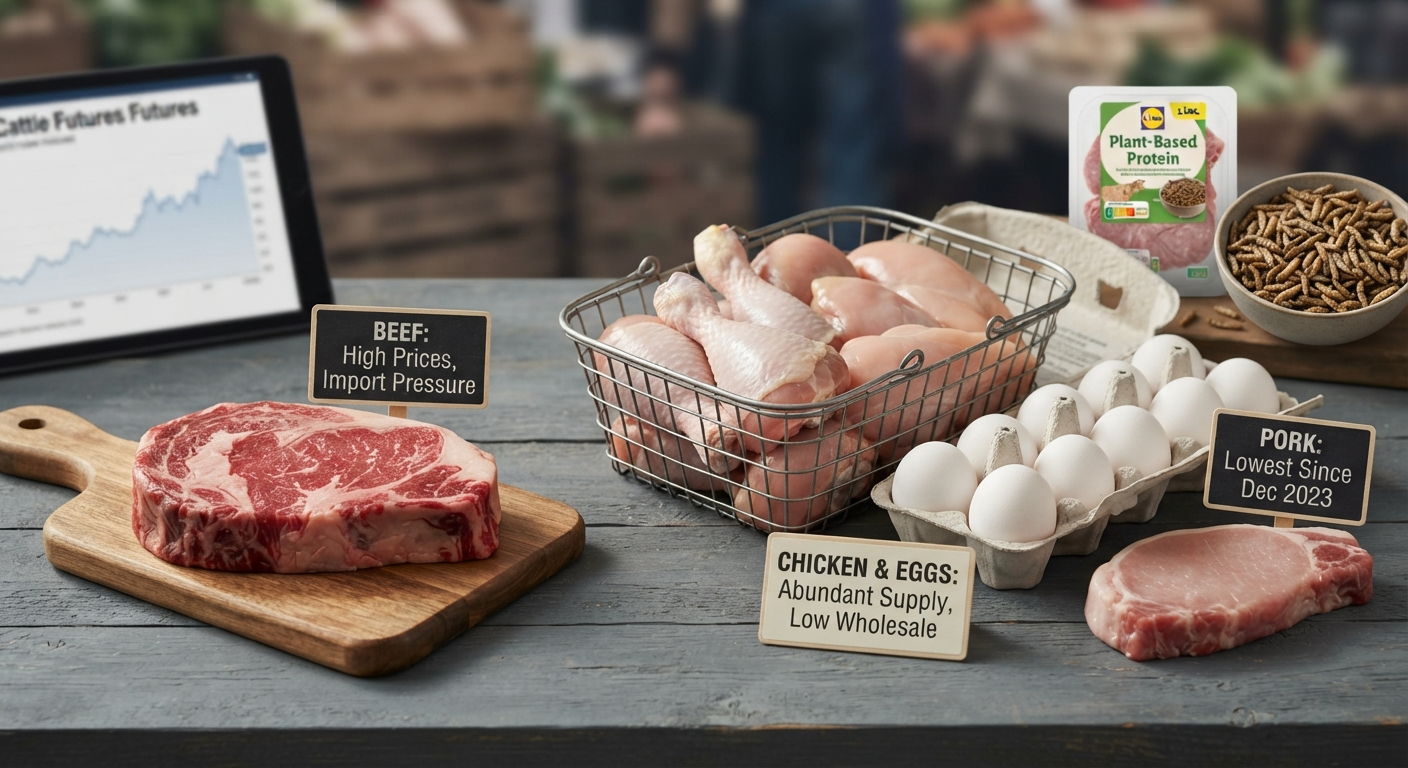

Pork prices hit a near three-year low, chicken floods global markets and bird flu season is back. Here is the week across beef, poultry, pork, eggs, plant-based and insects.
The protein market in early October 2026 is a story of divergence. Beef is still expensive and politically charged. Pork is losing ground to cheaper chicken. Eggs are cheap and plentiful, for now, as bird flu season starts again. In alternative proteins, plant-based brands are fighting a labelling battle in Brussels, while hybrid meat and insect protein quietly gain traction.
At a glance
| Protein | Key signal this week | Direction |
|---|---|---|
| Beef | Cattle futures near highs; tariff-free import window pressuring cow prices | Firm, but politically exposed |
| Pork | Pork cutout at lowest since December 2023; hog futures at contract low | Weak |
| Poultry | Brazil exports surging; bird flu returns in UK and US | Strong supply, rising disease risk |
| Eggs | US wholesale prices low, supplies ample | Soft |
| Plant-based | EU push to widen meat-name ban; hybrid products launched | Under pressure, adapting |
| Insects | Producers report lower costs and carbon footprint at scale | Gaining credibility |
Beef: high prices, rising political pressure
US cattle markets remain historically strong. December live cattle futures settled at about 223.8 cents per pound on 7 October, after reaching a three-week high the day before. November feeder cattle settled at about 335.8 cents per pound. The Choice boxed beef cutout was about $375.62 per hundredweight mid-week.
Packers are making money again. Average beef packer margins were estimated at about $110 per head on 7 October, according to HedgersEdge.
The pressure point is imports. In August, President Trump announced plans to allow up to 300,000 metric tons of beef intended for ground beef into the US without the out-of-quota tariff, for 90 days. That volume is equal to nearly 15% of US beef imports in 2025. Cattle markets fell sharply on the announcement.
Cow-calf producers say the effect is now showing up at the sale barn. A Minnesota auction operator told local media this week that market cows are selling for $500 to $600 less per head than a year ago, while costs for fertiliser, machinery and other inputs keep rising. Producers also warn that the US cattle herd remains near multi-decade lows and will take years to rebuild.
In Brazil, beef exports fell 22.2% year on year in August to 233,500 tonnes after shipments to China dropped almost 90%. Brazil had used up its lower-tariff quota with China, and volumes above the 1.1 million tonne quota now face a 55% tariff. Year to date, Brazilian beef exports were still up about 5.3% in volume and 21.7% in value.
What it means: Beef supply remains tight and prices high, but import policy is adding volatility. Buyers of lean trimmings and ground beef may see some relief. Cow-calf producers are the ones most exposed.
Pork: losing the price war to chicken
Pork is the weakest of the major proteins right now. On 7 October:
- The US pork carcass cutout fell $2.13 to $81.71 per hundredweight, its lowest level since December 2023.
- October lean hog futures hit a contract low of 76.85 cents per pound.
- December hogs settled at about 69.1 cents per pound.
Analysts blame soft domestic demand. As one market analyst put it, consumers are choosing chicken over pork, and the world chicken market is flooded with supply.
What it means: Cheaper pork is good news for processors, retailers and foodservice buyers, especially with beef this expensive. For hog producers, margins are tightening heading into the winter months.
Poultry: Brazil’s export surge meets bird flu season
Global chicken supply is plentiful, and Brazil is leading the charge. Brazilian chicken exports rose about 25% year on year in August to 492,600 tonnes, according to the Brazilian Animal Protein Association (ABPA). China was the top destination at 51,000 tonnes, up from almost nothing a year earlier, when Beijing had temporarily restricted imports after a bird flu case on a Brazilian commercial farm. From January to August, Brazil’s chicken exports totalled 3.91 million tonnes, up 15.5%, with revenue up about 22%.
At the same time, the 2026–27 bird flu season has started in the Northern Hemisphere:
- UK: Highly pathogenic H5N5 avian influenza was confirmed in poultry at Ness, on the Isle of Lewis in Scotland, on 2 October. It is the first case of the season, and Great Britain has lost its official freedom from highly pathogenic avian influenza status. A 3 km protection zone and 10 km surveillance zone are in place.
- US: Wisconsin confirmed avian influenza in a backyard flock in Racine County on 6 October. The birds were culled and will not enter the food supply.
What it means: Plentiful chicken is pulling demand away from pork and keeping a lid on prices. But autumn migration raises bird flu risk, and outbreaks in commercial flocks can quickly trigger trade restrictions. Exporters and importers should watch for regional bans.
Eggs: cheap for now
US egg markets are calm, a sharp contrast to the record prices of early 2025. According to USDA data:
- National wholesale loose white large eggs traded at about 45 to 46 cents per dozen in early October.
- The US table egg layer flock stood at about 312 million productive hens.
- Shell egg inventories were broadly steady, with demand described as moderate.
What it means: Supply has recovered strongly. The risk is the same as for poultry: if bird flu reaches large commercial layer flocks this autumn, egg prices can move quickly. Buyers with forward contracts at today’s low prices are well placed.
Plant-based: a labelling fight and a hybrid future
The EU has already approved a rule that bars meat alternatives from using “meat” and 31 related terms on packaging, with three years for companies to comply. Some lawmakers now want to widen the ban to more words. The European Parliament’s agriculture committee is scheduled to vote in December 2026, with a final plenary vote expected in 2027.
A group of companies and industry bodies, including Beyond Meat, Quorn, The Vegetarian Butcher and Redefine Meat, has written to MEPs urging them to reject the extension. They argue it would undercut the EU’s own protein strategy and force costly rebranding across the bloc’s 24 official languages. One German industry body estimates the naming restrictions could cost about €250 million in Germany alone. That figure is an industry estimate.
Meanwhile, hybrid products are entering the mainstream. In September, Lidl launched a nationwide hybrid range in the UK, blending British meat with pea protein, covering sausages, mince, burgers and meatballs from £1.99. Lidl says the range contains at least 20% more protein than conventional equivalents.
What it means: Pure plant-based meat faces regulatory and demand headwinds in Europe. Hybrid products, which blend meat with plant protein, offer retailers a way to cut costs and add protein claims without asking shoppers to give up meat.
Insects: the scale story
Insect protein producers are making the case that scale is solving their cost and carbon problems. Innovafeed and Protix, two of Europe’s largest black soldier fly producers, reported in late September that:
- Innovafeed says it has cut production costs sevenfold and raised output tenfold over the past three years.
- Innovafeed reports a 2025 carbon footprint of about 1.2 kg CO2e per kg of protein, with a target of about 0.6 kg by 2030.
- Global insect meal output is estimated at more than 15,000 tonnes.
These are company figures, and footprint results depend on feedstock, energy sources and what protein they are compared with.
What it means: Insect protein is still small, but it is moving from novelty to a credible ingredient in aquafeed and pet food. With fertiliser and feed costs under pressure from Middle East disruption, alternative feed proteins are getting more attention.
The big picture
Three themes run across the protein market this week:
- Price gaps are widening. Expensive beef and cheap chicken are pushing consumers and buyers toward poultry, at pork’s expense.
- Trade policy is a key driver. US beef import changes, China’s quota on Brazilian beef and bird flu bans are all shaping where protein flows.
- Disease risk is back. The start of the bird flu season is the main wildcard for poultry and eggs into the winter.
Bottom line
Protein buyers have opportunities right now: pork and eggs are cheap, and chicken is abundant. Beef remains the expensive exception, with policy adding uncertainty. Over the next few months, bird flu is the biggest risk to watch, with US beef import policy and the EU labelling vote also worth tracking.
FAQ
Why are pork prices falling? Soft domestic demand is the main cause. Analysts say consumers are choosing cheaper chicken, and the global chicken market is well supplied. The US pork cutout hit its lowest level since December 2023 on 7 October.
Are beef prices still high? Yes. US cattle futures remain near historically strong levels, and the Choice boxed beef cutout was about $375 per hundredweight mid-week. A temporary tariff-free import window for ground beef has put pressure on cull cow prices.
What is the US tariff-free beef import plan? In August, President Trump announced plans to allow up to 300,000 metric tons of beef for ground beef into the US without the out-of-quota tariff for 90 days, equal to nearly 15% of 2025 US beef imports.
Is bird flu back? Yes. The UK confirmed its first commercial-season case of highly pathogenic H5N5 in Scotland on 2 October, and Wisconsin confirmed a backyard flock case on 6 October. Autumn bird migration usually raises the risk of more outbreaks.
Why are Brazil’s chicken exports rising? Strong demand from China, which reopened to Brazilian chicken after a 2025 restriction, helped push August exports up about 25% year on year to 492,600 tonnes.
Are egg prices low? Yes. US wholesale large eggs were trading at about 45 to 46 cents per dozen in early October, with a layer flock of about 312 million hens. Bird flu outbreaks in large layer flocks could change that quickly.
What is happening with plant-based labelling in the EU? The EU has already banned meat alternatives from using “meat” and 31 related terms, with a three-year transition. Some MEPs want to widen the ban, with a committee vote due in December 2026.
Is insect protein becoming viable? Producers say yes, at scale. Innovafeed reports a sevenfold cut in production costs and a tenfold increase in output over three years, mainly for aquafeed and pet food.
Sources
| Source | Description |
|---|---|
| The Pig Site (Reuters CME report) | Hog futures contract low and pork cutout, 8 October 2026 |
| USDA Agricultural Marketing Service | Boxed beef cutout, shell egg and egg market reports, early October 2026 |
| IndexBox | Summaries of USDA beef and egg market reports, October 2026 |
| KTTC News | Cattle producers facing rising costs amid beef imports, 8 October 2026 |
| DTN Progressive Farmer | Report on the proposed beef tariff-rate quota lift, August 2026 |
| The Poultry Site (Reuters) | Brazil’s chicken exports jump, beef shipments fall, September 2026 |
| Farmers Guardian | First commercial bird flu case of the season confirmed, October 2026 |
| Spectrum News Wisconsin | Avian flu identified in Racine County poultry flock, 6 October 2026 |
| Green Queen | Industry urges EU to reject extension of plant-based labelling ban, October 2026 |
| Grocery Gazette | Lidl hybrid meat launch, 7 October 2026 |
| Food Ingredients First | Insect protein scale-up reducing costs and carbon, 28 September 2026 |
Additional Resources
| Resource | Why it’s useful |
|---|---|
| USDA Livestock, Dairy and Poultry Outlook | Monthly US forecasts for beef, pork, poultry and eggs |
| USDA AMS Market News | Daily boxed beef, pork cutout and egg price reports |
| USDA APHIS HPAI detections | Tracks confirmed bird flu cases in US flocks |
| UK Defra / APHA bird flu updates | Latest UK outbreaks and control zones |
| ABPA (Brazilian Animal Protein Association) | Monthly Brazilian chicken and pork export data |
| FAO Meat Market Review | Global meat production, trade and price trends |
| Good Food Institute State of the Industry reports | Data on plant-based, fermentation and cultivated protein |
| International Platform of Insects for Food and Feed (IPIFF) | European insect protein industry data and policy |
Data accuracy note: Prices are taken from USDA reports and market coverage between 2 and 8 October 2026 and change daily. Sources disagreed on whether the Choice boxed beef cutout rose or fell on 7 October, so only the level is given. The cow price comparison comes from a single auction operator and is not a national average. Brazilian export figures are for August 2026, the latest month available at the time of writing. Insect protein cost and carbon figures are company claims. The €250 million German labelling cost is an industry estimate.