
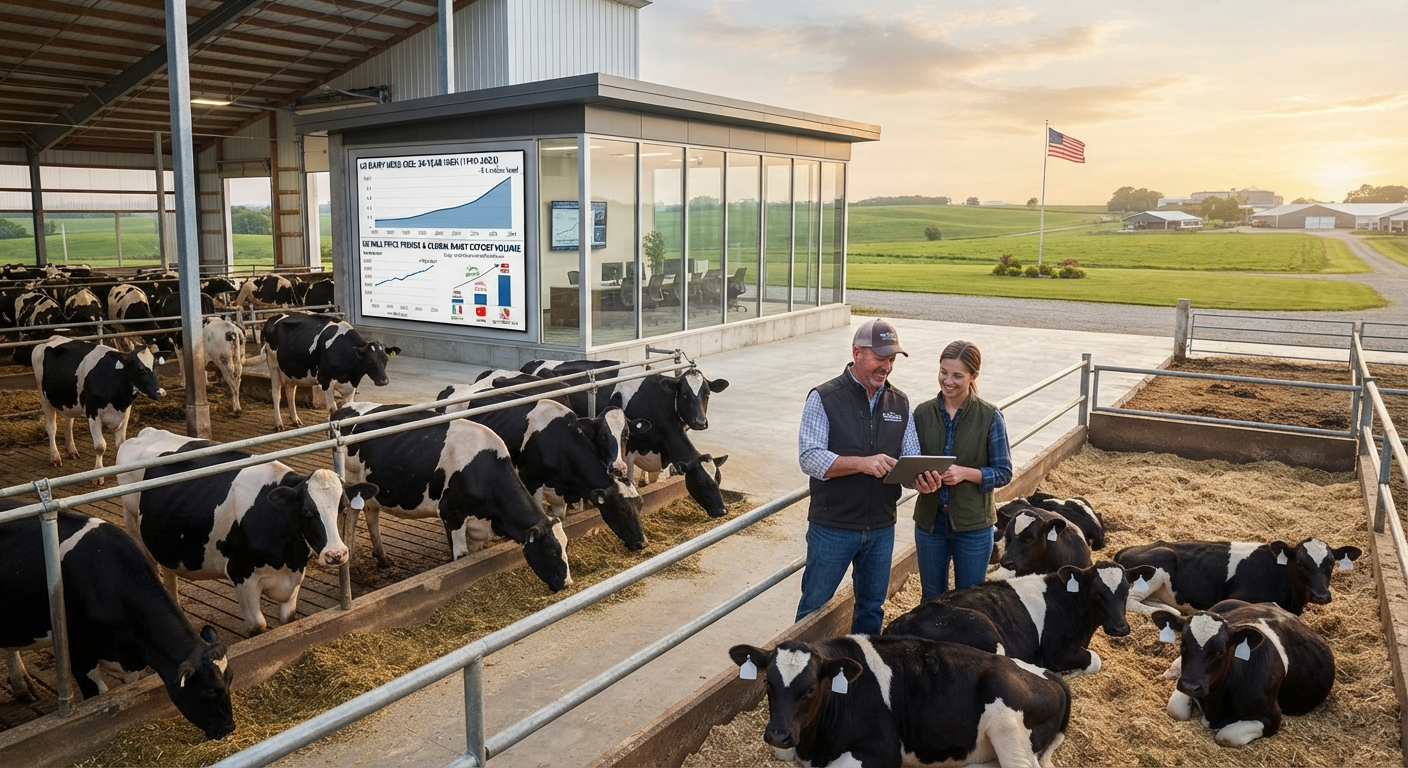

Beef-on-dairy calves worth $1,200 to $1,500 are pushing the US dairy herd to a 34-year high and keeping milk prices low. Here’s what it means for global dairy markets.
Something unusual has happened on American dairy farms. The product the industry is named after is no longer the main source of profit. Analysts at World Dairy Expo in early October made the point bluntly: as long as beef-on-dairy calves sell for $1,200 to $1,500 a head, milk prices aren’t going to rise much. Farmers can’t have both. For dairy buyers, processors and competing exporters around the world, that changes how you read the US milk market.
How beef ended up running dairy
The logic is simple. A dairy cow bred to a beef bull produces a black crossbred calf that feedlots want, because the US beef cattle herd is at multi-decade lows. Those calves now bring far more than a traditional Holstein bull calf. Earlier in 2026 some sold for $1,700 to $1,900. Prices have since cooled to around $1,300, but that’s still historically strong. CoBank estimates beef sales now make up roughly 12% to 15% of revenue on many dairy farms.
That income changes farmer behaviour. Lower-producing cows that would normally be culled are kept in the herd to deliver one more valuable calf. The result is a national herd of about 9.71 million cows, the largest since 1992, with far higher yields per cow than back then. As Ever.Ag’s Mike North put it at the Expo, the herd wasn’t built because milk prices were exceptional. It was built because beef prices were.
AgResource’s Dan Basse described the new reality: milk has become a residual. The margin sits in the calf. The milk is what happens in between.
The milk price is paying the bill
All that extra milk has to go somewhere, and the numbers show the strain:
- Class III milk for September 2026 came in at $16.04 per hundredweight, down 60 cents from August and $1.55 below September 2025. The year-to-date average is just under $16.
- Futures point lower. At the end of September, October Class III futures settled below $15, at $14.94.
- Class III and Class IV are pulling apart. October Class IV futures stood at $20.24. A gap of more than $5 between the two would encourage depooling in some federal milk orders, adding another layer of disruption to producer pay prices.
- Domestic demand is weak. Consumers are eating out less, so the home market isn’t absorbing the extra volume.
The cheese-heavy Class III market is taking the brunt of the pressure. Powder and protein-linked products have held up better, helped earlier in the year by processors diverting skim solids into high-protein yogurt, cottage cheese and ultra-filtered milk.
Exports are the release valve
With domestic demand soft, exports have become the main outlet. National Milk Producers Federation CEO Gregg Doud expects US dairy exports to reach around $10.5 billion this year, above the previous record of $9.5 billion. That would make dairy the third-largest US agricultural export category after corn and soybeans.
But as North pointed out, the volume moves because it’s cheap. Low US product prices win business overseas, and low product prices feed straight back into low milk cheques under the US pricing formula.
Butter shows how much has changed. The US used to import butter. Now it’s an exporter, with the European Union as a key destination, which Doud would like to diversify away from. He sees Southeast Asia, Indonesia in particular, as a strong long-term opportunity, though new trade access takes time to build.
What it means for the global dairy industry
For competing exporters (EU, New Zealand, South America): Expect sustained competitive pressure from the US. A large herd supported by beef income can keep supplying even when milk prices are weak, so US cheese, butter and powder will keep competing hard on price in Asia, the Middle East and Latin America.
For dairy buyers and importers: Good news, at least for now. Ample US supply and weak domestic demand point to a favourable buying environment for cheese and butter. Buyers with flexibility on origin should be looking at US product actively.
For processors: Plenty of milk, but uneven margins. Cheese makers face weak Class III pricing, while those making high-protein products have done better. The wide Class III–IV spread could make milk flows and pooling decisions harder to predict.
For producers outside the US: The US model is a warning and a template. Beef-on-dairy can protect margins when milk prices fall, but it can also prolong oversupply by removing the normal correction, where low milk prices force herd reductions.
The risk building underneath
This setup won’t last forever. Every cow bred to beef is a cow not producing a dairy replacement heifer. Replacement heifer prices have already passed $3,000 a head in many markets, with premium animals near $4,000, and analysts have warned of a looming shortage of replacements.
Other signs are worth watching. Dairy cow culling has been rising since May, and cull cow prices in the Southern Plains have fallen from a spring peak of around $187 to about $154 per hundredweight. When beef calf values eventually ease, or when the heifer shortage forces older cows out, US milk supply could tighten faster than the market expects. That could produce a sharp price turn.
There’s also trade risk. Rising US–Canada tensions and broader tariff uncertainty could disrupt export flows that the industry now depends on.
The bottom line
For now, US dairy runs on two engines: beef calves for profit and exports for volume. Neither one pushes milk prices up. Global buyers should expect US dairy to stay plentiful and competitively priced into 2027. Producers and competing exporters should plan for a market where the world’s biggest dairy exporter keeps milking even when milk doesn’t pay. The turning point will come from the calf market, not the milk market, so that’s where to keep watching.
Frequently Asked Questions
What is beef-on-dairy?
It means breeding dairy cows with beef bulls to produce crossbred calves that sell at a premium to feedlots, instead of breeding for dairy replacements.
How much are beef-on-dairy calves worth?
Analysts at World Dairy Expo cited $1,200 to $1,500 a head. Prices peaked above $1,700 earlier in 2026 before easing to around $1,300.
Why won’t US milk prices rise?
The national herd is at its largest since 1992, partly because beef calf income keeps cows in production. With weak domestic demand, extra milk is being exported at low prices, which keeps milk cheques down.
What was the September 2026 Class III milk price?
$16.04 per hundredweight, down 60 cents from August and $1.55 below a year earlier.
How large are US dairy exports?
NMPF expects around $10.5 billion in 2026, which would be a new record.
What is the “heifer cliff”?
A potential shortage of dairy replacement heifers, caused by so many cows being bred to beef rather than dairy. It could eventually tighten milk supply.
What does this mean for global dairy buyers?
Ample, competitively priced US supply, especially cheese and butter, is likely to continue in the near term.
Sources and Additional Resources
Data accuracy note: Calf prices vary widely by region, weight and sale, so the ranges above are indicative only. The heifer price figures come from USDA data reported in trade media. Futures prices are as of 30 September 2026 and may have moved since. The 2026 export estimate is NMPF’s projection, not a final figure.