
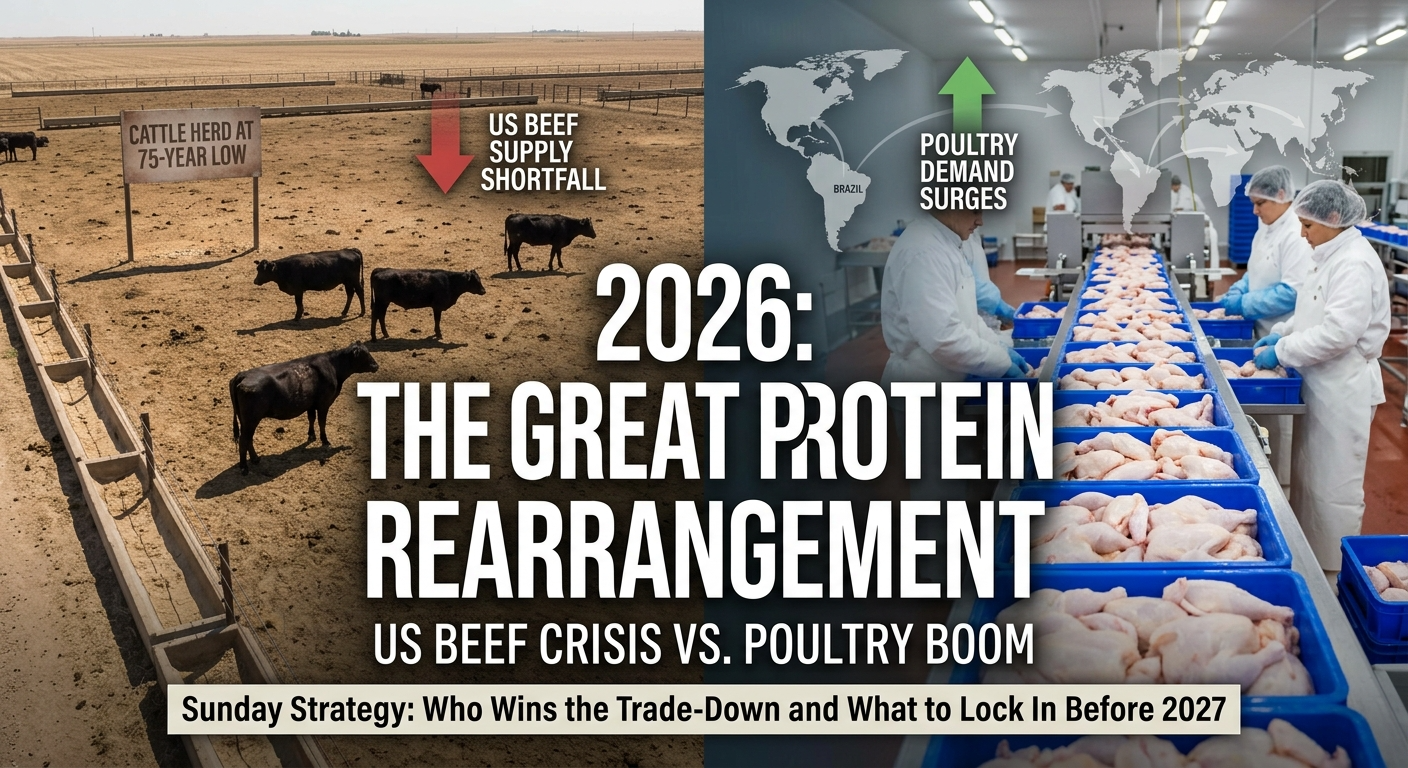

Tyson shuts two more beef plants, China’s 55% beef wall goes live, and bird flu returns early to Minnesota.
In 2026 the world ran short of red meat, and the whole protein market rearranged itself around that gap.
The US cattle herd started the year at its smallest size since the early 1950s. Cattle and beef prices hit records, packers lost money on almost every head they killed, and the screwworm parasite kept the Mexican border shut for most of the year. Rabobank expects global beef and pork output to shrink together in 2026, the first fall in land-animal meat production in six years.
The winner is chicken. Consumers trading down from beef pushed poultry demand higher, and Brazil shipped record volumes. Pork, meanwhile, spent the year absorbing an African swine fever outbreak in Spain and a sharp drop in Chinese import demand.
This Sunday Strategy edition explains why the beef shortage is structural rather than seasonal, who is winning the trade-down, and what to lock in before 2027.
Your 30-second scan
- Beef: a 75-year-low US herd, record cattle prices and no rebuild in sight
- Screwworm: more than a year of border closure, a partial reopening, and new US cases
- Global beef: China’s quota wall, Brazil’s record exports and Australia’s tariff hit
- Poultry: the trade-down winner, Brazil’s record half year and bird flu’s early return
- Pork: ASF in Spain, China imports down about 16%, and an EU sector in retreat
- Processing: Tyson and JBS shut plants as packer losses run at hundreds of dollars a head
- Trade: record US beef imports, tariff-rate quota relief and Middle East freight shocks
- The playbook: protein-by-protein buying calls and what to lock in now
1. Beef: the herd ran out
The defining fact of 2026 is simple: there are not enough cattle in the United States, and there will not be for years.
The herd. USDA data show the US entered 2026 with about 86.2 million cattle and calves, more than 8 million fewer than in 2019 and the smallest herd since the early 1950s. Years of drought and high feed costs forced ranchers to sell breeding stock, and the rebuild has barely started. Analysts saw little evidence of heifer retention going into the year, which means any growth in 2026 had to come from keeping older cows rather than adding young ones.
The prices. Records fell across the chain:
- In early 2026, feeder steer prices in several southern states topped $450 per hundredweight, and fed steers averaged nearly $247, both all-time highs.
- In mid-April, CME live cattle futures settled at $2.51 per pound, the highest level in records going back to the 1960s.
- USDA’s Economic Research Service forecasts slaughter steers averaging about $251 per hundredweight in 2026 and about $254 in 2027, both records.
- Retail Choice beef rose from about $8.51 per pound in August 2024 to $10.49 in July 2026, an increase of roughly 23%. In early July, steaks averaged $12.80 per pound, up 16% on a year earlier.
Demand did not break. This is what makes the cycle unusual. Despite record shelf prices, US consumers kept buying beef through the spring and summer grilling seasons. Restaurant chains with heavy beef exposure have felt the squeeze, but there has been no collapse in demand to help balance the market.
When does it end? Herd rebuilding is slow because a heifer kept back today does not produce a calf for slaughter for roughly two to three years. Industry voices, including Omaha Steaks’ chief executive, expect meaningful herd growth and price relief no earlier than 2028 or 2029.
Why this matters for you: high beef prices are now a planning assumption, not a risk scenario. Budget for elevated beef costs through at least 2027 and build menu and specification flexibility around them.
2. Screwworm: the parasite that closed a border
The New World screwworm turned a tight cattle market into an even tighter one.
The closure. The US first halted Mexican cattle imports in November 2024 after the flesh-eating parasite was found in southern Mexico. Trade briefly reopened in February 2025, then closed again in May 2025 as the pest moved north. It stayed closed for more than a year. Before the outbreak, that trade supplied roughly 1 million feeder cattle a year, mostly into Texas and the Southern Plains.
The spread. Mexico has reported more than 28,000 cases since late 2024. The parasite then reached the US, with cases confirmed in Texas, where state authorities declared new infested zones through September, and in New Mexico. In June, Mexico responded by suspending most live animal imports from the US.
The partial reopening. After months of pressure from feeders and lawmakers, USDA announced a phased reopening in late July, tied to a joint action plan with Mexico. The port at Douglas, Arizona reopened on 24 August under a new import protocol. Further reopenings, including the Santa Teresa and Columbus ports in New Mexico, depend on how the first phase goes. That timeline got harder in mid-September, when screwworm was confirmed in a horse in New Mexico on the same day a larger port reopening was announced.
The cost. The closure kept feeder supplies short in the southern states, raised feeder prices, and added disease-control costs for packers and feedlots. Mexican ranchers lost their main export outlet, while US feedlots and packers paid more for cattle.
Why this matters for you: Mexican feeder cattle will return only slowly, and any new US detection could close ports again overnight. Do not plan on border reopening to relieve 2027 beef prices.
3. Global beef: China builds a wall, Brazil reroutes
Outside the US, 2026 beef trade was shaped by one policy decision in Beijing.
China’s safeguard. From 1 January 2026, China set country-specific beef import quotas for three years, with an extra 55% tariff on anything above them. The total 2026 quota is about 2.7 million tonnes, roughly in line with China’s record 2024 imports but below what Brazil and Australia were shipping in 2025. Brazil was allocated about 1.1 million tonnes, Australia about 205,000 tonnes and the US about 164,000 tonnes.
The race to fill it. Exporters front-loaded shipments to get inside the quota. Australia hit its limit on 18 June, and the 55% surcharge applied from 20 June. Chinese imports of Brazilian beef rose about 46% in the first five months, and Brazil had used around 80% of its allocation by late July. Brazil’s packer lobby Abrafrigo estimated the measure could cost the country up to $3 billion in export revenue this year.
Brazil: less beef, more exports. Rabobank expects Brazilian beef output to fall 5% to 6% in 2026, to about 10.5 million tonnes, as farmers keep cattle back to rebuild herds. Exports are still forecast at a record 4.4 million tonnes, supported by a weak real and less competition from other suppliers. Brazilian consumers are absorbing the gap: domestic consumption is expected to fall by up to 9% as people switch to cheaper proteins.
Australia and New Zealand. Large cattle inventories have kept Australian beef production high. With China capped, more Australian and New Zealand beef is heading to the US, where demand for lean trimmings is at record levels.
Europe. EU beef supply remains tight, but high retail prices are weighing on consumption, with shoppers shifting toward pork and poultry.
Why this matters for you: China’s quotas reset on 1 January. Expect another front-loading rush in Q1 2027 from Brazil and Australia, followed by diversion to other markets once quotas fill. If you buy Brazilian or Australian beef outside China, the best availability is likely to come in the second half of the year.
4. Poultry: the trade-down winner
When beef gets expensive, chicken gets busy. Poultry is the one major land protein still growing in 2026, and it is capturing the consumers beef has priced out.
Growth leader. Rabobank expects seafood and poultry to drive all of 2026’s protein growth, while beef and pork contract. It reported poultry production up more than 5% year on year in several major markets in Q1. The FAO expects global poultry meat trade to grow about 3.1% this year to around 17.2 million tonnes.
Brazil’s record run. The world’s largest chicken exporter had its best first half ever. Shipments reached 2.94 million tonnes from January to June, up 12.9%, and revenue hit $5.7 billion, up 17%. May was the first month in which chicken export revenue topped $1 billion. Part of the jump reflects a weak 2025 comparison, when an isolated bird flu case on a commercial farm briefly closed key markets. Still, Brazil delivered these numbers while Middle East shipping disruption complicated deliveries to some of its biggest Gulf customers.
The destination mix is shifting too. China, Japan, the UAE and Saudi Arabia led June shipments, while sales to the EU, Mexico and South Africa jumped from very low bases.
Bird flu has not gone away. Highly pathogenic avian influenza remains the biggest risk to the poultry story:
- US egg producers culled about 12.4 million laying hens in 2026 through the spring, more than double the total for the whole second half of 2025.
- In June, detections returned to commercial layer, broiler and turkey flocks across 12 states.
- Minnesota, the largest US turkey state, has confirmed ten infected flocks since 1 September, affecting more than 260,000 birds. That is an unusually early start to the autumn migration season.
Eggs: from crisis to calm, for now. Wholesale egg prices peaked near $8 a dozen in early 2025 and fell to around $1 by early 2026 as flocks were rebuilt. An active autumn could reverse part of that.
Why this matters for you: chicken demand is structurally supported while beef stays expensive, so broiler pricing has a firm floor. Brazil gives buyers outside the US a deep, competitive supply source, but every buyer should have a plan B in case a bird flu case closes a key origin overnight.
5. Pork: disease and a Chinese pullback redraw the map
Pork’s 2026 story is about where the meat goes, not how much exists. Disease and policy have redrawn the trade map.
ASF hits Spain. In late November 2025, African swine fever was confirmed in wild boar in Catalonia, near Barcelona. It was Spain’s first case since 1994. Spain is the EU’s largest pig producer, with about 34.6 million head in 2024, and one of the world’s biggest pork exporters. Buyers including China restricted Spanish product from affected areas.
The EU absorbs the shock. Spanish pork that used to go to third countries is now partly being sold inside the EU, pushing carcass prices down across the bloc. China’s anti-dumping duties of 4.9% to 19.8% on EU pork, finalised in December 2025, added to the pressure. The USDA’s EU office describes a sector going through a restructuring:
- EU pig inventories fell about 3.9% to around 127 million head.
- EU pork production is forecast to fall about 1.2% in 2026, to about 21.7 million tonnes.
- EU pork exports are forecast to fall about 7.6%, to about 2.8 million tonnes.
- Lower prices are expected to keep EU pork consumption strong, as shoppers switch away from expensive beef.
China needs less. China’s own herd has recovered, so it is buying less abroad. USDA forecasts Chinese pork imports down about 16% in 2026, to about 1 million tonnes, below pre-ASF levels. Exporters including Brazil and the US are redirecting volume to Southeast Asia, Mexico and Central America.
The US holds up. US pork producers have stayed profitable, helped by lower feed costs. US pork exports are forecast up about 3% in 2026, with Mexico the anchor market. Disease-free status has become a selling point as buyers reassess Spanish supply.
Global output: flat, with disagreement. USDA expects global pork production to edge up about 0.6% in 2026, to around 120 million tonnes. Rabobank expects a decline of about 1%. Either way, pork is not growing fast enough to offset beef’s shortfall.
Why this matters for you: EU pork is cheap and plentiful while Spain’s export markets stay restricted, which creates an opportunity for European buyers. Buyers in Asia and Latin America should expect firmer competition from US and Brazilian pork.
6. Processing: packers shrink to fit the herd
Record cattle prices are good news for ranchers and feedlots. For beef packers, they have been a disaster, and 2026 is the year the industry started cutting capacity for good.
The losses. Beef packers have been losing roughly $200 to $400 on every head since 2023. Sterling Marketing’s tracker showed packer margins of about −$253 per head in late June, while feedlots were earning about $454 per head in the same week. Too much plant capacity is chasing too few cattle, so packers have to bid up cattle to keep their lines running.
Tyson’s retreat. Tyson has led the cuts:
- January: closed its Lexington, Nebraska beef plant, which employed about 3,200 people, and cut its Amarillo, Texas plant to a single shift.
- 13 August: closed its Joslin, Illinois slaughter plant and its Eagle Mountain, Utah case-ready facility, a $300 million plant opened in 2019, and put its Pasco, Washington plant up for sale.
- Guidance: Tyson now expects a beef segment operating loss of $500 million to $650 million for fiscal 2026. Chicken is carrying the company.
It is not just Tyson. JBS USA closed its 2,000-head-a-day plant in Souderton, Pennsylvania, in June. Together, the recent shutdowns have removed roughly 10,000 head a day of US slaughter capacity. Analysts expect at least one more major closure.
The political overlay. The Trump administration has said it is investigating the meatpacking industry for possible anti-competitive behaviour and has criticised foreign ownership in the sector. That adds regulatory uncertainty to an industry already under financial strain.
What it means next. Less capacity chasing the same tight cattle supply should gradually improve packer margins. It also means fewer plants, longer hauls for cattle and less flexibility if a plant goes down.
Why this matters for you: beef supply chains are becoming more concentrated and less resilient. Diversify your packer base where you can, and stress-test what happens to your supply if a single key plant closes.
7. Trade: record imports, shifting tariffs and Middle East freight
With its own herd depleted, the US has become the world’s biggest magnet for imported beef, and Washington has been loosening the rules to let more in.
Record US beef imports. The US imported a record amount of beef in 2025, about 5.5 billion pounds, and 2026 is on track to beat it. In the first quarter, imports rose about 15% to 1.7 billion pounds while exports fell about 18%. USDA’s latest forecast points to a new record of around 6.1 billion pounds for the year. Most of it is lean trimming for ground beef, blended with fattier domestic trim.
Where it comes from. In the first half of 2026, Brazil and Australia each supplied a little over a fifth of US beef imports, followed by Canada, Mexico and New Zealand. Brazil’s share under the “other countries” quota was used up within the first week of January, so most Brazilian beef entered at the higher 26.4% out-of-quota rate and still kept flowing.
Tariff relief. The administration has repeatedly eased beef import barriers to fight food inflation:
- In May, it moved to suspend beef tariff-rate quotas.
- In July, a new 25% tariff on Brazilian goods exempted beef.
- In August, it announced a 90-day cut in beef import tariffs.
US cattle groups oppose the moves and have called for tariffs on Brazilian beef. Brazil also remains under separate US trade investigations, so policy could reverse.
The Middle East shock. The conflict that began on 28 February disrupted shipping through the Strait of Hormuz and pushed up fuel, fertiliser and freight costs. Carriers serving the Gulf and Red Sea added war-risk surcharges on refrigerated cargo. The Gulf states are major buyers of poultry and beef, so this hit exporters directly. Brazil kept chicken volumes moving despite the logistics challenges.
Why this matters for you: US import policy is being set by food-price politics, which can change quickly. Lock in import volumes while tariffs are low, but avoid commitments that only work if today’s tariff relief stays in place.
8. Protein-by-protein outlook for buyers
Beef stays tight and expensive, chicken stays firm on trade-down demand, and pork is the best-value protein in Europe.
| Protein | Where it is now | Q4 2026 to H1 2027 bias | Buyer stance |
|---|---|---|---|
| US fed cattle and beef cuts | Record prices; herd at a 75-year low | Firm to higher; USDA sees record steer prices in 2027 | Budget high; secure supply over price; flex specs and portion sizes |
| Lean beef trim and imports | Record import volumes; tariffs eased | Firm, sensitive to US tariff policy | Contract import volumes while tariffs are low |
| Brazilian and Australian beef (ex-US) | China quotas filled; volume redirected | Tight in Q1 as exporters chase new China quotas, easier later in the year | Time purchases for after the Q1 China rush |
| Broilers | Demand strong as consumers trade down; Brazil exporting at record pace | Firm; risk from autumn bird flu | Secure core volume; qualify a second origin |
| Turkey and eggs | Egg prices well down from 2025 peaks; early autumn bird flu in Minnesota | Upside risk if outbreaks spread | Avoid running inventory thin into winter |
| EU pork | Prices depressed by diverted Spanish product | Soft while Spanish export limits last | Buyer’s market; consider forward cover |
| US and Brazilian pork | Profitable; exports redirected away from China | Stable to firm | Watch Mexico and Asia competition |
These are directional calls based on the latest published forecasts. They are not price predictions and assume no new disease or trade shock.
The bottom line
2026 is a supply-constrained protein market with demand that will not quit. Beef is short because of biology and drought, and no policy can fix that quickly. Disease is redrawing pork and poultry trade, and trade policy is being driven by food-price politics. The result is a market where securing supply matters more than squeezing the last cent out of price.
The practical upshot: plan for expensive beef through 2027, lean on chicken and European pork for value, and build disease and policy contingencies into every major contract.
Procurement playbook
Ordered by urgency.
- Lock 2027 beef volume now. Supply, not price, is the constraint. Prioritise volume commitments with flexible pricing over chasing a lower fixed price that suppliers may not honour.
- Build beef flexibility into specs and menus. Use alternative cuts, blended products and smaller portions to manage cost without losing the category.
- Contract imported lean trim while tariffs are low. US tariff relief could reverse. Secure volume, but avoid deals that only work if today’s tariff level holds.
- Time ex-US beef buying around China’s quota reset. Expect a Brazilian and Australian rush into China in Q1 2027. Better availability for other markets usually follows once quotas fill.
- Secure core chicken volume and qualify a second origin. Demand is strong, and a single bird flu case can close a supplier country overnight.
- Use cheap EU pork while it lasts. Spanish export limits are keeping European prices low. Forward cover is worth considering, but watch for markets reopening to Spain.
- Diversify your beef packer base. Plant closures are concentrating supply. Map exposure to any single plant and line up alternatives.
- Watch the autumn bird flu season closely. Keep turkey and egg inventory buffers into the holiday period.
- Price in Middle East freight risk on any lanes touching the Gulf or Red Sea.
Your 90-day call to action: review your 2027 protein mix before year-end contracting. The buyers who come out ahead will be the ones who shifted volume toward poultry and pork and secured beef supply early.
What to watch next
- Mid-October: USDA WASDE and Cattle on Feed. Placements and heifer numbers are the first signs of whether rebuilding has begun.
- Screwworm port decisions. Any reopening of Santa Teresa or Columbus, New Mexico, or a new US detection that closes Douglas again.
- Autumn bird flu. Minnesota’s early outbreaks set the tone. Watch Iowa, the Dakotas and the Southeast as migration peaks.
- Late November: the end of the 90-day US beef tariff cut announced in August. Watch whether it is extended or reversed.
- Mid-November: Tyson’s fiscal 2026 results. Expect an update on beef losses and any further plant closures.
- Brazil’s China beef quota. Once it is fully used, the 55% surcharge applies and more Brazilian beef heads elsewhere.
- 1 January 2027: China’s quotas reset. Expect a front-loading rush from Brazil and Australia.
- Spain ASF containment. Any reopening of third-country markets to Spanish pork would firm EU pig prices.
In closing
Most commodity shortages fix themselves within a season or two: high prices pull in more supply. Beef is different, because a cow takes years to turn into a steak. That is why 2026 is not just an expensive year for beef but the start of a multi-year reset across the whole protein plate.
The winners will be the buyers who stop treating protein as one budget line. Secure beef supply early, shift volume toward chicken and pork where your customers will follow, and treat disease and trade policy as standing risks, not surprises.