
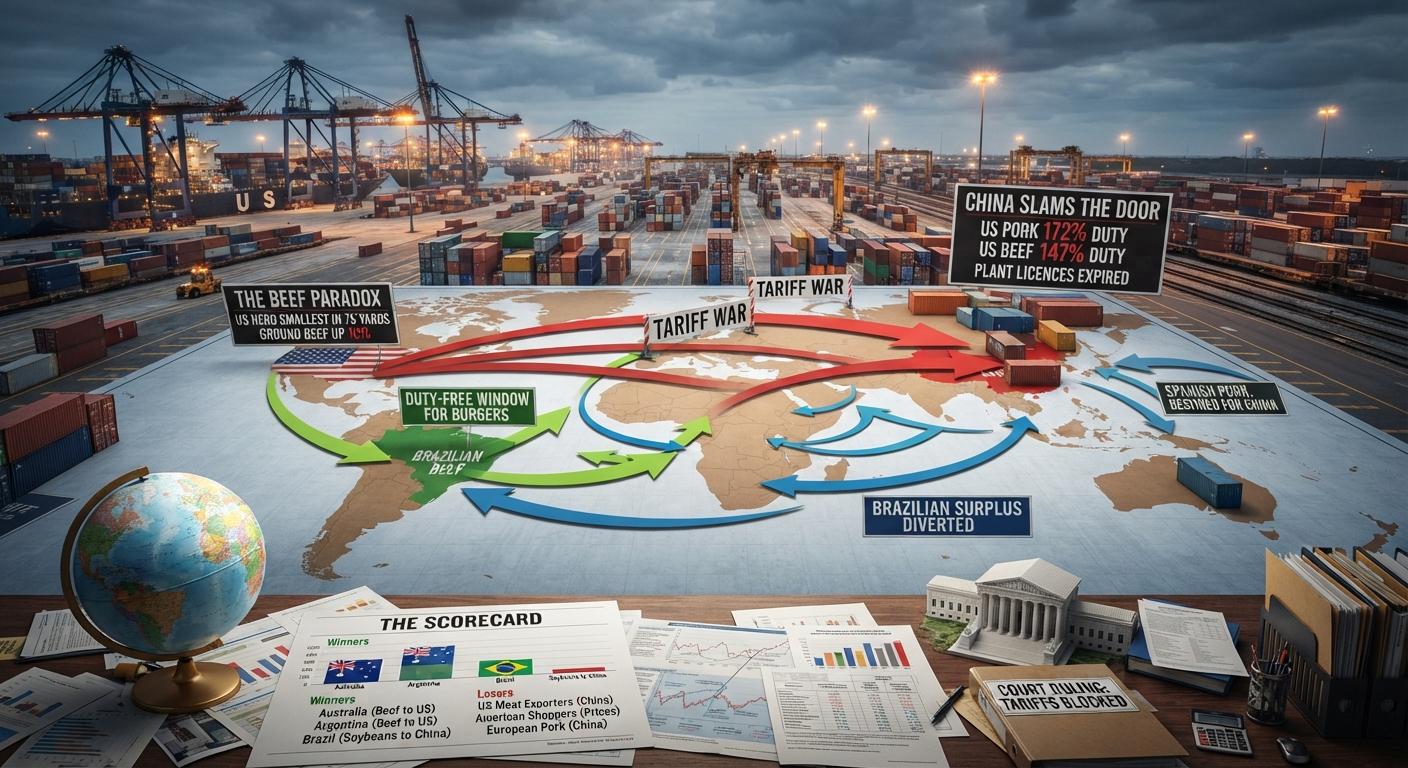

Twenty months of tariffs, retaliation and U-turns have rerouted the world’s meat trade, and this week we look at who won, who lost, and how to position before the 1 January quota reset.
Twenty months ago, the global meat trade ran on well-worn routes. American beef and pork went to China. Brazilian and Australian beef filled America’s burger supply. Europe sold pork offal to Chinese buyers who prized ears, feet and snouts that Europeans wouldn’t touch. Then the tariff war started, and nearly every one of those routes has since been bent, blocked or rerouted.
Act One: China slams the door
It began in early 2025 with tariffs on Canada, Mexico and China, followed by the April “Liberation Day” tariffs on almost everyone. China hit back hard. Within weeks, US pork faced total duties of about 172% and US beef about 147%. At that price, nothing moves.
Beijing also used a quieter weapon. It simply let the export licences of hundreds of American beef plants expire. Tariffs make trade expensive; an expired licence makes it impossible.
The damage was dramatic. US beef sales to China had grown from about $300 million in 2020 to just over $2 billion at their 2022 peak. By 2025 they had fallen below $500 million. America’s own meat exporters reckon losing China knocked roughly $150–165 off the value of every fed animal slaughtered in the US.
Later truces brought China’s duties down to where they sit today: 47% on US pork and 22% on beef. That’s lower, but still punishing.
Act Two: The beef paradox
Meanwhile, America had a problem of its own. Years of drought and high feed costs had shrunk its cattle herd to the smallest in about 75 years. A ban on Mexican cattle imports, prompted by an outbreak of the flesh-eating screwworm parasite, squeezed supply further. Beef prices hit record after record. Ground beef now costs close to $6.90 a pound, about 10% more than a year ago.
So Washington was taxing the very imports it needed. Brazilian beef shipped outside its quota briefly faced a combined duty of more than 76%. It couldn’t last. By November 2025 the White House had carved beef out of its tariff programme, and Brazilian beef lost its extra penalty.
This year it went further. It widened Argentina’s quota. Then, from September, it opened a three-month, 300,000-tonne duty-free window for the lean trimmings that go into burgers. A government that began by taxing foreign beef ended up pleading for more of it.
Act Three: The courts step in
In February 2026 the US Supreme Court ruled that the emergency law behind most of the tariffs never gave the President the power to impose them. Importers who paid those duties can now claim refunds.
The administration swapped in a temporary 10% global tariff, which was itself challenged in court and has now lapsed. In its place came new “forced labour” tariffs of 10–12.5% on about 60 countries, plus a separate 25% tariff on Brazil. Beef was spared both times, a clear sign of how politically sensitive grocery prices have become. Australian lamb and goat meat were not.
Act Four: The ripples
The biggest shocks to world meat trade this year haven’t come from Washington at all.
On New Year’s Day, China brought in its own beef quotas, with a 55% duty on anything above them. Australia used up its China quota by mid-June. Brazil, China’s biggest supplier, has used up its quota too, and its beef shipments to China have all but stopped.
China also locked in five years of anti-dumping duties on European pork, hitting Spain, Denmark and the Netherlands. Then, on 3 September, the EU banned Brazilian beef and chicken over antibiotic-use rules.
All that displaced meat has to go somewhere, and it’s finding new homes. Surplus Brazilian beef is heading into America’s new duty-free window and into Southeast Asia, the Middle East and Africa. Spanish pork shut out of Asian markets by swine-fever bans is flooding into South Korea at lower prices.
Beyond the butcher’s counter: the rest of the food basket
Meat wasn’t the only food caught in the crossfire. The same pattern repeated across the grocery aisle: tariffs went up, prices followed, and the White House backed down on anything America can’t easily grow itself.
- Coffee, cocoa and tropical staples. America gets about a third of its coffee from Brazil, and Brazilian beans were hit with a 50% tariff in mid-2025. Buyers cancelled contracts, stocks ran low and US retail coffee prices climbed around 40% in a year. In November 2025 the White House exempted more than 200 food products from its tariffs. They included coffee, tea, cocoa, spices, bananas, oranges, tomatoes, tropical fruit and juices, with Brazilian coffee freed days later. The lesson was that tariffs on foods America doesn’t produce simply land on the shopper.
- Soybeans and animal feed. China stopped buying American soybeans for much of 2025 and turned to Brazil instead, and US farmers were left with full silos. Under the trade truce China has promised to buy 25 million tonnes a year to 2028, and the buying has resumed. Even so, American beans still pay a 13% duty in China against 3% for Brazil’s, so almost all the purchases come from state-owned buyers. That matters for meat: soybeans are animal feed, and whoever wins the feed trade shapes the cost of pork and chicken.
- Seafood. Indian shrimp, America’s biggest supply, briefly faced combined duties above 50% in 2025, and Indian exporters braced for sharp falls. The court ruling wiped out that tariff, but seafood did not escape the new forced-labour tariffs. Every major shrimp supplier to the US, from India and Ecuador to Vietnam and Thailand, now pays an extra 10–12.5%. Existing anti-dumping duties still apply on top.
- Dairy and drinks. Since August 2026 a list of Canadian dairy products, alcoholic drinks and vehicles has faced a 50% US tariff. That list ignores the North American free-trade deal entirely. It signals that even “safe” regional trade is no longer guaranteed.
- Chicken. Brazil keeps winning here. Its chicken exports are up about 15% this year, helped by duty-free access to Mexico. American chicken has been held back in China by bird-flu restrictions as much as by tariffs.
The scorecard
- Winners: Australia shipped a record 1.5 million tonnes of beef in 2025, with America its biggest customer. Argentina nearly tripled its US beef sales. Brazil lost ground in China and Europe, but kept selling record volumes of beef to the US and chicken to the world. Brazilian soybean growers gained whenever China turned its back on America.
- Losers: US meat exporters in China, above all beef. American shoppers, who paid more for beef, coffee and much else. European pork exporters facing Chinese duties. Asian shrimp farmers facing a permanent US tariff layer.
- Held steady: US pork, up slightly this year. Japan, Central America and Canada took up the slack, while China stayed a tough market.
Where we stand now
This week felt like a turning point, but mostly in mood. Cattle are crossing from Mexico again for the first time in over a year. China has restored paper access for American beef plants, yet so far only a trickle of beef is actually moving. Presidents Trump and Xi met in Washington and extended their trade truce to 10 January 2027. That averts a November flare-up but doesn’t settle anything.
What to watch for the rest of 2026
- 30 November: America’s duty-free burger-beef window closes. Watch whether it’s extended, especially after the 3 November midterm elections.
- November and December: Trump and Xi may meet again, at APEC in Shenzhen and the G20 in Miami. Any cut to China’s duties on US meat and soybeans would most likely come there.
- 31 December: Mexico’s duty-free food import programme is due to expire. Brazil’s chicken advantage in Mexico depends on it being renewed.
- 1 January: China’s beef quotas and America’s import quotas both reset. Expect a stampede of Brazilian and Australian beef into both markets.
- 10 January: the US–China truce runs out, unless it’s extended again.
Strategy: how to play the next six months
1. Follow the quotas, not just the tariffs. The most important trade rules this year were volume caps, plant licences and disease bans, not headline tariff rates. Track when quotas open, fill and reset. The best buying and selling windows now sit around those dates, especially the 1 January reset.
2. Buy where the diverted product lands. Brazilian beef and chicken locked out of China and Europe, and Spanish pork shut out of parts of Asia, need new homes. Buyers in Africa, the Middle East and Southeast Asia have rare bargaining power right now. Use it to lock in volume and price before January, when China reopens its quota and competition for supply returns.
3. Diversify origin, not just customers. Every major supplier has been hit by something this cycle, whether tariffs, quotas, disease or antibiotic rules. A two- or three-origin sourcing plan per product is now basic risk management, not a luxury.
4. Write change into your contracts. Four different legal bases for US tariffs in 18 months show how quickly the rules can shift. Build in clauses covering tariff changes, quota closures and plant delistings. Agree up front who carries the cost when a rule changes mid-shipment.
5. Watch “affordability politics”. In America, political pressure over grocery prices has repeatedly beaten tariff ideology. Beef, coffee and fruit were all exempted once prices bit. When a food becomes a household-budget story, expect relief to follow, and position for it rather than against it.
6. Price in food safety as a trade barrier. The EU’s Brazil ban and China’s plant-licence freeze show that standards on antibiotics, residues and disease are becoming trade weapons in their own right. Suppliers with strong traceability and compliance paperwork will win access that cheaper rivals lose.
7. Keep an eye on feed. China’s soybean decisions ripple straight into pork and chicken costs worldwide. If a US–China deal lands at APEC or the G20, expect feed markets to move first and meat prices to follow.
The meat trade hasn’t shrunk; it has been rerouted. The winners of the next six months will be the ones who read the new map fastest.