
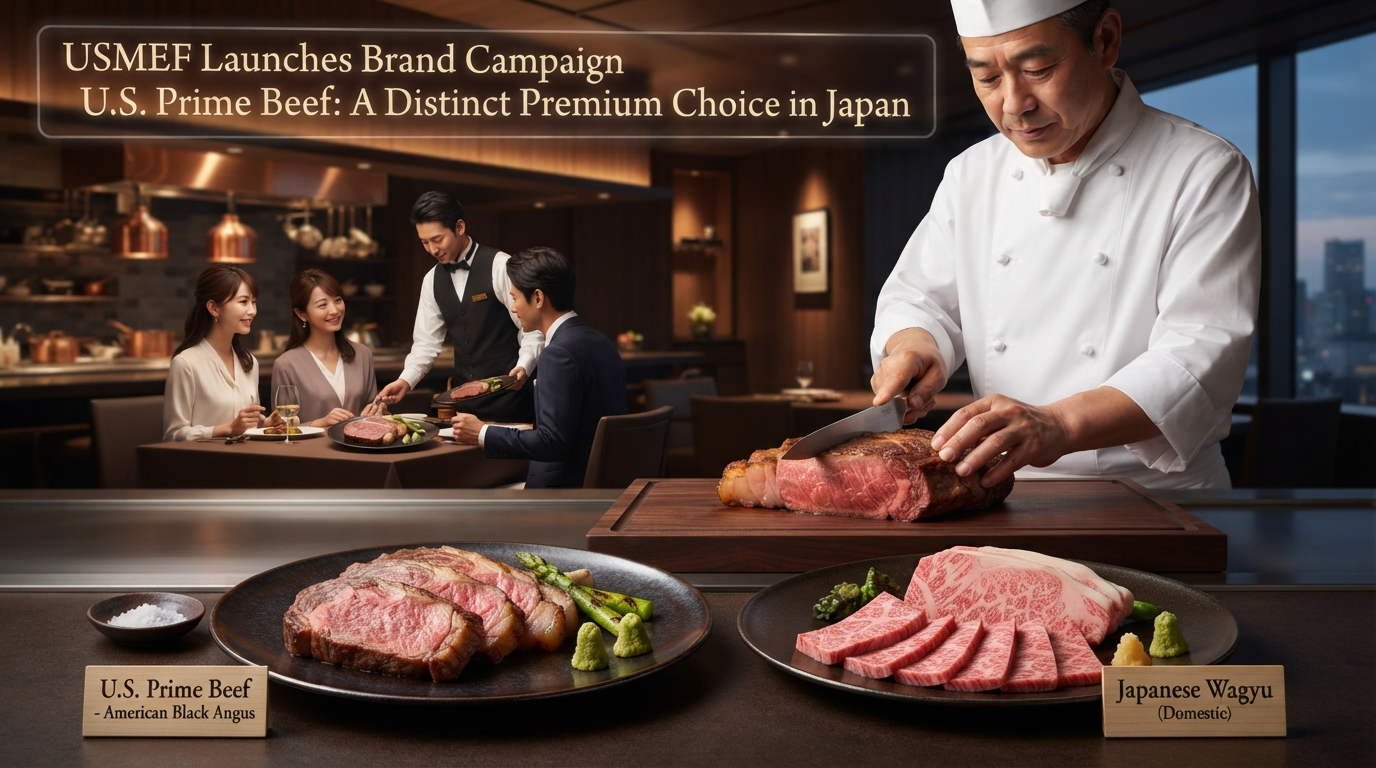

USMEF launches brand campaign to differentiate U.S. Prime beef in Japan as pricing premium challenges market share; consumer perception strategy targets domestic Wagyu alternatives.
How U.S. Beef Is Winning Japan’s Premium Market Battle
The Japanese beef market represents one of the world’s most lucrative and competitive segments for American exporters. Yet U.S. beef faces a persistent challenge: consumers see higher retail prices compared to competing imported products, creating a perception gap that threatens market penetration in the premium segment. The U.S. Meat Export Federation (USMEF) has recognized this challenge and launched a strategic brand campaign designed to reposition U.S. Prime beef as a compelling alternative to Japan’s world-renowned domestic Wagyu.
Understanding the Japanese Premium Beef Landscape
Japan’s beef consumption habits are deeply rooted in cultural tradition and quality expectations. Wagyu beef, particularly from specific regions like Kobe and Matsusaka, commands premium pricing and carries centuries of prestige. Japanese consumers associate Wagyu with exclusivity, tenderness, and superior marbling—factors that justify the significant price premium domestic beef enjoys in local markets.
However, the global beef trade has evolved. American beef producers now offer Prime grade cattle with exceptional quality metrics that rival Wagyu in specific characteristics, particularly in marbling and flavor profile. The challenge isn’t quality—it’s perception and positioning.
When consumers encounter U.S. Prime beef at retail, they often see prices that exceed competing imports from other nations. This pricing dynamic creates confusion: why pay premium prices for American beef when other imports cost less? Without a clear differentiation strategy, price becomes the primary decision factor, and U.S. beef loses the competition.
The USMEF Strategy: Positioning Premium Against Premium
USMEF’s campaign addresses this perception gap directly by establishing U.S. Prime beef not as a budget alternative to Wagyu, but as a distinct premium category with its own value proposition. This is a crucial strategic shift.
The campaign recognizes that Japanese consumers who seek premium beef are willing to invest in quality. These consumers understand grading systems, appreciate marbling and flavor, and view beef purchases as culinary experiences rather than commodity transactions. They represent the high-value segment of the market—the segment where American exporters can compete most effectively.
By positioning U.S. Prime as a premium alternative rather than a Wagyu substitute, USMEF addresses multiple consumer motivations:
Culinary Diversity: Japanese diners increasingly seek variety in their dining experiences. Premium restaurants and upscale butchers recognize that offering multiple premium beef options—rather than relying solely on Wagyu—enhances their brand prestige and customer satisfaction. U.S. Prime beef provides that differentiation.
Value Proposition: While U.S. Prime commands premium pricing, it typically costs less than top-tier Wagyu. For consumers seeking premium quality at a slightly more accessible price point, this positions U.S. beef as intelligent luxury rather than budget compromise.
Culinary Applications: Different beef types excel in different preparations. U.S. Prime beef characteristics suit specific cooking methods and flavor profiles that may actually outperform Wagyu in certain contexts. By educating consumers about these differences, the campaign expands the total addressable market rather than competing directly on Wagyu’s terms.
Market Dynamics and Competitive Pressure
The Japanese beef market operates within a complex trade environment. Domestic producers protect their market share fiercely, and consumer preference for local Wagyu remains extraordinarily strong. Import market share is limited, and competing exporters from Australia, Brazil, and other nations also vie for Japanese consumer attention.
U.S. beef exports to Japan have historically performed well, but growth requires strategy beyond simply offering quality product. Market expansion demands consumer education, retail partnership development, and sustained brand messaging that builds preference and justifies premium positioning.
USMEF’s brand campaign investment signals confidence in long-term market potential. Rather than treating Japan as a secondary market or accepting commodity pricing dynamics, this initiative positions U.S. Prime beef as a strategic category worthy of dedicated marketing resources.
Consumer Perception Challenges in Premium Markets
Perception gaps in premium markets are notoriously difficult to close. Consumers who associate Wagyu with centuries of tradition and heritage view that history as integral to the product’s value. Simply offering “equally good” beef doesn’t overcome cultural and historical advantages.
The most effective strategy—the one USMEF appears to be implementing—acknowledges this reality. Rather than claiming U.S. Prime is “as good as Wagyu,” the campaign positions it as fundamentally different. U.S. Prime brings distinct characteristics, unique flavor profiles, and culinary applications that appeal to consumers seeking premium variety.
This approach also leverages growing trends among affluent Japanese consumers toward international culinary experiences. Premium dining in Tokyo and other major cities increasingly features global ingredients and preparations. U.S. beef fits naturally into this trend, positioned not as a Wagyu replacement but as a premium international option.
Strategic Implications for Export Markets
The USMEF campaign illustrates broader principles that apply across export beef markets. Premium positioning requires:
Consistent Messaging: A unified brand narrative that communicates across retail, foodservice, and direct-to-consumer channels. Confusion undermines premium perception; consistency reinforces value.
Channel Partnership: Retail partners, restaurants, and butchers must understand and actively promote the value proposition. Training programs, point-of-sale materials, and chef endorsements amplify marketing impact.
Consumer Education: Premium consumers are research-oriented. They read reviews, seek recommendations, and investigate products before purchasing. Content marketing, influencer partnerships, and expert endorsements accelerate preference formation.
Patience and Investment: Building premium brand perception requires sustained investment over years, not months. USMEF’s commitment signals readiness for the long game.
Market Outlook for U.S. Beef in Japan
Japan represents a particularly attractive market for premium U.S. beef. Japanese consumers possess high disposable income, demonstrate willingness to pay for quality, and increasingly seek international dining experiences. The country’s affluent population continues growing, and culinary trends favor diverse protein options.
As USMEF’s campaign gains traction, several outcomes become possible:
Premium restaurant adoption accelerates as chefs recognize U.S. Prime’s culinary potential and unique applications. High-end butchers feature U.S. beef alongside Wagyu, offering customers premium choices. Affluent consumers develop preference for U.S. Prime based on distinct flavor profiles and cooking characteristics. Export volumes expand within the premium segment, supporting higher per-unit pricing that justifies American production.
The Broader Beef Trade Picture
This campaign doesn’t occur in isolation. Global beef markets face multiple pressures: trade restrictions, tariff uncertainties, and supply constraints. Within this environment, premium market positioning offers strategic advantages. Premium products command pricing power that insulates producers from commodity market volatility. Premium buyers demonstrate greater loyalty and less price sensitivity, providing export market stability.
For American beef producers, Japan represents exactly the type of market opportunity that premium positioning creates. By differentiating U.S. Prime through strategic brand campaigns, exporters can build sustainable competitive advantage based on quality perception rather than price competition.
FAQ
Q: Why does U.S. Prime beef cost more than other imported beef in Japan?
A: U.S. Prime beef reflects grading standards that ensure exceptional marbling and quality. Premium pricing reflects production standards, shipping logistics, and market positioning strategy.
Q: How does U.S. Prime beef compare to Wagyu?
A: Both are premium products with distinct characteristics. U.S. Prime offers different flavor profiles and marbling patterns suited to specific culinary applications. The campaign positions them as complementary premium options rather than direct competitors.
Q: Will U.S. beef replace Wagyu in Japanese markets?
A: No. Wagyu remains deeply embedded in Japanese culinary culture. U.S. beef targets growth within the premium segment by expanding options for consumers seeking premium variety.
Q: Which consumers represent USMEF’s target market?
A: Premium diners in upscale restaurants, affluent retail consumers seeking premium options, and culinary professionals seeking diverse product offerings.
Q: How long will the USMEF campaign run?
A: Premium brand building requires sustained investment over multiple years. Specific campaign duration depends on performance metrics and market response.
Q: What role do Japanese restaurants play in the campaign?
A: High-end restaurants are critical channel partners. Chef endorsements and menu integration significantly influence premium consumer perception and purchasing behavior.
Q: Are there trade barriers affecting U.S. beef exports to Japan?
A: Trade relationships between the U.S. and Japan support beef exports, though tariff rates and specific protocols apply. The campaign operates within established trade frameworks.
Q: How does this campaign affect U.S. domestic beef prices?
A: Export market expansion, particularly in premium segments, can support domestic pricing by reducing domestic oversupply and directing premium cattle toward higher-value export markets.
Sources & Additional References
| Source Type | Title/Organization | Relevance |
|---|---|---|
| Trade Organization | U.S. Meat Export Federation (USMEF) | Official source for U.S. beef export campaigns and market strategy |
| Market Research | Japanese Beef Import Statistics | Trade data documenting import volumes and pricing trends |
| Industry Analysis | Premium Beef Positioning in Asia-Pacific Markets | Strategic analysis of premium beef marketing in Asian markets |
| Consumer Research | Japanese Consumer Preferences in Premium Beef | Consumer behavior studies on Wagyu and imported beef preferences |
| Trade Data | Japan-U.S. Beef Trade Volumes | Official customs data on bilateral beef trade |
| Market Report | Premium Segment Growth in Japanese Foodservice | Industry analysis of premium dining and retail expansion |
| Culinary Analysis | U.S. Prime Beef Characteristics and Applications | Technical specifications and cooking applications for U.S. Prime |