
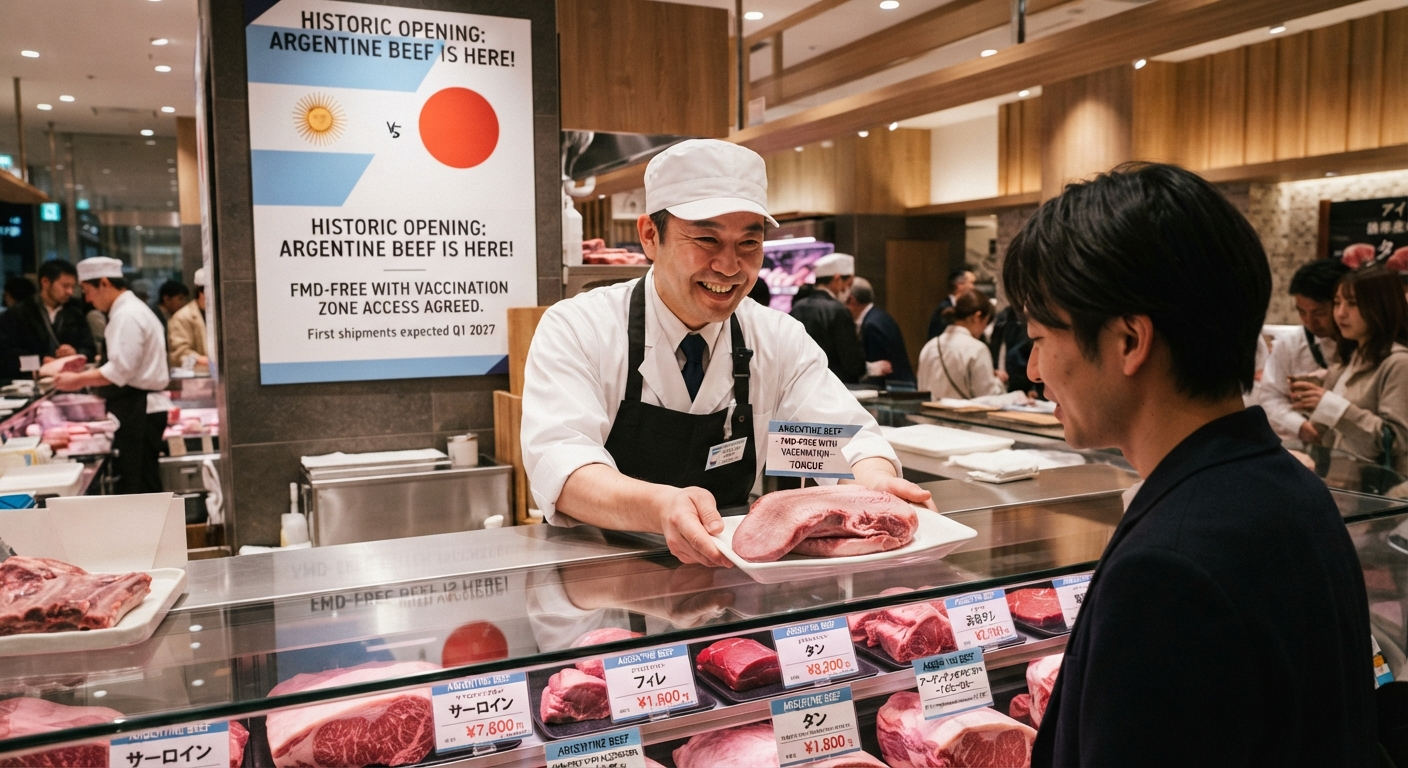

Japan has opened its market to Argentine beef from FMD-free zones with vaccination, with first shipments expected in Q1 2027 and beef tongue a key target.
Argentina has secured one of the most valuable market openings in its meat export history. After more than a decade of technical negotiations, Japan has agreed to sanitary requirements that will allow beef from Argentina’s foot-and-mouth disease (FMD)-free zone with vaccination to enter the Japanese market. Economy Minister Luis Caputo described it as a historic agreement. Argentine exporters now have a route into a premium market where buyers pay for quality, consistency and food safety.
What the Japan–Argentina Beef Agreement Covers
The agreement sets out the sanitary conditions for importing Argentine beef produced in the zone recognised as FMD-free with vaccination. That zone covers most of Argentina’s cattle-producing regions.
This expands on earlier, narrower access. Japan already accepted beef from Patagonia, which is recognised as FMD-free without vaccination. The new protocol brings in the country’s main livestock heartland, which is a much larger supply base.
Key points at a glance:
- Scope: Beef from Argentina’s FMD-free zone with vaccination
- Negotiation history: Talks began with Argentine authorities in 2014
- Status: Sanitary requirements agreed; Japanese health inspections still pending
- Expected first shipments: First quarter of 2027, according to the IPCVA
- Market size: Japan imports more than US$3 billion of high-quality beef each year, according to Argentina’s Economy Minister
Why Japan Matters for Argentine Beef Exports
A Premium, Quality-Driven Market
Japan is one of the most demanding beef import markets in the world. Its buyers focus on traceability, sanitary assurance, consistent specifications and eating quality. Approval from Japan signals that a supplier’s sanitary system meets a very high standard. Exporters can use that recognition in negotiations with other markets.
Argentine officials framed the opening in those terms. They presented it as recognition of both the quality of Argentine beef and the strength of the country’s sanitary controls.
Diversification Beyond Traditional Buyers
Argentina’s beef exports have long depended heavily on a small number of large buyers. A high-value Asian market such as Japan gives exporters a way to spread commercial risk. It also opens a channel for cuts and products that earn premium prices.
Beef Tongue: The Standout Opportunity
Industry representatives singled out beef tongue as one of the most promising products. Tongue is highly valued by Japanese consumers and is especially popular in grilled formats. For Argentine meatpackers, it is a chance to earn more from offal and specialty items that often sell for less elsewhere.
Other products from Argentina’s meatpacking industry are also expected to find demand. The final product mix will depend on the inspection outcomes and commercial negotiations.
The Road to Market Access: A Timeline
| Year | Milestone |
|---|---|
| 2014 | Argentine authorities begin negotiations with Japan on beef access |
| 2015 | IPCVA begins promotional and market development work in Japan |
| 2017 | IPCVA supports the government in securing access for Patagonian beef (FMD-free without vaccination) |
| 2019–2023 | IPCVA participates in Foodex Japan, one of Asia’s leading food and beverage trade fairs |
| 2026 | Japan agrees sanitary requirements for beef from Argentina’s FMD-free zone with vaccination |
| Q1 2027 (expected) | First shipments under the new agreement, subject to pending inspections |
The Role of the IPCVA
The Argentine Beef Promotion Institute (IPCVA) has been central to building Argentina’s position in Japan. Its work over roughly a decade has included:
- Supporting government negotiations for Patagonian beef access
- Working with national authorities to extend access to the rest of the country
- Running promotion and positioning campaigns in the Japanese market
- Exhibiting at Foodex Japan in Tokyo to build relationships with importers, distributors and foodservice buyers
IPCVA president Georges Breitschmitt was travelling with the official Argentine mission to Asia. He welcomed the outcome as a major milestone. He also noted that significant work remains before trade flows at scale.
What Still Needs to Happen
The agreement opens the door, but commercial trade is not yet guaranteed. Several steps remain:
- Japanese health inspections. Japanese authorities still have to carry out sanitary inspections. Their outcomes will determine timing and which facilities qualify.
- Plant approvals. Individual processing establishments will typically need to be listed as eligible to export to Japan.
- Commercial development. Exporters must build importer relationships, meet Japanese product specifications and compete with established suppliers.
- Logistics and cold chain. Long-haul chilled and frozen shipments to Japan require reliable cold chain performance and shelf-life management.
The Q1 2027 timeline for first shipments is an estimate. It depends on inspections being completed without significant delays.
Market Implications for the Global Beef Trade
For Argentine exporters: There is a new premium outlet for higher-value cuts and specialty products such as tongue. Shipments to Japan could also support stronger average export prices.
For Japanese importers: Argentina adds another option for sourcing grass-fed and grain-finished beef, which can support supply diversification.
For competing exporters: Established suppliers to Japan may face a new competitor in certain product categories, particularly offal and specialty items. Large-scale volume shifts are likely to take time.
For the wider industry: The agreement shows that regionalisation-based access, which recognises FMD-free zones with vaccination, can deliver results in highly regulated markets. That may shape Argentina’s approach to other Asian markets.
Frequently Asked Questions
Q: When can Argentine beef be exported to Japan under the new agreement?
A: The IPCVA estimates the first shipments could happen in the first quarter of 2027. This depends on Japanese health inspections, which are still pending.
Q: Which Argentine beef is covered by the agreement?
A: Beef from Argentina’s zone recognised as free of foot-and-mouth disease with vaccination. Patagonian beef, from the zone free without vaccination, already had access.
Q: How long did the negotiations take?
A: Argentine authorities began negotiations with Japan in 2014.
Q: How big is Japan’s beef import market?
A: According to Argentina’s Economy Minister, Japan imports more than US$3 billion worth of high-quality beef each year.
Q: Which Argentine beef products are expected to sell best in Japan?
A: Beef tongue has been identified as a key opportunity because Japanese consumers value it highly. Other meatpacking products are also expected to find demand.
Q: What is the IPCVA?
A: The IPCVA is the Argentine Beef Promotion Institute. It promotes Argentine beef internationally and has worked in the Japanese market since 2015.
Q: Is the market fully open now?
A: Not yet. Sanitary requirements have been agreed, but inspections and facility approvals must be completed before regular trade begins.