
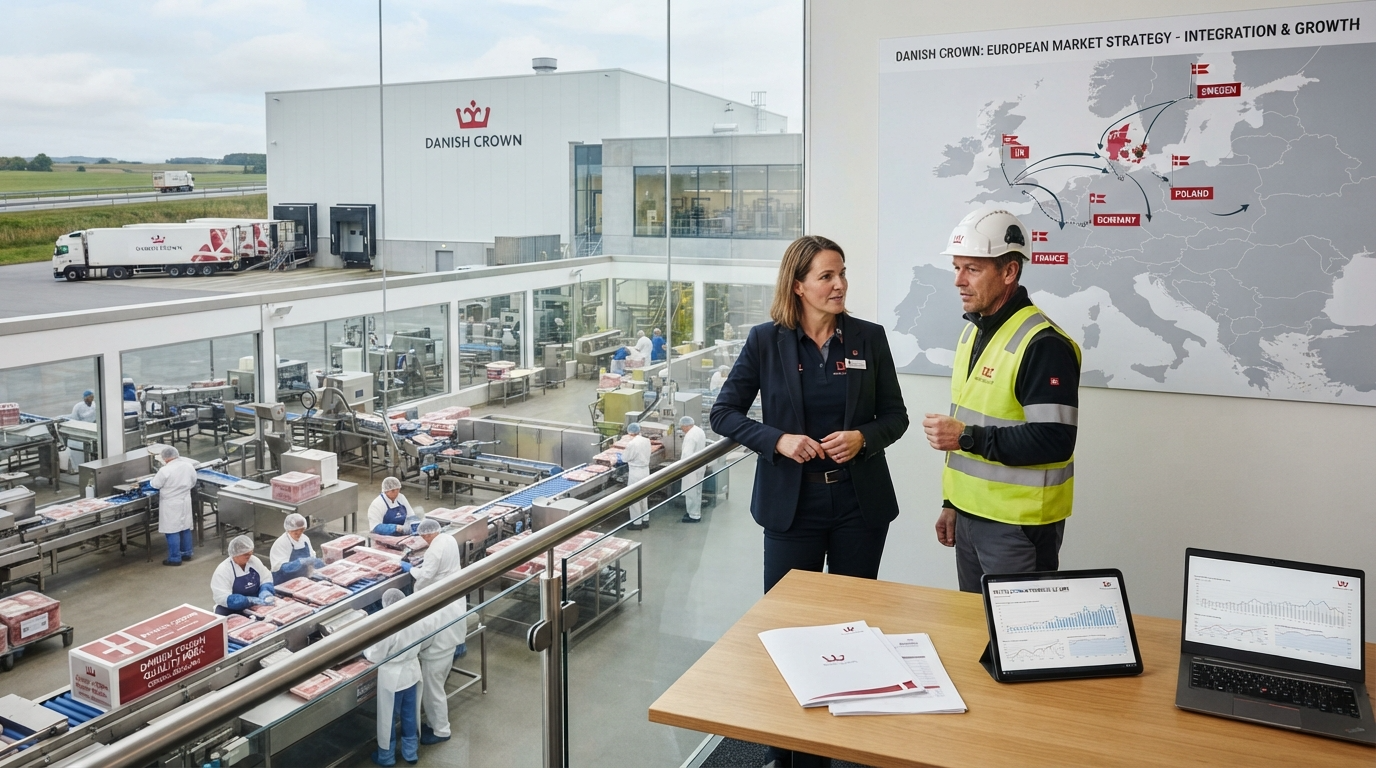

Danish Crown is merging seven business units, cutting brands and doubling processing to 50% by 2030. Here’s what it means for meat buyers, traders and rivals.
For decades, Danish Crown ran like a holding company. Its pork, beef, Polish, Swedish, UK and trading businesses each had their own managing director, their own sales teams and their own priorities. On 2 October 2026 that model ended. Seven of the group’s eight business units are being folded into a single organisation with shared manufacturing, shared sales and shared product development. Only DAT-Schaub, the by-products and casings business, keeps its independence.
On paper it’s an internal reshuffle. In practice, one of Europe’s biggest meat processors is changing what it sells, where it sells it, and how much raw material it puts on the open market. Every importer, processor and retail buyer dealing with European pork and beef will feel it.
Why Danish Crown is doing this now
The pressure has been building for a while. The group’s half-year report for October 2025 to March 2026 pointed to persistent oversupply and fierce competition in the European meat market. Pork was hit hardest, and African Swine Fever outbreaks in Spain made it worse. Beef margins have been squeezed by intense competition for a shrinking cattle supply in Denmark and Germany, combined with weaker demand.
Structural cost is a long-running problem too. Danish Crown has said previously that high Danish wages make slaughtering, cutting and deboning more than DKK 1 per kilo more expensive in Denmark than in Germany, Poland or Spain. That gap is very hard to close when you’re selling frozen commodity pork into global markets at low prices.
So management has reached a blunt conclusion. It can’t win as a global volume player selling commodity cuts. It needs to win by doing more with each animal, in fewer markets, with fewer brands and a leaner cost base.
The four shifts that matter for the industry
1. Processing doubles, so less raw material reaches the open market
The headline target is to lift the share of farmer-owners’ meat that Danish Crown processes further, from around 25% today to 50% by the end of 2030. Put simply, a much bigger share of the carcass will be turned into higher-value products in-house rather than sold as primals, trimmings and bulk cuts.
For third-party processors, sausage makers and further-processors who buy Danish raw material, that’s a warning sign. If the plan works, the volume of Danish pork available as commodity input will shrink over time, and these buyers may face tighter supply or more competition for what remains. It’s worth starting to diversify supply now rather than in 2029.
2. Europe first, the rest of the world second
Danish Crown says it will focus on six defined markets with a stronger European bias, and step back from being a global player. It hasn’t publicly named all six.
This matters most for importers in Asia, Africa, the Middle East and the Americas who have relied on Danish Crown for frozen pork, offal and beef. Supply won’t vanish overnight, but these customers should expect less priority, possible changes in commercial terms, and fewer dedicated sales resources. Folding ESS-FOOD, the group’s international meat trading arm, into the joint organisation is a strong signal that trading for its own sake is no longer the focus. Exporters from Spain, Germany, Brazil and the US could pick up share in markets Danish Crown deprioritises.
3. Fewer brands on the shelf
The group plans to sharply cut its number of brands and build a portfolio of fewer, stronger ones. For retailers and foodservice buyers, this points to SKU rationalisation, possible delisting of smaller labels, and a push to make the surviving brands earn more shelf space. Category managers should expect range reviews and conversations about private label as Danish Crown decides which brands survive.
4. A cost leader across Europe
Danish Crown wants to be the cost leader in the European market. The new structure builds on the June 2026 consolidation of group functions, which is expected to remove around 800 white-collar roles over two to three years and save about DKK 500 million.
A leaner, more integrated Danish Crown competing hard on cost in its core European markets will put pressure on other mid-sized processors. Those without scale or a clear value-added strategy may see margins squeezed further, which could drive more consolidation across the sector.
The leadership reset
The managing director roles for individual business units are being phased out. A global management team takes their place: Group CEO Niels Ulrich Duedahl, Group CFO Anders Aakær Jensen, Karolina Henriksen as CCO for Markets & Channels, Przemyslaw Gostkiewicz as CPO for Products & Brands, and a new COO for Manufacturing and Supply Chain. The COO has been recruited but will only be named later this autumn.
For suppliers and customers, the practical upshot is that relationships built with a business-unit MD in Poland, Sweden or the UK may now sit under group-level owners. Expect your contact points to change over the next six months.
Risks to watch
Big integrations often stumble during execution. Merging seven businesses across several countries, each with its own systems, culture and customer base, is a serious undertaking, and the six-month timeline to full operation is ambitious. There’s also a strategic risk. Moving from 25% to 50% processing needs real demand for value-added products, at a time when consumers are price-sensitive and private label is gaining ground. If branded and processed demand doesn’t follow, Danish Crown could end up with more processing capacity than its markets will pay for.
What buyers and suppliers should do now
- Processors buying Danish raw material: review exposure and build alternative supply over the next 12 to 24 months.
- Importers outside Europe: ask your account team directly whether your market is one of the six priority markets.
- Retail and foodservice buyers: expect brand and range reviews and plan for possible delistings or reformulated offers.
- Competing European processors: expect sharper pricing from Danish Crown in its core markets as the cost programme delivers.
The bottom line
Danish Crown is betting that a smaller global footprint and a bigger value-added business will pay its farmer-owners better than a sprawling commodity operation. If it delivers, Europe gets a more focused, more aggressive competitor in processed meat and a smaller supplier of commodity raw material. If it doesn’t, 2030 will look very different. Either way, the European meat trade’s map is being redrawn, and buyers who move early will be best placed.
Frequently Asked Questions
What did Danish Crown announce in October 2026?
It is combining seven of its eight business units into one joint organisation with shared production, sales and product development, run by an expanded global management team.
Which Danish Crown business units are being merged?
Sokołów, Beef, Industry, Foods, KLS, UK and ESS-FOOD. DAT-Schaub stays as an independent unit.
What is Danish Crown’s processing target?
To lift processing of its farmer-owners’ meat from around 25% to 50% by the end of 2030.
Will Danish Crown still export globally?
Yes, but with less emphasis. It will focus on six defined markets with a stronger European bias, so customers outside those markets may see lower priority.
How will this affect meat buyers?
Less commodity raw material may be available, brand ranges are likely to be rationalised, and pricing in core European markets could become more competitive.
Are there job cuts?
The June 2026 restructuring is expected to remove about 800 white-collar roles over two to three years. The October announcement mainly concerns management structure and integration. No separate job-cut figure has been published for it.
When will the new organisation be in place?
Danish Crown expects it to be fully operational within about six months of the 2 October 2026 announcement.
Sources and Additional Resources
Data accuracy note: Danish Crown has not publicly named its six priority markets, and the COO appointment has not yet been announced. The industry impacts above are analytical projections based on stated strategy, not company guidance.