
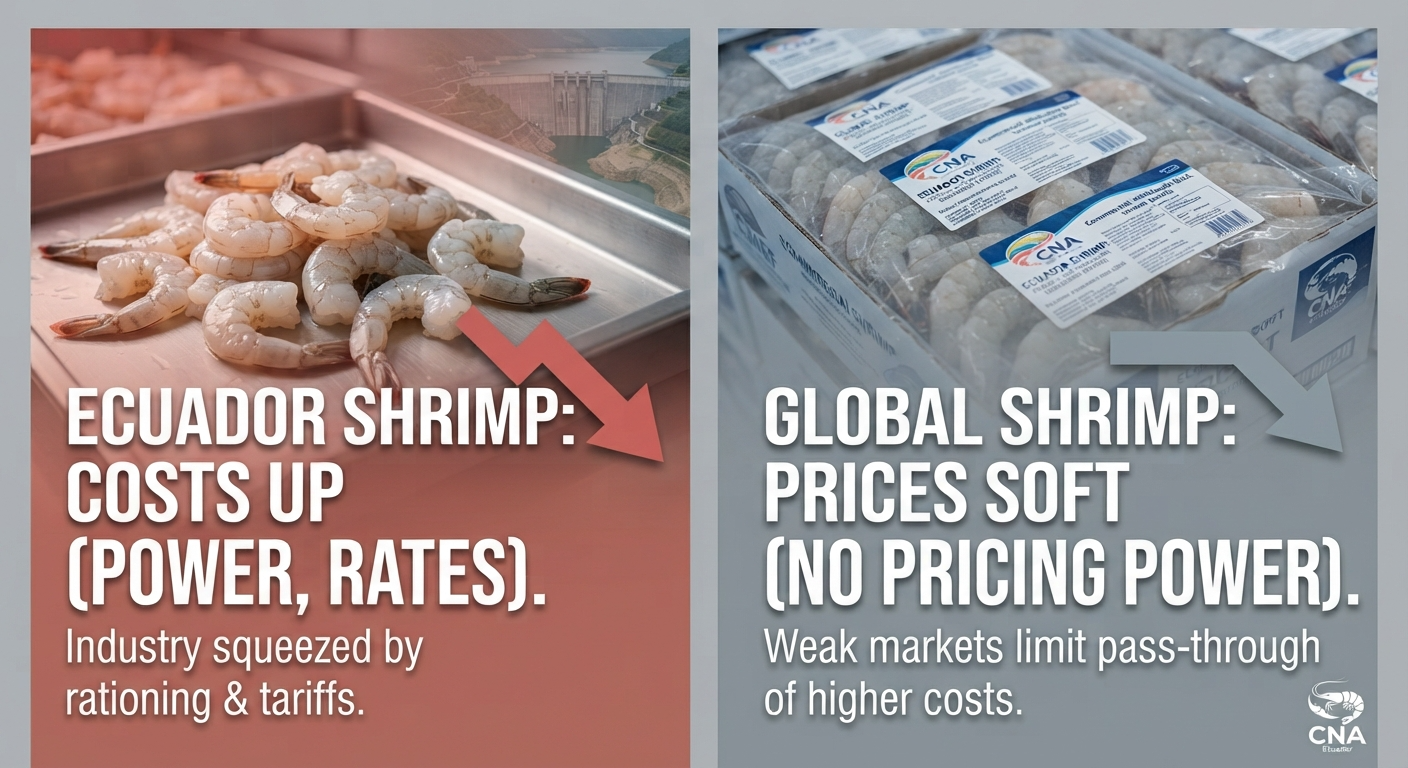

Ecuador’s shrimp processors, feed mills and hatcheries are facing rolling power cuts and higher industrial electricity rates while global shrimp prices stay soft.
The world’s largest shrimp exporter has a new problem, and it has nothing to do with disease, weather at the ponds or tariffs. It’s the electricity grid. Through late September and into October, Ecuador’s shrimp industry has been warning its government that power rationing and a new rate hike are squeezing the supply chain from the larvae tank to the packing plant.
For importers, distributors and foodservice buyers who rely on Ecuadorian white shrimp, it matters how this plays out over the coming weeks.
What’s happening on the ground
Ecuador is in a dry-season power deficit. The country relies heavily on hydropower, and when reservoir levels drop, generation drops with them. The government has rationed power to industry first, so that households are spared.
Timeline so far:
| Date | What happened |
|---|---|
| Sept 22 | Rationing begins with the country’s largest industrial power users |
| Oct 1 | Electricity regulator ARCONEL raises rates for high-voltage industrial users, the categories that cover most shrimp processors and feed mills |
| Oct 2 | Distributors notify more than 9,000 companies of 48-hour disconnection blocks over a two-week period |
| Oct 5 | President Daniel Noboa says homes will not face power cuts this dry season |
| November (planned) | A new transmission link with Peru is due to let Ecuador import power during dry spells |
The industry’s response has been loud and coordinated. The national hatchery association and the National Chamber of Aquaculture (CNA) have both appealed to the government for action. Their message is that the pain is not confined to one link in the chain.
Why shrimp is so exposed to power cuts
Shrimp is one of the most energy-dependent proteins in global trade, and every stage of the chain needs reliable power:
- Hatcheries run pumps, aeration and temperature control for larvae. Interruptions can hurt survival rates.
- Feed mills need continuous power to produce the pellets that farms depend on. If feed production slows, farmers may stock ponds less densely.
- Processing plants peel, grade, pack and freeze shrimp to -18°C or colder. Long outages disrupt shifts, cold storage and restart cycles.
Ecuador has been here before. In 2024, a drought-driven energy crisis led the CNA to estimate losses of up to $5 million a day. The chamber also warned that intensified rationing could cut shrimp exports by about $75 million a month. That episode showed how quickly a grid problem can become an export problem.
A cost squeeze with no pricing power
The timing is awkward. Processors would normally try to pass higher costs on to buyers, but the market is not cooperating.
At the Conxemar seafood show in Vigo this week, Ecuadorian processors said they are struggling to offset rising costs because prices remain low. Trade reports show farm-gate prices stabilising under cost pressure, not climbing. In China, Ecuador’s biggest market, wholesale prices softened during the Golden Week holiday.
On top of that, the US market faces policy uncertainty. A bill introduced in the US Senate would phase in a 40% tariff on Ecuadorian shrimp, and Ecuador’s industry is pushing back. Ecuador has gained US market share through 2026 as other origins struggled, so US buyers are now more exposed to Ecuador-specific risk than they were a year ago.
The result is a sector absorbing higher energy costs and operating disruptions, while having little room to lift prices and facing possible trade barriers in one of its key markets.
What it means for buyers
None of this guarantees a supply shortage. Ecuador’s farms are large and productive, and the Peru power link could ease pressure if it comes online as planned. But a few things are worth tracking.
- Lead times: If processors lose production hours to scheduled cuts, packing schedules and shipment dates may slip, especially for value-added formats that need more processing time.
- Feed-to-harvest lag: If feed mill output falls and farmers stock ponds less densely, the effect would show up in harvest volumes months later, not immediately.
- Price direction: The market is currently soft. If the energy squeeze tightens supply, origin prices could firm. If demand stays weak, processors may simply absorb the costs and margins will shrink.
- Origin concentration: Buyers who source heavily from Ecuador face a cluster of risks right now: energy, tariff policy and margin pressure among suppliers.
- Supplier health: Processors running on thin margins with higher fixed costs are more vulnerable. Supplier financial stability is a fair topic in contract conversations.
The bottom line
Ecuador’s shrimp industry has weathered power crises before, and the government has made clear that it is prioritising households over industry this dry season. How long rationing lasts, and whether the Peru link arrives on time, will decide whether this stays a margin story for processors or becomes a supply story for buyers. For now, the costs are rising at origin while prices are not.
FAQ
Why is Ecuador rationing electricity in 2026?
Ecuador depends heavily on hydropower, and a dry-season power deficit has reduced generation. Rationing began on September 22, starting with the largest industrial users, so that households are protected from cuts.
Will Ecuador’s power cuts raise shrimp prices?
Not necessarily, and not immediately. Prices are currently soft, and processors say they are struggling to pass costs on. If rationing cuts feed output or processing capacity for an extended period, supply could tighten later. That outcome depends on how long the cuts last.
Which parts of the shrimp supply chain are most affected?
Hatcheries, feed mills and processing plants are all exposed because each needs continuous power. Processors and feed mills also fall under the high-voltage industrial rate categories that saw an increase on October 1.
Additional Resources & Sources
| Source | What it covers |
|---|---|
| SeafoodNews (Expana) | Ecuadorian industry warnings on power rationing and the October 1 ARCONEL rate reform |
| Undercurrent News | Hatchery association appeals, Week 41 farm-gate prices, China wholesale prices, Conxemar processor comments |
| The Rio Times | Rationing timeline, company disconnection notices, presidential household pledge, Peru transmission link |
| S&P Global Commodity Insights | 2024 energy crisis and CNA export loss estimates |
| IntraFish | 2024 CNA daily loss estimates from energy rationing |
| National Chamber of Aquaculture (CNA), Ecuador | Industry statements on rationing and costs |
| ARCONEL (Ecuador’s electricity regulator) | Industrial tariff categories and the October 2026 rate reform |
| US Congress (Senate) | Proposed bill to phase in tariffs on Ecuadorian shrimp |