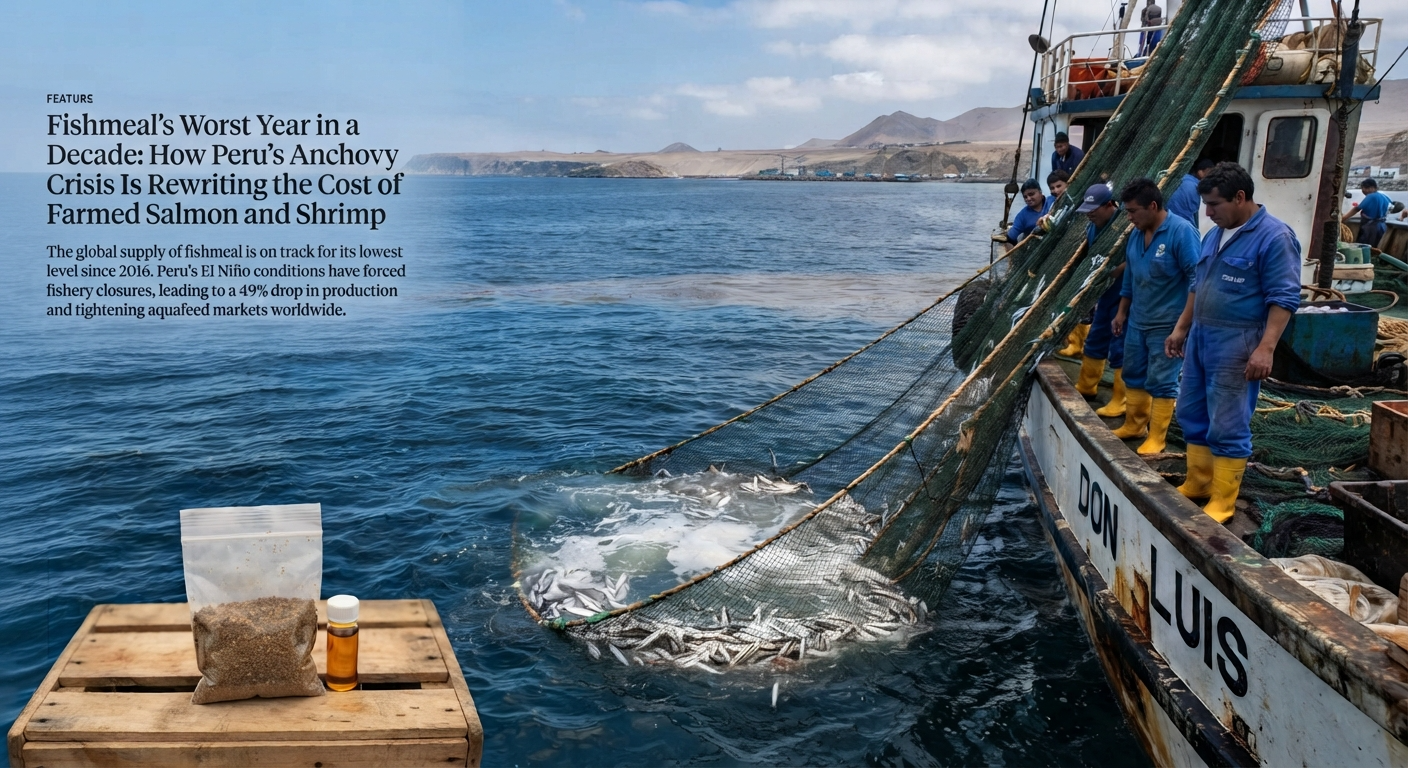

Global fishmeal supply is on track for its lowest level since 2016 as Peru’s anchovy crisis tightens aquafeed markets for salmon and shrimp farmers worldwide.
That is the headline projection from IFFO, the Marine Ingredients Organisation. It caps a year in which the world’s most important source of marine feed ingredients has largely failed to deliver. For anyone who buys, sells or farms seafood, the fishmeal story is no longer a niche commodity issue. It is a cost line that runs through every kilo of farmed salmon, shrimp and trout on the market.
Peru’s anchovy season: where the shortfall started
Peru matters more to fishmeal than any other country. Its Peruvian anchovy (anchoveta) fishery is the largest single-species fishery in the world by volume, and the country typically produces around a fifth of global fishmeal. When Peru has a bad year, the whole market feels it.
2026 has been a very bad year. Authorities set the first North-Central anchovy season at roughly 1.9 million tonnes. Coastal El Niño conditions then pushed unusually warm water along the coast, which dispersed the anchovy and disrupted their biology. Fishing was interrupted repeatedly, suspended in June and then formally closed after a scientific assessment. A large share of the quota was never landed.
The effect shows up clearly in IFFO’s member data, which covers producing countries that together account for about 40% of global fishmeal and half of global fish oil output. Cumulative fishmeal production for January to July 2026 was down 49% on the same period of 2025, and fish oil output was down 30%. Trade reports this week say a more recent anchovy survey points toward further disruption. The next season’s outlook is therefore far from settled.
The North Atlantic adds a second squeeze
Peru is not the only problem. Northern Europe’s raw material output has also fallen, with lower quotas for pelagic species such as mackerel and herring cutting into supply.
A second, quieter shift is now under way. Trade press reports that the salmon feed sector has lost access to a key ingredient following a decision by the North Atlantic Pelagic Advocacy Group (NAPA), a coalition of retailers and seafood suppliers. That move followed the failure of Northeast Atlantic coastal states to agree quota allocations in line with scientific advice. The full volume effect has not been publicly quantified. Still, it shows how sustainability sourcing commitments and fishery management disputes are now shaping feed supply alongside weather.
What a 10-year low means for the cost of farmed seafood
Fishmeal and fish oil are a minority share of modern aquafeed by volume. Even so, they remain high-value, hard-to-replace ingredients, especially in salmon and shrimp diets. When supply tightens, the effects tend to show up in a few places.
Feed costs. Salmon farmers are already signalling pressure. Lerøy Seafood Group told investors earlier this year that feed costs would rise into 2027, although it expects its cost-optimisation programme to offset much of the impact. If marine ingredient prices stay elevated, other integrated farmers could face similar pressure on their 2027 cost bases.
Formulation changes. Feed producers can lower fishmeal inclusion and replace it with plant proteins, insect meal, single-cell proteins or processing by-products. This is a long-running trend, and tight supply years tend to accelerate it. How far it can go without affecting growth, health or product quality varies by species and life stage.
Regional winners and losers. IFFO has noted that demand from high-value species with stronger margins remains stable. In contrast, fishmeal use in China’s pig sector is subdued and is not expected to recover meaningfully this year. When supply is short, the ingredient tends to flow toward buyers who can pay the most.
China’s buying pattern. China is the world’s largest fishmeal importer. IFFO reports that reduced global supply has constrained its imports and that domestic stocks have kept falling. IFFO described Chinese aquaculture demand as relatively resilient, though first-half consumption was slightly below last year’s.
Where relief could come from
The second half of the year usually brings stronger output from several producing regions, and IFFO has pointed to them as a possible partial offset. China, India, Oman and Morocco all have important fishing activity later in the year. If those fisheries perform well, part of the South American shortfall could be covered. IFFO has been clear that the full-year outcome depends heavily on second-half production.
The other key variable is Peru’s next anchovy season. The outlook for marine ingredient prices into 2027 will largely depend on when that season opens, how large the quota is, and whether ocean conditions normalise.
Key dates for buyers and producers
The industry will get a clearer read in the weeks ahead. IFFO’s Annual Conference runs in Buenos Aires from 19 to 21 October 2026, with South American supply expected to be a central theme. Listed salmon farmers will also publish full third-quarter results in the coming weeks, which may give the first detailed look at how feed costs are developing at company level.
The bottom line for the seafood supply chain
A fishmeal low not seen since 2016 does not translate one-for-one into higher retail prices. Feed is one cost among many, and much of the market is moving away from marine ingredients over time. But the 2026 shortfall is a reminder that the farmed seafood supply chain still depends on wild fisheries in South America and the North Atlantic. Procurement teams, feed buyers and farm operators will be watching Peru’s next season closely.
Frequently Asked Questions
Why is global fishmeal supply so low in 2026?
The main driver is Peru. Coastal El Niño conditions disrupted the first North-Central anchovy season, which was suspended and then closed with much of its quota uncaught. Lower North Atlantic pelagic quotas have added to the shortfall.
How much has fishmeal production fallen?
IFFO member data shows fishmeal output for January to July 2026 down 49% year on year, with fish oil down 30%. IFFO projects full-year 2026 supply at its lowest level since 2016.
Why does Peru matter so much for fishmeal?
Peru’s anchovy fishery is the world’s largest by volume, and the country typically produces around 20% of global fishmeal. Disruptions there tighten global supply quickly.
Will farmed salmon and shrimp get more expensive?
Not necessarily straight away. Feed is a major production cost, and some salmon farmers have already flagged rising feed costs into 2027. Final prices depend on many other factors, including harvest volumes, demand and currency movements.
Can feed producers replace fishmeal?
Partly. Plant proteins, insect meal, single-cell proteins and by-products are increasingly used, but the extent of replacement varies by species and stage of growth.
What happens next?
Watch second-half output from China, India, Oman and Morocco, the outcome of Peru’s next anchovy season, and the IFFO Annual Conference in Buenos Aires on 19–21 October 2026.
Sources and Additional Resources
| Source | What it covers |
|---|---|
| IFFO – The Marine Ingredients Organisation | Monthly fishmeal and fish oil production data, 2026 supply projections, Annual Conference 2026 |
| Peru Ministry of Production (PRODUCE) | Official anchovy season openings, suspensions and quotas |
| IMARPE (Instituto del Mar del Perú) | Anchovy biomass surveys and scientific assessments |
| SeafoodSource | IFFO production updates and El Niño impact on marine ingredients |
| Undercurrent News | Peru anchovy survey outlook and IFFO supply projections |
| IntraFish | NAPA decision and its impact on salmon feed ingredients |
| WeAreAquaculture | Peru season closures, IFFO market reports, China demand trends |
| Fish Farming Expert | IFFO commentary on Peru’s fishing suspension |
| Salmon Business / iLaks | Salmon farmer results and feed cost guidance (Lerøy) |
| SeafoodNews | IFFO 2026 fishmeal supply projection |
Data accuracy note: The NAPA feed-ingredient story rests on a single trade source and doesn’t specify the volume affected, so the article keeps it general. Peru’s exact uncaught tonnage is reported differently across sources, so it’s described as “a large share” rather than a precise figure. Statements about 2027 feed costs are attributed to Lerøy’s own guidance and framed as conditional.