
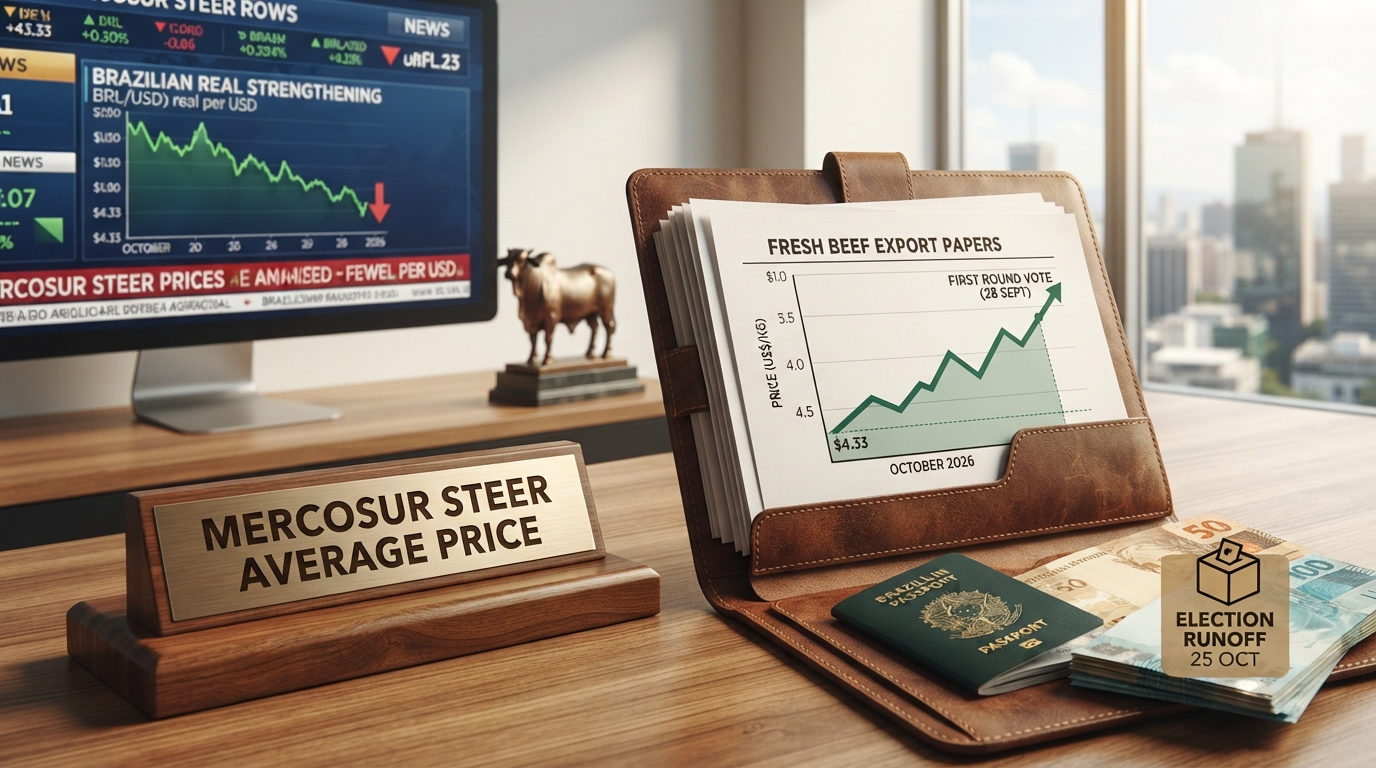

Mercosur steer prices jumped after Brazil’s first-round vote strengthened the real, raising dollar costs for beef buyers ahead of the 25 October runoff.
Brazil’s presidential election has gone to a second round, and the cattle market reacted before the votes were fully counted. Senator Flávio Bolsonaro’s first-round result against President Luiz Inácio Lula da Silva strengthened the Brazilian real, which pushed through the R$5-per-dollar mark. Because South American cattle are priced locally but traded internationally in dollars, the regional steer benchmark rose with it. Neither candidate cleared 50% of valid votes, so Brazilians return to the polls on 25 October. Until then, election headlines will move beef prices.
Why a Currency Move Lifts Cattle Prices
Brazilian ranchers sell cattle in reais, while exporters sell beef abroad in dollars. When the real strengthens, each real a rancher earns is worth more dollars. The dollar price of a slaughter steer therefore rises even if the local price stays flat.
That is what happened this week. Markets read the first-round result as a signal of tighter fiscal policy, bought the real, and pushed the dollar value of Brazilian cattle higher. The Mercosur steer average tracks Brazil, Argentina, Uruguay and Paraguay. Because Brazil carries the most weight in the region, it rose sharply.
For context, the latest published prices before the vote (28 September) put the Mercosur steer average at about US$4.84/kg carcass weight. Brazil was the cheapest origin at around US$4.33, while Argentina traded near US$5.56 and Uruguay near US$5.80. Brazil’s discount to its neighbours has long been its main export advantage, and a stronger real narrows that gap.
The Election Hits a Market Already Running Hot
The timing matters because Brazilian beef exports are running at full speed. September shipments to the United States reached a record volume, narrowly beating the previous high from April 2025. US demand got an extra lift on 1 September, when Washington temporarily expanded its tariff-rate quota for lean beef trimmings. The FAO cited that change as the reason Brazilian bovine export quotations rose in September while Australian prices eased.
Other markets are quieter. Trade with China was close to a standstill during the National Day holiday (1–7 October). Middle East buying is sporadic, as high prices limit deals. In Europe, the euro slipped to about 1.12 against the dollar, which made dollar-priced South American beef more expensive for EU importers and weighed on chilled cut prices.
Neighbouring supply is shifting too. Uruguay’s feedlot cattle numbers are up about 27% year-on-year. Paraguay’s cattle slaughter has fallen to its lowest level since 2019. Northern Argentina has secured agreed sanitary conditions for beef sales to Japan.
What It Means for Beef Buyers and Importers
For anyone buying South American beef in dollars, the next three weeks bring added currency risk on top of normal market risk. Several practical points follow from the current facts:
- Price quotes may move with political news. Polls before the vote showed a close race, and further swings in the real feed directly into dollar-denominated offers.
- Brazil’s discount to its neighbours is narrowing. A stronger real erodes Brazil’s main competitive advantage over Argentine, Uruguayan and Paraguayan beef.
- US-bound volumes are already high. Record September shipments mean exporters have full order books, which gives them less reason to cut prices.
- Contract timing matters more than usual. Deals priced before and after 25 October may reflect different currency conditions.
None of this means prices will keep rising. Currencies can reverse quickly after an election, in either direction. What is clear is that the runoff adds a new variable to beef pricing for the rest of October.
The Road to 25 October
Brazil’s runoff will decide who leads the world’s largest beef exporter into 2027. Polls throughout the campaign showed a statistically tight contest between Lula and Flávio Bolsonaro. Investors have treated the senator as the more market-friendly option, which is why the real responded to his first-round showing.
For the meat trade, the result will shape currency direction, trade policy tone with the United States, and the competitiveness of Brazilian beef against regional rivals in every major market.
Frequently Asked Questions
Why did Mercosur steer prices rise after Brazil’s election?
The Brazilian real strengthened after the first-round vote. Cattle are priced in reais locally, so a stronger real raises their value in US dollars, which lifts the regional steer benchmark.
When is Brazil’s presidential runoff?
The runoff is scheduled for 25 October 2026, because no candidate won more than 50% of valid votes in the first round.
How much do Mercosur steers cost?
The latest pre-election data (28 September) showed a Mercosur average of about US$4.84/kg carcass weight, with Brazil near US$4.33 and Uruguay near US$5.80. Prices have moved since the vote and change weekly.
Sources
| Source | Used for |
|---|---|
| World Beef Report | Post-election steer price move, real crossing R$5, record September exports to the US, regional supply data, China/MENA/EU market conditions |
| FAO Food Price Index (via pig333) | September bovine price trends and the US lean trimmings TRQ expansion |
| Reuters / MercoPress election coverage | Runoff rules and the 25 October runoff date |
Additional Resources
| Resource | What you’ll find |
|---|---|
| FAO Food Price Index (monthly) | Global meat, cereal and dairy price trends |
| USDA Foreign Agricultural Service – Livestock and Poultry: World Markets and Trade | Global beef production and trade forecasts |
| Brazilian Beef Exporters Association (ABIEC) | Brazil beef export volumes by destination |
| Brazil Superior Electoral Court (TSE) | Official election results and runoff information |
| INAC (Uruguay National Meat Institute) | Uruguayan cattle prices and slaughter data |
Data note: steer prices are pre-election baselines as of 28 September 2026. Official first-round vote shares were not independently confirmed and are therefore not quoted.