
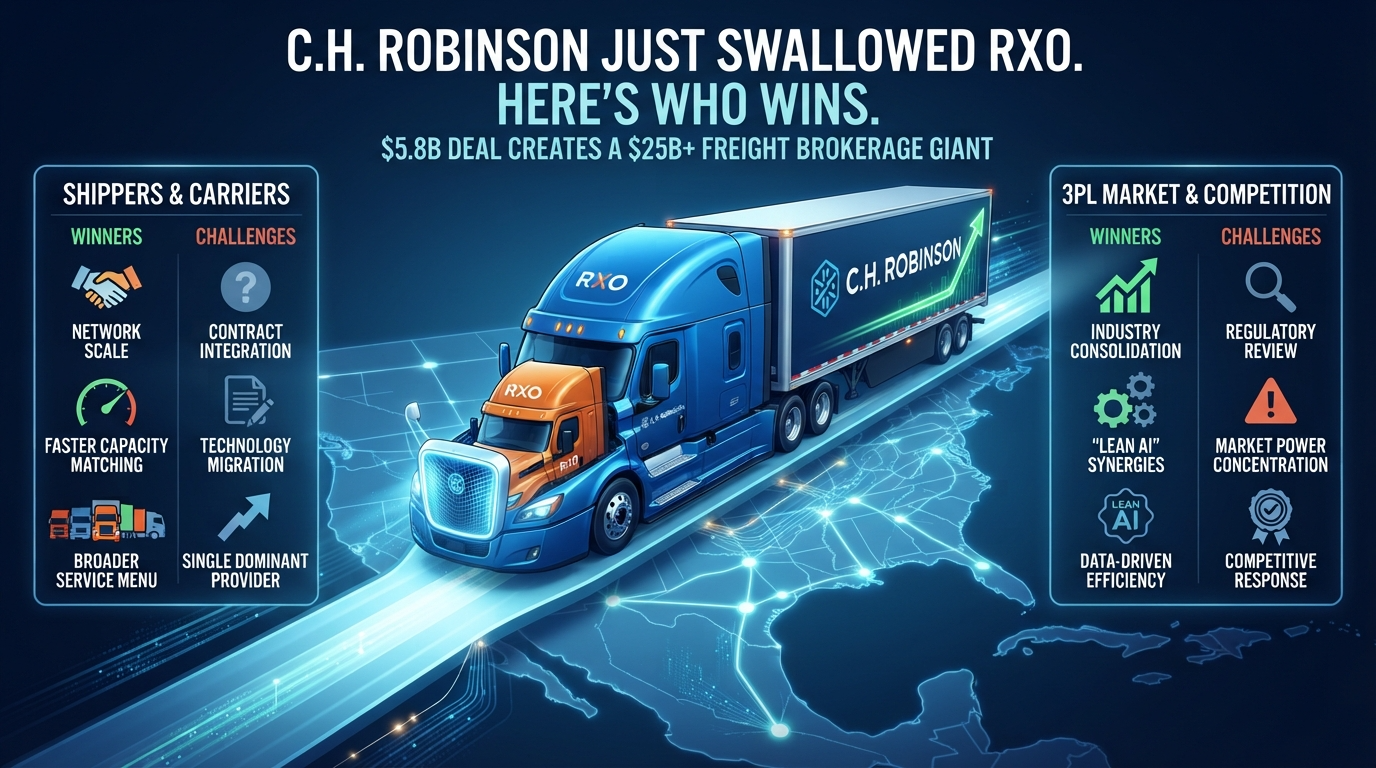

C.H. Robinson’s $5.8B deal for RXO creates a $25B+ freight brokerage giant. Here’s what it means for shippers, carriers and 3PL buyers heading into 2027.
The North American freight brokerage map changed on Monday, 5 October. C.H. Robinson, already the largest non-asset broker on the continent, agreed to buy RXO in a cash-and-stock deal valued at about $5.8 billion. That puts two of the biggest truckload brokerage networks under one roof.
If you buy freight, haul freight or compete with either company, this deal will touch your business in some way. Here’s what was actually agreed, why it happened now, and what to keep an eye on as it moves toward closing.
The deal in plain numbers
RXO shareholders will receive $17.25 in cash plus 0.0856 shares of C.H. Robinson stock for each RXO share they hold. That works out to an implied $30.25 per share, a 29% premium to RXO’s closing price on Friday, 2 October, and 27% above its 90-day volume-weighted average.
Once the deal closes, RXO’s shareholders will own about 11% of the combined company. That company is expected to carry an enterprise value of more than $25 billion.
The two businesses differ in size:
| Metric (2026 estimates) | C.H. Robinson | RXO |
|---|---|---|
| Gross revenue | $18.4 billion | $6.8 billion |
| Adjusted gross profit | $2.9 billion | $1.0 billion |
| Shippers served | ~75,000 | ~18,000 |
| Carriers in network | ~450,000 | ~150,000 |
C.H. Robinson’s shipper and carrier counts are derived from the combined totals of roughly 93,000 shippers and 600,000 carriers, so treat them as approximate.
Both boards approved the deal unanimously. RXO’s largest shareholder, Orbis Investments, supports it, and MFN Partners, which holds about 17% of RXO, has agreed to vote in favour. Closing is targeted for the first half of 2027, subject to regulatory clearance and an RXO shareholder vote.
Why RXO, and why now?
Scale in a fragmented market
Truck brokerage is still a crowded field. Even the largest players hold modest market shares. Combining the two brings together about 93,000 shippers and 600,000 carriers. C.H. Robinson’s leadership has framed that as a major jump in network density: more loads, more lanes and more carrier options to match against each other.
The companies also say their shipper overlap is limited. If that holds, the deal is less about consolidating the same customers and more about adding new ones.
RXO’s mix is more than truckload
Truck brokerage made up 71% of RXO’s gross revenue in 2025. The rest came from last mile (20%) and managed transportation (9%). C.H. Robinson CEO Dave Bozeman has pointed to RXO’s last-mile and expedited capabilities as the real differentiator, because they fill gaps in C.H. Robinson’s own offering.
Put together, the combined company would cover:
- truckload and LTL brokerage
- managed transportation
- expedited freight
- last-mile delivery
- C.H. Robinson’s global freight forwarding
The “Lean AI” playbook
C.H. Robinson has spent the past two years rebuilding its operating model around automation and AI. It brands this approach “Lean AI” and credits it with productivity gains across its brokerage business. The core of the RXO thesis is applying that same model to a second large network.
The company is targeting about $300 million in net run-rate cost synergies within two years of closing. It names four sources:
- Lower cost-to-serve through automation
- Consolidating shared services
- Cutting duplicate third-party vendor spend by moving RXO onto C.H. Robinson’s existing services
- Consolidating real estate
C.H. Robinson’s own platform will become the system of record for RXO’s overlapping truckload and LTL business. RXO’s expedited and last-mile technology could stay in place where it adds something C.H. Robinson doesn’t have. The company also expects the deal to add to adjusted earnings per share within nine months of closing, rising to a mid-teens percentage boost in 2028.
A quick history lesson
RXO itself is a product of the last wave of freight consolidation. It was spun off from XPO in November 2022 as a standalone brokerage. In September 2024 it bought Coyote Logistics from UPS for $1.025 billion, which made it North America’s third-largest provider of brokered transportation at the time.
So in about four years, RXO has gone from spin-off to acquirer to acquisition target. That arc says a lot about where brokerage is heading: scale, data and technology now matter more than ever.
What this could mean for shippers
None of this changes anything today. Until the deal closes, both companies operate independently, and the announcement didn’t specify changes to customer contracts, carrier agreements, rates or brand names.
If the deal closes as planned, shippers could see a few effects:
- Fewer large broker options. A shipper that uses both as separate partners in a routing guide would then be dealing with one company. That matters for procurement teams that diversify to manage risk and keep pricing competitive.
- A broader one-stop menu. RXO customers could gain access to C.H. Robinson’s global forwarding. C.H. Robinson customers could gain RXO’s last-mile and expedited services.
- Technology migration. Overlapping truckload and LTL business would move onto C.H. Robinson’s platform. Shippers integrated with RXO’s systems should expect onboarding and integration work at some point after closing.
The timing matters too. The deal lands in a tight truckload market: tender rejections have stayed well above their 2023–2025 range for months, and new capacity has been slow to enter. Broker scale and carrier access carry real weight in that environment. Whether a bigger network means better coverage or less pricing leverage for shippers will depend on how the combined company manages it.
What this could mean for carriers
For small fleets and owner-operators, the most visible change would be one dominant load source where there used to be two. A combined network of about 600,000 carriers would give C.H. Robinson unusual reach into the small-carrier market.
If the integration follows the plan, carriers working with RXO could eventually move onto C.H. Robinson’s booking and payment systems. Carriers should watch how payment terms, load-matching tools and carrier programmes are harmonised. The companies haven’t announced anything on those points yet.
The road to closing
Several steps remain before the deal is done:
- Regulatory review. The deal needs regulatory clearance. The companies haven’t said publicly how long that will take or what concessions, if any, might be required.
- RXO shareholder vote. Support from Orbis and MFN Partners gives the deal a strong starting position, but the vote still has to happen.
- Integration planning. RXO will be folded mainly into C.H. Robinson’s North American Surface Transportation division. Most of the synergies depend on how smoothly that happens.
Until all three are complete, the target date stays at the first half of 2027.
The bottom line
This isn’t just a bigger broker. It’s a bet that technology-driven scale is now the main competitive edge in freight brokerage, and that a proven AI operating model can pull real cost out of a second large network.
For shippers and carriers, the practical effects will show up gradually. They depend on regulatory approval and on how the integration is run. For the rest of the 3PL market, the message is already clear: the consolidation wave that produced RXO is now consolidating RXO itself.
Frequently Asked Questions
How much is C.H. Robinson paying for RXO?
The transaction has an implied value of about $5.8 billion. RXO shareholders receive $17.25 in cash plus 0.0856 C.H. Robinson shares per RXO share, an implied $30.25 per share.
When will the C.H. Robinson–RXO deal close?
The companies expect it to close in the first half of 2027, subject to regulatory clearance, an RXO shareholder vote and customary conditions.
How big will the combined company be?
It’s expected to have an enterprise value above $25 billion and a network of about 93,000 shippers and 600,000 carriers.
Will RXO’s brand, rates or contracts change?
Not yet. The announcement didn’t specify changes to customer contracts, carrier agreements, freight rates or brand names. Both companies continue to operate separately until closing.
Where do the $300 million in cost savings come from?
C.H. Robinson plans to apply its Lean AI operating model to RXO’s business. It also plans to consolidate shared services and real estate and to move RXO’s outside vendor services onto C.H. Robinson’s existing platforms. The target is $300 million in net run-rate synergies within two years of closing.
What does RXO bring that C.H. Robinson doesn’t have?
Mainly last-mile delivery and expedited freight, plus a large truckload brokerage customer base with limited overlap with C.H. Robinson’s.
Who are RXO’s biggest shareholders, and do they support the deal?
Orbis Investments, RXO’s largest shareholder, backs the deal. MFN Partners, which holds about 17%, has agreed to vote its shares in favour.
Sources
| Source | What it covers |
|---|---|
| RXO Inc., Form 8-K / joint press release (SEC filing, 5 Oct 2026) | Deal terms, implied value, premiums, ownership split, integration into NAST |
| Supply Chain Dive | Combined network size, 2026 revenue and gross profit estimates, shipper overlap, platform integration |
| Inbound Logistics | Per-share consideration, MFN Partners and Orbis support, closing timeline |
| Modern Distribution Management | Enterprise value basis, RXO shipper and carrier counts, Coyote acquisition history |
| Automotive Logistics | RXO revenue mix (truck brokerage, last mile, managed transportation), $300M synergy target |
| Logistics Management | Board approval, closing conditions, synergy timeline |
| SupplyChain247 | Earnings accretion outlook, contract and rate status, RXO spin-off history |
| FreightWaves (SONAR data) | Truckload tender rejection and capacity context |
Additional Resources
| Resource | Why it’s useful |
|---|---|
| C.H. Robinson Investor Relations | Merger presentation, synergy details and future integration updates |
| RXO Investor Relations | Proxy materials and shareholder vote timing |
| SEC EDGAR filings (CHRW, RXO) | Primary merger agreement documents and future regulatory filings |
| FreightWaves SONAR | Truckload tender rejection and spot-market capacity indicators |
| Transportation Intermediaries Association (TIA) | Industry data and perspective on brokerage consolidation |
| Supply Chain Dive / Trucking Dive | Ongoing coverage of 3PL M&A and integration progress |
Data accuracy note: Deal terms, synergy targets and closing timing come from the companies’ joint announcement and SEC filing and are forward-looking company estimates, not guaranteed outcomes. The 2026 revenue figures are consensus estimates. C.H. Robinson’s standalone shipper and carrier counts in the table are derived from combined totals and RXO’s reported figures. Market capacity context is described in general terms because the latest index readings come from a single data provider.