
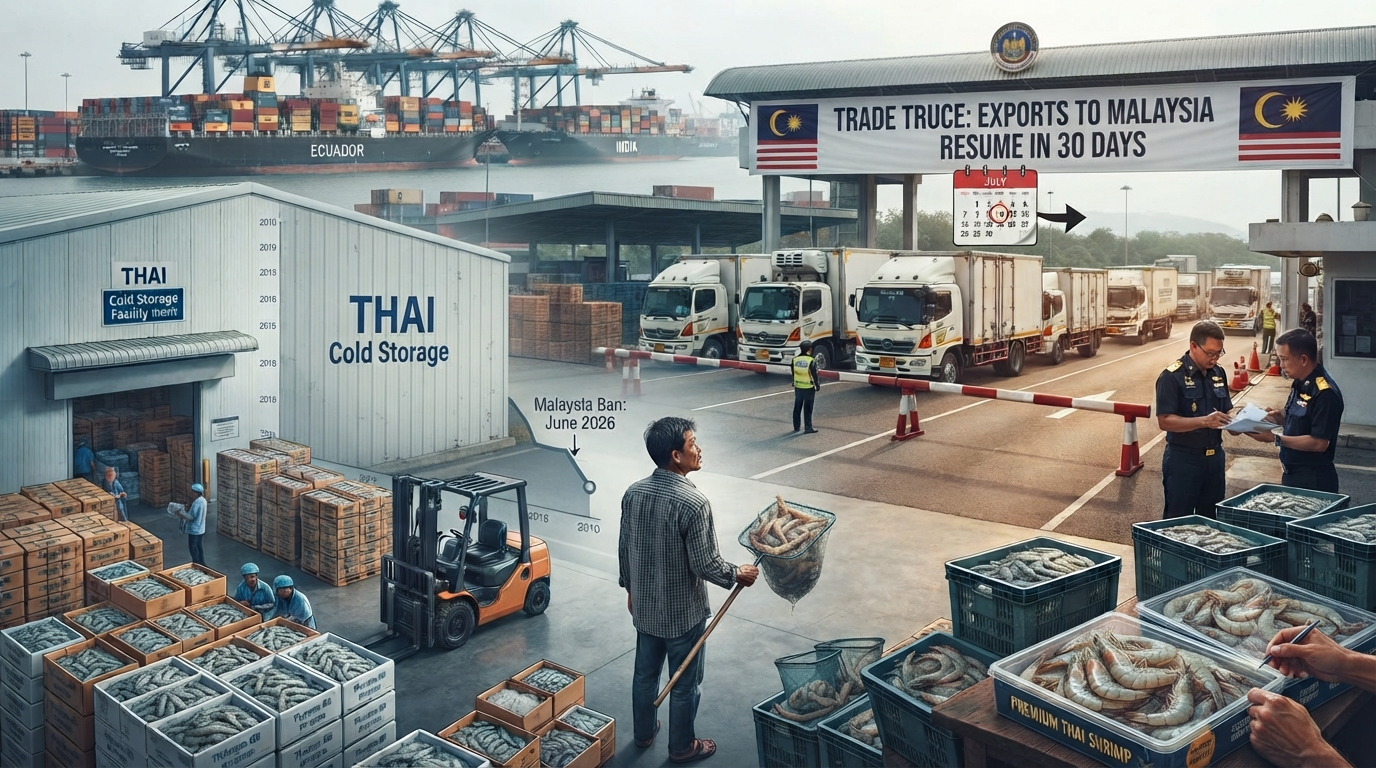

Thai shrimp exports to Malaysia may resume within 30 days, but the industry that once led the world is at its lowest point. What went wrong?
A trade truce is finally in sight for Thai shrimp. After high-level meetings in early July, Thailand and Malaysia have agreed to expedite sanitary and phytosanitary inspection processes, and Bangkok expects shrimp exports to its southern neighbour to resume within 30 days. But the diplomatic breakthrough only sharpens a bigger question hanging over the sector: the president of the Thai Shrimp Association says the industry is at its lowest point, and a resolved border dispute will not fix a decline that has been fifteen years in the making.
How the Thai Shrimp Ban Unfolded
The dispute began not with shrimp but with seabass. Thailand tightened inspection measures on Malaysian seabass over chemical and antibiotic residue concerns, and Malaysia answered on June 1 by suspending imports of five Thai shrimp species — brown tiger prawn, banana prawn, whiteleg shrimp, giant tiger prawn and blue shrimp — with Bangkok given barely three days’ notice. Malaysian authorities openly described the suspension as a reciprocal move.
The commercial damage was immediate. Direct Thai shrimp exports to Malaysia average 300–400 tonnes a month, but industry estimates put total flows routed via Malaysia far higher — around 100 tonnes a day, or roughly 3,000 tonnes a month. With those channels blocked, buyers slowed purchases, cold storage operators struggled to absorb excess stock, and farm-gate prices fell harder than retail prices amid already weak demand from the United States and Japan.
The Truce: Exports Could Resume Within 30 Days
Momentum shifted in early July. Thailand’s agriculture minister met his Malaysian counterpart on July 1, agreeing to fast-track residue and hygiene inspections, and the Thai prime minister reaffirmed the deal after meeting Malaysian Premier Anwar Ibrahim in Putrajaya on July 10. If implementation stays on track, Thai shrimp should be flowing across the border again by early August, with joint task forces now being established to oversee the details.
Thailand had earlier threatened to escalate the matter to the WTO and ASEAN, alongside 13 domestic support measures — purchasing hubs in key farming provinces, retail diversion into tourism centres and cross-border sales events — designed to absorb around 400 tonnes of displaced shrimp a month.
A Fallen Giant: From 640,000 Tonnes to Crisis
The deeper story is structural. Thailand was once the world’s largest shrimp producer and exporter, peaking in 2010 at 640,000 tonnes annually with exports worth more than 110 billion baht. The 2012 outbreak of early mortality syndrome (EMS) devastated production, and the industry never regained its crown. Ecuador and India seized the volume leadership Thailand surrendered, and today Thai farmers face intensifying competition, import tariffs in key markets, persistent disease pressure, and rising feed and fuel costs simultaneously. The Malaysia ban was not the cause of the crisis — it was a stress test that exposed how little resilience remains.
Implications for Buyers and Procurement Teams
- Buyers sourcing Thai shrimp should expect near-term price softness: blocked export volumes and strained cold storage create opportunistic buying windows, but verify storage duration and quality on discounted lots.
- The 30-day resumption timeline is a government projection, not a contractual fact. Build buffer stock or alternative-origin cover for August–September rather than assuming a clean restart.
- The seabass-to-shrimp retaliation cycle is a warning for anyone trading intra-ASEAN: SPS measures are increasingly being used as trade weapons, and single-border logistics dependencies carry real risk.
- Ecuador and India remain the structural winners. Buyers negotiating 2027 programmes should treat Thai origin as a quality and niche play, not a volume anchor, until the sector demonstrates recovery.
- Watch US and Japanese demand signals. Weak demand from both markets is compounding Thailand’s oversupply — any demand recovery would tighten the discount window quickly.
FAQ
Why did Malaysia ban Thai shrimp imports?
Malaysia suspended five Thai shrimp species from June 1, 2026 as a reciprocal response to Thailand’s stringent inspection measures on Malaysian seabass, triggering fears of a retaliation cycle between the two neighbours.
When will Thai shrimp exports to Malaysia resume?
Following ministerial talks on July 1 and a prime ministerial meeting on July 10, both countries agreed to expedite inspections, with Thailand expecting exports to resume within 30 days — roughly early August 2026.
Why is the Thai shrimp industry in decline?
Thailand peaked at 640,000 tonnes of production in 2010 before the 2012 EMS disease outbreak devastated the sector. It has since lost global leadership to Ecuador and India while battling competition, tariffs, disease, and rising feed and fuel costs.
Sources
- Bangkok Post — Thai shrimp industry explainer and resolution timeline
- SeafoodSource — Malaysia-Thailand trade dispute coverage
- The Nation Thailand — export volumes and government support measures
- South China Morning Post — Thai Shrimp Association commentary
- The Malaysian Reserve — industry impact and export flow estimates