

Cattle prices crashed with a record 15 consecutive lower closes as record US beef imports flip the market. Is the 2026 top already in for beef?
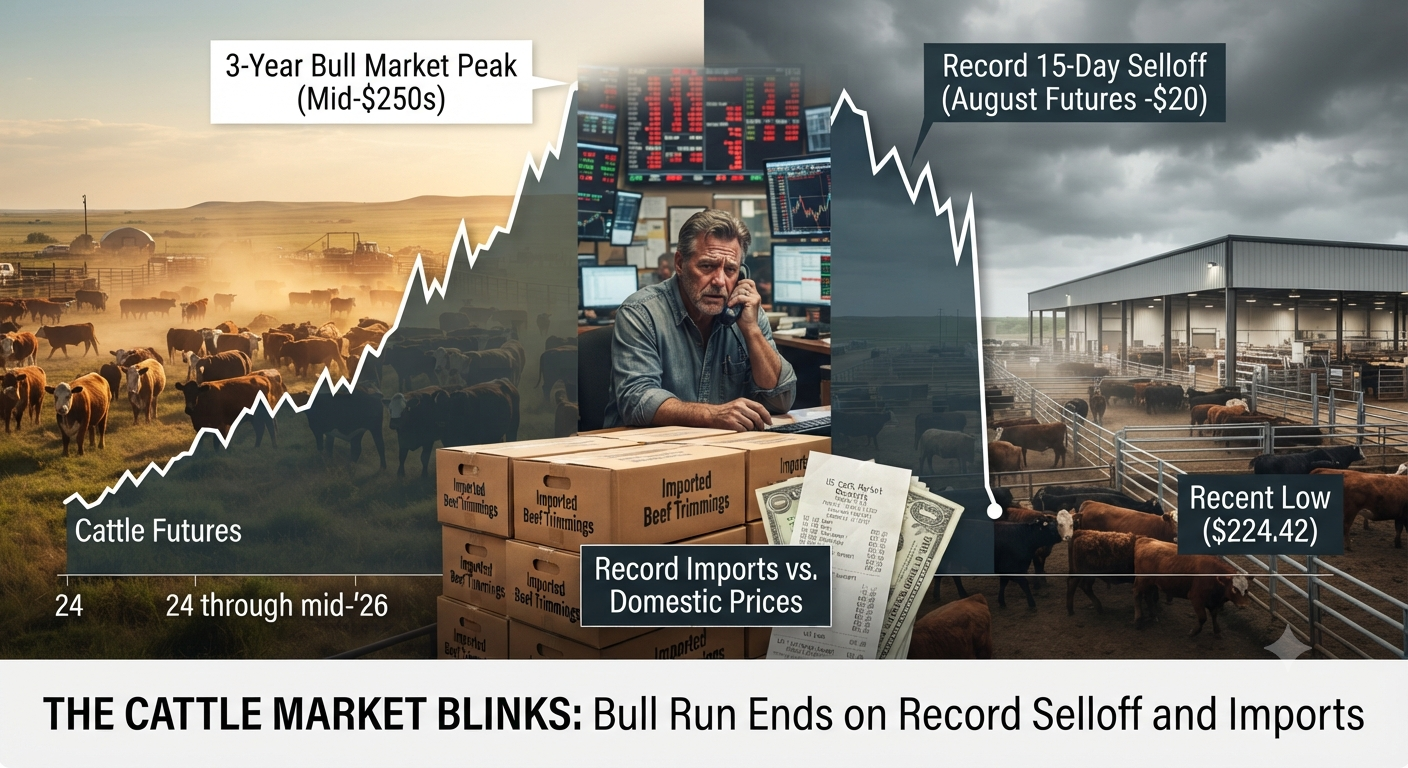
For three years, cattle prices only knew one direction. A 75-year-low US herd, relentless consumer demand and packers bidding desperately for scarce supply drove the greatest bull market the beef industry has ever seen. Last week, it ended — or at least, it blinked. The cattle complex was the only major US commodity market to buckle, and it did so in dramatic fashion: August live cattle futures fell $10.77 for the week to settle at $224.42 on Friday, capping a record 15 consecutive lower closes and a correction of roughly $20 off contract highs. The question now dominating every trading desk: was early July’s mid-$250s cash peak the top for 2026?
How Cattle Prices Unravelled in One Week
The selloff was brutal and broad. August feeder cattle shed $8.65 to $345.95, while the October, December and February live cattle contracts posted their lowest closes since December 30, 2025 — surrendering their entire 2026 gains. The cash market cracked alongside the board, posting its largest weekly decline in several years: Kansas and Texas cattle traded at $237–238 per hundredweight, down $10–11 on the week and roughly $18 below levels seen just two weeks earlier.
Technical damage accelerated the fall. Both the August and October contracts dropped below their 200-day moving averages, and with managed funds sitting on a sizeable net long position, speculative long liquidation poured fuel on the fire. Boxed beef offered no rescue: the Choice cutout slid to $366.81, its weakest reading since February.
Record Beef Imports Finally Get Priced In
The proximate trigger for the collapse in cattle prices was not supply of cattle — it was supply of beef. US beef imports have set records for three consecutive years: 4.64 billion lbs in 2024, then 5.39 billion lbs in 2025, up 16.4%. In 2026 the USDA forecasts around 5.6 billion lbs, while private trade estimates run closer to 6.1 billion lbs — up another 13%. On those numbers, roughly one in every five pounds of beef consumed in the US this year will be imported.
The trade balance is deteriorating from both sides. First-quarter imports ran 1.7 billion lbs, up 15% year-on-year, while exports fell nearly 18% — including a 95% collapse in shipments to China. Add Washington’s evident determination to pull beef prices down for consumers, and the market finally decided to price a dynamic it had ignored for three years. Packer leverage has also flipped: after absorbing historic losses, packers are cutting slaughter and letting the cash market come to them.
What Falling Cattle Prices Mean for Global Beef Trade
This is not just an American story. Record US import demand has been the marginal bid in world beef markets, underpinning export values for Brazil, Australia, New Zealand and other suppliers. If US cattle prices have topped and packers regain leverage, that pull weakens — even as those same exporters ship record volumes into the US market. South American and Oceania traders should watch whether US buyers step back from forward import commitments in Q4, when analysts expect import discussion to intensify.
Implications for Buyers and Procurement Teams
- For US retail and foodservice buyers, the leverage shift is the first genuine buying opportunity in three years — but chase it patiently; a record losing streak often produces a violent short-term bounce before any sustained downtrend.
- Importers holding high-priced forward beef positions face margin risk if the cutout keeps sliding; revisit hedges on Q4 arrivals.
- Exporters to the US should stress-test 2027 volume assumptions against a scenario where cattle prices confirm the 2026 top and import growth slows.
- Watch weekly cow slaughter (up 7.4% year-on-year) and packer slaughter rates — sustained cuts to kill schedules would confirm packers, not producers, now control the tempo.
- The herd is still at a 75-year low. If heifer retention finally begins, feeder supply tightens further and this correction could prove a pause, not a peak. Position for volatility, not a one-way market.
FAQ
Why are cattle prices falling now?
Record US beef imports — potentially 6.1 billion lbs in 2026, meaning one in five pounds consumed — finally got priced in, alongside collapsing exports, political pressure on beef prices, technical selling below the 200-day average, and heavy fund long liquidation.
Have cattle prices peaked for 2026?
Several veteran analysts believe the early-July cash peak in the mid-$250s will stand as the annual top, citing record imports, flipped packer leverage and softening cutout values. But with the US herd at a 75-year low, supply fundamentals still argue against a deep collapse.
What should beef buyers do as cattle prices fall?
US buyers can begin scaling into forward coverage on weakness rather than chasing rallies; importers should hedge Q4 exposure; and global exporters should prepare for softer US import demand if the correction extends into the autumn.
Sources
- Ag Bull Trading — weekly cattle and beef market scoreboard and import analysis
- Meatingplace Daily Livestock Report — futures, cutout and cow slaughter data
- Brownfield Ag News — cash cattle and boxed beef closes
- Western Livestock Journal — Friday market wrap and weekly cash volumes
- The Pig Site / Reuters — CME futures technical analysis and fund positioning
- USDA Economic Research Service — cattle and beef market outlook