
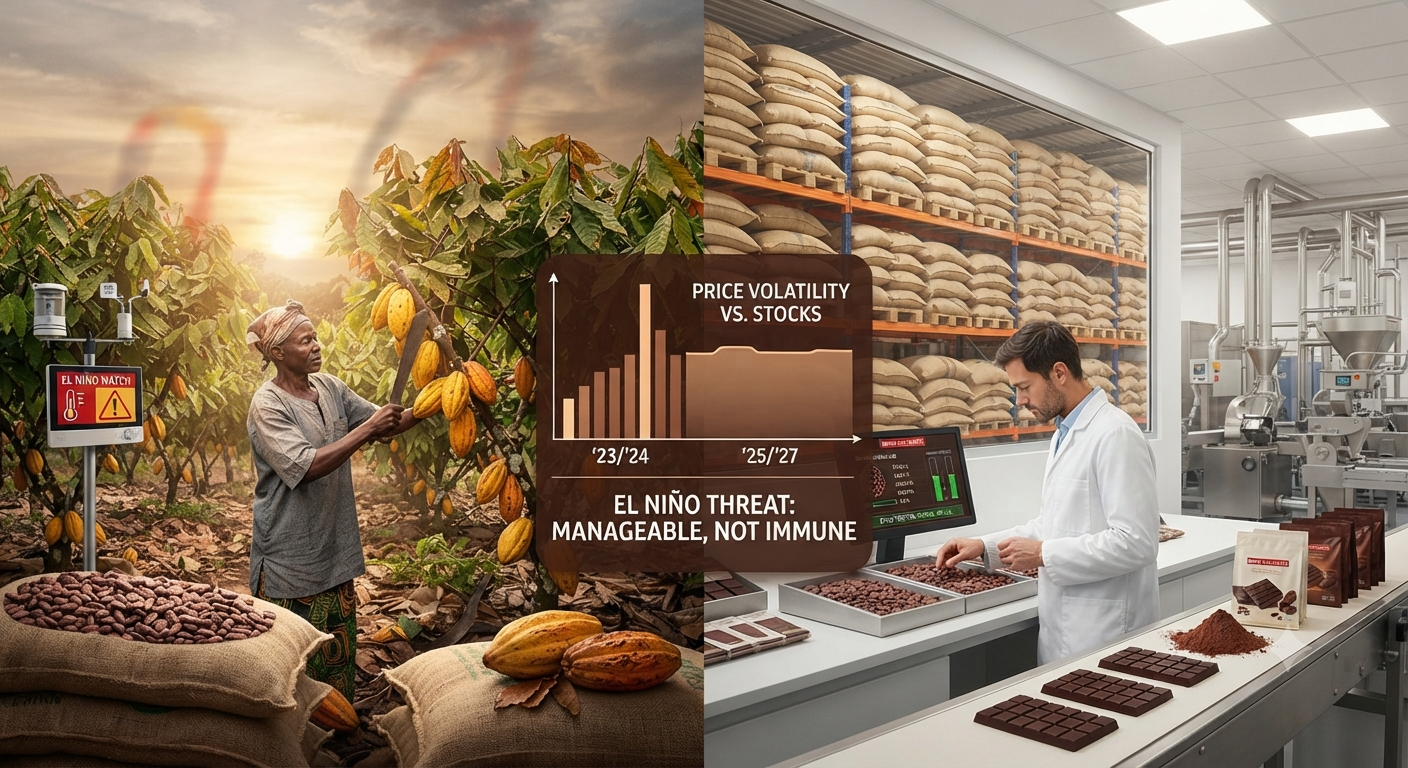

Cocoa prices face fresh El Niño risk, but Barry Callebaut says ample stocks and a strong surplus should prevent a repeat of the 2023/24 crisis.
The warning lights are flashing again over West Africa. The United Nations weather agency has raised its forecast for the rapid emergence of a strong El Niño in the coming months — the same climate pattern that helped drive cocoa to record highs and triggered three consecutive years of supply deficits. Yet Barry Callebaut, the world’s largest bulk chocolate and cocoa processor and supplier to Nestlé and Hershey, is telling the market this time is different. For buyers still scarred by the 2023/24 price explosion, the company’s confidence — and the reasoning behind it — deserves close scrutiny.
Why Barry Callebaut Expects a Different Outcome
Speaking alongside the group’s third-quarter results, CFO Peter Vanneste said the company does not expect a repeat of the cocoa-market turmoil of 2023 and 2024 even if a strong El Niño takes hold. The core of the argument is stock positioning. In 2023/24, El Niño coincided with the West African main crop and marked the third consecutive deficit year, leaving the market with no buffer. Today, the industry enters the new crop year from a position of strong surplus with ample cocoa stocks.
The 2025/26 crop year delivered a surplus of broadly similar magnitude to the previous shortfall, leaving the industry well-stocked heading into 2026/27. That cushion fundamentally changes how a weather shock transmits into price: a production dent hits inventories first, rather than translating directly into panic buying.
Structural Resilience After the Crisis Years
Barry Callebaut also argues it is a structurally different business than it was two years ago. Management points to origin diversification beyond the Ivory Coast–Ghana axis, increased sourcing flexibility, and enhanced bean blending capabilities that allow the company to substitute origins without compromising product specifications. These operational changes were forged during the crisis, when record differentials and farmgate price interventions punished processors with concentrated exposure.
Notably, the reassurance comes at a moment of commercial recovery: the group has just posted its first quarterly volume growth in two years, against a still-weak global chocolate market. That context matters — a supplier rebuilding volumes has every incentive to project stability, but it also has more sourcing headroom than it did at the bottom of the cycle.
The Bear Case Buyers Should Not Ignore
El Niño remains a genuine supply threat. The UN agency warns the pattern is likely to drive global temperatures higher, and historically it has brought hotter, drier conditions to West Africa, which produces the majority of the world’s cocoa. The 2023/24 episode showed how quickly a weather anomaly can compound existing agronomic problems — disease pressure, ageing tree stock and underinvestment at farm level have not disappeared.
The surplus cushion is real but finite. If a strong El Niño damages both the 2026/27 main crop and the following mid-crop, stocks can erode faster than the market currently assumes. Barry Callebaut itself frames El Niño as a downside risk to supply, not a non-event — the message is manageability, not immunity.
Implications for Buyers and Procurement Teams
For chocolate manufacturers, bakers, ice cream producers and private-label buyers, the practical question is how much of Barry Callebaut’s confidence to price into 2027 contracts. Points to weigh:
- The stock cushion argues against panic coverage, but forward cover for H1 2027 bought during calm conditions is cheaper than cover bought after a confirmed West African weather event.
- Watch the October–March West African main crop window closely; that is when El Niño impacts would show up in arrivals data and port shipments.
- Ask suppliers direct questions about origin mix and blending flexibility. The processors that navigated 2023/24 best were those able to shift between origins.
- Butter and powder ratios can move independently of bean prices; buyers of cocoa butter should hedge ratio risk separately rather than assuming bean-price stability protects them.
- Keep reformulation and compound options warm. The last crisis showed that having tested alternatives ready is worth more than developing them mid-spike.
Related
FAQ
Will El Niño cause another cocoa price crisis in 2026/27?
Barry Callebaut believes not, because the market enters the new crop year with a strong surplus and ample stocks — the opposite of the depleted position that amplified the 2023/24 spike. However, the company still classes El Niño as a downside risk to supply.
Why did cocoa prices spike in 2023/24?
A strong El Niño coincided with the West African main crop during the third consecutive year of supply deficits, compounding disease pressure and structural underinvestment, and leaving the market with no inventory buffer.
What should cocoa buyers do now?
Use the current calm to extend forward cover into H1 2027, interrogate suppliers on origin diversification and blending flexibility, monitor West African main crop arrivals from October, and keep reformulation options ready as insurance.
Sources
- FoodNavigator — Barry Callebaut assessment of El Niño risk and supply resilience
- Reuters — CFO Peter Vanneste comments on cocoa market outlook
- Investing.com — Barry Callebaut Q3 FY26 results and cocoa market analysis
- Inside FMCG — Barry Callebaut El Niño commentary
- UN World Meteorological Organization — El Niño forecast update