
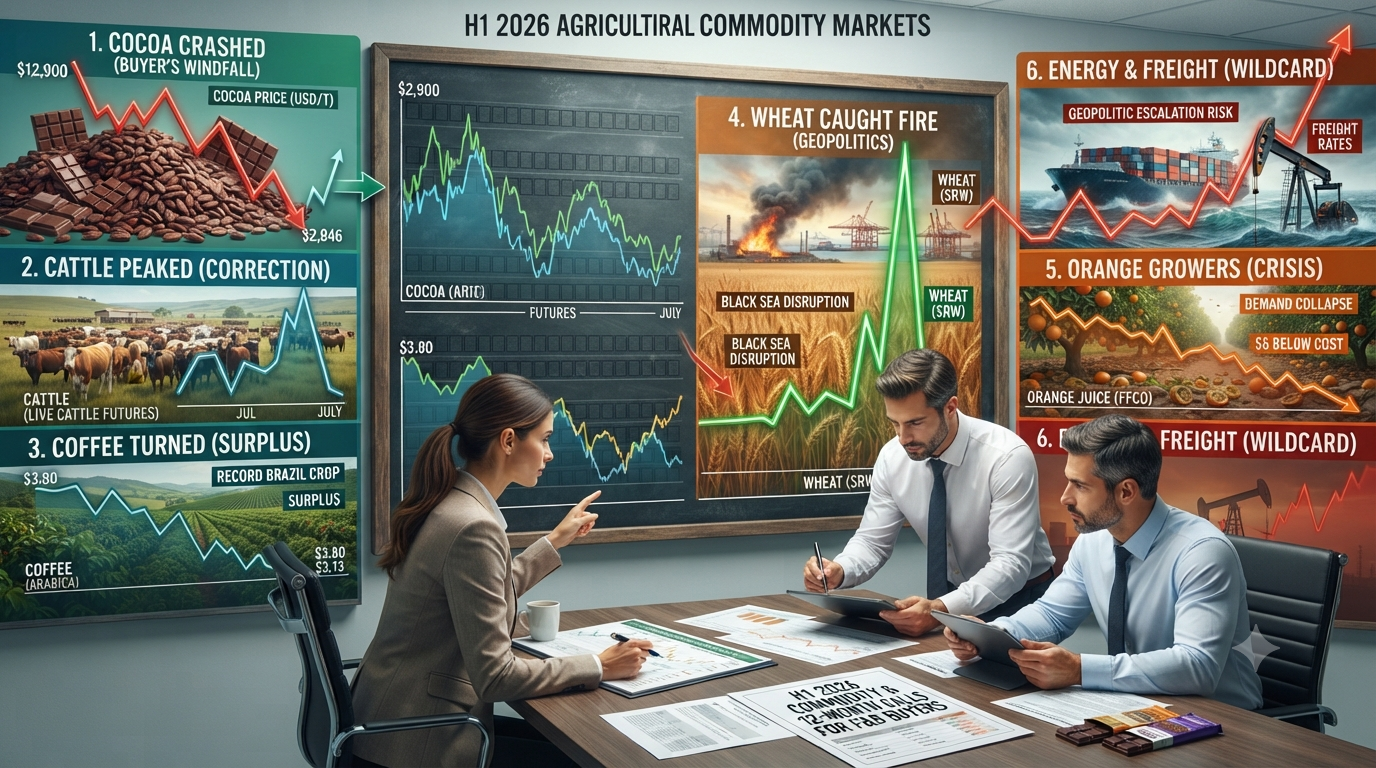

Cocoa crashed, cattle peaked, coffee turned and wheat caught fire. The full H1 2026 commodity scorecard with 12-month calls for F&B buyers.
The past twelve months in agricultural commodities delivered one of the most violent rotations in a generation. Markets that spent 2024 and early 2025 breaking century-old records spent the past year giving those gains back — while quieter markets caught fire from directions few buyers had priced in. This is Part 1 of our seven-part Winners & Losers Week: the raw materials layer, where every downstream margin story begins. Each verdict comes with our call for the next twelve months.
A note on framing before we start. In commodities, every price move creates a winner and a loser simultaneously — the grower’s collapse is the buyer’s windfall. We call winners and losers from the perspective of who captured value over the period, and we tell you what it means for your side of the trade.
Table of Contents
Winner: Cattle Producers — The Trade of the Decade, Now Wobbling
Nothing in the food system made more money over the past few years than owning cattle, and the past twelve months were the blow-off phase. The structural story is well known: the smallest US herd in decades, ranchers holding back heifers, and packers forced to bid up a shrinking supply. By mid-2026, packers were losing close to $300 per head and had been bleeding for roughly six months straight — a staggering transfer of value from the processing sector to the feedlot and the ranch.
Then July happened. In the space of two weeks, cash cattle in Texas and Kansas dropped roughly $18 per hundredweight to the $237–238 range, August live cattle futures sank to around $224–227 — their lowest levels since late 2025 — and open interest collapsed to its lowest July reading since 2022 as funds liquidated. Wholesale choice beef slid to its cheapest since February. The market that could do no wrong is finally correcting, and packers have regained pricing leverage for the first time in months.
Our 12-month call: This is a correction, not a collapse. Herd rebuilding is a multi-year biological process — every heifer held back today tightens slaughter supply further before it loosens it. Expect a choppy, lower-high trading range rather than a return to cheap beef. Beef buyers should treat this pullback as a forward-coverage window, not a reason to wait for 2021 prices that are not coming back.
Winner: Corn — Quietly Tightening While Nobody Watched
Corn spent the year as the unglamorous outperformer, up roughly 9% year on year to around $4.45 per bushel by mid-July. The drivers stacked up steadily: US planted area for 2026 cut by nearly five million acres, the July WASDE trimming US ending stocks more than the trade expected, hot and dry forecasts across the western Midwest during pollination, and France heading for its smallest corn harvest in more than three decades. Export inspections have run at the top end of expectations for much of the season.
Our 12-month call: The market is one weather scare away from a genuine rally, and the acreage cut means there is far less buffer than the comfortable stocks narrative of 2025 suggested. Feed and starch buyers should not assume sub-$4.50 corn is the permanent state of the world; layered coverage into Q4 looks cheap insurance.
Winner: Wheat Sellers Outside the Black Sea
Wheat was drifting through a well-supplied, forgettable year — until mid-July, when escalating attacks between Russia and Ukraine put Black Sea export capacity in genuine question. Chicago SRW jumped 30 to 35 cents in a single session and pushed through $6.00, with hard red winter above $6.40, as the market rebuilt a geopolitical risk premium it had spent two years unwinding. For exporters in the US, Australia, Argentina and Europe’s Atlantic ports, disruption to the world’s cheapest wheat origin is a straightforward gift.
Our 12-month call: Headline-driven and dangerous to chase, but the direction of risk has flipped. Millers and bakers who enjoyed two years of buyer’s-market complacency should re-examine coverage ratios now — if Black Sea flows are materially disrupted into the new marketing year, $6 wheat will look like the floor, not the ceiling.
Winner: Chocolate and Confectionery Buyers
The single biggest buy-side windfall of the year. Cocoa, which touched nearly $9,000 per tonne within the past 52 weeks and traded as high as $12,900 at the late-2024 mania, collapsed all the way to a low near $2,846 before stabilising. Even after a sharp 39% rebound over the past month to around $5,500 — driven by flooding in Ivory Coast and worrying early surveys of the 2026/27 crop — buyers who covered near the lows locked in input costs 60–70% below the peak. For every confectioner who survived 2024–25 on shrinkflation and reformulation, the past year was the great margin repair.
Our 12-month call: The easy money on the buy side has been made. Two new forces argue against a return to cheap cocoa: Ghana and Ivory Coast — together more than 60% of world supply — signed a June accord to align farm-gate pricing and crop calendars from 2026/27, an OPEC-style coordination attempt, and early crop surveys point to a weaker harvest ahead. Budget for a volatile $4,500–6,000 range rather than the sub-$3,000 world of the old normal.
Loser: Cocoa Origins and Anyone Who Bought the Top
The mirror image of the winner above. Producers, origin traders and speculators positioned for a permanently supply-short cocoa market absorbed a decline of roughly 30–40% year on year at the worst points, one of the most brutal round-trips any soft commodity has ever printed. Farm-gate economics in West Africa remain painful even after the rebound, which is precisely what makes the new two-nation pricing coordination such a serious development for the demand side to watch.
Our 12-month call: Origin has hit back. Between coordinated pricing, weak crop surveys and funds caught heavily short, the risk in cocoa is now asymmetric to the upside from these levels — a strange thing to write about a market down so far, but that is what the past month’s 39% snap-back was telling you.
Loser: Orange Growers — A Market Below the Cost of Production
The quietest catastrophe in soft commodities. Frozen concentrate futures, which hit all-time highs in mid-2025, have fallen roughly 30–40% year on year, and spot oranges in São Paulo now trade below $6 per box against highs of $20 in 2024 — below the cost of production for many growers. Worse, this is not a supply glut awaiting a weather rescue: Rabobank’s read is that demand itself is in structural decline, with record retail prices having pushed consumers permanently toward alternatives, and inventories building into 2027. Washington even moved the goalposts, with the FDA lowering the minimum Brix standard for pasteurised orange juice to give processors flexibility after years of disease-hit crops.
Our 12-month call: No recovery trade here. When a category loses demand at the consumer level, cheap raw material does not fix it. Beverage buyers hold all the leverage in juice negotiations for the foreseeable future; growers face consolidation and grubbing-up.
Loser: Coffee Roasters in H1 — and Coffee Farmers in H2
Coffee delivered a whiplash year that punished both sides of the trade in sequence. Roasters took the pain first: arabica ran to record territory around $3.80 per pound in January 2026, the climax of a multi-year deficit story, forcing retail price increases that tested consumer loyalty everywhere from supermarket shelves to independent cafés. Then the story inverted. The USDA now forecasts a record Brazilian 2026/27 crop of 71.9 million bags, up 14%, Rabobank has raised its global surplus estimate to 9.5 million bags, and prices have retreated to around $3.13 — roughly flat year on year, with the entire deficit premium deflating.
Our 12-month call: The surplus is real and it is arriving. Roasters and beverage manufacturers should use weakness to extend coverage well into 2027 — this is the best buying environment in three years and it may not last past the next Brazilian frost scare. For producers, the squeeze is only beginning.
Loser: Every Buyer Exposed to Energy and Freight
The wildcard that turned hostile. Crude oil pushed higher through July as the US reimposed a naval blockade on Iranian ports and Tehran struck back at regional infrastructure — and energy is the one input that touches every line of an F&B cost sheet: diesel for the farm, gas for the dryer and the fertiliser plant, bunker fuel for the container ship, electricity for the cold store. A geopolitical energy spike is a tax on the entire chain that no procurement strategy fully hedges.
Our 12-month call: Treat energy as the primary upside risk to every 2027 input budget. If Middle East escalation persists, it will do more damage to F&B margins than any single agricultural market on this page.
What This Means for Buyers and Procurement Teams
Three practical conclusions fall out of the scorecard. First, the deflation dividend is ending: the great 2025–26 unwind in cocoa, coffee and OJ handed buyers a once-in-a-cycle margin repair, and in cocoa and coffee that window is now measured in months, not years. Cover forward on weakness. Second, geopolitics is back as a pricing input: Black Sea wheat and Gulf energy risk both repriced within a single fortnight in July, and supply chains that optimised purely for cost will feel it first. Third, the protein bull market is resting, not finished: use the cattle correction to build coverage, because the biology of herd rebuilding guarantees tight supply into 2027.
The thread running through all of it: volatility itself is the new input cost. The teams that outperform over the next twelve months will not be the ones that guessed the direction right — they will be the ones that built coverage strategies robust to being wrong.
Tomorrow, Part 2: Protein — how the cattle supercycle, a hog market quietly rallying, and a dairy complex under pressure sorted the winners from the losers in meat, dairy and seafood.
Related
FAQ
Which agricultural commodity performed best over the past 12 months?
Corn was the steadiest gainer among majors, up roughly 9% year on year on shrinking US acreage and tightening stocks, while cattle delivered the largest cumulative gains before its July 2026 correction. Wheat posted the sharpest late rally on Black Sea supply disruption.
Why did cocoa prices fall so much in the past year?
Cocoa collapsed from record levels near $9,000–12,900 per tonne as West African supply recovered, demand weakened under record prices, and speculative positioning unwound. Prices bottomed near $2,846 before rebounding sharply on flooding in Ivory Coast, weak 2026/27 crop surveys and a new Ghana–Ivory Coast pricing pact.
Should food manufacturers buy forward at current commodity prices?
Selectively. Coffee’s emerging surplus and the cattle correction favour extending coverage on weakness, while cocoa and wheat carry asymmetric upside risk from coordinated origin pricing and Black Sea disruption respectively. Energy exposure is the key upside risk to hedge across all categories.
Sources
- Barchart — cocoa, sugar, cattle and grain futures market reports
- Investing.com — cocoa and coffee futures data
- Trading Economics — corn, orange juice and commodity price data
- USDA WASDE and Foreign Agricultural Service — grain balance sheets and Brazil coffee forecasts
- Rabobank — coffee surplus estimates and orange juice market outlook
- Reuters (via Brownfield Ag News and Tradingpedia) — cattle market coverage
- Farm Progress / AgWeb — grain market analysis
- Citrus Industry Magazine — orange market and demand analysis
- ICCO — cocoa market statistics
- Capital.com — cocoa price analysis and Ghana–Ivory Coast accord coverage
- Newsweek — FDA orange juice Brix standard change