

El Niño 2026 Has Officially Arrived — And It’s Moving Fast
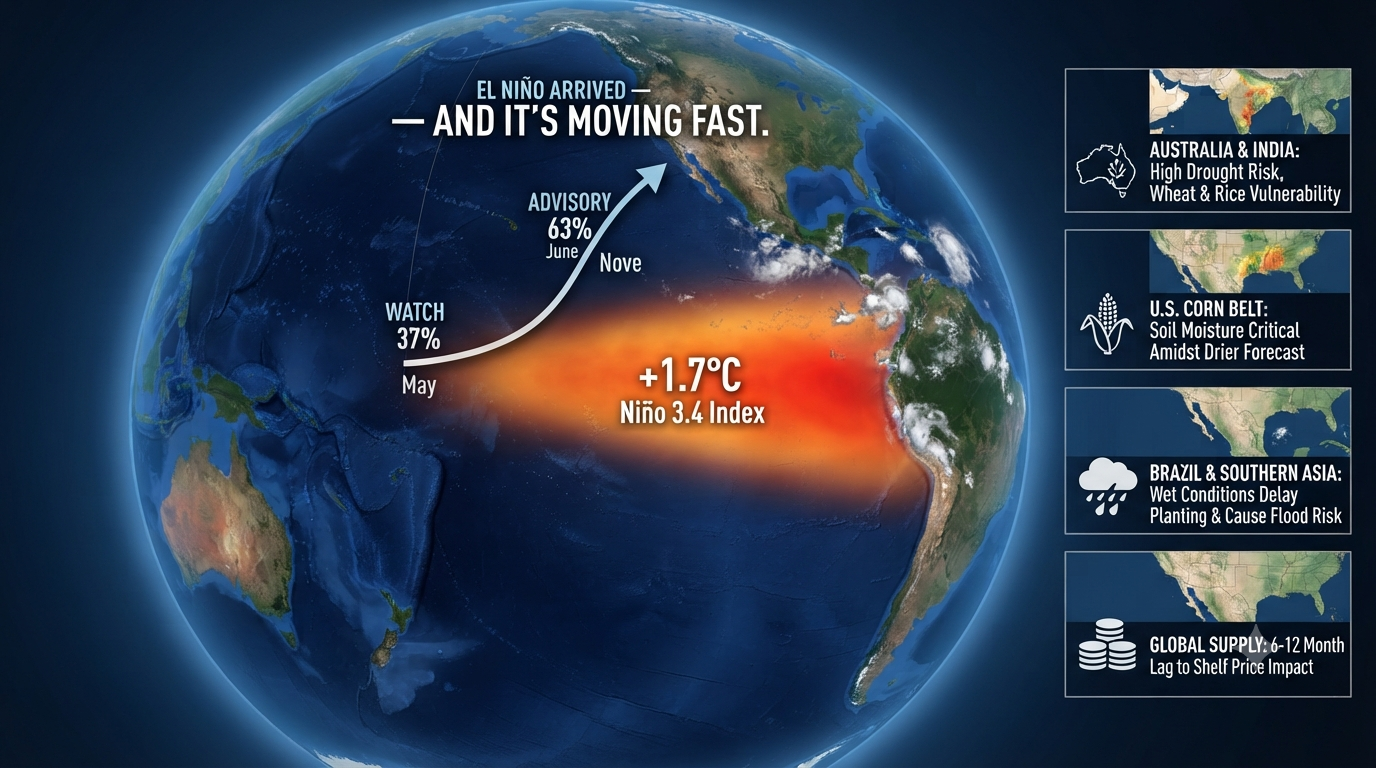
NOAA’s Climate Prediction Center upgraded its alert status from El Niño 2026 Watch to El Niño Advisory on 11 June 2026, meaning El Niño conditions are now confirmed present in the equatorial Pacific and expected to strengthen through the Northern Hemisphere winter. The shift happened quickly: as recently as May, no strength category exceeded a 37% probability, but the June forecast now assigns a 63% chance of a very strong event during November through January — a magnitude that would rank among the largest ENSO episodes since 1950.
The underlying ocean signal backs this up. The weekly Niño 3.4 index, centred on 17 June 2026, has climbed to +1.7°C, with sea surface temperature anomalies showing a steady upward trend from +0.48°C in March-May to +0.94°C in May. All 24 participating forecast models now indicate El Niño conditions strengthening through 2026 and persisting into early 2027, with the ensemble’s highest-confidence projection pointing to a very strong event by September-November. The WMO’s own figures put the probability of El Niño during June-August 2026 at 80%, rising to 90% or higher through November.
For anyone in food and beverage sourcing, production or trading, this is the signal that matters most this quarter: the “will it happen” debate is over, and the conversation has shifted entirely to strength, timing and which crops take the hit first.
Table of Contents
Grains: A Split Picture Between Corn Belt, Brazil and Asia
The grain outlook is unusually divided by geography this cycle.
United States: NOAA’s formal declaration on 11 June has put U.S. Corn Belt weather squarely back on traders’ radar, though meteorologists caution that El Niño 2026 may not be the dominant force shaping the critical summer pollination window. Soil moisture across the Midwest and Plains, rather than the ENSO signal itself, is currently seen as the stronger predictor of extreme July heat risk. Separately, the North American Multi-Model Ensemble is forecasting a drier bias for most of the Corn Belt, while the Plains region should see improved moisture — a pattern that could ease existing drought if it plays out.
Brazil: Brazil’s wheat belt and southern Safrinha corn region are trending progressively wetter, with periodic bouts of well-above-normal rainfall likely through the rest of 2026, raising the risk that spring planting of rice, corn, soybeans and dry beans falls behind schedule due to wet, muddy fields. Soybeans are the bright spot — improved yields in Brazil, Argentina and the U.S. could help offset supply pressure elsewhere in the grains complex, though Brazil’s safrinha corn crop, due for harvest in the next month or two, remains genuinely uncertain.
Australia and South Asia: Australia’s eastern wheat belt tends to dry out under El Niño 2026, and strong events have historically coincided with reduced Australian wheat output, with one estimate putting potential 2026/27 Australian wheat losses at around 9 million tonnes. India carries the biggest drought risk in the grains complex — an El Niño-driven drought hasn’t occurred there since 2015-16, and the last major event, in 2010, cut national rainfall by nearly 22%. India’s monsoon is currently forecast at 90% of the long-period average, which would be the weakest since 2015, and early-June rainfall has already tracked below normal. Rice is the crop analysts flag most consistently as vulnerable across this event.
China: Southern China faces the opposite problem to India — too much rain, with rice and sugar cane both at risk of flood damage.
Fruit and Vegetables: Where the Volatility Concentrates
Fresh produce is proving especially exposed this cycle, for two reasons: shorter growing cycles mean weather shocks show up faster, and cold-chain-dependent categories can’t simply wait out a bad season.
El Niño 2026 typically increases storm activity in the eastern Pacific basin, raising the risk of disruption to Central American tropical fruit, citrus and vegetable production — with Mexico’s role as a major exporter meaning any disruption ripples into key destination markets like the U.S. Within the Central America and Caribbean region specifically, severe dryness is already threatening maize and rice from Colombia through the Caribbean, while Bolivia, Ecuador and Peru are forecast to see above-average rainfall — a reminder that El Niño rarely produces one clean regional outcome.
Mexico’s own inflation data gives an early read on how this transmits to price. During the 2023-24 El Niño episode, Mexican fruit and vegetable prices peaked at 25.69% year-on-year inflation. As of March 2026, that same category was already running at 21.77% year-on-year, easing only slightly to 14.38% by May — still well above headline CPI. Centre-south Mexico faces reduced rainfall this cycle, putting coffee, sugarcane, maize, beans and avocados among the most exposed crop categories.
Excess rainfall poses its own threat to delicate fruit crops — too much water bruises harvests and can turn a promising season into a total loss on flood-prone farms, underscoring that the fruit and vegetable risk isn’t uniformly a drought story; it’s a volatility story, with too much and too little rain both doing damage depending on the region.
Southern Africa: A Good Harvest Now, More Uncertainty Ahead
Southern Africa is actually entering this event from a position of strength — the 2025/2026 regional cereal harvest is running above average, driven by a 10% maize increase in South Africa versus the five-year average, a record harvest in Zambia, and a 2% rise in Zimbabwe year-on-year. The catch is what comes next: while the current harvest is solid, the coming summer crop season carries a high risk of heat and drought stress as El Niño sets in, and South Africa’s winter crops, while well-established now, could face yield stress from El Niño 2026 right at the critical reproduction stage once spring arrives.
Why the Price Impact Takes Time to Show Up
One of the most important — and most consistently under-appreciated — points across current forecasting is the lag between the climate signal and the shelf-price impact. Strong El Niño events historically hurt yields across most major agricultural regions, but the supply impact typically takes six to twelve months to fully arrive after the event peaks. For perishable goods with tight cold-chain requirements, retail price increases can show up within three to six months of a strengthening event, while shelf-stable staples tend to see a more delayed pass-through as importers use longer lead times to hedge against volatility.
That said, the broader inflation backdrop isn’t waiting for El Niño 2026 to peak. U.S. grocery inflation is already tracking at 2.9%, with overall food prices projected to rise roughly 3.4% in 2026, and analysts warn a severe El Niño could compound existing pressure if extreme weather compromises import-dependent categories. Rice is flagged as the most immediate import concern given exposure in Thailand, Vietnam and Indonesia, and in worst-case scenarios, analysts point to potential price shocks of 10% to 50% across core commodities, with some crops seeing even larger swings.
What This Compounds With: Fertilizer and Input Costs
El Niño 2026 isn’t arriving in isolation. Fertilizer trade disruption tied to the Strait of Hormuz situation has stalled an estimated 3 to 4 million tonnes of fertilizer trade per month, with U.S. supply running at roughly 75% of normal in mid-March, right at peak Corn Belt application season. The fertilizer shortage is hitting the 2026 growing season directly, while the El Niño yield impact is expected to land more heavily in 2027 — two supply shocks with similar lag structures converging on the same crop cycle.
How the Industry Is Responding
Large buyers aren’t waiting for certainty. Nestlé is distributing drought-tolerant robusta coffee varieties to farming cooperatives, and Unilever is piloting regenerative agriculture practices across exposed supply chains in eleven countries, both aimed at building steadier yields under climate stress. On the investment side, analysts are increasingly framing resilience — physical asset hardening, water-linked value chain security, and predictive risk tools — as a central competitiveness factor rather than a defensive afterthought, with capital reallocation toward adaptation solutions expected to accelerate.
The Bottom Line for F&B Operators
This is shaping up to be a genuinely consequential ENSO event rather than a media-cycle scare. The confirmation is real, the intensification is happening faster than earlier spring forecasts suggested, and the exposure map is now reasonably clear: rice and Indian monsoon-dependent crops carry the highest immediate risk, Central American and Mexican fruit and vegetable categories are already showing elevated inflation, Australian wheat faces a well-documented historical drag, and U.S. grain markets remain a genuine toss-up pending soil moisture through July. Southern Africa’s current harvest strength is a rare bright spot, but it’s a lagging indicator, not a hedge against what next season brings.
For sourcing and procurement teams, the window to act on this information is now — before the 6-12 month lag between climate signal and shelf price closes.
Sources
FAQ
Is El Niño officially confirmed for 2026?
Yes. NOAA upgraded its status from a Watch to an Advisory on 11 June 2026, confirming El Niño conditions are present and expected to strengthen through winter 2026-27.
How strong could this El Niño get?
Current forecasts assign a 63% probability of a “very strong” event by November-January, which would place it among the largest on record since 1950. Some models describe it as a potential “super El Niño.”
Which crops are most at risk?
Rice carries the broadest exposure, given monsoon dependency in India and production risk in Thailand, Vietnam and Indonesia. Australian wheat, Central American fruit and vegetables, and Southeast Asian palm oil are also flagged as high-risk categories.
When will consumers see price impacts?
Perishable, cold-chain-dependent goods can see retail price movement within three to six months of a strengthening event. Shelf-stable staples typically lag six to twelve months behind the peak of the climate event itself.
Is Southern Africa at risk this cycle?
The current 2025/26 harvest is above average across South Africa, Zambia and Zimbabwe. The risk sits with the next summer crop season, where El Niño-driven heat and drought stress could affect yields at the reproduction stage.