
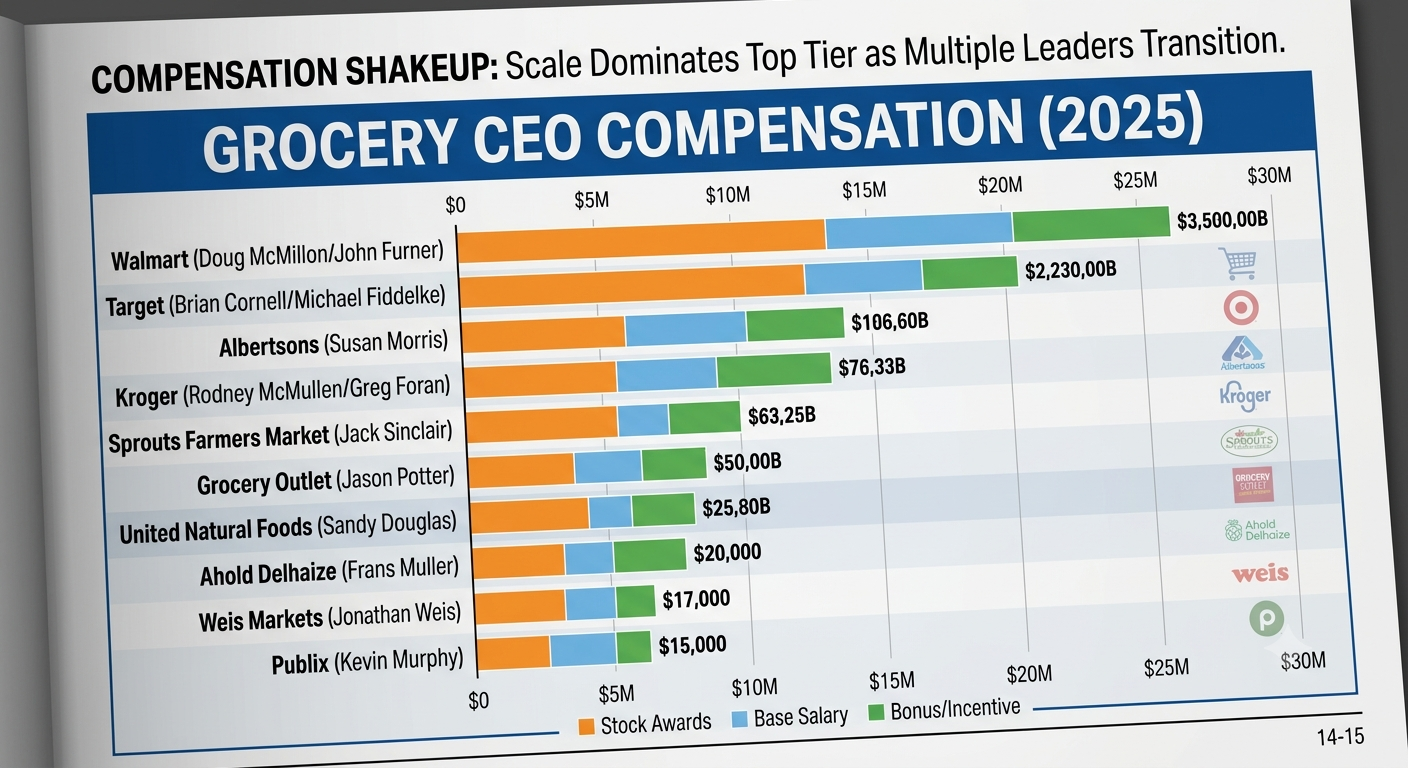

It was another lucrative year at the top of America’s largest grocery chains, with several chief executives clearing eight-figure pay packages even as the industry worked through an unusually turbulent stretch of leadership change. Three of the country’s biggest grocery players, Kroger, Albertsons, and Grocery Outlet, all closed out 2025 with different CEOs than they started with, a reshuffle that shows up clearly in this year’s compensation figures.
Here’s how the pay packages stacked up, and what’s driving the numbers at the top of the industry.
Table of Contents
Walmart’s McMillon Stays on Top, Even in His Final Year
Doug McMillon, who stepped down as Walmart’s president and CEO at the end of January, closed out his tenure with the largest pay package of any grocery chief executive in the country: $29.2 million for the company’s fiscal 2026, which began February 1, 2025. That figure is up from $27.4 million the year before, meaning McMillon’s compensation actually grew in his final year running the company. The bulk of that package, more than $21 million, came in the form of stock awards, on top of a $1.5 million base salary.
McMillon’s successor, John Furner, didn’t take long to land in the same pay bracket: his package for Walmart’s most recent fiscal year was valued at $27.3 million, signaling that the retail giant’s compensation structure for its top job isn’t changing much with the leadership transition.
Target’s Cornell Crosses the $20 Million Mark on His Way Out
Brian Cornell was the only other grocery-adjacent CEO to break the $20 million threshold in 2025, earning $21.8 million in his final full year as Target’s chief executive before moving into the executive chair role on February 1. That’s an increase of more than $1.4 million from the prior year, driven by a roughly $2.5 million jump in stock awards, even though his bonus fell by more than 40 percent. Michael Fiddelke, who took over as CEO, earned $9.6 million, less than half of what Cornell pulled in during his last year in the role.
A Year of New Faces at the Top
What sets 2025 apart isn’t just the size of the pay packages, it’s how many of them went to executives who were brand new to their roles.
Susan Morris took over as Albertsons’ CEO on May 1, 2025, succeeding Vivek Sankaran, and her compensation reflected the jump in responsibility. Morris earned almost $16.8 million for the year, more than double what she made in fiscal 2024 as the company’s chief operations officer. Her package included a $1.3 million salary, a $2 million bonus, and more than $11 million in stock awards. Notably, her contract also includes personal use of Albertsons’ corporate aircraft for up to 100 hours a year for herself, family, and guests, though she’s responsible for the income tax on the value of that travel.
Ron Sargent stepped in as interim CEO of Kroger following the abrupt resignation of longtime chairman and CEO Rodney McMullen in March 2025. Sargent earned just over $14 million for the year, including roughly $4 million in salary and $10 million in stock awards, before handing the role to former Walmart executive Greg Foran, who became Kroger’s permanent CEO in February.
Jason Potter, a former chief executive of The Fresh Market, joined Grocery Outlet as CEO in February 2025 and earned just over $9.5 million in his first year, made up of a $925,000 salary, $4.1 million in stock awards, and almost $500,000 in non-equity incentive compensation. He replaced Eric Lindberg, who had served as interim CEO after RJ Sheedy departed as president and CEO.
Not every leadership change involved a new arrival, however. Tony Sarsam, who earned $7 million as president and CEO of SpartanNash in 2024, exited the role entirely after the company was acquired by C&S Wholesale Grocers.
The Rest of the Pack
Outside of the leadership shake-ups, several CEOs in steadier positions still posted strong, if more modest, compensation numbers.
Jack Sinclair of Sprouts Farmers Market earned just over $11.5 million in fiscal 2025, actually a 6 percent decline from the year before, with his pay built from a $1.3 million salary, nearly $5 million in stock awards, and over $3.6 million in non-equity incentive pay.
Sandy Douglas of United Natural Foods saw one of the sharper year-over-year increases in the group, earning almost $9.7 million, up notably from the prior year thanks to stock awards climbing from $5 million to more than $6.6 million. His base salary, just over $1 million, stayed essentially flat.
Frans Muller of Ahold Delhaize earned a package valued at roughly $8.6 million (7.5 million euros), consisting of a 1.3 million euro salary, a 1.6 million euro cash incentive, and a long-term share-based incentive worth more than 4 million euros. Muller announced in May that he’ll retire next year, with Thierry Garnier, currently CEO of UK home improvement company Kingfisher, lined up to succeed him.
Jonathan Weis of Weis Markets earned just under $6.8 million, down by more than a quarter from the nearly $9.3 million he made the year before. His pay was mostly made up of a $1.4 million salary and approximately $5 million in non-equity incentive compensation.
Kevin Murphy of Publix rounded out the group with a $4.2 million package in his second year as CEO, up from about $3.4 million the year before, including a $3.4 million salary and roughly $565,000 in non-equity incentive pay.
The Bigger Picture
Two things stand out across this year’s numbers. First, scale still drives pay at the very top: Walmart and Target, by far the largest retailers in the group, are the only two companies whose chief executives crossed the $20 million mark, and stock awards rather than salary make up the overwhelming majority of compensation at that level. Second, 2025 was clearly a year of transition in grocery leadership. With new CEOs installed at Kroger, Albertsons, and Grocery Outlet, and a succession plan already announced at Ahold Delhaize, the industry’s leadership bench looks meaningfully different heading into 2026 than it did a year ago, and next year’s compensation figures will be the first to reflect a full year under most of these new leaders.