
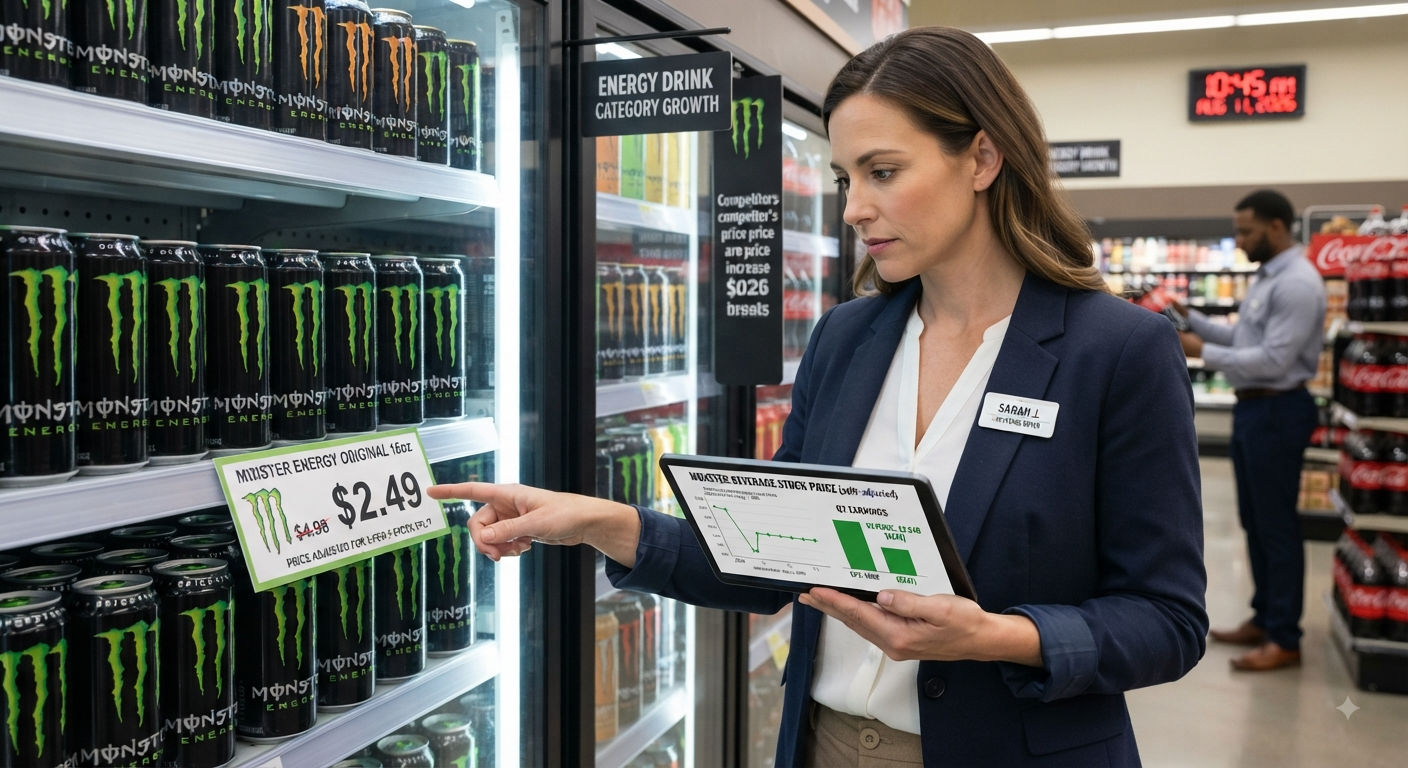

Monster Beverage stock touched a 52-week low of $45.72 this week, but the headline number is misleading — a 2-for-1 stock split took effect the same day, meaning the “low” reflects a mechanical price adjustment rather than a genuine decline in value.
The Split Behind The Headline
Monster’s board approved a 2-for-1 forward stock split, structured as a 100% stock dividend, back on July 8. Shareholders of record as of July 24 received one additional share for each share held, distributed after the close of trading on August 10, with the stock beginning split-adjusted trading on August 11. At the time the split was declared, shares were trading near a 52-week high of $99.15, having delivered a 57% return over the prior year. Comparing the new, halved post-split price against the prior 52 weeks of un-adjusted trading data is what technically registers as a fresh low, even though the split itself changes nothing about underlying shareholder value.
This is Monster’s sixth forward stock split since its IPO, a pattern closely tied to its long-running partnership with Coca-Cola, which took an equity stake in Monster as part of a 2014 asset swap that handed Coca-Cola’s energy drink operations to Monster in exchange for Coca-Cola’s non-energy assets. Regular forward splits have historically kept the share price more accessible even as Monster’s underlying market value has climbed roughly 24,000% since 2005.
Earnings Actually Beat Expectations
The split landed alongside genuinely strong second-quarter results. Monster reported adjusted earnings of $0.60 per share against a $0.58 consensus, and record net sales of $2.54 billion — the first time quarterly sales crossed $2.5 billion — against an expected roughly $2.42–2.43 billion, a 20.2% year-over-year increase. Diluted EPS rose 19% to $0.59, and net income climbed 19.6% to $584.5 million. International sales were the standout driver, growing 34.6% to $1.16 billion and now accounting for 46% of total revenue, up from 41% a year earlier, with Monster gaining share across Europe, Latin America, and Asia Pacific.
Several major Wall Street firms raised price targets in response: Morgan Stanley lifted its target to $110 from $103, UBS moved to $105 from $104, and Deutsche Bank raised its target to $100 from $98, with Goldman Sachs maintaining its Buy rating. Morgan Stanley specifically flagged a high-single-digit Red Bull price increase in the US effective August 1 as a near-term positive for Monster, since it gives the category leader room to raise prices alongside its top competitor without ceding relative value.
Where The Real Pressure Points Are
Beneath the headline beat, some underlying metrics softened. Distribution expenses surged 44.9% to $118.8 million — 4.7% of net sales, up from 3.9% a year earlier — largely reflecting higher freight and fuel costs, with total operating expenses growing faster than revenue for the quarter. Gross margin actually improved slightly to 55.9% from 55.7% a year earlier, helped by pricing actions and product mix, though that gain was partly offset by higher aluminum can, freight-in, and geographic mix costs.
The clearer soft spot was the Alcohol Brands segment, where revenue dropped 15.2% year-over-year to $32.2 million, continuing to underperform the company’s core energy-drink business. Analysts have also flagged valuation as a factor that could amplify stock volatility around any operational hiccup going forward: even before the split, Monster’s forward price-to-earnings ratio sat near 37, a roughly 16% premium to its own five-year average multiple.
Category Context: A Warmer Summer Helped Peers
Broader beverage category data adds useful context. Nielsen data analyzed by Bernstein showed soft drink volumes in Western Europe grew 6.5% in the four weeks ending July 12, a sharp acceleration from flat growth in the prior period, driven largely by hot weather boosting bottled water and carbonated soft drink sales, particularly in the UK and France. That kind of seasonal tailwind benefits the broader beverage category Monster competes in, even though Monster’s own results reflect company-specific dynamics — the split, rising distribution costs, and alcohol segment weakness — more than category-wide weather effects.
Buyer And Procurement Implications
For beverage retail and foodservice buyers, Monster’s underlying fundamentals — record revenue, 20%-plus sales growth, and multiple analyst price target increases — suggest the brand’s shelf presence and consumer demand remain strong despite the confusing headline price action. Buyers negotiating category placement or promotional terms with Monster should treat the post-split share price as a non-event and focus instead on the company’s actual operating trends, particularly the rising distribution cost base tied to freight and fuel, which could eventually factor into wholesale pricing or promotional flexibility if the trend continues.
The Red Bull price increase Morgan Stanley flagged is also worth watching for category buyers more broadly: if Monster follows with its own pricing action in response, as some analysts expect, buyers negotiating shelf and cooler space across the energy drink category should anticipate a broader repricing across top brands rather than an isolated move from a single competitor. Buyers with exposure to Monster’s alcohol segment products should note the continued revenue softness there, which may warrant closer inventory and demand monitoring compared with the core energy drink lineup.
FAQ
Why did Monster Beverage stock hit a 52-week low right after beating earnings?
The apparent low was caused by a 2-for-1 stock split that took effect August 10–11, which halved the per-share price. Compared against un-adjusted historical trading data from before the split — when shares were near a 52-week high of $99.15 — the new price technically registers as a fresh low, even though it doesn’t reflect any decline in the company’s actual market value.
Did Monster Beverage’s second-quarter results beat or miss expectations?
They beat expectations. Adjusted earnings of $0.60 per share topped the $0.58 consensus, and revenue reached a record $2.54 billion against expectations of roughly $2.42–2.43 billion, marking 20.2% year-over-year sales growth. Several analysts raised their price targets following the report.
What parts of Monster’s business showed weakness in the latest quarter?
The Alcohol Brands segment saw revenue drop 15.2% year-over-year to $32.2 million, and distribution expenses jumped 44.9% to $118.8 million on higher freight and fuel costs, causing operating expenses to grow faster than revenue even as gross margin improved slightly.
Sources
- Investing.com, “Monster Beverage stock hits 52-week low at $45.72,” Aug. 11, 2026
- Investing.com, “Monster Beverage approves 2-for-1 stock split”
- Investing.com, “Earnings call transcript: Monster Beverage tops Q2 2026 forecasts as sales hit record”
- StockTitan, “Monster Beverage Reports 2026 Second Quarter Financial Results”
- TradingPedia, “Monster Beverage Rallies on Split, Earnings, Upgrades,” Aug. 11, 2026
- The Motley Fool, “Wall Street’s Latest Blockbuster Stock Split Has Arrived”
- 24/7 Wall St., “Monster Beverage (MNST) Earnings Report Q2 2026”