
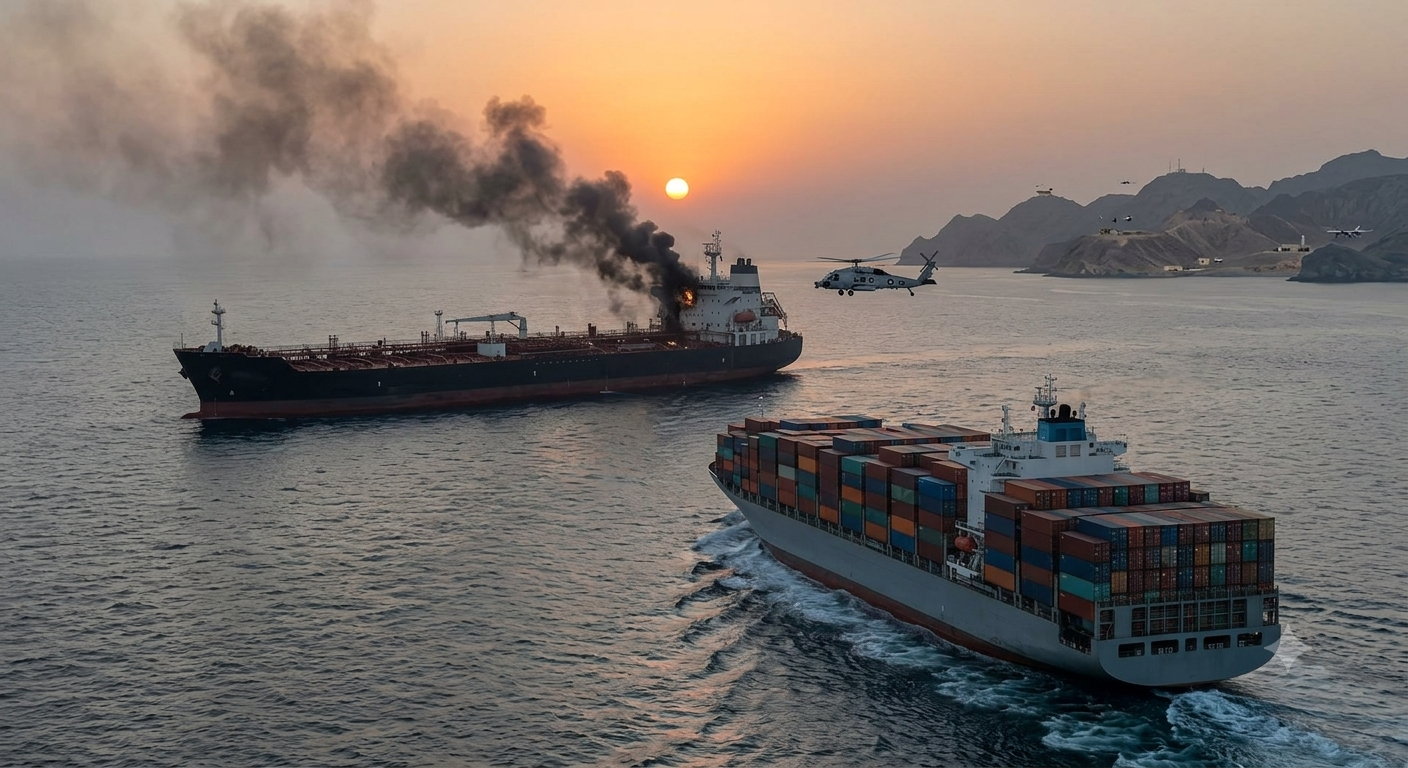

Just as the Strait of Hormuz appeared to be stabilizing under an interim US-Iran agreement, a fresh attack on a commercial tanker has reversed that progress and pushed maritime threat levels back up. The incident is the latest reminder that, for container shipping and the wider freight industry, the world’s most important energy chokepoint remains a live and unresolved risk rather than a closed chapter.
This report covers what happened, why naval authorities raised the threat level again, and what it means for container shipping rates, capacity, and routing decisions heading into the back half of 2026.
Table of Contents
What Happened: Tanker Struck, Threat Level Raised
A tanker carrying Qatari crude oil was struck by an unidentified projectile while transiting the Strait of Hormuz, sustaining damage to its bridge. The vessel’s crew were reported safe and no environmental damage was recorded. In response, the Joint Maritime Information Center, the body that coordinates threat assessments between allied navies and merchant shipping in the region, raised its threat level for the Strait of Hormuz, the Arabian Gulf, and the Gulf of Oman back up to “Substantial.”
This was the second attack on a merchant vessel within the same week. Days earlier, a container ship was struck, prompting US Central Command to carry out retaliatory strikes on Iranian military infrastructure, including sites linked to missile and drone capabilities along Iran’s southern coastline. Iran’s Revolutionary Guard described the US response as a violation of an ongoing ceasefire and claimed to have struck back at US positions in the region.
The renewed violence is particularly significant because it comes after weeks of gradual de-escalation. The threat level in Hormuz had been downgraded from “Critical,” the highest classification, all the way down to “Substantial” following the announcement of a US-Iran interim agreement reached earlier in June. That agreement was intended to reopen the strait to commercial traffic and lift a US naval blockade of Iranian ports. The new attacks have not pushed the threat level back to its prior peak, but they have erased much of the confidence that had been building among shipowners and underscore how fragile the underlying truce remains.
Why the Strait of Hormuz Matters This Much
The Strait of Hormuz is the narrow waterway separating Iran and Oman, and it is, by a wide margin, the most important chokepoint in global energy trade. Under normal conditions, roughly 20 percent of the world’s seaborne oil supply and 20 percent of global liquefied natural gas exports pass through it daily. For container shipping specifically, the strait carries a much smaller share of volume, generally estimated at 2 to 3 percent of global container traffic, but its closure has outsized consequences for the industry because of its effect on fuel costs, insurance, and the broader Middle East trade corridor.
The current crisis traces back to late February 2026, when the United States and Israel launched air strikes against Iran, prompting Iran to effectively close the strait through a combination of warnings, vessel seizures, missile and drone attacks, and the laying of sea mines. At the peak of the disruption, the International Maritime Organization estimated that around 20,000 mariners and 2,000 ships were stranded in the Persian Gulf, unable to safely transit the waterway.
An interim agreement between Washington and Tehran, formalized in a Memorandum of Understanding in mid-June, was meant to restore safe passage. Under its terms, a 60-day ceasefire window was established, alongside a commitment from Iran to clear mines from the strait and an agreement to reopen designated shipping corridors. The International Maritime Organization estimated that as many as 80 mines could remain in the strait’s historic shipping lanes, illustrating how much physical risk persists even where political progress has been made.
Container Shipping Rates: Climbing Again
Even before this latest tanker strike, container freight rates had already moved sharply higher as a side effect of the broader Hormuz crisis. The Shanghai Containerized Freight Index global composite climbed 16 percent in a single week to reach its highest level since the height of the Red Sea crisis in September 2024, effectively doubling from where it stood in late February before the war began.
The mechanism driving this increase is primarily fuel cost, not container scarcity. Major carriers have been absorbing enormous additional bunker fuel expenses as a direct result of the Hormuz disruption. Maersk’s chief executive has disclosed that the company is paying approximately 500 million dollars per month in extra fuel costs tied to the crisis. Hapag-Lloyd’s chief executive has reported a similar burden, in the range of 250 to 300 million dollars per month, and has said the company’s rate increases have tracked closely with its cost increases.
On the transpacific trade specifically, the Shanghai to US West Coast index has more than doubled since late February, and Shanghai to Los Angeles and New York spot rates have jumped between 59 and 129 percent since the crisis began. Asia-Europe rates have also climbed, though less dramatically than the transpacific lane.
Several factors are compounding the fuel-driven increases. Carriers are pulling demand forward into the current period ahead of an expected July 1 bunker fuel adjustment, creating an early and unusually intense peak season. Vessels on major lanes have been reported fully booked through the end of the month, with carriers rolling containers and reducing allocations, conditions that typically support further rate increases in the near term.
Capacity: A Market That Should Be Oversupplied, But Isn’t
One of the more counterintuitive dynamics in container shipping right now is that the global fleet has, on paper, never had more capacity, yet rates keep climbing. An unprecedented wave of new vessel ordering during the pandemic years has continued delivering ships throughout 2024, 2025, and into 2026, and most industry analysts had expected this glut of new tonnage to push the market into a sustained downcycle this year.
Instead, the Hormuz crisis has effectively absorbed much of that new capacity. Industry estimates suggest the crisis has reduced effective container shipping capacity by approximately 19 percent through three combined effects. Continued avoidance of the Red Sea and Hormuz corridors in favor of the longer Cape of Good Hope route accounts for roughly 12 percent of that reduction, adding 3,500 to 4,000 nautical miles and 10 to 14 additional days to affected voyages. Slow steaming, where carriers deliberately reduce vessel speed to conserve increasingly expensive fuel, accounts for another 2 percent. Port congestion, particularly bunching of vessels at Gulf ports with reported waits of 7 to 10 days at some UAE terminals, accounts for the remaining 5 percent.
As one shipping executive put it, supply and demand have been diverging on paper since 2023, and the market should logically be trending toward oversupply. In reality, rates have been increasing, because the effective capacity available to carriers has been shrinking even as the nominal fleet grows.
What Happens If the Strait Fully Reopens
The path forward for container shipping rates depends heavily on how durable this latest ceasefire proves to be, and that question has just become considerably harder to answer following the new tanker attack. Even under the more optimistic scenario where the interim agreement holds, most industry analysts caution that a full return of shipping traffic to pre-war levels will likely take months rather than weeks. The strait’s lanes remain physically narrowed by mines that still need to be cleared, and shipping trade groups have stated they need credible, verifiable assurances from both Iran and the United States before they would consider it safe to resume normal transit patterns at scale.
If a large-scale return to both the Red Sea and Hormuz corridors does eventually materialize, the industry broadly expects a two-stage effect. In the near term, simultaneous arrivals of vessels that had been diverted around the Cape of Good Hope would likely cause significant port congestion and temporary rate spikes at European hubs as schedules realign. Once that congestion clears, however, more than 2 million TEUs of capacity currently absorbed by longer routings would be released back into an already structurally oversupplied market, a development most analysts expect would drive sustained rate compression on major east-west lanes.
This dynamic puts shippers negotiating long-term contracts in a genuinely difficult position. Long-term rates entering 2026 were already pricing in expectations of a weakening market, with a notable gap opening up between elevated spot rates and lower long-term contract rates on key lanes into the Mediterranean and North Europe. Shippers locking in long-term agreements now are effectively betting on the timing and durability of any Hormuz resolution, a bet that just became considerably riskier with this latest escalation.
What This Means for Shippers Right Now
For companies moving freight through or near the affected region, several practical realities apply in the current environment. Emergency conflict surcharges in the range of 1,500 to 3,000 dollars per container have been applied by major carriers including CMA CGM, Hapag-Lloyd, and Maersk on cargo touching Persian Gulf and Red Sea ports, and these surcharges remain active given the renewed instability. Transit time uncertainty has become the norm rather than the exception for any cargo routed through or near the Gulf, with vessel bunching, navigational interference, and short-notice rerouting all currently in play.
Industry guidance consistently points toward the same set of practical responses: diversifying carriers and routes rather than relying on a single corridor, using a hybrid of spot and contract freight strategies to maintain flexibility, planning for extended booking lead times of four to six weeks given current congestion, and building emissions and war-risk surcharges directly into landed cost calculations rather than treating them as temporary anomalies. Given how quickly conditions have shifted twice within the same month, shippers with cargo anywhere near the region should treat the situation as actively unresolved rather than assume the worst has already passed.
Outlook
The renewed tanker attack and subsequent threat level increase serve as a pointed reminder that de-escalation in this conflict has not been linear. Threat levels have now moved down, then back up, within the span of roughly two weeks, and the underlying causes of instability, including unresolved mine clearance, disputed shipping routes, and continued mutual accusations of ceasefire violations between Washington and Tehran, remain firmly in place.
For container shipping specifically, this means the unusual market condition of the past several months is likely to persist for now: a nominally oversupplied global fleet continuing to produce elevated freight rates, driven not by container scarcity but by fuel costs, rerouting, and the sheer unpredictability of a conflict that keeps generating fresh incidents just as markets begin to price in resolution. Shippers and carriers alike should expect continued volatility rather than a clean, one-directional path back to pre-crisis conditions.
Frequently Asked Questions
What happened in the Strait of Hormuz this week?
A tanker carrying Qatari crude oil was struck by an unidentified projectile while transiting the Strait of Hormuz, sustaining damage to its bridge. The crew was reported safe with no environmental damage. It was the second attack on a merchant vessel within the same week, following a strike on a container ship days earlier that prompted US retaliatory strikes on Iranian military targets.
Why was the maritime threat level raised?
The Joint Maritime Information Center, which coordinates threat assessments between allied navies and merchant shipping, raised the threat level for the Strait of Hormuz, Arabian Gulf, and Gulf of Oman to “Substantial” following the latest attacks. This reverses part of a gradual downgrade that had occurred after a US-Iran interim agreement was announced earlier in June, though the threat level remains below the “Critical” peak seen earlier in the conflict.
How much container shipping actually passes through the Strait of Hormuz?
Relatively little in direct volume terms, an estimated 2 to 3 percent of global container traffic, compared to roughly 20 percent of global oil and LNG supply. However, the strait’s closure has a much larger indirect effect on container shipping through rising fuel costs, rerouting around the Cape of Good Hope, and broader disruption to Middle East-linked trade lanes.
Why are container shipping rates rising if there’s a global oversupply of vessels?
Industry estimates suggest the Hormuz crisis has reduced effective global container capacity by approximately 19 percent, even though the nominal fleet has grown. This is driven by continued avoidance of the Red Sea and Hormuz routes in favor of the longer Cape of Good Hope route, slow steaming to conserve expensive fuel, and port congestion at Gulf terminals. These factors have absorbed the capacity that would otherwise be expected to drive rates down.
Will container shipping rates fall once the Strait of Hormuz fully reopens?
Most analysts expect rates to fall over time if a full, durable reopening occurs, since more than 2 million TEUs of capacity currently tied up in longer routings would be released back into an already oversupplied market. In the short term, however, a sudden return of traffic could cause temporary port congestion and rate spikes at European hubs as vessel arrivals bunch together before the market rebalances.
What surcharges are shippers currently facing because of the Hormuz crisis?
Major carriers including CMA CGM, Hapag-Lloyd, and Maersk have applied emergency conflict surcharges generally ranging from 1,500 to 3,000 dollars per container on cargo touching Persian Gulf and Red Sea ports. These surcharges have been layered on top of standard fuel and general rate increases tied to the broader market conditions.
How long is this situation expected to last?
This remains highly uncertain. Even before this latest attack, most analysts expected a full return to pre-crisis shipping patterns to take months rather than weeks, given the need to clear an estimated 80 mines from the strait’s shipping lanes and establish verified, durable assurances between Iran and the United States. The renewed attack and threat level increase suggest that timeline may now extend further.
Sources
- CNBC — U.S. military attacks Iranian targets after commercial tanker hit in the Strait of Hormuz
- Jefferson City News-Tribune (TNS/AFP) — Tanker struck in Hormuz as navies lift threat level to ships
- NBC News — U.N. agency pauses Strait of Hormuz evacuation effort as ship is struck off Oman
- Wikipedia — 2026 Strait of Hormuz Crisis
- NPR — UN agency pauses evacuation of ships through the Strait of Hormuz after attack on vessel
- International Crisis Group — Strait of Hormuz Trigger List
- Seatrade Maritime News — Threat level reduced to shipping in Strait of Hormuz
- CNBC — Strait of Hormuz threat level downgraded after Iran deal, says U.S.-led maritime security group
- gCaptain — Tanker Struck In Hormuz As Navies Raise Threat Level To Ships
- Lloyd’s List — Hormuz crisis side effect: a sharp rise in container shipping rates
- Freightos — Ocean rates level, but mid-month increases possible soon (June 16, 2026 Update)
- Freightos — The Strait of Hormuz and the Container Market: What You Need to Know
- Maritime Gateway — Container Shipping Forecast 2026: Rates, Routes and Risks
- Xeneta — Red Sea Return: What It Means for 2026 Container Shipping Contract Rates
- Anadolu Agency — Strait of Hormuz closure reshapes global shipping as freight costs climb
- Carra Globe — Strait of Hormuz Closure 2026: What It Means for Your Supply Chain and Shipping Routes