
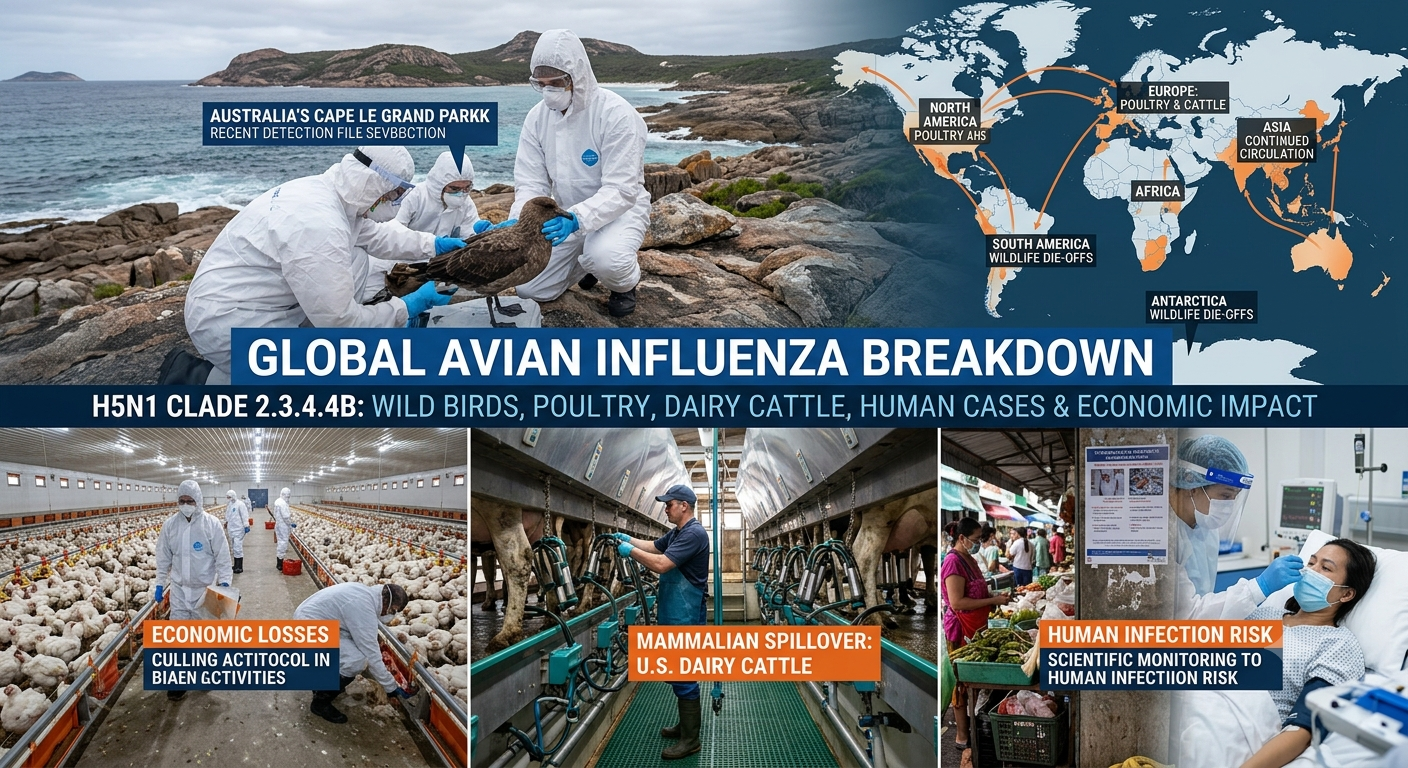

Avian influenza, commonly known as bird flu, has now reached every continent on Earth. What began as a regional poultry disease in southern China nearly three decades ago has evolved into the largest and most geographically widespread avian influenza outbreak ever recorded. As of mid-2026, the dominant strain — highly pathogenic avian influenza (HPAI) H5N1 clade 2.3.4.4b — is circulating in wild birds, poultry, and a growing list of mammal species across six continents, with Australia confirming its first-ever detections this June.
This report breaks down where the avian influenza outbreak stands today: the latest case data, the regions under the most pressure, the economic fallout for poultry and dairy industries, and the questions scientists are asking about pandemic risk.
Table of Contents
What Is Avian Influenza and Why This Outbreak Is Different
Avian influenza refers to influenza A viruses that primarily infect birds. The current global outbreak is driven by a lineage known as the goose/Guangdong H5N1 strain, first identified in 1996. For decades, avian influenza outbreaks were largely contained to poultry farms and live-bird markets in Asia, flaring up periodically before being controlled through culling and biosecurity measures.
That changed in 2020 with the emergence of clade 2.3.4.4b. This version of the virus proved far more transmissible in wild bird populations, allowing it to spread along migratory flyways into Europe, then Africa, North America, South America, and finally Antarctica. Unlike earlier outbreaks, this strain has shown an unusual ability to jump into mammals, including foxes, seals, sea lions, cats, and — most unexpectedly — dairy cattle in the United States. Scientists increasingly describe the virus as panzootic, meaning it now affects multiple species across the globe simultaneously, rather than being a contained, seasonal poultry disease.
Global Spread: Avian Influenza Reaches All Seven Continents
For most of this outbreak, Australia stood out as the one continent without a confirmed case of H5 highly pathogenic avian influenza in the wild. That changed in June 2026. Testing confirmed H5 bird flu in a brown skua found in Cape Le Grand National Park near Esperance in Western Australia, with a second bird, a giant petrel, also testing positive shortly after. As of June 30, 2026, Australian authorities have confirmed five cases of H5 bird flu in wild birds: four in Western Australia and one in South Australia.
This detection is significant for one simple reason: it means H5N1 has now been confirmed on every continent on the planet, including Antarctica, where the virus was first detected in 2023 and has since killed large numbers of seabirds and seals. Australian officials have stressed there is currently no evidence of spread into poultry flocks or signs of mass wildlife die-offs, and enhanced surveillance and biosecurity measures are now active in the affected regions. Still, the arrival of the virus on the Australian mainland closes the final geographic gap in what is now a truly global outbreak.
Regional Snapshot
North America. The United States remains one of the most active hotspots for avian influenza transmission anywhere in the world. More than 180 million poultry birds have been affected since the outbreak began, alongside more than 1,000 dairy farms across multiple states reporting cattle infections — a development virologists call unprecedented, since dairy cattle had never previously been considered a natural host for this virus. The U.S. government has spent in excess of $1.19 billion reimbursing farmers for flock losses. Bird flu activity in the U.S. tends to follow a seasonal pattern tied to wild waterfowl migration, easing in summer and intensifying again each fall and winter, but outbreaks have persisted at unusually high levels even outside peak season.
Europe. The 2025–2026 autumn-winter season ranked among the worst outbreaks the continent has experienced in five years, particularly among wild waterfowl. Poland faced especially heavy poultry losses early in 2026. The detection of H5N1 in a Dutch dairy cow in early 2026 marked the first confirmed case of the virus in cattle outside North America, raising concern that the mammalian spillover pattern seen in the U.S. could begin repeating elsewhere.
Asia. As the historical origin point of this viral lineage, Asia continues to report periodic outbreaks in poultry and live-bird markets, alongside sporadic human cases in countries including China, Cambodia, and Bangladesh. The region’s dense poultry farming and live-market systems remain a persistent source of new viral reassortment, where avian influenza strains exchange genetic material with other circulating flu viruses.
Africa, South America, and Antarctica. Africa and South America have both reported significant wild bird mortality events tied to clade 2.3.4.4b. South America in particular experienced unprecedented seabird and marine mammal die-offs in 2023, with the virus confirmed in penguin and sea lion colonies. In Antarctic and sub-Antarctic territories, the toll has been severe: an outbreak on Australia’s remote Heard Island and McDonald Islands beginning around August 2025 killed more than 13,000 southern elephant seal pups, representing over 75 percent of that breeding season’s cohort.
Human Cases: Rare but Closely Watched
Despite the scale of the animal outbreak, human infection with avian influenza remains uncommon. Since the first identified human case in 1997, more than 23 countries have reported over 880 sporadic human infections with H5N1 to the World Health Organization. In the United States specifically, cumulative confirmed human cases stand at 321, with two deaths recorded to date.
The World Health Organization’s most recent quarterly risk assessment tracked 13 avian and swine influenza cases in people during the first quarter of 2026 alone, including a previously unreported fatal case in a child in Bangladesh. The WHO has continued to state that the overall public health risk from currently known avian influenza viruses remains low, and that sustained human-to-human transmission has not been documented.
That said, several developments are keeping scientists vigilant. Genetic analysis has identified a newer genotype, D1.1, that has spread across migratory waterfowl flyways in North America and has been linked to more severe human illness, including the first confirmed U.S. bird flu death, recorded in Louisiana. Separately, a review of existing case data found evidence that some H5N1 infections in humans may be entirely asymptomatic, meaning transmission could be occurring undetected in some populations — a finding researchers describe as challenging the long-held assumption that H5N1 infection in humans is almost always symptomatic and severe.
Virologists have also flagged H9N2, a different and historically milder avian influenza strain, as a virus worth closer monitoring. Although H9N2 has typically caused only minor illness in birds, researchers tracking its genetic evolution say it appears to be adapting in ways that could make it more efficient at infecting humans.
Economic Impact: Poultry, Eggs, and Dairy Under Pressure
The economic toll of this outbreak has been substantial, particularly in the United States. Egg prices saw their largest jump since 1980 as repeated waves of flock culling reduced the national laying-hen population. During 2024 alone, the average price of a dozen large Grade A eggs rose by roughly 65 percent, with government forecasters predicting further increases in subsequent years as outbreaks continued.
The core challenge for the poultry industry is that there remains no widely available vaccine or treatment for avian influenza in commercial flocks in most major producing countries, including the United States. The primary containment method remains mass culling: when the virus is detected in a single bird within a flock, the entire flock is typically destroyed to prevent further spread. Farmers receive indemnity payments to offset these losses, but the approach is inherently reactive, addressing outbreaks only after they have already occurred rather than preventing them.
The spread of the virus into U.S. dairy cattle herds added a new and unexpected dimension to the economic picture beginning in 2024. Cows infected with H5N1 typically develop mastitis and reduced milk production, and the virus has been found circulating in raw milk supplies in affected regions, prompting expanded mandatory testing programs in several states.
Globally, the avian influenza diagnostics, vaccine, and biosecurity market itself has become a significant and growing industry, reflecting just how entrenched the response to this outbreak has become across the agricultural sector.
Why Containment Remains So Difficult
Public health experts increasingly describe avian influenza as endemic in wild bird populations worldwide rather than an outbreak that can realistically be eradicated. Migratory waterfowl, particularly dabbling ducks, are believed to play an outsized role in the virus’s long-distance spread because they can carry and shed the virus while showing few or no symptoms, allowing them to continue migrating across continents while infectious.
Several additional factors have made this outbreak particularly difficult to contain. Evidence has emerged suggesting the virus may be capable of spreading between farms via airborne transmission, a route that conventional biosecurity measures such as disinfection and protective equipment are not designed to stop. Surveillance and reporting practices also vary significantly between countries and even between individual states within affected countries, complicating efforts to build an accurate global picture of how widely the virus has actually spread. Some researchers have specifically criticized gaps in geospatial and demographic data sharing around poultry operations, arguing that better data access could meaningfully improve outbreak response.
Antiviral resistance has also begun to emerge, with resistant strains identified in poultry populations in Canada, adding a further complication to long-term control strategies.
Pandemic Risk: What Scientists Are Watching
The central question hanging over this outbreak is whether H5N1 could eventually gain the ability to transmit efficiently between humans, which would represent a fundamentally different and far more dangerous phase of the situation. Currently, all confirmed human cases have been linked to direct contact with infected birds, cattle, or contaminated environments, and no sustained human-to-human transmission has been documented anywhere in the world.
However, modeling research published in 2025 suggested that if a pandemic-capable strain did begin spreading among humans, the window for effective containment could be extremely narrow — potentially as few as two to ten detected cases before containment became practically impossible. This has prompted renewed calls from public health researchers for expanded genomic surveillance, faster case detection systems, and continued investment in vaccine platforms capable of responding quickly to a new pandemic strain.
On the positive side, researchers note that the world is considerably better prepared for a potential influenza pandemic than it was prior to COVID-19, particularly in diagnostic capacity and international surveillance coordination. Human vaccine candidates against H5N1 have already entered clinical trials, and several existing vaccine platforms have shown promising results in early testing. The challenge that remains is one of scale: rapidly manufacturing and distributing vaccines to a global population would still take considerable time even with an effective candidate in hand.
Outlook
The avian influenza situation in mid-2026 sits at an unusual inflection point. The virus has achieved a level of global geographic reach with the confirmation of cases in Australia that makes it, by definition, present on every continent. At the same time, the fundamental public health risk to humans remains classified as low by major health authorities, supported by the absence of any confirmed sustained human-to-human transmission anywhere in the world to date.
What has changed is the breadth of species now affected and the persistence of the virus across seasons that previously offered some natural relief. The expansion into dairy cattle, the emergence of more severe genotypes such as D1.1, and growing evidence of possible asymptomatic human infection all point toward a virus that continues to evolve in ways that demand sustained, rather than seasonal, attention from public health and agricultural authorities worldwide.
Related
The global poultry industry 2026 stands as the world’s largest and most dynamic animal protein sector. Valued at approximately USD 417 billion in 2026, the market is on a strong growth trajectory, expected to reach USD 531 billion by 2030 at a compound annual growth rate of 6.3%.
Frequently Asked Questions
What is the current global situation with avian influenza?
As of mid-2026, highly pathogenic avian influenza H5N1 clade 2.3.4.4b is circulating in wild birds, poultry, and multiple mammal species across all seven continents, following Australia’s first confirmed detections in June 2026. The virus remains endemic in global wild bird populations, with the overall public health risk to humans currently assessed as low by the World Health Organization.
Has avian influenza spread to humans?
Yes, but human cases remain rare relative to the scale of the animal outbreak. More than 880 sporadic human infections have been reported to the World Health Organization since 1997 across more than 23 countries. In the United States, 321 confirmed human cases and two deaths have been recorded. The large majority of human cases are linked to direct contact with infected birds, poultry, or dairy cattle.
Can avian influenza spread between humans?
No sustained human-to-human transmission has been documented. All confirmed cases to date have been linked to direct contact with infected animals or contaminated environments. Health authorities continue to monitor closely for any signs that this could change, given the virus’s demonstrated ability to evolve and infect new species.
Why are egg prices affected by avian influenza?
When avian influenza is detected in a commercial poultry flock, the entire flock is typically culled to prevent further spread, since there is currently no widely available vaccine or treatment for the virus in poultry in most major producing countries. Repeated mass culling has significantly reduced the laying-hen population in affected countries, particularly the United States, driving sharp increases in egg prices.
Has avian influenza been found in cattle?
Yes. H5N1 was first confirmed in U.S. dairy cattle in 2024, a development researchers describe as unprecedented since cattle had not previously been considered a natural host for the virus. More than 1,000 U.S. dairy farms have since reported infections. The virus was also confirmed in a Dutch dairy cow in early 2026, marking its first detection in cattle outside North America.
Is Australia now affected by bird flu?
Yes. Australia confirmed its first-ever detections of highly pathogenic H5 avian influenza in wild seabirds in Western Australia in June 2026, with cases subsequently confirmed in South Australia as well. As of this report, there is no evidence the virus has spread into Australian poultry flocks or caused mass wildlife mortality, and enhanced surveillance is underway.
What is being done to stop the spread of avian influenza?
This remains an open question among scientists. While the virus has not gained the ability to transmit efficiently between humans, researchers have expressed concern about its continued evolution, its expanding host range, and modeling suggesting that containment of a future human-adapted strain could become very difficult once a small number of cases are detected. Public health experts emphasize that continued surveillance and rapid vaccine readiness are critical to managing this risk.
Sources
- Centers for Disease Control and Prevention (CDC) — A(H5) Bird Flu: Current Situation
- Centers for Disease Control and Prevention (CDC) — A(H5) Bird Flu Surveillance and Human Monitoring
- World Health Organization — Avian Influenza A(H5N1) Virus
- World Health Organization, Global Influenza Programme — Human Cases with Highly Pathogenic Avian Influenza A/H5N1 (via Our World in Data)
- CIDRAP (Center for Infectious Disease Research and Policy, University of Minnesota) — WHO reports H5N1 death among variant zoonotic flu cases seen this year
- Wikipedia — 2020–2026 H5N1 Outbreak
- BBC Science Focus Magazine — Scientists warn bird flu could spark a human pandemic in 2026
- Gavi, the Vaccine Alliance (VaccinesWork) — Could bird flu be quietly spreading undetected worldwide?
- ScienceDirect — Avian influenza H5N1: A warning signal for the next influenza pandemic
- Think Global Health — U.S. Egg Prices See Largest Jump Since 1980 as Bird Flu Outbreaks Continue
- Sentient Media — Bird Flu Cases Are Surging in 2026. What Does It Mean?
- Australian Government Department of Agriculture, Fisheries and Forestry (DAFF) — Bird Flu (Avian Influenza)
- Australian Government Ministers — H5 Bird Flu Confirmed in Australia
- EarthSky — H5N1 Bird Flu Has Now Spread to All 7 Continents
- Aussie Animals — Bird Flu in Australia in 2025 and 2026: A Status Update