
When a biopharmaceutical company files an NDA (New Drug Application) with the FDA, the manufacturing site matters as much as the clinical data. A single Pre-Approval Inspection (PAI) finding can delay approval by a year, costing billions in lost market exclusivity. This reality — that manufacturing quality, regulatory readiness, and operational excellence are now deal-making or deal-breaking factors — has fundamentally reshaped how pharma companies approach production. The result: the explosive growth of CDMOs (Contract Development and Manufacturing Organizations) as strategic partners, not back-office vendors.
This report explains what CDMOs do, why outsourcing has become the dominant model, and what the shift means for pharmaceutical supply chains.
Table of Contents
What is a CDMO?
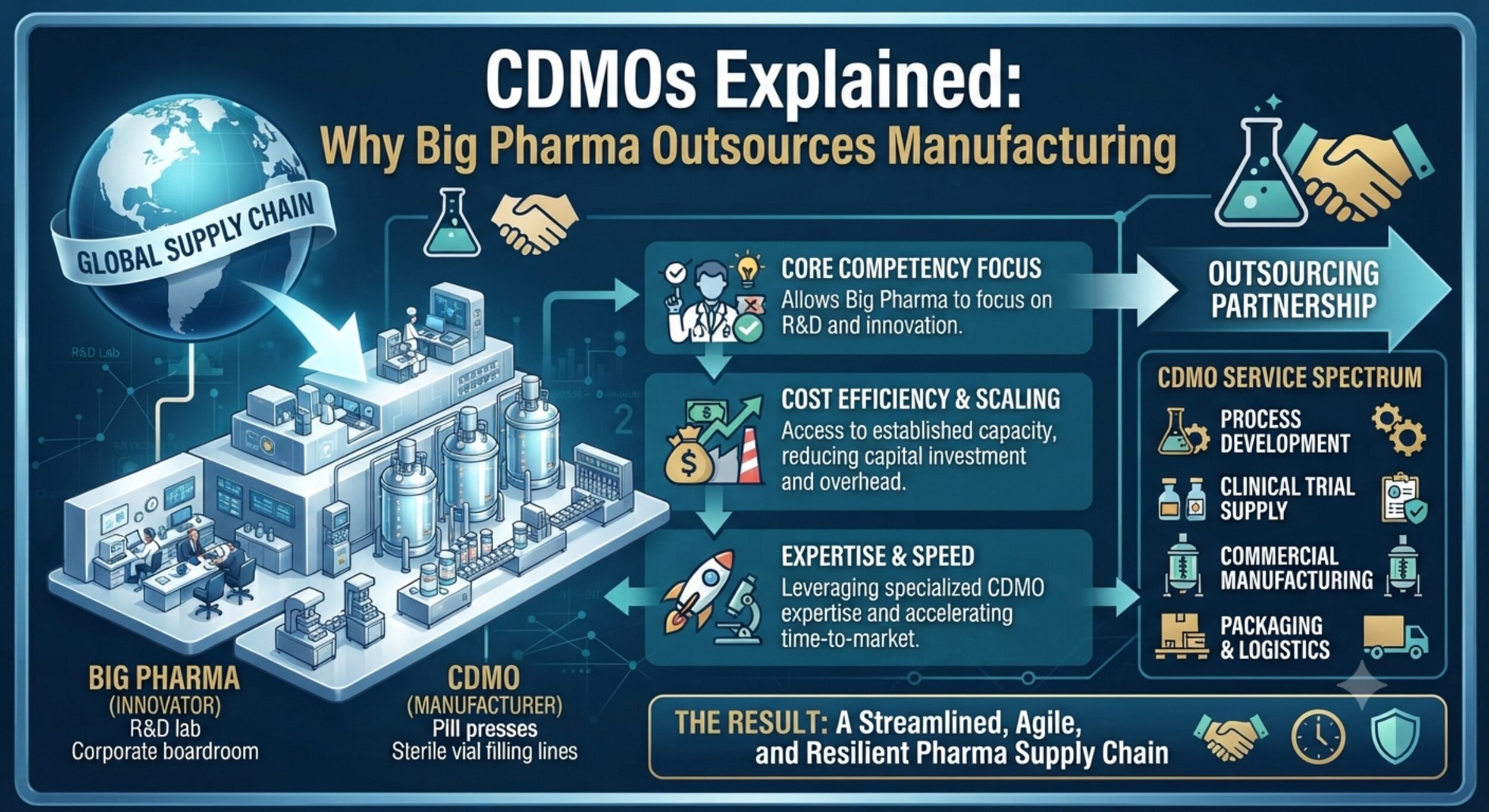
A CDMO is an organization that provides drug development, manufacturing, and supply-chain services to pharmaceutical and biotech companies. They offer a complete menu: process development and optimization, drug substance (API) manufacturing, drug product formulation, fill-and-finish (putting drugs into vials or syringes), analytical testing, quality control, regulatory support, and commercial production.
The industry divides CDMO services into categories:
Development services: Route scouting for API synthesis, process optimization, analytical method development and validation, process safety engineering, scale-up strategy.
Drug substance manufacturing: Producing the active pharmaceutical ingredient (API) — whether a small molecule synthesized through chemistry, a peptide made by SPPS (solid-phase peptide synthesis), a biologic produced in cell culture, or a high-potency API (HPAPI) requiring specialized containment.
Drug product manufacturing: Formulation development, filling tablets/capsules, creating injectables (liquids for injection), lyophilization (freeze-drying), and packaging.
Fill-and-finish services: The aseptic filling of pre-manufactured drug substance into final containers (vials, syringes, cartridges) under sterile conditions. This is now one of the highest-demand services because of the explosion in biologics and GLP-1 injectables.
Analytical and quality control: Testing for identity, potency, purity, and stability. Regulatory support and quality systems documentation.
Not every CDMO offers all of these services. The market has specialized: some focus exclusively on fill-and-finish (Vetter, for instance), others on biologics, still others on small-molecule chemistry. The right CDMO depends entirely on your molecule type and development stage.
Why outsourcing has become standard
For most of pharmaceutical history, large pharma integrated backward: they built and operated their own manufacturing facilities. But the economics of modern drug development have made that model obsolete for most companies.
<cite index=”57-1″>Escalating R&D costs and pipeline complexity drive pharmaceutical majors to off-load non-core manufacturing. Asset-light models free capital for discovery while leveraging CDMO expertise to maintain global supply continuity.</cite>
The capital requirement is the core issue. <cite index=”64-1″>Manufacturing facilities cost $50-500M+ to build, take 2-3 years to construct, and require significant ongoing fixed costs (facility maintenance, regulatory compliance, specialized labor) regardless of output.</cite> A sterile injectable fill-and-finish line costs $50-150 million. A CAR-T cell therapy manufacturing suite costs $30-80 million. For a biotech company with $300 million in cash, committing $150 million to a manufacturing facility is a strategic bet that the drug will succeed and that your internally-built facility will be cheaper than outsourcing.
<cite index=”62-1″>The choice is not primarily about unit economics. It is about burn rate management and investor signaling. A company that spends $150 million of its treasury on a manufacturing facility is telling shareholders it has committed to a single asset with sufficient confidence to fund fixed infrastructure. CDMOs carry that capital risk on their own balance sheets, spreading it across multiple clients and programs.</cite>
Outsourcing converts a massive fixed capital cost into a variable operating cost. You pay only for what you use, when you use it. This is especially critical for biotech, which accounts for over 63% of clinical trial starts globally and almost entirely outsources manufacturing. But large pharma is also shifting: <cite index=”63-1″>several major pharmaceutical companies pledged over $480 billion in U.S. manufacturing investments in 2025, but much of that capacity is being built through CDMO partnerships, not standalone internal facilities.</cite>
The second driver is complexity and specialization. Modern drug pipelines include bispecific antibodies, monoclonal antibodies, antibody-drug conjugates, mRNA therapies, viral vectors, cell therapies, peptides, and high-potency APIs. Most companies don’t maintain the specialized infrastructure, containment systems, and technical expertise needed across every modality. <cite index=”58-1″>A CDMO with deep experience in sterile injectables is not automatically capable for viral vector manufacturing or ADC conjugation.</cite> Outsourcing to specialists avoids the need to build and validate multiple platforms.
The third driver is regulatory risk and inspection burden. <cite index=”63-1″>The regulatory environment has intensified. FDA warning letters surged in FY2025. Pre-approval inspections are more rigorous. Companies that outsource to experienced CDMOs with clean inspection histories reduce their compliance exposure.</cite> <cite index=”62-1″>When a sponsor company selects a CDMO with strong regulatory credentials, it is partly purchasing insurance against a CMC rejection at NDA review. FDA has refused to approve NDAs because the proposed manufacturing site failed a PAI. That outcome delays approval, extends clinical-stage capital outflow, and can cost a year or more of market exclusivity. The cost of that delay, measured against the incremental cost of a high-quality CDMO, almost invariably favors the higher-quality partner.</cite>
Market size and growth
<cite index=”47-1″>The Pharmaceutical contract development and manufacturing organization (CDMO) market size is expected to grow from USD 258.88 billion in 2025 to USD 275.27 billion in 2026 and is forecast to reach USD 374.68 billion by 2031 at 6.33% CAGR.</cite> Different analysts show slightly different numbers — some project 7-9% CAGR — but the direction is consistent: CDMOs are growing 1-2x faster than the overall pharmaceutical market.
<cite index=”48-1″>The Contract Development and Manufacturing Organization market size is projected to grow from $214.95 billion in 2026 to $419.93 billion by 2034, with a CAGR of 8.7%.</cite> This explosive growth reflects the structural shift: pharma and biotech are not gradually outsourcing; they are fundamentally reorganizing around CDMO partnerships as central infrastructure.
GLP-1 drugs: The capacity-constrained driver
No single drug class better illustrates the CDMO story than GLP-1 receptor agonists for diabetes and obesity. <cite index=”66-1″>GLP-1 therapies for obesity and diabetes have become a massive demand driver, fueling injectable capacity buildouts and creating competitive pressure across the CDMO landscape. Peptide manufacturing expertise and large-scale sterile fill/finish capacity are in particularly high demand.</cite>
The scale is staggering. <cite index=”73-1″>GLP-1 prescriptions grew at roughly 38% annually between 2022 and 2024, and total GLP-1 sales are forecast to exceed $100 billion by 2030. This single therapeutic class is consuming a disproportionate share of global CDMO capacity, particularly for large-scale cGMP peptide manufacturing. Lead times at major peptide CDMOs have stretched to 18–24 months.</cite>
This capacity constraint is already reshaping CDMO strategy and M&A. <cite index=”51-1″>According to DCAT Value Chain Insights in December 2024, the largest market move was Novo Holdings’ $16.5 billion acquisition of Catalent to support obesity treatment manufacturing.</cite> <cite index=”67-1″>Catalent’s existing semaglutide fill-finish lines in Bloomington, IN were immediately repurposed for Novo products, underscoring a CDMO strategy: leveraging a broad manufacturing network (mammalian, bacterial, sterile filling) to serve GLP-1 and other high-growth biologics.</cite>
The implication for procurement: if your health plan or hospital system covers GLP-1 therapy for obesity, secure supply agreements now. Spot market pricing is volatile; CDMO capacity will remain tight through 2027-2028.
CDMO business model and economics
CDMOs have two revenue streams: development services and commercial manufacturing.
Development: Process development, analytical work, scale-up, and regulatory support are project-based, time-limited fees. These are lower-margin services that anchor the early relationship but generate limited recurring revenue.
Commercial manufacturing: Once a drug is approved, the CDMO manufactures at scale under long-term supply agreements (typically 3-7 years with renewal options). Revenue is driven by volume (units produced), pricing (cost-per-unit or cost-plus pricing), and capacity utilization.
CDMO margins are highly sensitive to capacity utilization because manufacturing facilities have massive fixed costs (depreciation, maintenance, quality systems, regulatory compliance staff) regardless of output. <cite index=”64-1″>A biologics manufacturing facility running at 85% utilization might generate 25-30% EBITDA margins, while the same facility at 60% utilization might generate far lower margins.</cite>
This creates a strategic tension: CDMOs want to secure long-term commercial contracts with high utilization to maximize returns on capital-intensive assets. Pharma companies want flexibility and competitive pricing. The result is aggressive competition for programs with predictable long-term demand.
The consolidation wave
The CDMO market is consolidating. Large players are acquiring specialized capabilities, geographic capacity, and drug portfolios. <cite index=”57-1″>Lonza’s USD 1.2 billion Vacaville site purchase from Roche underpins this transition, adding 330,000 L of biologics capacity to support blockbuster antibody demand.</cite> <cite index=”59-1″>Strategic facilities are being divested by large pharmaceutical companies, striking long-term supply deals with CDMOs who in turn are acquiring the pharmaceutical companies’ manufacturing sites. For the pharmaceutical company, this is a powerful act of capital reallocation — divesting an underutilized asset and securing a long-term supply agreement. For the CDMO, this provides instant capacity, bypassing the prohibitive costs and timelines of a greenfield build.</cite>
The winners in this consolidation will be end-to-end providers: companies that can offer development services, drug substance manufacturing, formulation, fill-and-finish, and analytical support across multiple modalities. Specialists will survive but will operate as niche players.
Geopolitical factors reshaping CDMO sourcing
The BIOSECURE Act (signed December 2025) restricts U.S. and allied countries from sourcing from certain Chinese biotech firms. This has immediate implications for CDMO selection. <cite index=”63-1″>The BIOSECURE Act is making outsourcing even more compelling in 2026. India-based CDMOs with no China-linked supply chain exposure are now the primary beneficiaries of global oncology outsourcing demand that was previously going to Chinese manufacturers.</cite>
For procurement teams, this means India-based CDMOs (Neuland, Dr. Reddy’s Laboratories, Laurus Labs, and others) are becoming strategically important for supply chain diversification and regulatory compliance.
What this means for procurement and supply chain
CDMO selection is now a strategic decision, not a procurement transaction. The choice of manufacturing partner affects development timelines, regulatory risk, quality outcomes, and long-term supply security. Evaluate on regulatory track record, modality expertise, capacity utilization, long-term financial stability, and cultural fit with your organization.
Capacity constraints are real and persistent. Lead times for peptide synthesis and sterile fill-finish can stretch to 18-24 months. If you need CDMO services, secure them early or face delays to your commercial timeline.
Diversification is necessary. Rely on a single CDMO and you inherit their supply risk. Prefer partnerships with 2-3 CDMOs if your volume permits, or ensure your primary CDMO has redundant manufacturing capacity across multiple sites.
GLP-1 sourcing is a near-term strategic priority. If your organization needs peptide manufacturing or sterile fill-finish capacity in 2026-2027, capacity is scarce. Budget accordingly and expect premium pricing.
Frequently asked questions
What’s the difference between a CDMO and a CMO?
CMO stands for Contract Manufacturing Organization — it typically provides manufacturing services only. CDMO (Contract Development and Manufacturing Organization) encompasses development services in addition to manufacturing. In practice, the terms are used interchangeably, but a true CDMO offers more comprehensive support across the development lifecycle.
Can a CDMO handle multiple drugs simultaneously?
Yes, most CDMOs operate multiple facilities and campaigns in parallel. A single facility might produce Drug A for weeks, then switch to Drug B. This is why capacity utilization matters — changing over from one drug to another requires downtime and validation, during which the facility generates no revenue.
What happens if a CDMO shuts down or loses FDA approval?
This is a real risk. If your CDMO faces a quality issue or regulatory action, you may need to find alternative manufacturing immediately — often impossible on short timelines. This is why supply agreements frequently include contingency clauses allowing transition to an alternative CDMO in case of emergency.
Are all CDMOs FDA-approved?
Not automatically. CDMOs are subject to FDA cGMP (current Good Manufacturing Practice) requirements and regular inspections, but FDA approval is specific to the facilities and processes, not to the organization as a whole. When evaluating a CDMO, review their inspection history, any warning letters, and their regulatory track record.
Why is fill-and-finish so constrained?
Aseptic fill-finish (filling drugs into sterile vials under a clean-room environment) is capital-intensive and highly regulated. Validating a fill-finish line takes years. With explosive growth in biologics and GLP-1 injectables, demand for fill-finish capacity has outpaced supply. Most CDMOs are investing heavily to add fill-finish capacity, but the timeline is 18-36 months per new line.
Sources
- <cite index=”47-1″>Mordor Intelligence — Pharmaceutical CDMO Market 2026-2031</cite>: https://www.mordorintelligence.com/industry-reports/pharmaceutical-contract-development-and-manufacturing-organization-cdmo-market
- <cite index=”48-1″>Fortune Business Insights — CDMO Outsourcing Market 2026-2034</cite>: https://www.fortunebusinessinsights.com/contract-development-and-manufacturing-organization-cdmo-outsourcing-market-102502
- <cite index=”51-1″>Research and Markets — CDMO Market Report 2026</cite>: https://www.globenewswire.com/news-release/2026/01/26/3225380/28124/en/Contract-Development-and-Manufacturing-Organization-Market-Report-2026.html
- <cite index=”52-1″>Persistence Market Research — Pharmaceutical CMO Market 2026-2033</cite>: https://www.persistencemarketresearch.com/market-research/pharmaceutical-contract-manufacturing-organization-cmo-market.asp
- <cite index=”58-1″>PharmaSource — What Is a CDMO? The Complete Guide 2026</cite>: https://pharmasource.global/content/cdmo-explained-an-overview-of-contract-development-and-manufacturing-organisations-in-pharma/
- <cite index=”59-1″>Pharma Almanac — How Capital Constraints Are Impacting M&A in CDMO</cite>: https://www.pharmasalmanac.com/articles/how-are-capital-constraints-impacting-m-a-and-strategic-partnerships-in-the-cdmo-and-pharma-sectors
- <cite index=”60-1″>DrugPatentWatch — CDMO Selection: The Ultimate Checklist</cite>: https://www.drugpatentwatch.com/blog/cdmo-selection-the-ultimate-checklist/
- <cite index=”61-1″>Piramal Pharma Solutions — What Is a CDMO? 2025-2026 Guide</cite>: https://piramalpharmasolutions.medium.com/what-is-a-cdmo-0b967514e82e
- <cite index=”62-1″>Healthcare IB Guide — CDMO Engagement Models</cite>: https://ibinterviewquestions.com/guides/healthcare-investment-banking/cdmo-business-model
- <cite index=”63-1″>Your Health Magazine — Why Companies Are Opting for Pharmaceutical Outsourcing</cite>: https://yourhealthmagazine.net/article/health-industry-insights/end-to-end-cdmo-services/
- <cite index=”64-1″>Healthcare IB Guide — The CDMO Business Model</cite>: https://ibinterviewquestions.com/guides/healthcare-investment-banking/cdmo-business-model
- <cite index=”65-1″>Pinnacle Life Science — CDMO vs In-House Manufacturing</cite>: https://pinnaclelifescience.com/cdmo-vs-inhouse-manufacturing-pharma/
- <cite index=”66-1″>Piramal Pharma Solutions — CDMO Market Guide 2026</cite>: https://piramalpharmasolutions.medium.com/what-is-a-cdmo-0b967514e82e
- <cite index=”67-1″>IntuitionLabs — GLP-1 Drug Manufacturing: CDMO Expansion & Tech Transfer</cite>: https://intuitionlabs.ai/articles/glp-1-drug-manufacturing-cdmo-tech-transfer
- <cite index=”68-1″>Markets and Markets — Top 20 Biomanufacturing & CDMO Providers 2026</cite>: https://www.marketsandmarkets.com/ResearchInsight/leading-pharmaceutical-contract-manufacturing-companies.asp
- <cite index=”69-1″>Vector Biomed — Key CDMO Market Trends 2025 and Outlook 2026</cite>: https://vectorbiomed.com/resource/what-economic-or-market-trends-are-having-the-biggest-impact-on-cdmo-capacity-and-pipelines-in-2025-and-what-will-2026-bring/
- <cite index=”70-1″>PharmaSource — CDMO Overview and Services Guide 2026</cite>: https://pharmasource.global/content/cdmo-explained-an-overview-of-contract-development-and-manufacturing-organisations-in-pharma/
- <cite index=”71-1″>PharmaSource — Fill and Finish CDMO Services & Market Guide</cite>: https://pharmasource.global/content/guides/category-guide/fill-and-finish-cdmo-services-capabilities-market-guide/
- <cite index=”72-1″>Healthcare Ranking — Top 20 Biomanufacturing & CDMO Providers 2026</cite>: https://hcranking.com/news/2026/05/202605288878
- <cite index=”73-1″>Neuland Labs — What Is a CDMO? Complete Guide 2026</cite>: https://www.neulandlabs.com/en/insights/stories/what-is-a-cdmo