
How a drug travels from the factory floor through multiple intermediaries to reach the patient — and why that path matters for supply chain resilience and recall speed.
The journey of a drug from manufacturer to patient is not a straight line. It is a branching channel where a single drug might reach patients through retail pharmacies, hospital formularies, mail-order specialty pharmacies, or infusion centers — each path controlled by different actors, each requiring different infrastructure, each subject to different economic incentives.
Understanding that channel is essential for procurement teams, supply chain professionals, and anyone trying to forecast pharmaceutical availability or manage supply disruption. A biologic required for cancer treatment does not flow through the same channel as an antibiotic. A rare-disease drug might have one or two approved dispensers nationwide. A common small molecule like metformin can be purchased through dozens of channels.
This report maps the pharmaceutical distribution system: the layers from manufacturing through patient dispensing, the parallel channels that have emerged, and the infrastructure that now underpins them.
Table of Contents
From factory to pharmacy: The core flow
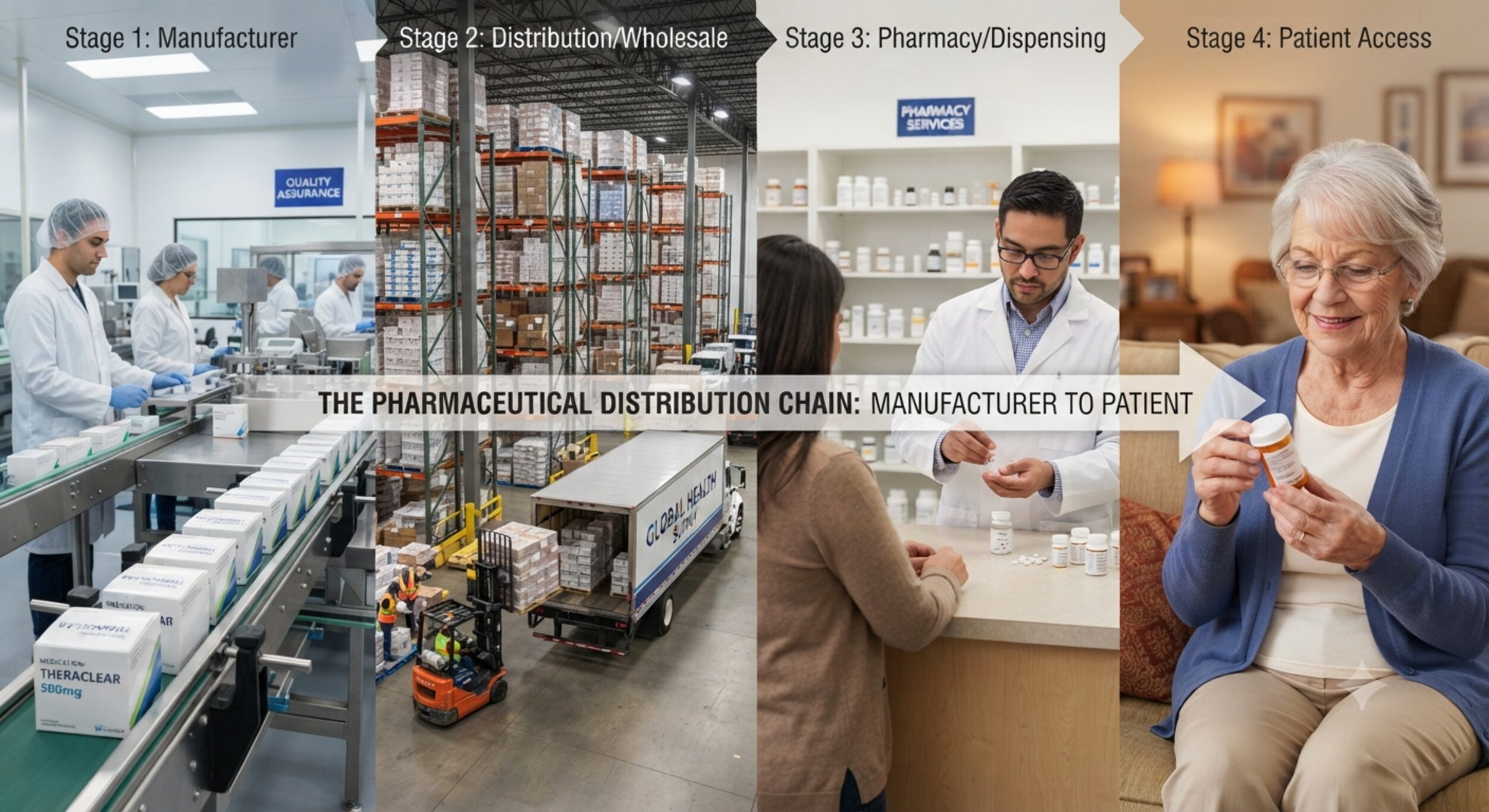
Step 1: Manufacture and fill-finish. A drug begins as an active pharmaceutical ingredient (API) or as cells/viral vectors (for biologics and cell/gene therapies). The API is synthesized by an API manufacturer (often overseas — China or India for most small molecules). It then ships to a formulation and fill-finish facility in the US, where it is combined with excipients, placed into vials or tablets, and packaged.
For biologics, this step is far more complex. The producing cell line is grown in bioreactors, the protein is harvested and purified through chromatography, then filled into syringes, pens, or vials in a sterile environment. The entire facility must be validated for that specific product; the same product made in two different facilities might have slightly different post-translational modifications.
Step 2: Manufacturer distribution center. The finished product ships from the fill-finish facility to the manufacturer’s own distribution center, or to a third-party logistics (3PL) provider contracted by the manufacturer. This facility stores bulk inventory and ships to downstream channels.
Step 3: Wholesaler. For most drugs, the product then moves to one of the Big Three wholesalers (McKesson, Cencora, Cardinal Health), which operate massive regional distribution centers. These wholesalers maintain inventory for tens of thousands of SKUs and ship to thousands of retail pharmacies and hospitals. Wholesalers handle logistics, inventory management, and compliance reporting.
Step 4: Pharmacy. The drug reaches either a retail pharmacy (CVS, Walgreens, Walmart, independent), a hospital pharmacy, or a specialty pharmacy. This is where the drug sits until it is dispensed to a patient.
The entire flow from manufacturer to retail pharmacy typically takes 2-4 weeks, though specialty drugs may be routed differently.
The three parallel channels
Retail pharmacy. Community pharmacies fill roughly 70% of all prescriptions in the US. A retail patient presents an Rx, the pharmacy dispenses the drug (often from wholesaler stock), and the patient leaves with a 30-day supply. The flow is: manufacturer → wholesaler → retail pharmacy → patient.
Retail pharmacy is low-complexity for small molecules, high-complexity for biologics. A retail pharmacy cannot store biologics requiring refrigeration unless it has invested in cold storage. Patients on injectable biologics often receive them through specialty pharmacy instead.
Hospital pharmacy. Hospitals maintain their own formulary and stock drugs for inpatients. The flow can be: manufacturer → wholesaler → hospital pharmacy, or (for 340B-eligible hospitals) direct from manufacturer at a steep discount. Hospital pharmacies fill inpatient doses and sometimes outpatient prescriptions. They require infrastructure (cold chain for biologics, IV compounding capability, controlled substance safes) that retail pharmacies do not.
Specialty pharmacy. This is the fastest-growing channel. Specialty pharmacies dispense high-cost, complex drugs: biologics, oncology injectables, rare-disease drugs, cell therapies. Specialty pharmacies employ nurses and patient advocates, manage insurance prior authorization, dispense in coordination with infusion centers or treatment clinics, and often provide financial assistance programs.
Specialty pharmacy revenue was roughly $265 billion in 2024 (39% of all pharmacy revenue). The market is highly concentrated: CVS Health, Cigna/Express Scripts, and UnitedHealth/Optum account for roughly two-thirds of specialty dispensing. The specialty distribution market itself is valued at $4.1 billion in 2026, projected to reach $10.6 billion by 2033 at a 15% CAGR.
Crucially, many specialty drugs are available only through one or a handful of approved specialty pharmacies. As of January 2025, 68% of limited-distribution drugs use 1-4 pharmacies, and roughly 34% are exclusive to a single pharmacy. This concentration means manufacturers can tightly control distribution but also means patients and payers have no choice on where to fill the prescription.
The cold chain: Logistics for biologics
Biologic distribution requires infrastructure that small-molecule pharmacies do not have. Temperature-controlled shipping (refrigerated or ultra-cold), specialized packaging, real-time temperature monitoring, and trained personnel are mandatory.
Wholesalers have invested in dedicated cold-chain distribution centers. McKesson, for instance, has built facilities with specific capacity for biologics and specialty drugs. Specialty pharmacies maintain ultra-low freezers and cryogenic shipping capabilities.
Cold chain failures are costly. A damaged shipment of a $50,000 biologic dose represents sunk investment. Cold-chain data logging (temperature monitors embedded in shipments) is now standard and required by regulatory agencies. If a shipment deviates from the mandated temperature range, the entire lot is typically considered compromised.
For cell and gene therapies, the cold chain is even more critical. Cryogenic shipping (ultra-cold, often –150°C or colder) and time-sensitive delivery windows mean logistics costs run 5-15% of the product cost, compared to <1% for traditional drugs.
Returns and recalls: The reverse channel
When a drug is recalled, it must travel backward through the supply chain: from patient or pharmacy back to wholesaler, potentially back to manufacturer. This reverse logistics process was once manual and slow. A major recall could take weeks to execute.
The Drug Supply Chain Security Act (DSCSA), fully implemented by November 2024, changed this. DSCSA requires serialization (unique identification) of every drug package and electronic recording of every transaction. When a recall is issued, manufacturers and wholesalers can now pinpoint exactly where affected products are and notify relevant dispensers within hours.
For a hospital or pharmacy, DSCSA compliance means:
- Scanning drug serial numbers at receipt and dispensing
- Maintaining electronic transaction records with trading partners
- Verifying product authenticity at the package level
- Rapidly responding to recalls with precise batch identification
The first major business value of DSCSA is not compliance — it is targeted recall speed. Instead of a manufacturer issuing a broad recall affecting millions of doses, a serialized system allows recalls to target only the affected lots, reducing waste and patient disruption.
What this means for procurement
Understand your supply path. A drug sourced through a GPO contract flows through the wholesaler (standard channel). A 340B-eligible drug might flow direct from manufacturer. A specialty drug only through an approved specialty pharmacy. Each path has different timing, cost, and risk characteristics.
Plan for cold-chain infrastructure. If you are stocking biologics, you need investment in refrigeration, monitoring, and staff training. Budget for it upfront; retrofitting later is expensive.
Leverage DSCSA for recall readiness. You are now required to maintain serialization data. Use this as an advantage: rapid recalls reduce exposure and improve patient safety. Build DSCSA into your standard workflow, not as a compliance afterthought.
Recognize specialty pharmacy bottlenecks. If a drug has a limited-distribution network (single or two-pharmacy exclusive), you have no negotiating power on pharmacy or shipping cost. Plan supply strategy accordingly.
Frequently asked questions
Why are some drugs only available through certain pharmacies?
Manufacturers use limited-distribution networks (LDNs) to control dispensing quality, manage patient support programs, reduce diversion, and (sometimes) capture higher margins through affiliated specialty pharmacies. They can legally restrict distribution to a handful of qualified pharmacies.
What is the difference between a mail-order pharmacy and a specialty pharmacy?
Mail-order refers to the delivery method (shipped to patient’s home). Specialty pharmacy refers to the type of drugs dispensed (complex, high-cost, biologics). Many specialty drugs are mail-order only, but not all.
Does DSCSA slow down pharmacy operations?
Initially, yes. Scanning and verification add workflow steps. But over time, automation and integrated systems reduce friction. The trade-off is worth it: targeted recalls and counterfeit prevention.
Sources
- Smart+Sense — Distribution Methods for Pharmaceuticals: https://blog.smartsense.co/distribution-methods-for-pharma-cold-chain
- IntuitionLabs — Mail-Order Specialty Drugs: A Guide to Limited Distribution: https://intuitionlabs.ai/articles/mail-order-specialty-drugs
- IntuitionLabs — US Specialty Pharmacies: A Guide to Mail-Order Providers: https://intuitionlabs.ai/articles/mail-order-specialty-pharmacies-usa
- Rx Almanac — Best Specialty Pharmacies for Pharma Manufacturers: https://rxalmanac.com/articles/top-specialty-pharmacies-pharma-manufacturers/
- Fairfield Market Research — Specialty Drug Distribution Market Report: https://www.fairfieldmarketresearch.com/report/speciality-drug-distribution-market
- Inmar Inc. — DSCSA and the New Era of Faster, More Effective Drug Recalls: https://www.inmar.com/blog/insights/healthcare/dscsa-and-new-era-faster-more-effective-drug-recalls
- Healthcare Packaging — Breaking Down the Drug Supply Chain Security Act: https://www.healthcarepackaging.com/logistics/traceability-serialization/article/22921940/breaking-down-the-drug-supply-chain-security-act-dscsa
- Megaventory — Pharmaceutical Track and Trace Software: A Complete Guide: https://blog.megaventory.com/2026/03/pharmaceutical-track-and-trace-software-a-complete-guide-for-u-s/
- Pharmaceutical Commerce — How DSCSA Compliance Is Unlocking Recall Efficiency: https://www.pharmaceuticalcommerce.com/view/how-dscsa-compliance-is-unlocking-recall-efficiency
- FDA — Drug Supply Chain Security Act: https://www.fda.gov/drugs/drug-supply-chain-integrity/drug-supply-chain-security-act-dscsa