
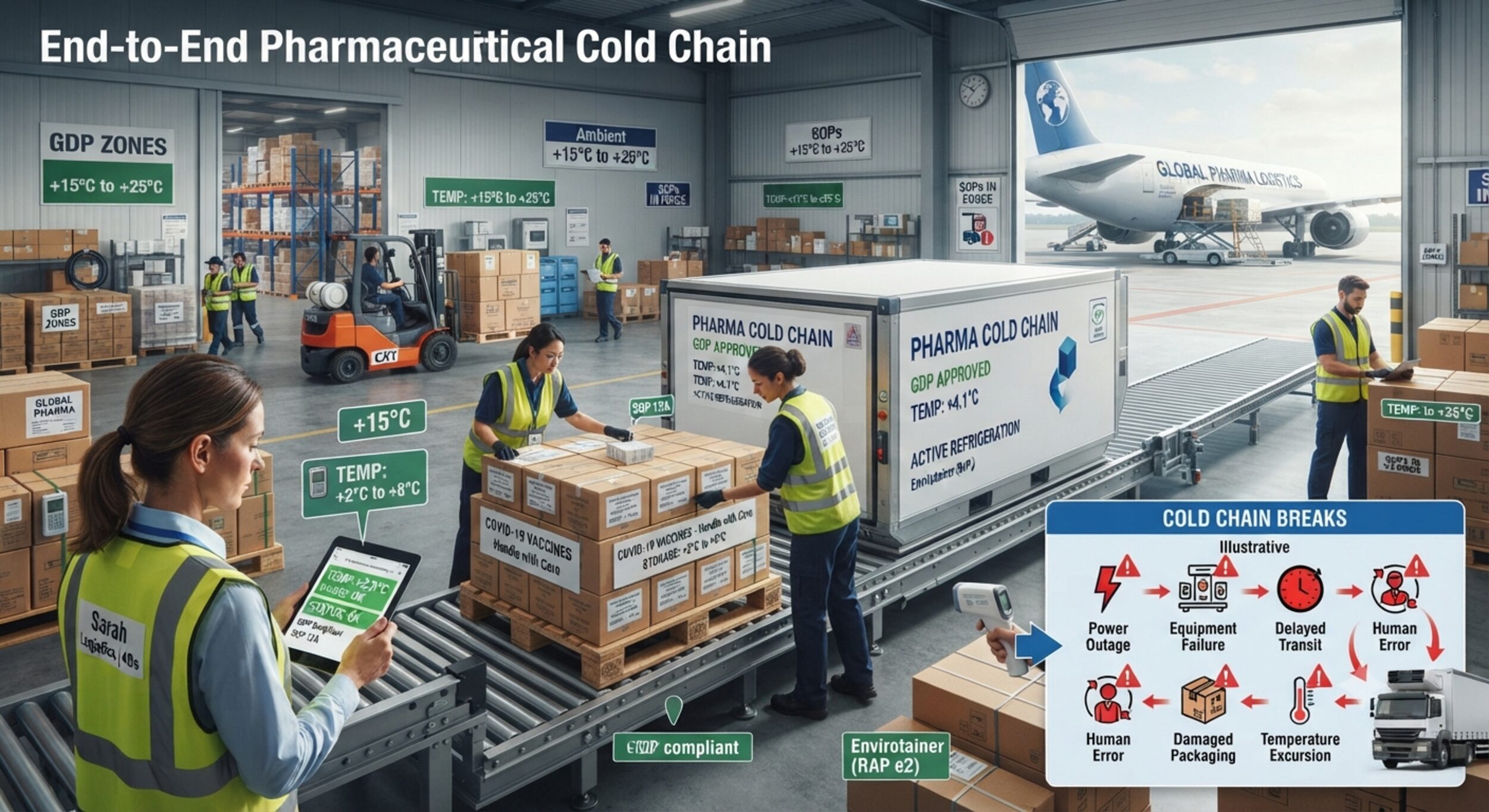

Why a 2°C temperature excursion can destroy millions in inventory — and how the gap between regulatory compliance and operational execution is where supply chains fail.
A pharmaceutical cold chain is not a logistics problem. It is a supply chain architecture problem. A biologic manufactured under strict temperature control, validated through stability testing, and packaged in insulation must then travel through a system where no single actor owns the entire temperature journey. The manufacturer validates their facility and hands off to a wholesaler. The wholesaler coordinates with a 3PL, which coordinates with a customs broker, which hands off to a specialty pharmacy that may not receive the product into controlled storage for hours or days after it clears customs. Each handoff is an opportunity for a temperature excursion.
The regulatory framework that governs this is Good Distribution Practice (GDP). GDP is well-written and makes sense on paper. In execution, GDP compliance separates the organizations that protect product integrity from those that protect themselves with documentation.
This report explains what GDP requires, which temperature ranges matter and why, and where real cold chains break.
Table of Contents
Good Distribution Practice: Regulation vs. execution
Good Distribution Practice is the regulatory standard that governs how pharmaceuticals are stored, transported, and handled from manufacture through patient receipt. GDP applies to manufacturers, wholesalers, logistics providers, and dispensers. The framework is harmonized globally: the European Union’s GDP rules mirror those of the PIC/S (Pharmaceutical Inspection Cooperation Scheme), which are adopted by most regulatory agencies worldwide. In the United States, the FDA does not have a separate GDP code but enforces temperature compliance through product-specific guidance, the DSCSA (Drug Supply Chain Security Act), and 21 CFR Part 11 (electronic records).
GDP requires:
Validated storage and transport. Every cold room, every refrigerated vehicle, every shipping container must be qualified to prove it maintains the specified temperature range under real-world conditions. Qualification means documented thermal mapping (placing temperature sensors throughout the space under expected load conditions) and data collection over an extended period to demonstrate consistent performance. A qualification file is not a checklist; it is an engineering dossier.
Temperature monitoring with real-time data. Traditional temperature loggers were passive — data was downloaded after delivery. Modern GDP expects active monitoring with electronic recording and (increasingly) real-time alerting so deviations trigger response before they become catastrophic. Electronic data must be secure, audit-trailable, and compliant with 21 CFR Part 11.
Personnel training and competency. Every person who touches a cold-chain product must be trained on GDP procedures and demonstrate competency. Training must be documented and refreshed when procedures change. It is not “everyone is trained”; it is “person X was trained on Y procedure on date Z and demonstrates competency.”
Deviation management and root cause analysis. When a temperature excursion occurs — and they will — the organization must immediately (a) assess whether the product is compromised, (b) quarantine affected inventory, (c) investigate the root cause, and (d) implement corrective and preventive actions (CAPA). A deviation without documented root cause analysis is a regulatory red flag.
Supplier qualification and audit. If you use a 3PL, a customs broker, or any subcontractor in the cold chain, GDP requires you to qualify them — verify they have proper procedures, validated equipment, trained staff — and audit them periodically. You cannot outsource accountability.
The critical insight: GDP regulation is performance-based, not prescriptive. Regulators inspect operations, not just documents. A 2026 analysis of 48 EU GDP inspections found that 50% were linked to authorization-related activities and that cold chain monitoring gaps were a recurring finding. Organizations that align compliance requirements with daily operational controls pass inspection. Those that treat GDP as a documentation exercise get findings.
Temperature bands: Why 2°C matters
Pharmaceutical products require specific temperature ranges because stability is validated within those ranges. The product’s regulatory approval — its marketing authorization — specifies the storage condition. Storing outside that condition is storing outside the product’s approved use.
2–8°C (refrigerated). This is the most common cold-chain band. Biologics (monoclonal antibodies, TNF inhibitors, interferons), vaccines, insulin, GLP-1 therapies (semaglutide, tirzepatide), most growth factors — all require 2-8°C. The range is tight because many proteins begin to denature above 8°C. WHO stability guidelines show that some vaccines lose significant potency after exposure to temperatures above 8°C for just 2-4 hours. The molecule does not suddenly break at 9°C; it degrades continuously as temperature rises. At 25°C (room temperature), degradation accelerates exponentially.
−20°C (frozen). Certain biologics, some vaccines, and research materials require −20°C. The difference between 2-8°C and −20°C is not academic — it requires different infrastructure, different packaging, and different logistics partners.
−70°C to −80°C (ultra-cold). The Pfizer-BioNTech COVID-19 vaccine ignited the ultra-cold boom. mRNA is exceptionally temperature-sensitive; the Pfizer vaccine initially required −70°C. Moderna’s version was stable at −20°C, a critical difference that shaped real-world distribution. Ultra-cold requires specialized equipment: ultra-low temperature (ULT) freezers rated to −80°C or −100°C, dry ice shippers, or liquid nitrogen systems. ULT freezers cost $50,000-150,000 per unit and have limited geographic distribution. Most small cities and rural hospitals do not have ULT capacity.
Advanced therapies — cell therapies, gene therapies — often require cryogenic storage (−150°C or lower). This is the frontier. Infrastructure barely exists in most regions.
The economics of temperature bands are stark: a product designed for 2-8°C transport costs roughly $200-500 per unit to ship globally. A −70°C ultra-cold product costs $5,000-15,000 per shipment (per unit costs are astronomical on low volumes). This economic reality shapes manufacturing location, distribution strategy, and patient access.
What breaks: Real failure modes
An estimated 20% of temperature-sensitive healthcare products are damaged or degraded during distribution — not because the product was defective, but because the supply chain failed. IQVIA estimates roughly $35 billion annually is lost to cold chain failures across all temperature bands.
The failure modes are systemic:
Customs delays. A shipment arrives at port and clears customs in 4-6 hours under normal conditions. But delays happen: missing paperwork, inspection holds, port congestion. During that delay, the product sits in a non-controlled environment. If it is summer in Miami, 85°F ambient temperature will infiltrate the insulated box within hours. The shipper — the party responsible for temperature through delivery — has no control over customs. But GDP holds the shipper accountable for the temperature record during delay. This creates a gap between responsibility and control.
Dry ice sublimation. Ultra-cold shipments use dry ice (solid CO₂ at −78.5°C) in insulated boxes to maintain −70°C. But dry ice sublimates — it evaporates directly to gas without becoming liquid. A shipment that takes 3 days can lose 30-50% of its dry ice mass, allowing temperature to rise. Pfizer’s mRNA vaccine distribution network revealed this at scale: shipments that should have maintained −70°C were arriving at −45°C or warmer because dry ice had sublimated. Modern solutions include active phase-change systems (stable at precise temperatures for longer) and dual-pack configurations (redundancy), but these add cost and complexity.
Warehouse handoff failures. A product clears customs but must wait for a receiving facility to have available cold storage. The receiving facility might be a specialty pharmacy that operates during business hours. A shipment arriving Friday evening might sit in an uncontrolled dock until Monday morning when receiving staff can process it into controlled storage. That is 60+ hours of potential temperature drift. The structural solution: customs clearance and cold-storage handoff must be integrated. One vendor must own the transition point, not two separate entities.
Validation gaps. A refrigerated warehouse is qualified to ±2°C accuracy at the validation temperature setpoint. But that validation was done when the facility was lightly loaded. In real operation, when 100 pallets are stacked floor-to-ceiling, temperature distribution changes. The top of a pallet stack might be 5°C while the bottom is 3°C. If a product is sensitive to temperature variation, this matters. Continuous monitoring (not just quarterly checks) catches this; passive compliance approaches miss it until product is degraded.
Personnel turnover without documented retraining. A receiving technician who has worked in the facility for 5 years retires. A new hire starts but receives generic training instead of role-specific, facility-specific GDP training. The new hire inadvertently leaves a cold-storage door propped open. Temperature excursion occurs. Documented competency verification and facility-specific training prevent this.
Incompatibility between manufacturing stability data and transport packaging. A biologic is manufactured and stability-tested under precise conditions (e.g., −20°C storage, 72-hour degradation profile). But the product must be shipped at 2-8°C in an insulated box with ice packs. The transport condition was never formally validated. If transit time approaches 72 hours, degradation risk rises. Packaging engineering must reverse-map from stability data: if the product degrades X% at 2-8°C over 72 hours, and my shipment will take 60 hours plus 12-hour contingency, is my insulation adequate? Many cold-chain failures are baked into packaging design early and only discovered when field failures occur.
The cost of failure
A single high-value biologic shipment can represent $500,000 to $2 million in product cost. A rejected load due to a temperature excursion is not a $200 write-off. It is:
- Product cost (full value): $500K–$2M
- Disposal and reverse logistics: $10K–$50K
- Replacement manufacturing lead time (weeks to months of patient delay)
- Expedited air freight for replacement (rush shipping: $50K–$200K)
- OTIF (on-time, in-full) penalties from customers or distributors: $25K–$100K
- Regulatory investigation and documentation: $50K–$200K in internal labor
A single failure can cascade into $1M+ in total cost. Preventing one rejected load per year across a portfolio justifies months of investment in active monitoring, sensor networks, and integrated handoff coordination.
For cell and gene therapies, the economics are worse. A personalized cell therapy manufactured for one patient costs $250,000–$600,000. A temperature excursion means that specific patient’s manufactured product is lost. Manufacturing takes weeks. The patient must wait. There is no fallback. This is why cryogenic shipping infrastructure and ultra-cold logistics have become critical infrastructure.
The integration problem: Why compliance does not guarantee safety
A 3PL warehouse passes its GDP qualification audit. A customs broker is certified. A specialty pharmacy is licensed. Each is compliant with their piece. But the transition between them — customs to warehouse, warehouse to specialty pharmacy — is often unowned. No single party has end-to-end accountability for temperature during the handoff.
Modern cold chain management integrates these handoffs:
Single-vendor accountability. The shipper remains accountable for temperature until the receiver accepts the product into controlled storage. The receiver must confirm acceptance within a defined time window. If there is a gap, it is the shipper’s risk and responsibility.
Real-time data sharing. Temperature data from the shipment is shared with all parties (customs broker, receiving facility) in real time. If an excursion is detected during customs clearance, the receiving facility is alerted and can prepare contingency (quarantine space, acceptance assessment protocol).
Defined contingency protocols. Before shipment, parties agree: if customs holds the product for >2 hours, what is the response? Does the shipper arrange emergency cold storage at the port? Does the receiver extend their receiving window? Is there a third-party cold-storage provider on speed dial? Contingencies are pre-agreed, not improvised.
What this means for procurement and supply chain
Understand your 3PL’s actual GDP compliance, not their certifications. Ask to see their validation files, their monitoring records, their deviation history, and their CAPA documentation. A 3PL that has had zero deviations in a year is either exceptional or not monitoring. Ask to observe a receiving process.
Design cold-chain strategy around your product’s stability profile. If your biologic is stable for 120 hours at 2-8°C, 96-hour transit time is too close to the margin. Account for customs delays. A safer strategy: product stable for 168 hours minimum, or invest in active (refrigerated) transit instead of passive (insulated box) for longer routes.
Integrate customs clearance with cold storage. This is the highest-leverage intervention. Ensure the party receiving into cold storage also owns customs clearance, or that they are contractually integrated with tight handoff timing. Any gap here is a failure point.
Budget for active monitoring, not passive compliance. Real-time temperature alerting costs $2,000–$5,000 per shipment lane per year (technology + data). Preventing one rejected load pays for 5-10 years of monitoring.
For ultra-cold products, inventory your ULT capacity. Facilities with −70°C storage are rare. If you have multiple ultra-cold SKUs, you may exceed available capacity. Plan years in advance or work with CDMOs that have integrated ultra-cold distribution.
Frequently asked questions
What happens if a vaccine is exposed to temperatures above 8°C for a few hours?
It depends on the specific vaccine and the ambient temperature. Some vaccines lose potency linearly with time above threshold. Others have a threshold (e.g., 4 hours above 8°C is acceptable; 5 hours is not). The stability profile is set during clinical development. If exposure occurs, the product must be assessed by the manufacturer or a qualified third party before use or disposal. Most often, out-of-range exposure results in product quarantine and destruction.
Why do some facilities use dry ice and others use active refrigeration for ultra-cold shipping?
Dry ice is passive and cheap (lower per-shipment cost) but degrades over time. Active refrigeration (battery-powered or externally powered units) maintains precise temperature longer, but equipment is more expensive and bulky. For short-haul or high-volume routes, active systems often make sense. For remote or less-frequent routes, dry ice is cost-effective despite sublimation risk.
Can a pharmacy switch from one 3PL to another mid-distribution network?
Technically yes, but operationally complex. The new 3PL must be GDP-qualified, their cold storage must be validated for your specific products, and the transition requires coordination to avoid gaps. Cold-chain changeovers are high-risk events. They should be planned months in advance with detailed protocols, not rushed.
What does DSCSA require for cold-chain products?
DSCSA mandates serialization and electronic transaction record-keeping. For cold-chain products, this means the serialized data must include temperature records. When a recall is issued, the serial numbers and associated temperature history allow precise identification of which batches experienced acceptable conditions vs. which were potentially compromised. This is the first real business value of DSCSA for cold chain: targeted recalls instead of broad-brush destruction.
How do hospitals handle ultra-cold biologics if they don’t have −70°C storage?
They don’t stock them. Ultra-cold products are typically dispensed through specialty pharmacies with appropriate infrastructure, or through regional distribution centers that maintain ULT storage. A hospital can order a dose on demand and receive it within 24-48 hours from a specialty facility, but cannot hold inventory. This limits availability and increases costs for rural or small hospitals.
Sources
- <cite index=”9-1″>IntuitionLabs — Pharma Cold Chain Software & GDP Compliance Guide 2026</cite>: https://intuitionlabs.ai/articles/pharma-cold-chain-software-gdp-compliance
- <cite index=”10-1″>Euro Biom — Pharma Cold Chain Logistics UK: 2026 GDP Compliance Guide</cite>: https://eurobiom.co.uk/blog/cold-chain-pharmaceutical-logistics-guide
- <cite index=”11-1″>Zamann Pharma — Good Distribution Practice (GDP) Audit and Compliance in Year 2026</cite>: https://zamann-pharma.com/2026/03/26/good-distribution-practice-gdp-audit-and-compliance-in-year/
- <cite index=”18-1″>Tive — How to Reduce Temperature Excursions in Pharmaceutical Cold Chain Shipping</cite>: https://www.tive.com/blog/how-to-reduce-temperature-excursions-in-pharmaceutical-cold-chain-shipping
- <cite index=”19-1″>NEWBASE — Pharmaceutical Cold Chain Logistics: Ensuring 2-8°C Temperature Compliance 2026</cite>: https://www.newbasen.com/pharmaceutical-cold-chain-logistics-ensuring-2-8c-temperature-compliance-for-vaccine-and-biologic-transport-in-2026/
- <cite index=”20-1″>Air Cargo Week — Protecting Vaccine Shipments in 2026: What the Next Era of Cold Chain Looks Like</cite>: https://aircargoweek.com/protecting-vaccine-shipments-in-2026-what-the-next-era-of-cold-chain-looks-like/
- <cite index=”21-1″>SenseAnywhere — Why Is Cold Chain Management Important in Pharmaceuticals?</cite>: https://www.senseanywhere.com/why-is-cold-chain-management-important-in-pharmaceuticals/
- <cite index=”22-1″>CarGO Health — Cold Chain Logistics in Healthcare: Challenges, Protocols, and Innovations</cite>: https://www.cargo.health/cold-chain-logistics-in-healthcare-challenges-protocols-and-innovations/
- <cite index=”23-1″>Euro-American Worldwide Logistics — Managing Temperature Excursions in Pharmaceutical Cold Chain Logistics</cite>: https://www.eawlogistics.com/managing-temperature-excursions-in-pharmaceutical-cold-chain-logistics-a-comprehensive-guide/
- <cite index=”24-1″>Euro-American Worldwide Logistics — Future-Proofing Your Pharmaceutical Cold Chain</cite>: https://www.eawlogistics.com/future-proofing-your-pharmaceutical-cold-chain/
- <cite index=”25-1″>CDMO World — Pharma Cold Chain Logistics: Temperature Control & Risks</cite>: https://cdmoworld.com/pharma-cold-chain-logistics-temperature-control/
- <cite index=”26-1″>Euro-American Worldwide Logistics — The Future of Biologic Drug Cold Chain Management</cite>: https://www.eawlogistics.com/the-future-of-biologic-drug-cold-chain-management/