
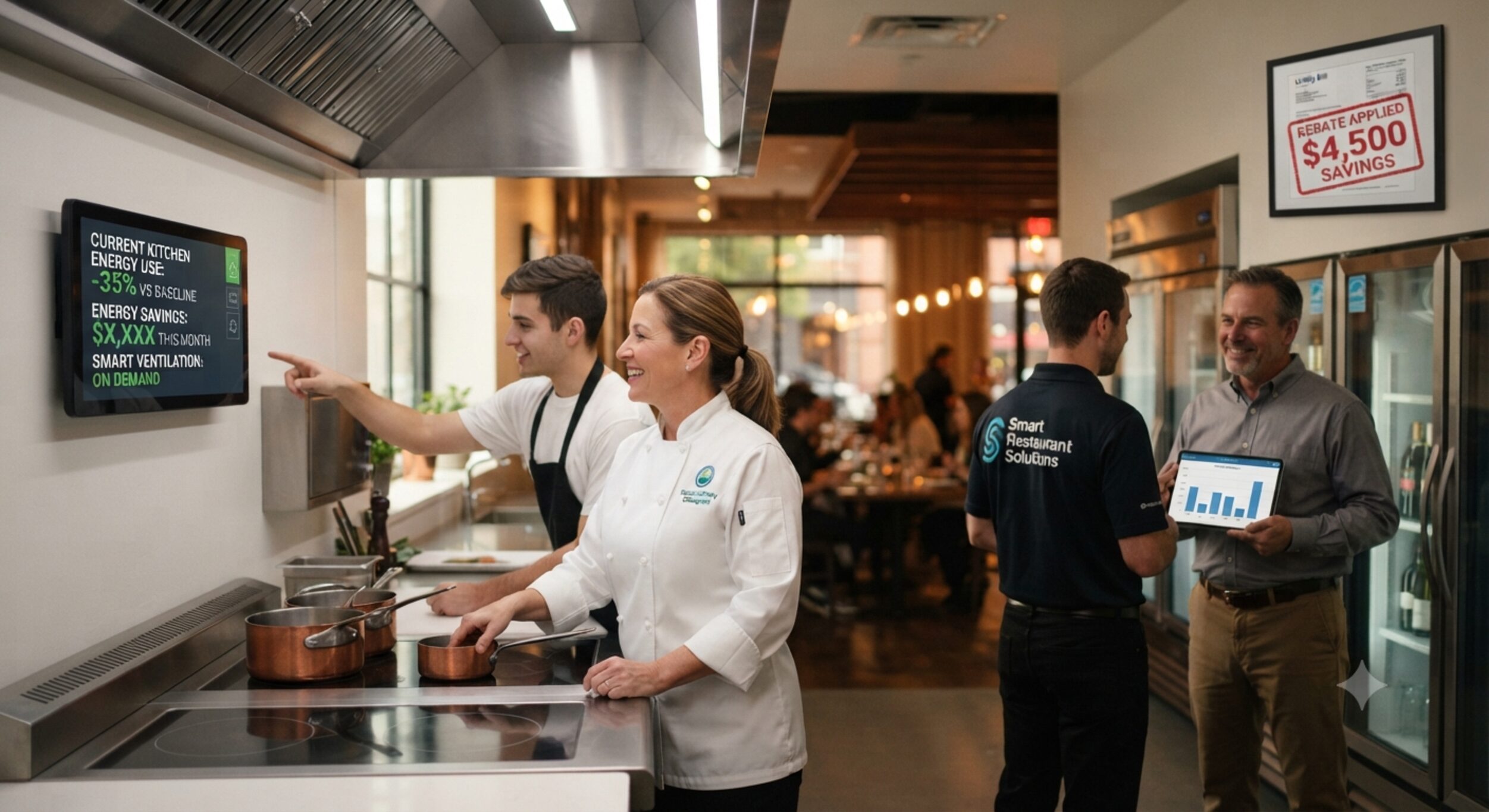

Restaurant energy costs represent 3-5% of revenue across most operations, but most owners treat electricity as a fixed cost beyond their control—missing a major profitability opportunity that can deliver $1,250-$2,000 in monthly savings through demand management, equipment optimization, and battery-backed strategies.
Restaurant Energy Costs: The Margin Crisis Hiding in Utility Bills
<cite index=”41-1″>Restaurants are energy-intensive operations. HVAC, refrigeration, commercial cooking equipment, lighting, and dishwashing collectively represent 3% to 5% of revenue for most concepts.</cite>
For a restaurant generating $1 million in annual revenue, restaurant energy costs represent $30,000–$50,000 yearly—a line item that rivals food waste or shrink. Yet unlike food purchasing or labor scheduling, most operators treat restaurant energy costs as immutable. They arrive each month, get paid, and receive minimal strategic attention.
This passive approach is costing restaurants thousands. <cite index=”43-1″>MaaS providers typically guarantee results. Minimum 10% utility reduction within 12 months or they continue service at no cost until achieved. Most restaurants exceed that minimum easily, delivering 25-40% savings that crush restaurant energy costs beyond expectations.</cite>
The math is compelling: for a typical restaurant spending $5,000 monthly on utilities, a 25-40% reduction delivers $1,250–$2,000 in monthly savings—direct profit in an industry where margins are frequently measured in single-digit percentages.
Understanding Restaurant Energy Costs: Where the Money Actually Goes
Restaurant energy cost management requires understanding what drives the bill. Most operators pay two distinct charges:
Energy charge (usage-based): This is straightforward—you consume 10,000 kWh at $0.12 per kWh = $1,200.
Demand charge (peak-based): This is where most restaurant energy costs hide. <cite index=”44-1″>Kitchen equipment drives 50-60% of usage. Peak demand from ovens, fryers, and HVAC running simultaneously spikes demand charges.</cite>
Many commercial utility rates calculate demand charges based on your peak consumption during any 15-minute window in the month. If your kitchen fires up all equipment simultaneously during lunch rush, causing a 40 kW spike for 15 minutes, you’re charged based on that peak for the entire month—even if you never hit that peak again.
For a 10,000 sq ft restaurant, this peak demand charge can represent 30-50% of the total monthly bill. This is why restaurant energy costs can feel disproportionate to actual consumption.
Restaurant Energy Costs Strategy #1: Stagger Equipment Startup and Demand Management
The single highest-ROI restaurant energy cost reduction strategy is demand charge management through equipment scheduling.
<cite index=”44-1″>Staggering equipment startup cuts demand 20-35%.</cite> Rather than starting ovens, fryers, griddles, and HVAC simultaneously at 10:30 AM before lunch service, a strategic stagger schedule works like this:
- 10:30 AM: HVAC pre-cooling begins
- 10:45 AM: Ovens and griddles fire up
- 11:00 AM: Fryers and smaller equipment activate
- 11:15 AM: Final equipment warming
This simple operational change, requiring no capital investment and no equipment replacement, can cut peak demand by 20-35%. For a restaurant with a $5,000 monthly bill, demand charges might be $1,500–$2,000. A 25% reduction saves $375–$500 monthly—$4,500–$6,000 annually—from workflow optimization alone.
Technology amplifies this strategy. Real-time monitoring systems identify exactly when demand spikes occur and alert kitchen managers to adjust equipment startup timing. No guessing, no behavioral dependency—just data-driven operational guidance.
Restaurant Energy Costs Strategy #2: LED Lighting and Efficient Refrigeration
Lighting and refrigeration represent 25-28% of restaurant energy costs combined—and both have straightforward efficiency upgrades.
Lighting: <cite index=”44-1″>LED replacements exist for virtually every restaurant application—from decorative dining room fixtures to high-bay kitchen lights. Energy savings of 50-70% versus traditional lighting are typical, with improved color rendering for food presentation.</cite>
A 3,000 sq ft restaurant with 150 lighting fixtures might spend $100–$150 monthly on lighting electricity. LED retrofit eliminates $50–$105 of that—savings that compound over the 50,000-hour lifespan of LED bulbs (no replacement labor costs either).
Refrigeration: Walk-in coolers and reach-in refrigerators run 24/7, making refrigeration efficiency crucial. <cite index=”45-1″>Walk-in cooler/freezer hygiene: clean condenser coils quarterly, replace door gaskets at first sign of wear, install strip curtains. 3-8% savings, near-zero capital.</cite>
Dirty condenser coils force the compressor to work harder, consuming 15-30% more electricity for the same cooling output. A semi-annual deep cleaning (condenser coils, evaporator fins, drain line) typically costs $150–$300 and saves $100–$150 monthly on refrigeration energy. ROI is 1-2 months.
Combined, lighting + refrigeration efficiency can trim 8-15% from restaurant energy costs—a $400–$750 monthly savings.
Restaurant Energy Costs Strategy #3: Battery Storage and Demand Response Programs
The newest and most powerful restaurant energy cost reduction tool is battery-backed demand management, combined with demand response program participation.
<cite index=”51-1″>Battery storage is the fastest growing power technology today. In 2025, 108 GW of new battery storage capacity was deployed worldwide, 40% more than in 2024. Installed capacity is now eleven times higher than in 2021.</cite>
For restaurants, battery systems work like this: batteries charge during low-demand, low-cost hours (typically off-peak evenings, early mornings, or weekends when grid pricing is lowest). When demand peaks or grid stress occurs, the battery discharges to power the restaurant, avoiding expensive peak-hour electricity rates.
The mechanism is simple but powerful: <cite index=”47-1″>Energy storage systems play a crucial role in enabling effective demand response participation. In the case of an energy storage system with an energy management system (EMS), the EMS responds to the event by dispatching during grid peak periods.</cite>
<cite index=”53-1″>Did you know your business can earn money by participating in Demand Response (DR) programs? With Briggs & Stratton commercial generators and battery systems, you can contribute to grid stability and generate new revenue streams by reducing your energy consumption during peak demand periods.</cite>
Restaurants participating in demand response programs can earn additional revenue ($500–$2,000 monthly, depending on location and program design) simply for allowing the grid operator to discharge their battery during peak demand events. The restaurant continues normal operations; the battery supply backs up a portion of power consumption.
Restaurant Energy Costs Strategy #4: Audit and Renegotiate Supplier Rates
<cite index=”46-1″>Most restaurants renew with the same provider out of convenience and end up overpaying by 15–25%. In Texas, you’re not locked in — you can force 25+ retail electricity providers to compete for your business in real time.</cite>
The mechanism: a licensed energy broker analyzes your consumption patterns and demand profile, then conducts a blind reverse auction among competing suppliers. Without knowing competitors’ bids, suppliers make competitive offers, resulting in transparent pricing that’s almost always better than one-on-one negotiation.
<cite index=”46-1″>I’ve seen Plano taco chains drop from 9.8¢/kWh to 7.4¢/kWh and Houston burger spots save $9,000–$18,000 annually on 20,000–40,000 kWh/month usage.</cite>
A 2.4¢/kWh rate reduction (from 9.8¢ to 7.4¢) on 30,000 kWh monthly usage = $720 monthly savings = $8,640 annually from rate negotiation alone, with zero operational changes.
This strategy works best in deregulated markets (parts of Texas, Pennsylvania, Ohio, Illinois, Maryland). In regulated utility monopoly states, rate options are limited, but multi-year contract negotiation often yields 5-10% reductions for large multi-unit operators.
Restaurant Energy Costs Strategy #5: Real-Time Energy Monitoring and Accountability
<cite index=”42-1″>Traditional utility management relies on monthly bill review that arrives too late for intervention, providing aggregate consumption data without the granular visibility needed to identify specific equipment, time periods, or operational practices driving excessive consumption throughout all daily operations.</cite>
Real-time monitoring platforms (sometimes called “Monitoring as a Service” or MaaS) provide sub-hourly visibility into exactly which equipment is consuming power and when. <cite index=”43-1″>For a typical restaurant spending $5,000 monthly on utilities, MaaS could deliver $1,250-$2,000 in monthly savings for a $750-$1,100 subscription cost. That is potentially $500-$1,250 monthly net profit from day one, growing as you identify additional opportunities to reduce restaurant energy costs through commercial energy monitoring.</cite>
These systems identify waste patterns: an ice machine filling at 3 AM wasting 50 gallons weekly, HVAC running during closed hours, refrigeration equipment with dirty coils, ovens not properly shutting down post-service.
The accountability structure is powerful: when kitchen managers see real-time data showing their equipment choices’ direct impact on restaurant energy costs, behavioral change follows naturally—without mandates or guilt.
Building Your Restaurant Energy Costs Reduction Plan
<cite index=”41-1″>Audit and Reduce Energy Consumption: Restaurants are energy-intensive operations. Replacing incandescent bulbs with LED, running dishwashers only at full capacity, pre-soaking dishes to reduce cycle time, and setting temperature controls appropriately for occupancy periods are low-effort changes with real cumulative impact. An energy audit every two years is worth the cost.</cite>
A practical roadmap:
Month 1: Conduct an energy audit (identify highest-consumption equipment and peak demand windows). Audit cost: $200–$500.
Months 2–3: Implement quick wins: LED retrofit in high-use areas, walk-in cooler maintenance, equipment startup staggering. Investment: $0–$5,000. Expected savings: 8-15% of current bill.
Months 4–6: Audit and renegotiate electricity supplier rates (if in deregulated market). Investment: $0 (broker-facilitated). Expected savings: 5-15% of kWh charges.
Months 7–12: Deploy real-time energy monitoring (MaaS subscription). Investment: $750–$1,100 monthly. Expected savings: additional 10-15% as staff behavior adjusts to visibility.
Year 2: Evaluate battery storage and demand response participation (if ROI justifies). Investment: $0–$30,000 (depending on system size and incentives). Expected savings: additional 5-25% plus demand response revenue.
Related
Frequently Asked Questions
Why do restaurant utility bills have demand charges if I only run equipment during service hours?
Demand charges are based on your highest peak consumption during any single 15-minute window within the billing month. If every piece of kitchen equipment fires up simultaneously at 11 AM for 15 minutes—even if this never happens again—your rate structure charges you based on that peak for the entire month. This is why staggering equipment startup is so valuable: it prevents that peak from occurring, reducing demand charges permanently. Commercial utility rates are specifically structured this way to incentivize load shifting away from peak hours.
Will LED lighting make my dining room or kitchen look worse?
No. Modern LED technology has dramatically improved color rendering. <cite index=”44-1″>LED dimmers adjust light levels for different dayparts. Bright for lunch service, dimmed for dinner ambiance.</cite> LEDs can replicate warm or cool light temperatures and integrate with dimming systems for ambiance control. Food presentation quality is unaffected; many fine-dining restaurants have successfully switched to LED. The only perceptible benefit: brighter, crisper lighting that actually improves food appearance and ambiance versatility.
If I install a battery storage system, will it interrupt service if the battery is discharging?
No. Battery systems are designed for seamless operation behind-the-scenes. The restaurant draws power from the battery when it’s discharging, but power supply is uninterrupted—customers and staff notice nothing. If the battery fully discharges, the restaurant automatically draws from the grid. The battery is a supplemental power source, not a replacement, so service continuity is guaranteed. Demand response participation works the same way: the grid operator sends a signal, the battery discharges according to a pre-programmed schedule, and the restaurant continues normal operations.
Sources
| Source | URL | Details |
|---|---|---|
| ClearCOGS | https://www.clearcogs.com/blog/cost-saving-strategies-for-restaurants/ | “25 Restaurant Cost-Cutting Strategies That Actually Work in 2026”; energy consumption 3-5% of revenue; LED and equipment optimization |
| Envigilance | https://envigilance.com/energy-monitoring/restaurant-utility-costs/ | “Restaurant Utility Costs: 5 Proven Reduction Strategies 2026”; demand charge management; real-time monitoring |
| Envigilance | https://envigilance.com/blog/restaurant-energy-costs/ | “Restaurant Energy Costs: Cut 25-40% with Monitoring 2026”; MaaS model guarantees; refrigeration and HVAC optimization |
| ElectricRates.org | https://electricrates.org/blog/restaurant-electricity-guide/ | “Restaurant Electricity Costs: $3-5/sq ft Guide (2026)”; demand charges; LED and EC motor efficiency; staggering equipment startup |
| Seenra | https://seenra.com/guides/restaurant-energy-cost-savings | “Restaurant energy costs — the 15-25% savings playbook”; energy spend allocation (cooking 35%, refrigeration 18%, HVAC 28%, lighting 10%) |
| EnergyBrokerTX | https://energybrokertx.com/blog/texas-restaurants-electricity-cost-savings-2026 | “5 Ways Texas Restaurants Can Save on Commercial Electricity Rates in 2026”; reverse auction; rate negotiation; supplier competition |
| Energy Toolbase | https://www.energytoolbase.com/blog/energy-storage/demand-response-and-dr-programs/ | “Demand Response and Demand Response Programs”; energy storage systems; EMS dispatch during peak periods |
| Briggs & Stratton Energy Solutions | https://energy.briggsandstratton.com/en-us/commercial/markets-applications/demand-response | “Demand Response Programs”; battery systems for grid participation; revenue incentives for peak reduction |
| IEA Global Energy Review 2026 | https://www.iea.org/reports/global-energy-review-2026/technology-battery-storage |