
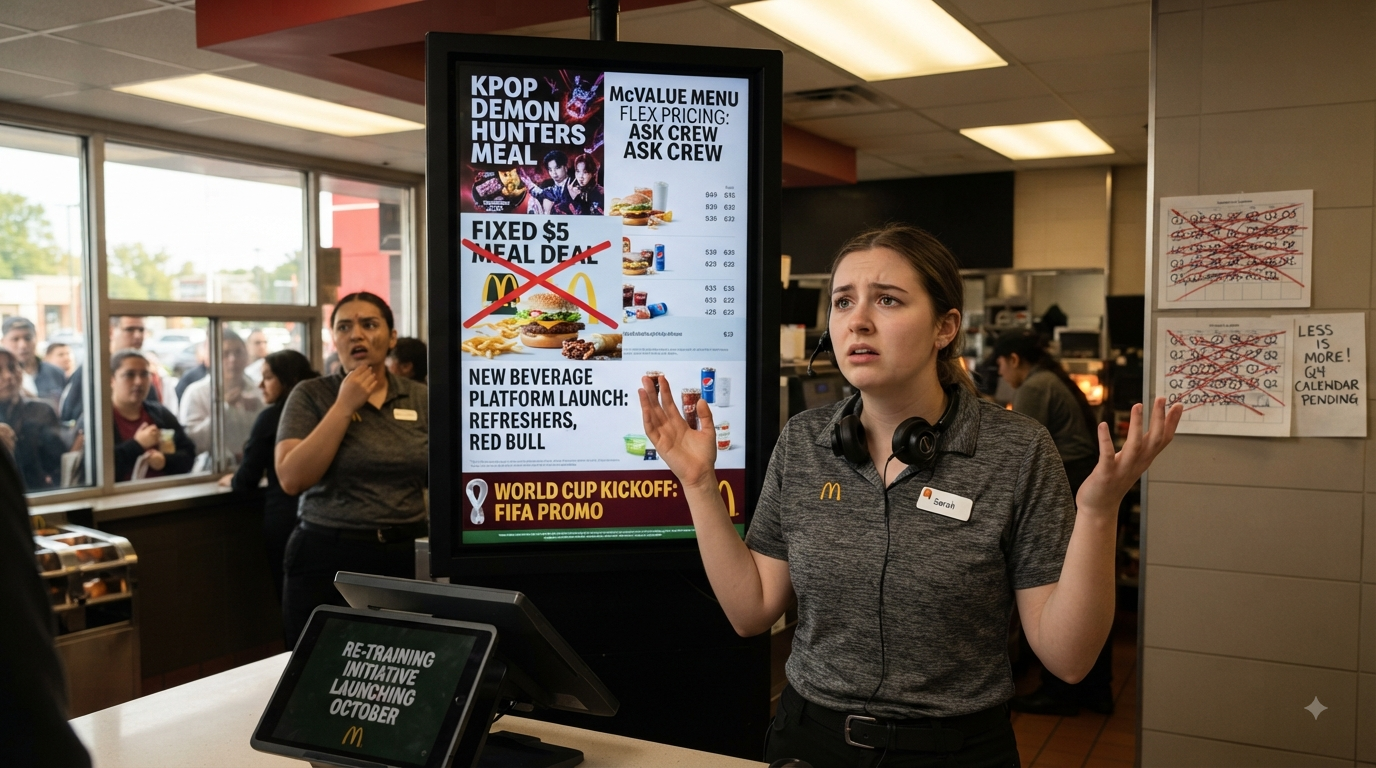

McDonald’s is overhauling its promotional calendar after admitting that too many overlapping campaigns overwhelmed restaurant crews and drove down US customer traffic in the second quarter.
What Went Wrong In The Second Quarter
McDonald’s US comparable sales rose just 0.8% in the quarter, down sharply from 2.5% growth in the same period a year earlier, with the shortfall driven entirely by fewer guest visits rather than weaker spending per visit. CEO Chris Kempczinski was direct about the cause: not a strategy failure, but an execution one, with restaurant teams overwhelmed by the sheer number of initiatives layered on top of each other.
His breakdown of the quarter’s calendar illustrates the problem. Crews trained on a KPop Demon Hunters meal promotion, then pivoted three weeks later to a McValue menu overhaul that pulled familiar digital deals customers had come to expect, then absorbed a full beverage platform launch in early May, then shifted again for a FIFA World Cup campaign in June that underperformed expectations. Each initiative got roughly a three-to-four week window before the next one arrived, leaving little room to build customer awareness or let staff get comfortable with execution.
There was also a pricing wrinkle inside the value menu redesign. Unlike the fixed $5 Meal Deal it replaced, the newer flexible pricing format gave franchisees latitude on individual item pricing, and some operators used that flexibility to raise prices on items like small fries rather than lower them, compounding customer confusion around where the actual deals were. Executives said the combined impact of the value menu changes and execution issues accounted for roughly two-thirds of the quarter’s traffic underperformance.
The Response: Fewer, Better-Spaced Campaigns
McDonald’s says it’s now applying tighter scrutiny to its remaining 2026 promotional calendar, prioritizing initiatives crews can actually execute well over ones that look strong on paper. That includes restoring digital offers that were pulled during the value menu transition and reallocating marketing spend toward proven value formats like Extra Value Meals rather than one-off campaign tie-ins.
The company has also set a longer-term fix in motion: a companywide retraining initiative launching in October, reaching more than 2 million restaurant crew members, corporate staff, and supplier partners, focused on consistency in taste, quality, and hospitality execution. Management has been careful not to promise an immediate turnaround — comparable sales were still negative in July, and the CFO described Q3 adjustments as a mixed bag given the quarter was already underway when changes started. The full set of corrective measures isn’t expected to be simultaneously in place until the fourth quarter.
Beverage Platform Is The Bright Spot
While the promotional calendar drew criticism, McDonald’s new beverage lineup — cold coffee, craft sodas, refreshers, and Red Bull energy drinks — is performing in line with expectations. Germany was the only market with the full lineup live during the quarter, with the US and Canada gaining Red Bull products later in August following the initial May launch across the US, Canada, and Germany, and Australia joining in July.
More than half of beverage traffic is landing after the traditional lunch rush, which McDonald’s is reading as genuinely incremental business rather than customers simply swapping one order for another. The average check on beverage-inclusive orders is running about 50% above the full-day average, reinforcing the case for treating beverages as a distinct growth lever rather than a side addition to the existing menu.
Buyer And Procurement Implications
For suppliers and foodservice partners working with McDonald’s or comparable QSR accounts, the takeaway is that promotional cadence and execution capacity are now explicit planning constraints, not afterthoughts. Vendors supporting limited-time offer ingredients, packaging, or merchandising should expect more conservative, better-spaced campaign calendars going forward, with fewer simultaneous SKU or format changes hitting restaurants at once.
The beverage platform’s after-lunch traffic pattern is also worth watching for ingredient and equipment suppliers tied to that category, since McDonald’s is treating it as a genuine new daypart opportunity rather than a promotional add-on — likely meaning sustained rather than campaign-length demand. Suppliers tied to value-tier menu items should also note the pricing flexibility issue raised this quarter; expect McDonald’s corporate to push for tighter, more standardized pricing guardrails with franchisees on value formats going forward, which could affect how flexible future limited-time or value promotions are at the ingredient-cost level.
FAQ
Why did McDonald’s US traffic decline in the second quarter?
McDonald’s attributed the decline mainly to overlapping promotional campaigns that overwhelmed restaurant crews, along with a value menu redesign that pulled familiar digital deals and, in some cases, let franchisees raise prices on individual items.
Is McDonald’s cutting back on promotions going forward?
McDonald’s says it’s applying more scrutiny to its remaining 2026 calendar to avoid overloading restaurant teams, though it hasn’t said promotions will be less frequent overall — the focus is on spacing and execution feasibility.
How is the new McDonald’s beverage platform performing?
The beverage lineup, including cold coffee, craft sodas, refreshers, and Red Bull products, is meeting expectations, with more than half of beverage traffic occurring after lunch and beverage-inclusive orders carrying roughly a 50% higher average check than the full-day average.
Sources
- QSR Magazine (attributed article), “McDonald’s rethinks promotions after traffic slowdown,” Aug. 10, 2026
- CNBC, “McDonald’s (MCD) Q2 2026 earnings,” Aug. 4, 2026
- Yahoo Finance, “McDonald’s Q2 2026 earnings: U.S. same-store sales slow, new U.S. president named”
- TechTimes, “McDonald’s US Traffic Sinks 4.5%, Triggering Leadership Change at Largest Unit”
- TechTimes, “McDonald’s Admits Value Menu Design Let Franchisees Raise Prices, Erasing Loyal Customers”