
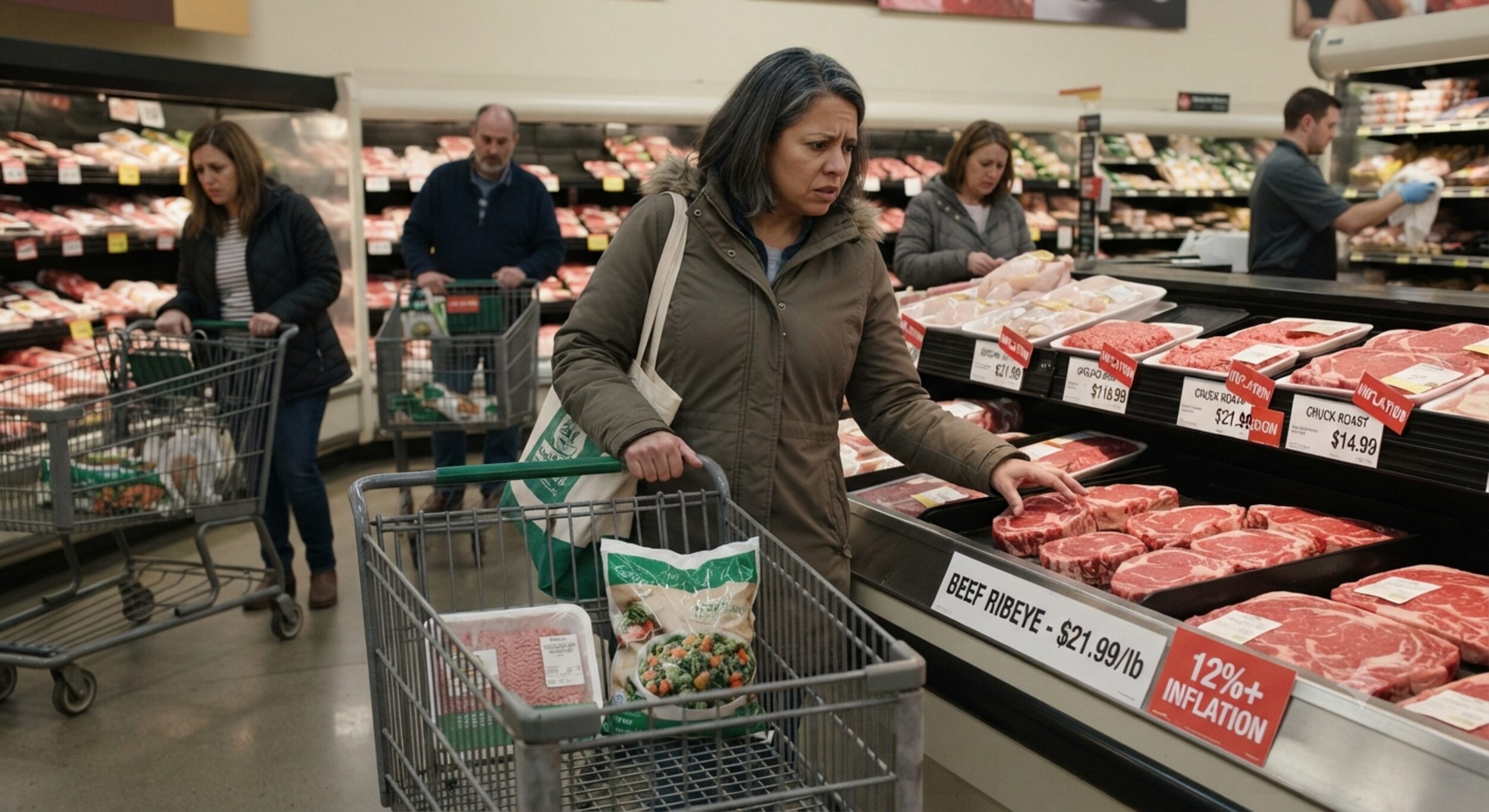

U.S. shoppers purchased 2.3% fewer pounds of fresh and processed meat in June than a year ago, as beef prices surged 12% year-over-year—signaling a consumer price ceiling and forcing retailers, foodservice operators, and suppliers to recalibrate meat department strategies mid-year.
Meat Volume Decline: The Data Behind June’s Pullback
U.S. grocery shoppers bought fewer pounds of fresh and processed meat in June than they did during the same month a year ago, building on a smaller decline in May, according to Circana sales data published by 210 Analytics.
The June meat volume decline is significant because it represents acceleration of a trend: May saw approximately 1% volume decline; June deteriorated to 2.3%. This isn’t seasonal fluctuation. It’s price-driven demand destruction.
Total meat department volume was off by 2.3% last month, although sales for the category rose by more than 1% as prices continued to rise.
This divergence is critical: meat volume fell while dollar sales rose. That’s not a healthy market signal. It means retailers are capturing incremental revenue through higher prices, but consumers are responding by purchasing less meat per visit. For procurement teams, this indicates elasticity constraints: consumers won’t sustain current price levels indefinitely.
Beef Price Inflation Driving Volume Loss
The proximate cause of meat volume decline is beef. Meat prices rose sharply overall in June, led by beef and veal, which saw year-over-year inflation of almost 12%, according to the U.S. Bureau of Labor Statistics. Prices for uncooked beef roasts rose almost 14%, while uncooked ground beef prices were up more than 12%.
For context: 12% annual beef price inflation is extraordinary. Most food categories experience 2-4% annual inflation. Beef at 12%+ represents a structural market imbalance between supply and demand.
The meat volume decline is bifurcated:
Processed meat took the hardest hit: Packaged lunchmeat volume fell 9%, frankfurters dropped 8%, and bacon declined nearly 6%. Only dinner sausages posted gains. Processed meat took a bigger hit than fresh meat in June as shoppers continued to deal with higher prices for many animal products.
Processed meats are price-sensitive categories. Consumers have readily available substitutes (poultry, legumes, eggs). When lunchmeat prices spike, shoppers switch products immediately.
Fresh meat showed more resilience: Beef volume declined 2%, but chicken dropped less than 1% and turkey volume increased 3%. Fresh meat volume, meanwhile, fell in June by a more modest 1.4%, as beef volume dropped almost 2% and veal by 12%. By contrast, the number of pounds of chicken sold was off by less than 1% and fresh turkey volume moved up nearly 3%, suggesting that people are shifting to those proteins as costs for other kinds of meat go up.
This substitution pattern is economically rational: beef prices are rising sharply, so price-conscious consumers switch to relatively stable alternatives.
The Meat Volume Decline Isn’t a One-Month Phenomenon
The June meat volume decline follows a May decline, suggesting a structural shift rather than seasonal noise. The category’s more than 2% volume drop in June was significantly higher than the approximately 1% decrease in May, when the decline for processed meat also outpaced the level for fresh meat, according to the market research firm.
Looking backward, meat volume is still above 2-year-ago levels—indicating the market hasn’t reached crash territory. But the month-over-month acceleration (1% in May → 2.3% in June) signals consumer resistance intensifying.
For USDA beef supply forecasts, this matters. Beef is now seen at 25.547 billion pounds, down 243 million from April due to the tight supply of ready numbers, with the average steer price estimated at $249.66 per hundredweight, up $8, and higher imports and consumption against lower exports.
Tight supply is driving prices higher, which is driving volume demand lower. This creates a self-reinforcing squeeze: processors reduce production due to tight cattle supplies, which drives prices up, which depresses consumer demand, which reduces processor orders.
Beef Supply Tightness: The Root Cause of Meat Volume Decline
The meat volume decline isn’t a mystery—it’s the inevitable consequence of tight beef supplies colliding with high prices.
Looking ahead, 2026 is expected to usher in a period of demand consolidation after the rapid growth of recent years. Retail beef prices should stabilize between $9.00 and $9.50 per pound, while the composite cutout averages near $350/cwt. Placements will be constrained by limited calf availability, modest heifer retention, and the continued absence of Mexican feeder imports—a wildcard that could shift the supply picture dramatically once the border reopens. Current expectations are for a phased reopening sometime in 2026, potentially adding 1.2 million head annually. Until then, fed cattle slaughter will remain tight, falling another 600,000 head in 2026 after a 1.4 million head drop in 2025.
The beef herd contraction is multi-causal: drought impacts on feed availability, low calf crops, producer profitability compression, and regulatory headwinds all constrain cattle supplies. These constraints aren’t temporary. Rebuilding a herd takes 3-5 years.
For beef prices, this means: don’t expect relief in 2026. And there’s no sign of stopping: August ground beef prices sat at $6.3 per pound, compared to July’s $6.25 per pound. Even small month-over-month price increases compound into large annual increases.
Meat Volume Decline and Pork/Poultry: The Divergence
Interestingly, beef isn’t the only meat category pressured, but it’s the only one seeing volume decline. On the other hand, pork prices were up last month by only 2.4%, with bacon and related products down by 1.5%. Poultry prices, meanwhile, were flat.
Pork and poultry are holding their own because supply/demand balance is more favorable:
Pork: Herd sizes are stable, feed costs are moderate, and exports are steady. Pork prices rose only 2.4% (vs. beef’s 12%), so demand destruction isn’t occurring.
Poultry: Broiler production is strong, prices are flat year-over-year, and consumer substitution from beef is actually supporting poultry volume.
The meat volume decline is beef-specific, which explains why foodservice and retail operations are more focused on poultry substitution menus and promoting pork alternatives.
Meat Volume Decline Impact on Retail, Foodservice, and Suppliers
The meat volume decline has cascading implications:
Retail: Meat department traffic is declining (fewer shoppers, smaller basket), but dollar sales are rising (higher prices). This creates margin opportunity on a dollar basis but operational risk: if price increases accelerate further and volume declines accelerate, profit dollars could compress as mix deteriorates.
Foodservice: Menu engineering becomes critical. Protein costs are the highest controllable expense in most foodservice operations. As beef prices rise 12%+ annually, foodservice operations are forced to reduce portion sizes, substitute proteins, or accept margin compression. Competitive pressure limits price-passing to consumers.
Suppliers: Beef exporters facing reduced domestic demand will seek export markets. The outlook for 2026 beef imports is lowered 50 million pounds from last month to 6.059 billion pounds. Exports are revised 10 million pounds lower in 2026 to 2.331 billion pounds. Lower exports mean more domestic supply available—potentially moderating price increases, but also creating competitive pressure on domestic processors.
Meat Volume Decline and Overall Grocery Deflation Risk
The meat volume decline doesn’t exist in isolation. Meat volume moved down in June as grocers also faced pressure in other categories. Overall, the number of grocery products sold in the U.S. was down by almost 2% last month compared with the same period in 2025, Bain & Company reported in an analysis of data from NielsenIQ.
Consumers are buying less of nearly everything—not just meat. This suggests broader price elasticity: consumers are hitting affordability ceilings across categories, and private label adoption is accelerating. Retailers and suppliers need to account for potential deflationary pressure if consumers continue cutting volumes.
Related
Frequently Asked Questions
If beef prices are so high, why are retailers seeing dollar sales growth?
Retailers experience dollar sales growth when prices rise faster than volume declines. If beef prices rise 12% and volume falls 2%, retailers capture roughly 10% incremental dollar revenue. However, this dynamic is unsustainable long-term. Consumer price sensitivity has a ceiling: at some point, shoppers either stop buying beef entirely or purchase significantly smaller quantities. June’s 2.3% volume decline suggests consumers are approaching that ceiling. If prices continue rising while volume falls accelerating, dollars will eventually flatten or decline.
Why did processed meat suffer more than fresh meat in the meat volume decline?
Processed meats (lunchmeat, bacon, frankfurters) are convenience/discretionary purchases with readily available substitutes. Fresh meat (beef roasts, ground beef) is often a planned protein for dinner meals with fewer substitutes in the minds of many consumers. When prices spike, shoppers cut discretionary purchases first. Additionally, many processed meat products have lower income elasticity—lower-income consumers buy them more frequently, and those consumers are most price-sensitive. Fresh meat has higher income elasticity, so price spikes reduce volume more slowly in affluent segments.
Will the meat volume decline persist if beef prices remain elevated through 2026?
Likely yes, with possible acceleration. If beef prices stabilize at current levels (12%+ above year-ago), volume decline should stabilize around 2-3%. However, if beef prices continue rising (as some forecasts suggest), volume decline will likely accelerate toward 5%+ as more consumers abandon beef. Conversely, if beef prices plateau and even begin moderating later in 2026, volume decline should flatten and potentially reverse by year-end. Procurement and foodservice teams should monitor USDA herd size reports and cattle price forecasts monthly to anticipate volume/price dynamics.
Sources
| Source | URL | Details |
|---|---|---|
| Grocery Dive | https://www.grocerydive.com | Sam Silverstein reporting; July 22, 2026; Circana/210 Analytics meat volume data; June 2026 |
| Bureau of Labor Statistics | https://www.bls.gov | June 2026 CPI report; beef/veal inflation 12% YoY; ground beef prices +12%, roasts +14% |
| Brownfield Ag News | https://www.brownfieldagnews.com | “USDA lowers 2026 beef production”; May 12, 2026; beef production 25.547B lbs; steer price $249.66/cwt |
| Beef It’s What’s For Dinner | https://www.beefitswhatsfordinner.com | “2026 Beef Market Trends”; retail prices $9.00-$9.50/lb; fed cattle slaughter decline 600k head; herd rebuild timeline |
| Beef Magazine | https://www.beefmagazine.com | “Beef demand jumped in 2025. What about 2026?”; beef demand index 138; domestic production 26B lbs (-4%); imports 5.5B lbs (+18%) |
| USDA Economic Research Service | https://www.ers.usda.gov | “Cattle & Beef – Market Outlook”; slaughter steer price $251.10/cwt (2026); beef imports 6.059B lbs; exports 2.331B lbs |
| The Food Institute | https://foodinstitute.com | “Beef Prices Shock Food Inflation Metrics”; ground beef $6.3/lb August; consumer pullback to poultry/pork |
| CBS News | https://www.cbsnews.com | “Beef, that all-American food, is getting harder for Americans to afford”; April 2026; beef prices +10-18% forecast |
| AOL/USDA | https://www.aol.com |