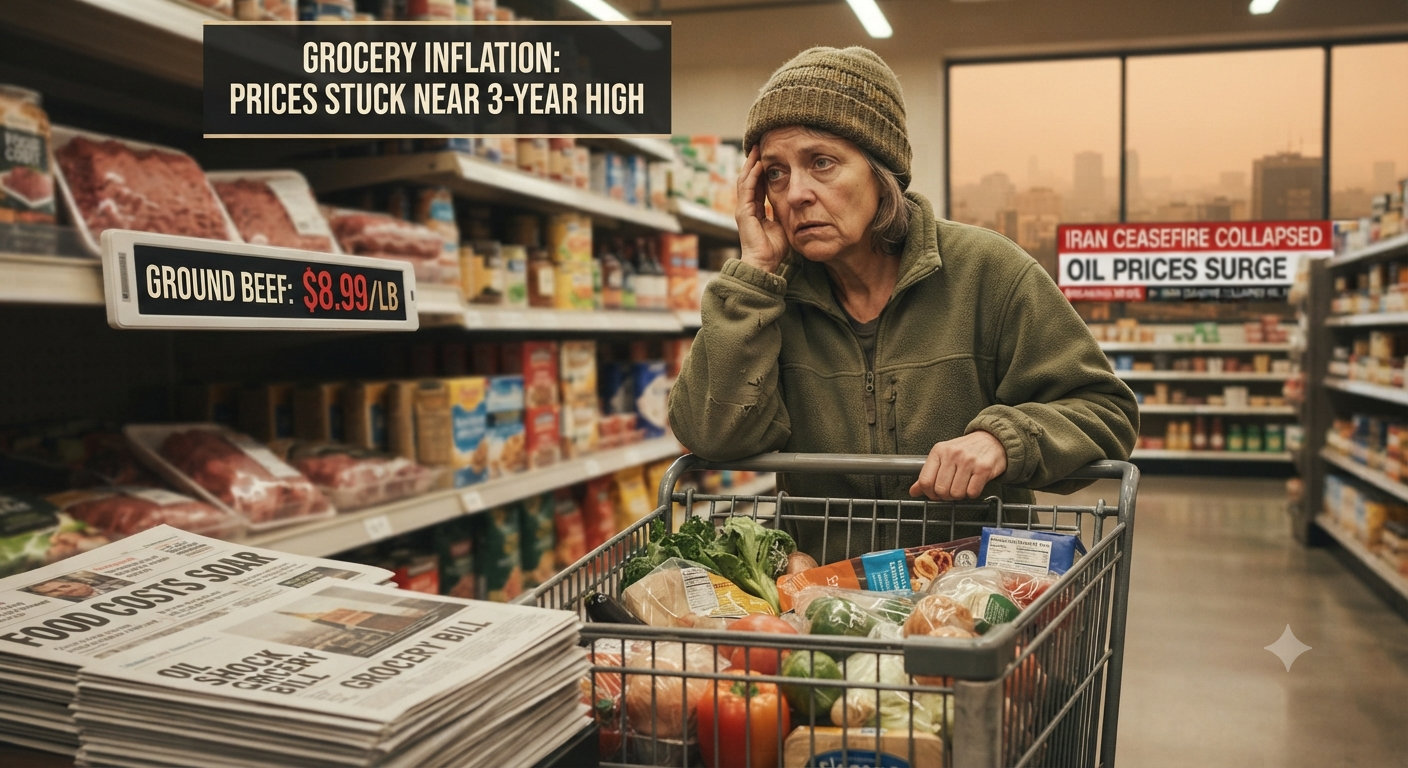

Grocery prices have been running hot for months, and the one thing that looked like it might ease the pressure — a winding-down war in the Middle East — just reversed course. On July 8, President Trump declared the U.S.-Iran ceasefire “over” after the two countries exchanged fresh strikes, sending oil prices up roughly 7-8% in a single session and wiping out weeks of price stability in crude markets. For an industry where fuel, freight, and packaging costs move in lockstep with oil, that’s not background noise — it’s a direct input into what groceries cost next.
Table of Contents
The May Inflation Numbers
Food-at-home prices rose 2.7% year-over-year in May, according to the Consumer Price Index released by the Bureau of Labor Statistics — down slightly from April, but still hovering near the three-year high of 2.9% recorded that month. Overall inflation hit 4.2% in May, its highest level in three years, with energy prices responsible for more than 60% of the monthly increase. Strip out food and energy, and core prices were still up 2.9% year-over-year — the largest core increase since September.
That headline number is outrunning paychecks. Wage growth measured 3.4% as of the end of April, meaning the typical household is losing ground even before accounting for the specific categories — gas, food, electricity, medical care — that Navy Federal Credit Union chief economist Heather Long flagged as running hottest. Energy was the biggest mover: gasoline prices were up 40.5% year-over-year and fuel oil jumped 58.9%, but the pain wasn’t confined to the pump. Apparel rose 4.8%, shelter climbed 3.4%, and electricity was up 5.9%.
Which Groceries Are Actually Getting More Expensive
The category-level detail is where grocery shoppers feel it most directly. Tomato prices were up 32% year-over-year in May, instant coffee jumped 24%, and beef and veal prices rose about 13%. Eggs were the rare bright spot, down more than 35% from the same month in 2025 as flock recovery continued following prior avian-flu disruptions.
That divergence lines up with USDA’s own Food Price Outlook, which projected 2026 beef and veal prices up 12.1% at the midpoint for the year — making beef the most persistent pressure point on the protein aisle — while forecasting eggs down nearly 30% at the midpoint, a genuine relief category even as most of the rest of the cart gets more expensive.
Bank of America economists, writing ahead of the BLS release, argued that tariff-driven inflation had largely run its course by May, but warned that supply-chain pressure was building from the Iran war — a call that looks more prescient with each new escalation.
Consumers Are Running Out of Room to Absorb It
U.S. consumer sentiment fell to its lowest level in four years, according to the Numerator Consumer Sentiment Tracker, with more people expecting their finances to worsen over the next year than expecting improvement. The decline spanned generations and ethnic groups — this isn’t a narrow demographic story, it’s broad-based fatigue with the cost of living.
Heather Long’s read on the outlook is blunt: even a resolution to the Iran conflict wouldn’t bring fast relief. “Ending the war in Iran will help to moderate inflation, but the worst is likely still to come for rising food prices,” she said in emailed comments accompanying the May data. That warning was written before this week’s ceasefire collapse — which makes the “worst still to come” framing look considerably more likely than it did a month ago.
The Wildcard That Just Got Worse
The Iran conflict has been the single biggest wildcard in the 2026 inflation picture since it began in late February, driving the largest disruption to global oil markets in recent history and, at its peak, cutting off a meaningful share of Strait of Hormuz shipping traffic. A ceasefire and follow-up memorandum of understanding in April and June had allowed oil prices to fall roughly 20% from their 2026 highs and given economists like Bank of America room to argue the worst of the energy shock was behind the market.
That calm broke this week. After a series of attacks on vessels transiting the Strait of Hormuz, the U.S. revoked a waiver that had allowed Iran to sell crude, launched fresh strikes, and Trump told reporters at the NATO summit in Ankara that he considers the ceasefire finished and further strikes likely. Brent crude jumped nearly 8% to around $80 a barrel on the news, U.S. stock indexes fell more than 1%, and the Dow dropped several hundred points intraday. Market strategists described the renewed uncertainty as fading the prospect of a swift return to pre-conflict energy and goods flows through the strait — precisely the scenario that had been supporting hopes for inflation relief.
For food and beverage companies, the read-through is straightforward: fuel surcharges, ocean and trucking freight costs, and petroleum-linked packaging inputs are all exposed to this volatility, and the direction just turned unfavorable again after months of gradual improvement.
How Retailers Are Responding
Faced with a consumer who is increasingly done absorbing higher prices, food retailers have moved from occasional promotions to structural price investment.
Walmart and Sam’s Club rolled out price cuts across grocery, household essentials, and several other departments in early July, including a nearly 12% cut on Walmart’s 73% ground beef roll, from $6.74 to $5.94. Sam’s Club cut prices on more than 250 items, including private-label bone-in chicken wings, beef hot dogs, and ground beef. President Trump publicly credited the move to his own request on Truth Social, though Walmart’s own announcement made no reference to the administration.
Kroger is preparing what CEO Greg Foran has described as the company’s biggest price cuts in years, funded through direct importing and technology-driven cost reduction rather than simply eating margin. The move is explicitly defensive: Kroger has been losing share to Walmart, Costco, Amazon, Aldi, and Trader Joe’s, and traditional supermarkets as a group lost roughly 40 basis points of market share in the twelve months through February 2026.
Aldi is leaning into the same dynamic from the opposite direction, opening more than 180 new U.S. stores this year while continuing to position its no-frills model as the antidote to sticker shock. Target has focused its own price reductions on everyday essentials, cutting prices on roughly 3,000 products earlier this year. Within the Ahold Delhaize USA family, Stop & Shop finished rolling out lower everyday prices across its full fleet of more than 350 stores, while sister chain Food Lion ran a three-week loyalty savings event offering up to 50% off select products.
GlobalData Retail managing director Neil Saunders sees this less as a series of isolated promotions and more as a shift in what shoppers now expect. Temporary price cuts help at the margin, he noted, but what shoppers really want is confidence that the whole basket won’t be excessive — a bar that favors retailers investing in consistently low prices over one-off deals.
How Consumers Are Responding
Shoppers aren’t just waiting for retailers to blink. According to McKinsey’s State of Grocery North America 2026 report, 51% of shoppers say they’ve cut impulse purchases in the last three months, 47% have shifted toward private label, 43% are relying more on promotions, and another 43% are comparing prices more carefully before buying. Beyond that, 35% report delaying purchases, 34% are buying in bulk to stretch value, and 22% say they’re trading down on fresh or premium items.
The behavioral shift shows up in the growth numbers too: private label sales are growing roughly three times faster than national brands, and grocery growth overall is increasingly coming from more frequent, smaller shopping trips rather than bigger baskets — a sign that households are managing cash flow trip-by-trip rather than stocking up.
What’s Next
The next major data point lands July 14, when BLS releases June’s CPI report — the first full read on prices since the ceasefire’s initial signing in April and the first that will show whether June’s relative calm in energy markets showed up in the numbers before this week’s escalation undid it. Beyond that, the size and duration of this week’s Iran-Iraq-Gulf flare-up will matter more to food companies’ cost structures than almost any single domestic policy decision on the table right now — a reminder that, for an industry this exposed to global energy and freight costs, geopolitics is now a core input cost, not a side story.
Is grocery inflation getting better or worse right now?
It’s mixed and fragile. Food-at-home inflation actually ticked down slightly in May, but it’s still sitting near a three-year high, and the energy-driven pressures that economists expected to ease have just reversed following this week’s collapse of the U.S.-Iran ceasefire.
Why did oil prices spike this week, and does that affect food prices?
President Trump declared the U.S.-Iran ceasefire “over” on July 8 after the two countries exchanged strikes and the U.S. revoked a waiver allowing Iran to sell crude oil. Oil prices jumped roughly 7-8% on the news. Since fuel, freight, and many packaging inputs are priced off crude oil, sustained increases tend to work their way into food costs over the following months.
Which grocery items are rising the fastest?
As of the May CPI report, tomatoes (+32% year-over-year), instant coffee (+24%), and beef and veal (+13%) were the standout increases. Eggs were a notable exception, down more than 35% year-over-year as flock recovery continued.
Why are eggs getting cheaper while beef gets more expensive?
Egg prices are recovering from earlier avian-flu-related flock losses, so supply is normalizing. Beef faces the opposite dynamic — tight cattle supplies following years of herd reduction — and USDA’s own Food Price Outlook projects beef and veal prices up around 12% for 2026, even as it forecasts eggs down nearly 30%.
What are retailers actually doing to offset inflation for shoppers?
Walmart and Sam’s Club cut prices on hundreds of grocery items in July, including a nearly 12% reduction on ground beef. Kroger is preparing its largest price cuts in years, funded through direct importing and cost efficiency rather than margin sacrifice. Aldi, Target, Stop & Shop, and Food Lion have all made similar moves, reflecting an industry-wide shift toward sustained price investment rather than one-off promotions.
Will ending the Iran conflict actually bring inflation down?
Economists including Heather Long of Navy Federal Credit Union have said a resolution would help moderate inflation but wouldn’t reverse it quickly — food price pressure was expected to persist regardless. That caution looks more warranted now that the ceasefire has broken down rather than moved toward a permanent deal.