
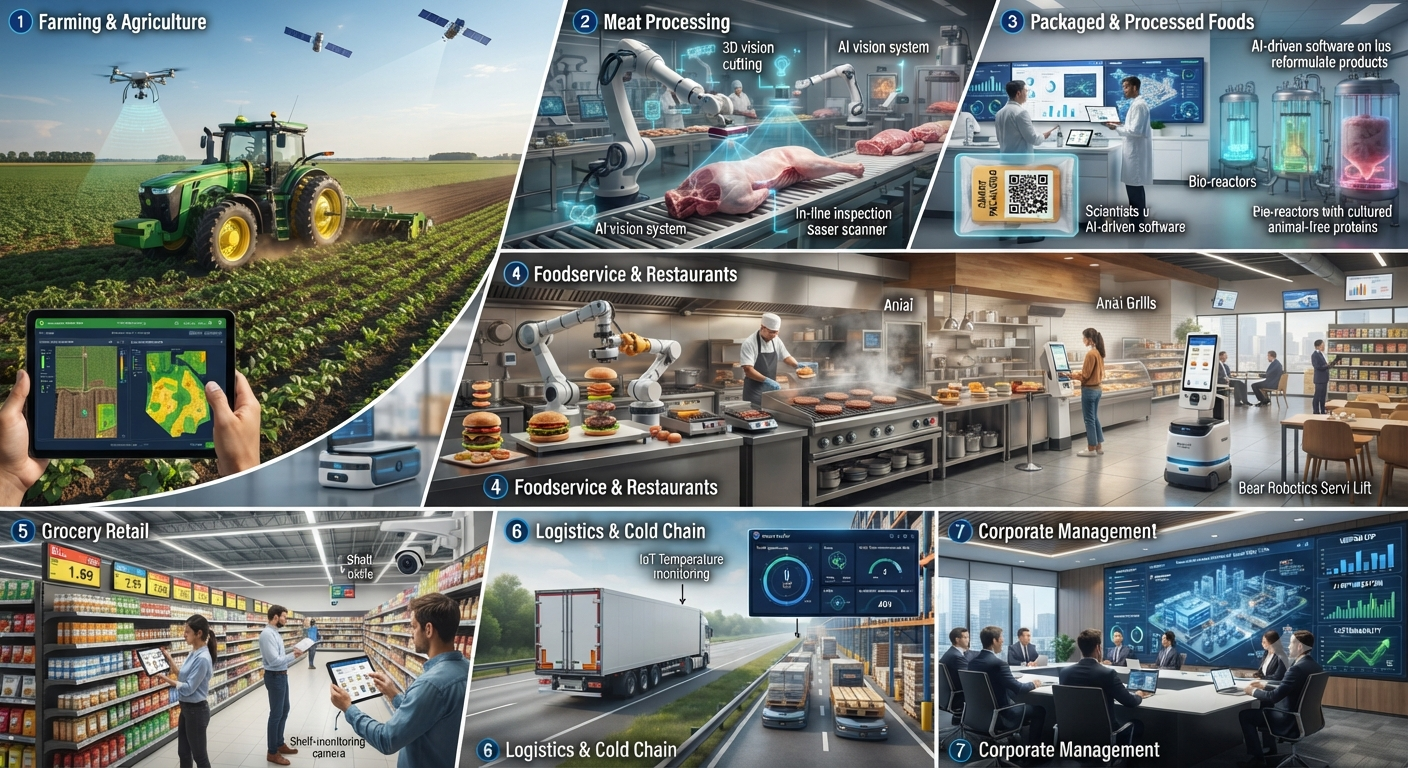

The Food and Beverage Technology Innovation is in a transformation phase. With the global market valued at roughly $9.79 trillion in 2026 and projected to climb toward $11.78 trillion by 2031, competitive pressure, labor scarcity, and rising input costs are pushing operators to modernize faster than ever. The Institute of Food Technologists estimates that half of all food and beverage companies plan significant investments in AI and supply chain technologies in 2026 — a signal that the sector has moved from reactive adaptation to structural, tech-enabled reinvention.
This report walks the entire value chain — from the field to the boardroom — detailing the innovations changing how food is grown, processed, packaged, sold, moved, and managed. Each segment covers the technologies that matter now, the commercial drivers behind adoption, and where the frontier is heading.
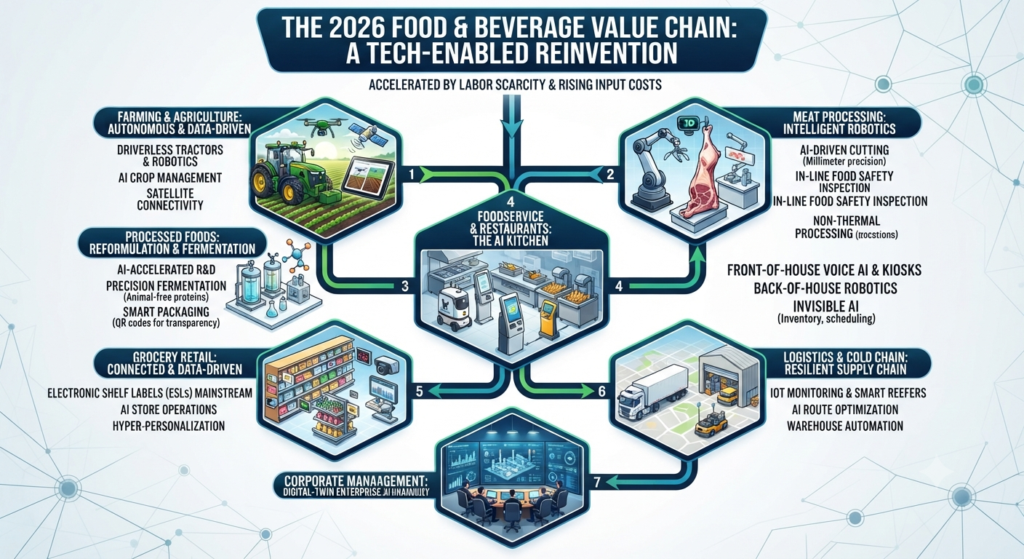
Table of Contents
1. Farming and Agriculture: The Autonomous, Data-Driven Field
Agriculture is arguably where the technology curve is steepest. Precision agriculture — the practice of tailoring inputs to the exact needs of each location and crop — has become the organizing principle for modern farming, powered by GPS, sensors, drones, data analytics, and artificial intelligence.
Autonomous machinery and robotics
Driverless tractors, robotic harvesters, and AI-powered sprayers are moving out of R&D and into commercial fields. The global autonomous farm equipment market is projected to reach $55.3 billion by 2032, and industry forecasts suggest that more than 35% of U.S. field tractors could offer autonomous operation by 2026. John Deere’s Autonomous 8R tractor — built on the autonomy stack of acquired startup Bear Flag Robotics — entered commercial use for large-scale row-crop tillage in the U.S. Midwest, a clear sign that venture capital innovation is now blending directly with legacy equipment makers.
The economics are compelling: some fully AI-driven electric tractors use computer vision to let a single operator oversee a fleet of up to eight machines at once, sharply reducing labor needs and enabling timely operations like harvesting exactly when crops are ready. Purpose-built robots are proliferating — machines designed specifically for orchards, vineyards, high-value vegetables, and broadacre operations, rather than generic all-purpose units.
AI, machine vision, and smart inputs
AI has become the connective layer linking agricultural technologies across the entire production cycle. Machine-vision harvesters identify ripe crops (tomatoes, berries, apples) and pick them with increasing precision. Laser weeders and AI tillage robots read soil density and moisture in real time, adjusting plowing depth to minimize soil damage. By deploying precise inputs, optimized irrigation, and early pest detection, farmers can sharply cut water, fertilizer, and pesticide use — lowering costs and reducing pollution runoff simultaneously.
Connectivity, satellites, and data platforms
Satellite-based precision farming, IoT sensor networks, and farm-management software are enabling earlier stress detection, smarter input timing, and more predictable yields even under climate volatility. Over 70% of large crop farms are expected to adopt satellite-based precision technologies as connectivity spreads, and telematics systems increasingly deliver precision sowing and tillage data straight to a farmer’s phone — even in low-connectivity regions. Flexible financing models are helping lower the barrier to entry for these capital-intensive tools.
2. Meat Processing: From Mechanical Automation to Intelligent Robotics
Meat processing has historically been among the hardest food segments to automate because of the natural variability of carcasses and the delicate handling of soft, slippery tissue. That barrier is finally falling — and the breakthrough is coming from software rather than mechanical engineering.
3D vision and AI-driven cutting
For cutting and deboning, processors are shifting from simple electromechanical systems to smart robots guided by artificial intelligence. The pivotal enabling technology has been 3D vision and camera systems: where older 2D machine vision struggled with alignment accuracy (70–80% success), 3D point-cloud systems now achieve 85–92% precision through spatial mapping and dual-robot coordination. Deep-learning methods improve robustness against anatomical variability, making high-throughput, fully automated carcass processing increasingly viable. Smart-cutting precision has been refined to the millimeter level.
In-line inspection and food safety
AI-powered vision systems now perform in-line product inspection with greater consistency and speed than manual labor, addressing weak points in human inspection. Advanced biosensors and spectroscopy tools integrated with AI algorithms enable real-time detection of microbial pathogens, antibiotic residues, and spoilage. Startups like HyperSpectral deploy AI-powered spectroscopy to identify contaminants through rapid scans.
Non-thermal processing and Industry 5.0
Beyond robotics, non-thermal processing techniques are reshaping quality and shelf life. High-pressure processing (HPP) enhances protein functionality in cured meats while inactivating microorganisms and extending shelf life; pulsed electric field (PEF) sterilization achieves efficiency exceeding 90%; and ultrasonic-assisted marinating cuts processing time dramatically. IoT real-time monitoring, blockchain-enhanced traceability, and digital twins round out a “Meat Industry 5.0” that combines multimodal sensors (vision, tactile, spectroscopy) with AI for real-time decision-making — while flexible, modular automation cells allow gradual integration into existing plants.
3. Packaged and Processed Foods and Beverages: Reformulation, Fermentation and Smart Packaging
The center of the store is being reformulated in real time, driven by health-conscious consumers, the GLP-1 effect, and a wave of biotechnology.
AI-accelerated formulation and R&D
AI has shifted from an experimental add-on to an essential R&D engine. Platforms are compressing product-development timelines, helping brands optimize everything from sugar and fat reduction to cocoa reformulation faster than ever. Advanced computational tools now identify promising proteins in days rather than months, and AI-driven quality assurance — real-time contaminant detection, automated anomaly spotting, predictive shelf-life monitoring — is becoming a baseline expectation.
Alternative proteins and precision fermentation
Precision fermentation has “grown up.” The market is projected to grow toward $57.1 billion by 2032 at a remarkable CAGR of ~40.5%, with the food and beverage sector representing about 62% of global share. Dairy proteins (caseins, whey, beta-lactoglobulin, lactoferrin) lead commercial and regulatory progress, exemplified by Perfect Day’s dairy proteins, The EVERY Company’s egg proteins, and Impossible Foods’ heme. Fonterra, with partners Vivici and Abu Dhabi backers, announced investment in a four-million-liter precision fermentation facility in the UAE to produce halal-compliant animal-free proteins. Rather than sitting outside existing systems, fermentation is increasingly co-located and integrated into incumbent manufacturing.
Cellular agriculture, high-moisture extrusion, and structured fibers are also enabling next-generation hybrid products that blend animal and alternative proteins to improve margins, health profiles, and carbon footprints.
Functional foods and personalized nutrition
The GLP-1 wave is rewriting portion sizes and amplifying demand for calorie-conscious, nutrient-dense foods packed with plant proteins, prebiotics, probiotics, and fiber. Novel stevia technologies and natural taste modifiers drive calorie reduction, while starches, gums, and stabilizers preserve mouthfeel. Nanoencapsulation protects sensitive ingredients and improves bioavailability, and 3D food printing enables precise product design and personalized dosing.
Smart and sustainable packaging
Smart packaging and QR codes are turning labels into storytelling and transparency tools — over 64% of consumers scan QR codes in-store to access product origins, safety details, and certifications. Nanotech-enabled sensors improve food-safety monitoring, while sustainable packaging has shifted from ESG messaging to a cost, compliance, and margin imperative.
4. Foodservice and Restaurants: The AI-Driven, Automated Kitchen
In 2026, the AI-driven restaurant transitioned from high-tech novelty to operational necessity, driven by persistent labor shortages and razor-thin margins. As one industry framing put it, the window for treating AI as a “future project” has closed.
Front-of-house: voice AI and kiosks
Voice AI has matured to handle complex food orders with accuracy that now routinely exceeds human performance in controlled conditions, and operators report meaningfully faster order processing. Drive-thru voice assistants from providers like SoundHound already take orders at chains including White Castle and Panda Express, with phone-order voice AI used across thousands of locations for brands such as Jersey Mike’s, Papa Johns, Casey’s, and Chipotle. Self-service kiosks and AI-powered drive-thrus are becoming the industry standard.
Back-of-house: kitchen robotics
Robotic arms, automated portioning, AI vision, and POS integrations now automate the full order lifecycle. Semi-autonomous grills such as Aniai’s Alpha Grill can produce around 200 burgers an hour, cooking five-ounce patties in 55 seconds. Fully autonomous, containerized kitchen modules — deployable far faster and cheaper than conventional restaurants — are commercially operating, and self-driving delivery robots like Bear Robotics’ Servi Lift navigate elevators to deliver food in apartments and offices. Most real-world deployments are hybrids: automation handles high-volume repetitive tasks while a reduced human team manages service, quality, and exceptions.
Invisible AI and new business models
The biggest 2026 growth is in “invisible AI” — systems managing hyper-personalized loyalty, dynamic pricing, real-time inventory forecasting, and autonomous staff scheduling based on predictive weather and local events. Robotics-as-a-service (RaaS), revenue-share pilots, and white-label ghost-kitchen networks are lowering integration complexity, though upfront CapEx, hardware obsolescence, and non-standardized local health regulation remain friction points.
5. Grocery Retail: The Connected, Data-Driven Store
Retail has become a “trend lab” where technology is the accelerator. Falling hardware costs, higher customer expectations, and an AI inflection point have finally made in-store technology a genuine revenue opportunity.
Electronic shelf labels (ESLs) go mainstream
After years of pilots, ESLs are hitting the mainstream. Walmart announced it would roll out digital price tags across all its U.S. stores by the end of 2026, with Kroger, Aldi, and Whole Foods following suit. The ESL market — worth just over $2 billion today — is projected to reach $7.3 billion by 2033. Beyond labor savings and pricing accuracy, ESLs enable strategic dynamic pricing, remove the lag between decision and execution, and can enhance accessibility (audible pricing, SNAP/EBT flags, allergen data). Notably, this has triggered a regulatory backlash: several U.S. states and Canadian provinces have introduced bills to restrict surveillance-based pricing or ban ESLs above certain store sizes.
AI across store operations
Grocers are embedding AI throughout operations. Kroger expanded its partnership with Google Cloud to deploy Gemini tools and improve “Sage,” an AI assistant for employees. Shelf-mounted cameras and AI predict which stock gaps matter most and guide staff before an out-of-stock becomes a lost sale. AI layered on connected devices predicts refrigeration maintenance needs and triggers self-regulating actions to cut downtime and waste. Consumer-facing AI shopping assistants are spreading, though consumer adoption remains early — only about 15% of U.S. shoppers reported using AI tools for grocery shopping in the past year.
Personalization and automation
Hyper-personalized loyalty schemes, AI-driven recipe bots, digital advertising screens, and automated promotion optimization are reshaping merchandising. The real value comes from integration — POS, inventory, ESLs, loyalty, and e-commerce operating as a single connected system with a shared source of truth.
6. Logistics, Cold Chain, Transport and Container Shipping
The cold chain is exploding — projected to grow from roughly $436 billion in 2025 toward $1.36 trillion by 2034 at about 13.5% annually. That growth is being driven almost entirely by digitization rather than doing things the old way.
Smart reefers and IoT monitoring
Modern cold chains run on a three-layer architecture: IoT sensors provide continuous data at the product and compartment level; telematics platforms aggregate and transmit it to cloud dashboards; and AI analytics engines interpret the stream to detect anomalies and predict failures. Over 71% of commercial cold chain facilities globally now operate real-time temperature monitoring, and cloud-based cold-management software has reached roughly 55% penetration. Smart refrigeration systems self-adjust based on cargo needs and send alerts on temperature excursions before product is damaged. Fleets deploying smart monitoring and AI-driven reefer diagnostics report cutting spoilage losses by up to 30%.
AI route optimization and predictive maintenance
AI and machine learning predict shipping routes, anticipate reefer capacity constraints, and proactively reroute around weather and high-risk zones — prioritizing shorter-shelf-life perishables in stop sequencing. Predictive maintenance spots equipment failures before they happen, while low-cost disposable IoT sensors extend visibility down to the pallet and item level, capturing temperature, humidity, shock, and door events.
Regulatory compliance as a driver
Digital traceability mandates are accelerating adoption. The U.S. FSMA Section 204 requires digital traceability for certain foods, the EU’s Import Control System 2 mandates electronic pre-notification, and Canada and China have similar requirements. Operators that can prove — with data — that every shipment stayed within spec are winning contracts and commanding premium rates.
Warehouse automation and new form factors
Automatic guided vehicles (AGVs) are advancing rapidly, borrowing sensor technology from automotive and robotics. Warehouses are prioritizing IoT-enabled monitoring, advanced picking intelligence, and productivity tools. Innovative last-mile form factors like reusable, vacuum-insulated shipping containers with semiconductor refrigeration and automated return logistics are making sustainable cold shipping cost-competitive.
7. Corporate Management: The Intelligent, Digital-Twin Enterprise
At the top of the value chain, the world’s largest food and beverage corporates are re-architecting how they plan, build, and operate — with digital twins, unified ERP, and enterprise AI agents at the core. Roughly 70% of manufacturers are expected to adopt digital twins and AI-based forecasting tools, and over half of supply chain decisions are expected to be supported by AI and real-time data.
Digital twins for plants and supply chains
The flagship example is PepsiCo’s multi-year collaboration with Siemens and NVIDIA, announced at CES 2026 — described as an industry-first for a global CPG company. Using Siemens’ Digital Twin Composer built on NVIDIA Omniverse, PepsiCo converts factories and warehouses into high-fidelity 3D digital twins that simulate operations and end-to-end supply chain flows before any physical change is made. At pilot sites, the approach has reportedly delivered a 20% throughput increase, near-100% design validation, and 10–15% capital expenditure reductions by uncovering hidden capacity virtually. AI agents act as co-designers of facility layouts, with the ambition of every plant and warehouse operating as part of a single intelligent ecosystem that anticipates and adapts to demand.
Unified ERP and enterprise AI
Nestlé’s SAP ERP backbone connects manufacturing, sales, supply chain, finance, and HR end-to-end in a single system, forming the data foundation for its global digital transformation and the deployment of an AI copilot embedded directly into core business systems. PepsiCo separately deepened a multi-year agreement with Google Cloud, using the Gemini Enterprise Agent Platform to move “from insight to action” across supply chain management and in-store execution. A looming catalyst: SAP will sunset ECC support at the end of 2027, forcing complex, highly regulated food manufacturers into daunting S/4HANA migrations.
AI in innovation, procurement and sustainability
Danone is using predictive modeling and AI-enabled research in areas like gut health to develop products for evolving consumer needs. Across the sector, AI supports compliance, traceability, and quality control; risk-sensing models analyze supplier health, weather, and geopolitical data to anticipate disruptions; and AI tracks carbon, optimizes energy use, and improves sourcing for sustainability goals. Meanwhile, after a decade of consolidation, large corporates (Unilever, Kraft Heinz, and others) are breaking apart and divesting to specialize — a strategic reset that makes agile, connected, data-driven operating models more important than ever.
Conclusion
Across every segment — field, plant, package, kitchen, shelf, container, and boardroom — three forces are converging: AI as a connective intelligence layer, automation as a response to labor scarcity, and data-driven traceability as both a compliance mandate and a competitive advantage. The organizations gaining ground treat these not as isolated projects but as interconnected operational mandates. In 2026, technology has stopped being a differentiator and started becoming the baseline for survival and growth in food and beverage.
Related
Frequently Asked Questions (FAQ)
What is the single biggest technology trend in the food and beverage industry in 2026?
Artificial intelligence is the defining trend, acting as a connective layer across the entire value chain — from crop management and precision fermentation to demand forecasting, digital twins, and in-store execution. Roughly half of food and beverage companies plan significant AI and supply chain technology investments in 2026.
How is AI changing farming and agriculture?
AI powers precision agriculture by analyzing satellite, drone, and IoT sensor data to guide autonomous tractors and harvesters, optimize irrigation, detect pests early, and tailor inputs to each location. This reduces water, fertilizer, and pesticide use while improving yields and lowering labor costs.
Why has meat processing been slow to automate, and what changed?
Meat processing was hard to automate because carcasses vary naturally and soft tissue is difficult to handle. The breakthrough came from 3D vision systems and AI/deep learning — software rather than mechanical engineering — which now enable cutting and deboning with 85–92% precision and in-line inspection faster and more consistent than manual labor.
What is precision fermentation and why does it matter?
Precision fermentation uses microbial hosts to produce specific proteins, fats, enzymes, and flavors — such as animal-free dairy and egg proteins — without animals. It is one of the fastest-growing food technologies (projected toward $57.1 billion by 2032), offering supply chains that don’t depend on weather, land, or biological risk.
Are robots really running restaurants in 2026?
Increasingly, yes — but mostly in hybrid form. Robotic grills, automated portioning, AI vision, voice-AI drive-thrus, and self-driving delivery robots are commercially deployed, while fully autonomous containerized kitchens operate in some markets. Most operators pair automation for repetitive tasks with a reduced human team for service and quality control.
What are electronic shelf labels (ESLs) and why is grocery adopting them?
ESLs are digital e-ink displays that replace paper price tags, allowing instant chain-wide price updates. They improve pricing accuracy, cut labor, and enable dynamic pricing. Walmart, Kroger, Aldi, and Whole Foods are rolling them out, though some jurisdictions have introduced legislation to restrict surveillance-based pricing.
How is technology improving the cold chain and food logistics?
IoT sensors, AI analytics, and cloud platforms provide real-time, item-level temperature and condition monitoring, predictive maintenance, and AI route optimization. These systems can cut spoilage by up to 30% and help operators meet digital traceability mandates like FSMA Section 204.
What is a digital twin and how are food corporates using it?
A digital twin is a high-fidelity virtual 3D replica of a physical plant or supply chain used to simulate and optimize operations before making costly physical changes. PepsiCo, with Siemens and NVIDIA, reported 20% throughput gains and 10–15% capital expenditure reductions at pilot sites using this approach.