
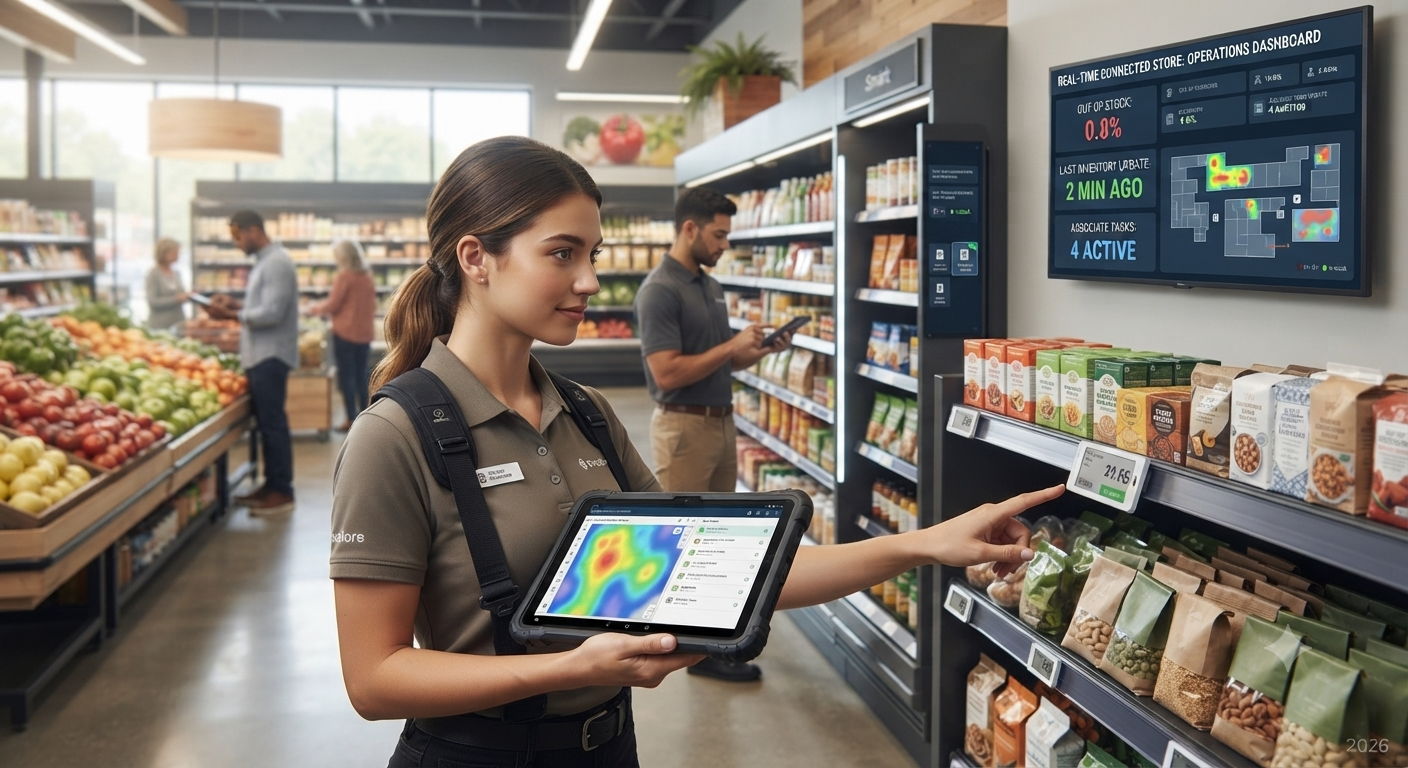

Grocery retail has spent the last decade throwing technology at the same underlying problem from every angle — better forecasting, better analytics, better dashboards. Most of it improved planning at the head-office level. Almost none of it fixed what actually happens on the shop floor, where a shelf goes empty, a price is wrong, or a delivery doesn’t match what the system expects, and nobody finds out until it’s already cost a sale.
The single biggest innovation in grocery retail in 2026 is the technology finally closing that gap — real-time connected store systems that turn static, backward-looking store operations into something that responds while the problem is still happening, not days later in a report nobody reads until it’s too late.
Table of Contents
Why “Lag” Is the Real Enemy, Not Missing Technology
The defining operational challenge in grocery right now isn’t a lack of data — it’s the delay between when a problem appears on the shelf and when store teams become aware of it and fix it. Associates still walk aisles to physically check shelf conditions. Managers question whether reports reflect current reality. Fulfillment teams hit substitutions when the shelf doesn’t match what the system expects. In every case, the core issue is the same structural lag, and it’s built into how most stores have always operated — promotions change weekly, deliveries vary in timing and accuracy, and the gap between “what the system thinks” and “what’s actually on the shelf” never fully closes.
Out-of-stock rates in grocery and fast-moving goods remain stubbornly in the 7–10% range even after years of investment in forecasting and supply chain visibility tools — proof that better planning alone doesn’t solve a problem that’s fundamentally about real-time awareness, not prediction.
What “Closing the Lag” Actually Looks Like
The technology solving this isn’t one single product — it’s a connected stack of real-time inputs finally working together, rather than living in separate, disconnected systems the way retail tech historically has.
Electronic shelf labels and smart shelving give stores instant, centrally controlled visibility and control over pricing and shelf conditions, replacing manual price changes and periodic shelf walks with systems that update and report automatically.
Computer vision-enabled self-checkout and store monitoring extends real-time visibility beyond pricing into shrink prevention and store-wide conditions, catching problems as they happen rather than after inventory counts reveal the damage.
Agentic AI for replenishment and inventory is moving retailers from periodic reordering toward continuous, autonomous inventory management that reacts to actual conditions rather than fixed schedules.
Real-time analytics pushed to frontline associates, rather than sitting in a dashboard for a manager to review days later, is the connective layer tying all of this together — the same shift from passive reporting to active, in-the-moment decision support showing up across the entire food value chain this year.
The Scale of Deployment Happening Right Now
This isn’t a distant concept — it’s already being rolled out at enormous scale by the world’s largest grocery retailer:
- Walmart Mexico is deploying EdgeSense technology, its connected-store platform, across all Walmart Express stores by the end of 2026 — the first large-scale rollout of the platform in Latin America.
- That initial deployment alone includes more than 1.7 million electronic shelf labels and over 180,000 smart shelving rails.
- Walmart Mexico is also piloting the same technology in its Bodega format, with plans to expand into Walmart Supercenters following the Express rollout.
- Coresight Research projects the U.S. grocery retail sector will grow 2.8% year over year in 2026 to reach $1.6 trillion, with technology investment concentrated specifically around agile supply chains, frontline workforce tools, and digital store connectivity as top strategic priorities.
- AI adoption across grocery retail broadly is projected to unlock nearly $136 billion in value by 2030, according to industry research — with the most valuable applications described as unglamorous but high-impact: demand forecasting, dynamic markdowns to reduce food waste, and workforce planning aligned to real, not static, demand.
- 97% of grocery retailers have either deployed or plan to deploy store intelligence technology within the next year, reflecting how quickly this has moved from experimental to expected.
Why This Is the Innovation That Matters Most, Not Just Another Trend
Grocery retailers are also investing heavily in other visible areas this year — retail media networks, agentic AI shopping assistants, ChatGPT-integrated shopping experiences, and personalized loyalty engagement. All of these matter, and all are real. But most of them are aimed at influencing what happens outside the store or how a retailer monetizes existing shopper data.
Connected store technology is different because it fixes the operational foundation everything else depends on. A retail media network is worth less if the advertised product is out of stock. A personalized offer means little if the shelf price doesn’t match what the app promised. Real-time store awareness is the layer that makes every other 2026 innovation actually reliable at the point of sale, which is exactly why major retailers are treating it as core infrastructure rather than an optional upgrade.
The Caution Signs Worth Watching
Not every rollout is happening without friction. Self-checkout, once treated as an unstoppable trend, has faced enough customer pushback that some major retailers are actively reducing self-checkout lane counts rather than expanding them — a reminder that customer acceptance, not just technical capability, still shapes what succeeds at scale.
There’s also a regulatory dimension emerging around some of this technology. Recently introduced legislation aims to restrict how retailers use consumer data for pricing decisions, with some proposals specifically targeting electronic shelf labels over concerns about dynamic or personalized pricing. Retailers moving quickly on connected store technology will need to navigate this alongside the operational rollout itself.
What This Means for the Rest of the Food Value Chain
For brands, distributors, and suppliers selling into grocery retail, the rise of connected store technology changes what “in-stock” and “on-shelf” actually mean in practice. Retailers with real-time shelf visibility can catch and correct supply issues faster, which raises the bar for supplier fulfillment accuracy and timing. It also means retail media and promotional placements are increasingly tied to verified real-world shelf conditions rather than assumed compliance — suppliers whose products are reliably represented accurately on connected-store platforms are positioned to benefit most as this technology scales.
The Bottom Line
Self-checkout, AI shopping assistants, and retail media all matter to grocery retail’s future, but the innovation actually closing the industry’s most persistent operational gap in 2026 is real-time connected store technology — electronic shelf labels, smart shelving, and agentic AI working together to eliminate the lag between what’s happening on the shelf and when someone finds out. With retailers like Walmart deploying this at a scale of millions of devices across entire store formats, and nearly all major grocers planning similar investments within the year, this is quickly becoming the operational backbone the rest of grocery retail’s innovation depends on.
Related
FAQ
What is the biggest innovation in grocery retail in 2026?
Real-time connected store technology — including electronic shelf labels, smart shelving, and agentic AI for replenishment — is considered the leading grocery retail innovation of 2026, because it closes the operational lag between shelf conditions and store awareness that has limited the industry for years.
What is Walmart’s EdgeSense technology?
EdgeSense is Walmart’s connected-store platform combining electronic shelf labels and smart shelving rails to give stores real-time visibility and control over pricing and shelf conditions. Walmart Mexico is deploying it across all Express stores by the end of 2026, with more than 1.7 million electronic shelf labels and 180,000 smart rails in the initial rollout.
Is self-checkout still the top grocery technology trend?
No. Self-checkout adoption has actually slowed in some markets, with certain major retailers reducing self-checkout lane counts due to customer pushback. Real-time connected store technology and agentic AI have overtaken it as the primary focus of 2026 grocery technology investment.
How big is the potential value of AI in grocery retail?
Industry research projects AI could unlock nearly $136 billion in value for grocery retailers by 2030, primarily through demand forecasting, dynamic markdowns to reduce food waste, and workforce planning tied to real-time demand rather than static schedules.
Are there any regulatory concerns around this technology?
Yes. Some proposed legislation specifically targets electronic shelf labels and consumer data use in pricing decisions, reflecting concerns about dynamic or personalized pricing. Retailers adopting connected store technology will need to navigate this evolving regulatory landscape alongside their rollout plans.
How does this innovation affect suppliers and brands selling into grocery retail?
As retailers gain real-time shelf visibility, supplier fulfillment accuracy and timing become more important, since discrepancies are caught faster. Retail media and promotional placements are also increasingly tied to verified real-world shelf conditions rather than assumed compliance.