
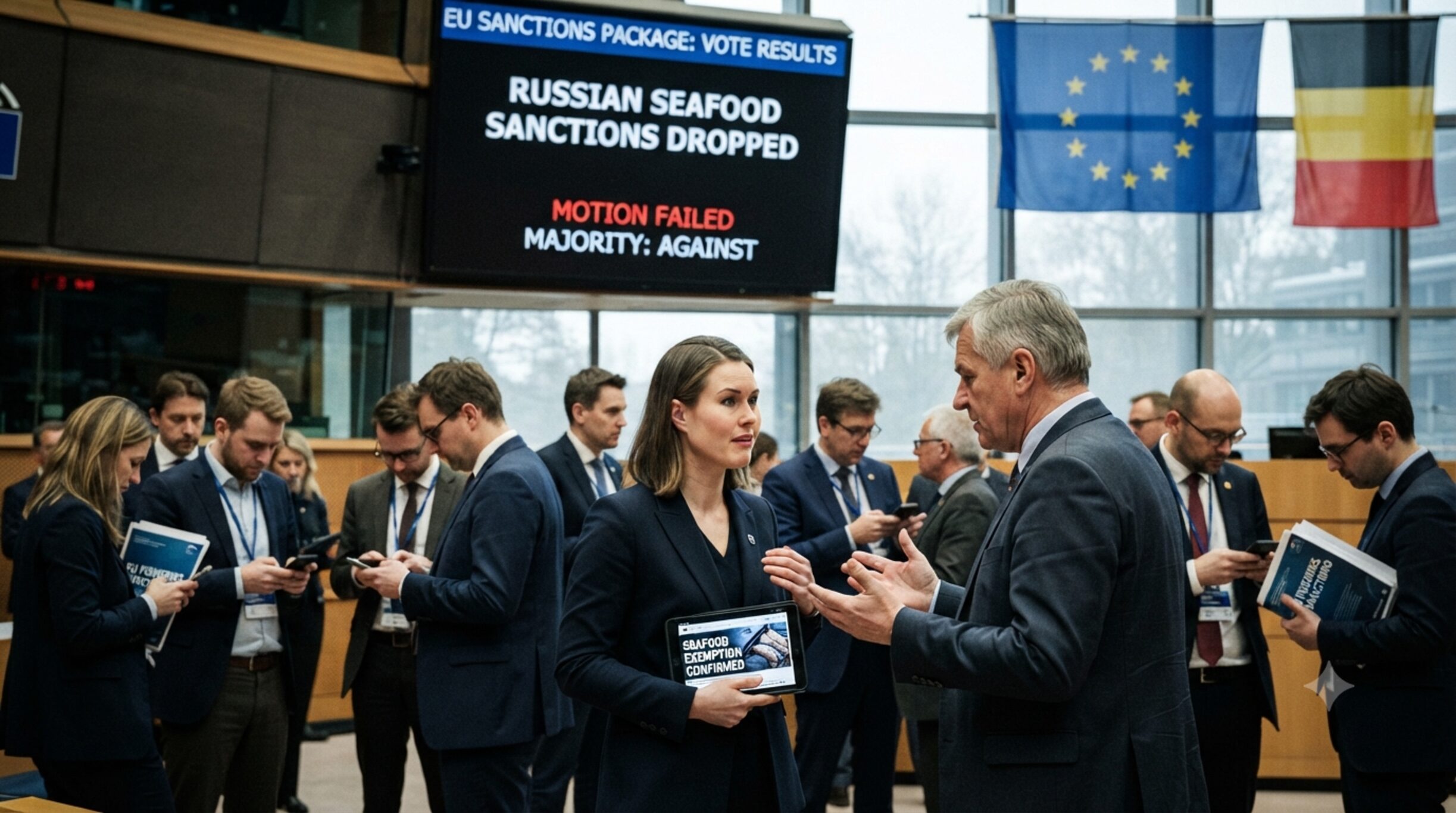

Russian seafood sanctions were cut from the EU’s 21st package after member state pushback, leaving whitefish flows intact but tariff risk unresolved.
Six weeks after the European Commission promised to close what it called one of the last major unsanctioned sectors, fisheries has been left untouched. The EU adopted its 21st sanctions package against Russia on 22 July with every seafood measure stripped out — no cod ban, no pollock restrictions, no residual language on fish products at all.
For whitefish buyers who spent June rebuilding contingency plans, the outcome is a reprieve. It is not a resolution. The measure that actually constrains Russian-origin supply into Europe was never part of this package, and it comes up for renewal in five months.
From a complete cod ban to nothing
When Ursula von der Leyen announced the package on 9 June, the fisheries component was headline material: substantial restrictions on some fish products and a complete import ban on others, cod explicitly named. It would have been the first time EU sanctions directly targeted the Russian fishing sector.
The proposal started unravelling almost immediately. By early July, reporting from Brussels indicated the Commission was contemplating a quota-based compromise rather than outright bans. By mid-July, the fish measures were reportedly heading for deletion. The bloc missed its own 15 July deadline — a deadline set to avoid the lapse of Russian oil price caps — and pushed the timetable to 22 July, with seafood and shipping both cited among the sticking points.
What emerged had no fisheries element whatsoever. The Commission has not publicly explained the reversal.
Why the blocking coalition held
Sanctions require unanimity across 27 member states, and on whitefish the economics run directly against the politics.
Germany, France, the Netherlands, Poland and Portugal were reported as resisting, with France and Portugal specifically objecting to the cod and Alaska pollock bans. The interests are not identical but they point the same way. German processors depend on Russian-origin raw material for fish fingers and breaded fillet lines. Portugal’s bacalhau market and France’s cod consumption are both structurally exposed. Polish and Dutch processing plants sit on the same supply chains.
The underlying dependency numbers explain the resistance better than any diplomatic account. Around 94% of the EU’s whitefish supply was imported in 2024. Russian-origin fish accounted for an estimated 34% of total EU whitefish supply in 2023 — and that figure understates it, because more than 95% of the Alaska pollock arriving from China is Russian fish that has been reprocessed en route. The EU imported close to 15,000 tonnes of Russian whitefish in March 2026 alone.
There is no substitute pool of that size. Alaska, Norway and Iceland cannot backfill it, and both Barents and Bering Sea quotas have been tightening.
What did make the package
The adopted measures are substantial in every sector except this one: restrictions on 32 additional Russian banks, controls on crypto firms and oil trading platforms, a further one-year freeze on the oil price cap adjustment mechanism, new designations against shadow-fleet vessels, and preparatory steps toward barring Russian combatants from entering the bloc.
Bulgaria separately blocked the proposed listing of Patriarch Kirill. Diplomats have been candid that after 21 rounds, finding targets that command unanimous agreement is getting materially harder.
The measure that already bites
Buyers should be clear that Russian whitefish is not entering the EU freely. It simply is not restricted by sanctions.
Since 1 January 2024, Russian and Belarusian products have been excluded from the EU’s Autonomous Tariff Quota scheme under Council Regulation 2023/2720. Trade continues at MFN rates: roughly 13.7% on pollock fillet blocks and H&G raw material, 14.2% on surimi, 12% on headed-and-gutted cod, 7.5% on cod fillets. That is a standing cost disadvantage, not a prohibition — and it applies to Russian-origin fish regardless of where it was processed, which means Chinese reprocessing does not launder the tariff treatment.
That regulation runs to 31 December 2026. The 2027–2029 ATQ round is the decision that will actually move landed costs, and it is now the file to watch.
What it means for buyers and procurement teams
Do not unwind contingency planning. A dropped proposal is not a closed file. Sanctions packages are annual-plus in cadence and fisheries is now an established candidate. The political appetite exists; only the unanimity does not.
The ATQ renewal is the real event. Q4 2026 negotiations on the 2027–2029 scheme will determine whether Russian exclusion persists, whether volumes for non-Russian origins expand, and whether new species enter the list. Processors should be lobbying now, and buyers should be modelling both outcomes.
Origin documentation stays non-negotiable. With Russian-origin fish excluded from ATQ irrespective of processing country, end-use and origin paperwork on Chinese-reprocessed pollock remains the single highest-risk compliance point in the chain. Audit it.
Transatlantic divergence widens. The US ban covers Russian seafood including third-country processed product; the EU does not. Any business selling into both markets is running two incompatible sourcing books, and that gap just got another year of life.
Price risk is now supply-led, not policy-led. With sanctions off the table for this cycle, watch Barents cod quota decisions and pollock TACs rather than Brussels for direction on 2027 whitefish pricing.
Related
FAQ
Did the EU ban Russian seafood in its 21st sanctions package?
No. The proposed cod ban and wider fish restrictions announced in June were removed entirely before the package was adopted on 22 July 2026. The final measures contain no seafood provisions.
Which countries opposed the Russian seafood sanctions?
Germany, France, the Netherlands, Poland and Portugal were reported as resisting, with France and Portugal objecting specifically to bans on cod and Alaska pollock. Sanctions require unanimous approval from all 27 member states.
Can Russian whitefish still enter the EU duty-free?
No. Russian and Belarusian products have been excluded from the EU’s Autonomous Tariff Quota scheme since January 2024, so imports pay MFN duties — around 13.7% on pollock blocks and 12% on H&G cod. The exclusion applies by origin, so Chinese-reprocessed Russian fish is caught too.