
New US Section 301 tariffs now hit seafood from 60 economies. Here is what the duties mean for shrimp, whitefish and salmon procurement costs.
The United States imposed additional duties on imported seafood from 60 economies on 24 July, after the Trade Representative explicitly declined to carve the sector out. The measure landed at the same moment the previous global surcharge expired, which makes the net cost change less dramatic than the headline suggests — but far more durable. For buyers, the significant detail is not the rate. It is that the temporary instrument has been replaced by a permanent one.
That change arrives into a market already pulling in two directions: whitefish in a genuine scarcity cycle, salmon in oversupply, and shrimp still resettling after a year of tariff whiplash.
Table of Contents
Section 301: the exemption request that failed
The Trade Representative announced final action on 23 July in Section 301 investigations covering 60 economies for failing to impose and effectively enforce a prohibition on imports produced with forced labour. Additional duties took effect at 12:01am Eastern on 24 July.
Two rates apply. Economies that operate a forced labour import prohibition, have committed to one through an Agreement on Reciprocal Trade, or maintain a partial regime with equivalent effect, face 10%. All others face 12.5%.
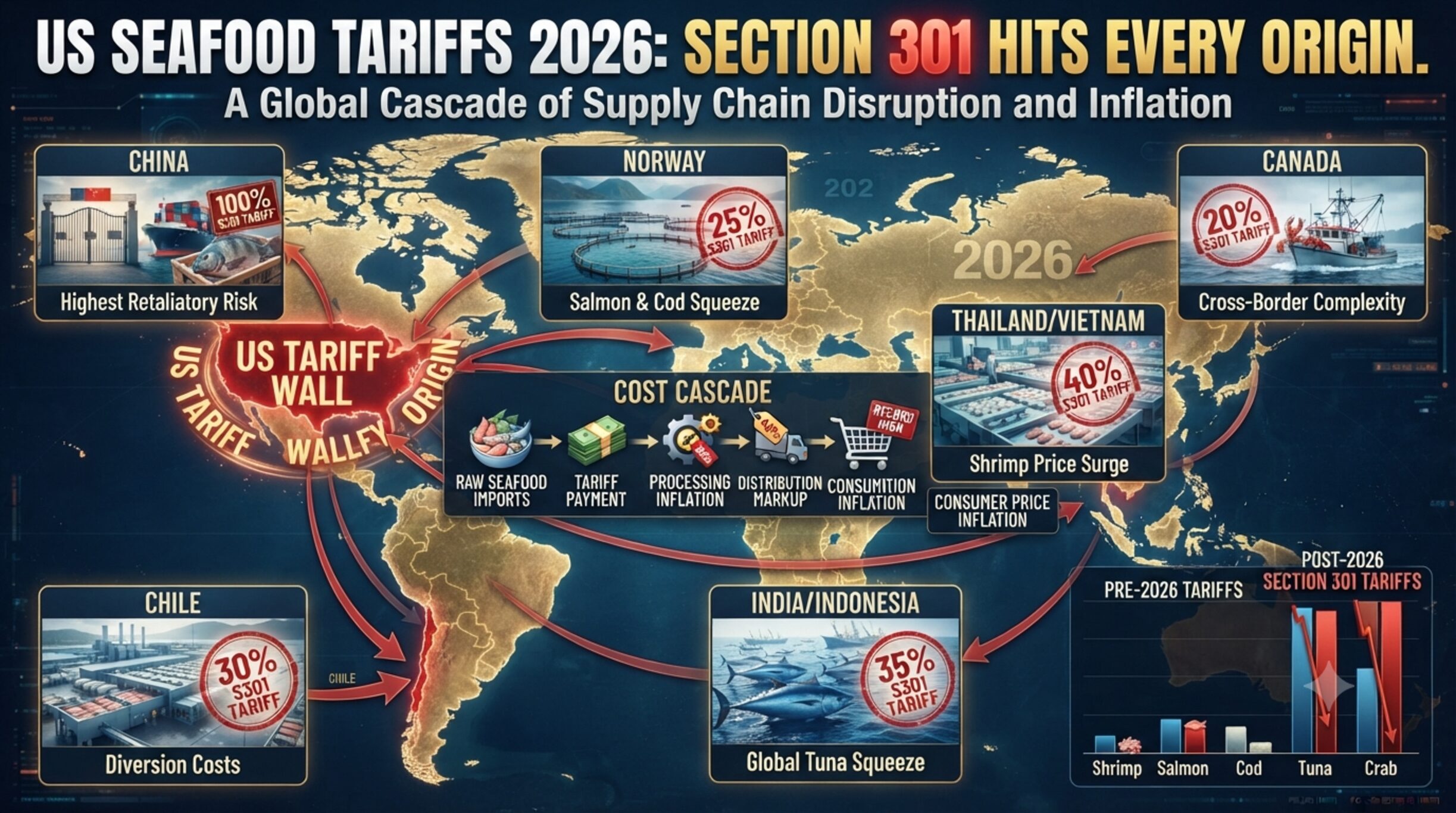
For seafood, the split runs as follows. Ten percent applies to India, Ecuador, Indonesia, Argentina, Mexico and Canada, covering shrimp in all product forms. Twelve and a half percent applies to Vietnam, Thailand, Peru and China. Those ten origins are the ten largest shrimp suppliers to the US market by value. Beyond shrimp, the action catches tilapia from Vietnam and Atlantic salmon from Chile and Norway. Canadian product qualifying for duty-free treatment under USMCA is exempt.
The industry fought this. The Trade Representative received more than 1,600 written comments and held three days of hearings from 7 to 9 July with over 100 witnesses. The National Fisheries Institute quantified the sector’s exposure at roughly $2.86 billion in annual tariff liability, across approximately $15 billion of finfish and shellfish imports at the higher rate and $9.3 billion at the lower one. The request to exempt seafood was rejected on the grounds that the domestic industry cannot meet all domestic demand.
There is a narrow in-transit provision. Goods loaded at the port of loading and in transit on the final mode of transit before 12:01am on 24 July escape the duty if entered for consumption before 12:01am on 28 July. Product-level exemptions exist by HTS subheading in two annexes to a 431-page Federal Register notice, and eligibility for a preference programme does not by itself shield goods from the duty.
What replaced what: the Section 122 swap
The reason this is not a straightforward cost increase is timing.
A 10% global import surcharge under Section 122 of the Trade Act of 1974 took effect on 24 February 2026 and expired by operation of law at 12:01am on 24 July, exactly 150 days later. That surcharge was itself a pivot: the administration turned to Section 122 within days of the Supreme Court ruling on 20 February that the International Emergency Economic Powers Act does not authorise the president to impose tariffs.
Section 122 carries a hard statutory ceiling of 150 days and a 15% rate cap, and extending it requires an Act of Congress. No extension legislation was pending. The Court of International Trade separately held the surcharge unlawful, with the Federal Circuit staying that ruling pending appeal.
For most origins, then, 24 July was a swap rather than a stack: 10% out, 10% or 12.5% in. The material difference is structural. Section 301 duties carry no statutory expiration and no rate cap. Buyers who have spent 2026 treating tariff costs as a temporary line item now need to model them as a permanent component of landed cost.
Whitefish: scarcity pricing meets a new duty layer
Whitefish is the segment where the tariff compounds an existing supply problem rather than creating one.
Norway and Russia set the 2026 Barents Sea cod total allowable catch at 285,000 tonnes, a 16% reduction and the lowest level since 1991. The cut was smaller than the 21% the Norwegian Institute of Marine Research had advised, but it follows several consecutive years of reductions from a quota that stood at 885,600 tonnes in 2021. Haddock moved the other way, rising 18% to 153,293 tonnes, with Greenland halibut at 19,000 tonnes and beaked redfish at 69,177 tonnes.
Price has responded accordingly. Norwegian cod has approached $12,000 per tonne. Russian pollock B-season quotes have moved to $2,500 to $3,000 per tonne against spot levels around $2,220, driven partly by a 41% reduction in North Atlantic blue whiting quotas — roughly 600,000 tonnes of displaced volume pushing substitution demand toward pollock. Substitution into haddock and saithe has proven limited, because catches in those species have not been strong enough to absorb it.
The practical consequence is that processors in China and Europe are absorbing sharply higher raw material costs, and current levels are increasingly expected to establish a new baseline rather than correct.
Salmon and shrimp: diverging fundamentals
Salmon is running the opposite way. Norwegian spot fell to NOK 68.38 per kilogram in week 23, the lowest level of the year and marginally below the same week in 2025, while Norway had exported 632,000 tonnes round weight year to date, 5% ahead of last year. Volume up, price down.
The forward curve tells the more useful story for anyone contracting now. Prices declined month by month through October, bottoming near EUR 5,860 per tonne, before Q1 2027 forwards moved to around EUR 8,300 to 8,400 per tonne. Annual contracts for 2027 and 2028 have sat near EUR 7,350 and EUR 7,540 respectively. That is a steep contango, and it means the current weakness is not being priced as structural.
Shrimp has spent the year re-levelling. Tariffs on Indian goods were cut from 50% to 18% on 2 February, reversing an advantage that had briefly allowed Ecuador to overtake India as the largest supplier to the US market. Ecuador’s 2025 shrimp exports reached a record $8.4 billion, up 20%, overtaking oil as the country’s leading export, with China taking around 48% of output and the US 22 to 23%. In January and February 2026, US shrimp imports totalled 125,133 tonnes, down 7% year on year, with Ecuador up 25% and India down 31%. The new 10% rate now applies equally to both, which removes the tariff differential that had been driving that reshuffle.
Elsewhere, consolidation continues: Pacific Seafood and Ocean Beauty Seafoods confirmed a merger of their distribution businesses on 17 July.
What this means for buyers and procurement teams
Check every container in transit against the 28 July cut-off. This is the only immediate action with a hard deadline. Product loaded before 24 July and entered for consumption before 12:01am on 28 July avoids the duty entirely. That window closes in days, and it is worth expediting customs entry on anything eligible.
Re-model landed cost as permanent, not temporary. The single most consequential feature of this action is the absence of a sunset clause. Contracts and budgets built on the assumption that 2026 tariff layers would lapse need revisiting. Where supply agreements contain duty-change or force majeure language drafted around the temporary measures, review whether it still functions.
Verify HTS subheadings rather than relying on country-level summaries. Exemptions are granted by subheading across two annexes in a very long notice, and preference programme eligibility does not confer protection. Country-name summaries in trade press will not be reliable at line-item level. Confirm with a licensed broker before committing.
The shrimp origin arbitrage has narrowed. With India, Ecuador, Indonesia, Argentina and Mexico all at 10%, sourcing decisions revert to fundamentals — transit time, product form capability, antidumping and countervailing duty exposure, and value-added processing capacity — rather than tariff differential. Vietnam, Thailand, Peru and China now sit 2.5 points worse off.
Whitefish buyers should assume the higher baseline holds. With Barents cod at a 35-year low, blue whiting sharply reduced and substitution species unable to absorb the gap, there is no obvious mechanism for correction inside 2026. Forward cover has more value here than in any other segment.
Salmon offers the clearest tactical opportunity. Weak spot pricing against a steeply higher 2027 forward curve is an unusual configuration. Buyers with storage or the ability to take frozen positions should be looking at the second half of 2026 rather than waiting.
Related
Frequently asked questions
Which seafood products are affected by the new Section 301 tariffs?
The action applies broadly to goods from 60 investigated economies, subject to HTS-level exemptions. Confirmed seafood coverage includes shrimp in all product forms from all ten of the largest suppliers to the US market, tilapia from Vietnam, and Atlantic salmon from Chile and Norway. Canadian product entering duty-free under USMCA is exempt.
Do these tariffs stack on top of the previous 10% surcharge?
No. The Section 122 global surcharge expired by operation of law at 12:01am Eastern on 24 July, the same moment the Section 301 duties took effect. For most origins this is a substitution rather than an addition, though the new duties carry no expiration date whereas Section 122 was capped at 150 days.
Why was seafood not granted an exemption?
Importers, including the National Fisheries Institute, requested that commercial seafood be added to the exemption annex. The request was rejected on the basis that the domestic seafood industry cannot supply all US demand — a rationale that leaves little scope for a subsequent sector-wide carve-out, though product-specific HTS exemptions do exist.
Sources
- Office of the United States Trade Representative — Section 301 forced labour investigations, final action notice, 23 July 2026
- Global Trade Alert — analysis of the final action and per-economy breakdown
- Southern Shrimp Alliance — seafood-specific duty rates by origin
- National Fisheries Institute — sector tariff liability estimate and hearing testimony
- Norwegian Ministry of Fisheries and the Joint Norwegian-Russian Fisheries Commission — 2026 Barents Sea quotas
- Norwegian Institute of Marine Research — cod and haddock stock advice
- Norwegian Seafood Council and Akvafakta — salmon export volumes and spot pricing
- Fish Pool and Sitagri — salmon forward price curves
- Shrimp Insights and Ecuador’s National Aquaculture Chamber — shrimp trade volumes
- SeafoodSource, Undercurrent News and Tradex Foods — market commentary and price assessments
- RaboResearch — 2026 seafood market outlook