
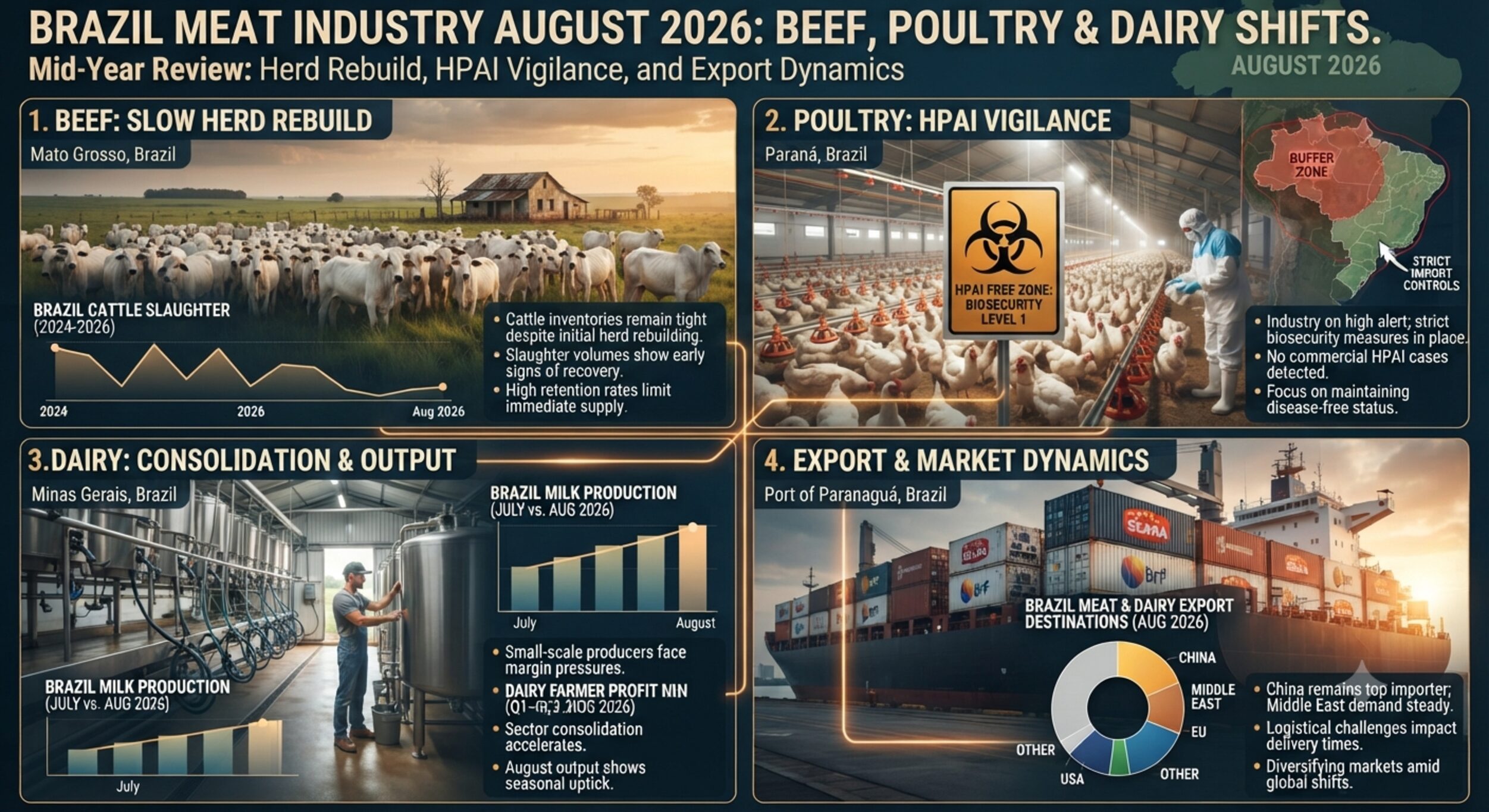

Brazil’s meat industry faces a China beef quota wall, record poultry exports and a dairy dumping fight. Here is what B2B buyers need to know now.
Three of Brazil’s protein chains are moving in different directions at the same time, and the divergence matters for anyone pricing forward contracts into the fourth quarter. Beef has just run into a hard Chinese ceiling after a record first half. Poultry is printing all-time highs on a soft comparison base. Dairy is caught between a domestic supply squeeze and an antidumping case that Brasília has approved but not yet enforced. Layered over all three is a fresh 25% United States tariff and a European deforestation rule that lands in December.
Table of Contents
Beef: a record first half, then the quota wall
Brazil exported roughly 1.705 million tonnes of beef in the first half of 2026, generating close to $9.85 billion — a record for the period, with revenue up around 36% year on year. The number looks like strength. It is closer to a front-loading effect.
China introduced safeguard measures on 1 January, running three years, that impose an additional 55% duty on volumes above an allocated quota. Brazil’s allocation is 1.106 million tonnes for 2026, rising to 1.128 million in 2027 and 1.151 million in 2028. Against that, Brazil shipped a record 1.648 million tonnes of fresh beef to China in 2025 — close to half its total beef trade by both value and volume.
Every major exporter therefore raced to ship inside the quota before it closed. That race is now over. With the ceiling effectively reached by mid-year, further sales to China become uneconomic until importers begin drawing on the 2027 quota, which the trade expects from around October.
The operational response is already visible. Frigol, Better Beef, Iguatemi Beef and Plena Alimentos have moved to partially suspend slaughter and place staff on mandatory leave. JBS-controlled Friboi confirmed it would stop producing China-specific cuts. Minerva is expected to keep Brazilian plants running for the United States market while its Argentine, Uruguayan and Colombian units continue serving China — a structural advantage of a multi-origin footprint that single-origin competitors do not have.
Cattle economics are the other half of the squeeze. Fed cattle in São Paulo hit a record 366.20 reais per arroba in April, up roughly 15% since January, driven by the same scramble for quota-eligible volume. Consultancy Safras & Mercado expects Brazilian slaughter to fall about 3.6% this year. ABIEC now guides full-year exports at 3.3 to 3.5 million tonnes against 3.5 million in 2025, and has flagged a possible 10% decline.
The price gradient explains the behaviour. Forequarter cuts have moved to China at roughly $7,000 per tonne, against about $6,000 into the United States and near $5,600 to other destinations. No alternative market replaces China at that netback. Vietnam has been newly authorised and talks continue with Japan and South Korea, but these are multi-year builds, not a second-half fix.
Poultry: record volumes on a soft base
Chicken is running the opposite way. Brazil shipped 2.936 million tonnes in the first half, up 12.9% year on year, with revenue of $5.7 billion, up 17%. June alone reached 482,800 tonnes, a 40.6% jump. May became the first month in the sector’s history to clear $1 billion in export revenue.
Part of that growth is arithmetic. Brazil recorded its first highly pathogenic avian influenza case in a commercial flock in May 2025 in Rio Grande do Sul, triggering broad import bans and pushing June 2025 volumes to their lowest monthly level since 2020. The outbreak was declared resolved in June 2025 and China lifted its embargo at the end of October, so 2026 is lapping an artificially depressed base.
The underlying trend is still positive. Conab has forecast record output near 15.86 million tonnes for 2026, with ABPA guiding slightly lower, and Brazil is expected to hold its position as the world’s largest chicken exporter at roughly 5.1 to 5.2 million tonnes. China led June destinations at 50,100 tonnes, followed by Japan, the United Arab Emirates and Saudi Arabia. Paraná remains the dominant supplying state.
The strategic priority for Brazilian authorities is negotiating regionalisation clauses into health certificates, so a single localised case no longer closes the entire country. Until those clauses are in place, disease risk remains a binary exposure for buyers.
Dairy: an antidumping case on hold
Brazil’s dairy chain is structurally import-dependent, with whole milk powder its largest dairy import and Argentina its biggest supplier. That dependency is now politically contested.
On 28 May, Gecex-Camex approved antidumping measures on powdered milk from Argentina and Uruguay following an investigation launched in late 2024. Application was immediately suspended pending a public interest review, at the request of the Ministry of Planning and Budget, on concerns about food inflation in an election year.
The recommended duties are severe. For Argentine exporters they range from US$167.31 per tonne, or 4.4%, up to US$4,183.17 per tonne, or 111.8%, with most of the 17 participating companies assigned US$1,707.08 per tonne. Uruguayan exporters face US$378.27 to US$4,196.72 per tonne. Critically, the scope covers bulk industrial milk powder only. Retail packs up to 800 grams and UHT milk sit outside the measure — though the product is a core input into dairy, bakery, chocolate, biscuit and ice cream manufacturing, so the indirect cost pass-through is broad.
Domestic fundamentals are tightening independently. Cepea put the net Brazil average farmgate price at BRL 2.6584 per litre in April, a fourth consecutive monthly rise and up 10.4% from March, though still 7.1% below April 2025 in real terms. The Cepea milk production index fell 14.6% year on year, with reduced investment constraining supply, while operating costs continue to climb. March imports rose 33% to 604 million litres of milk equivalent.
Trade policy: the US tariff and the EUDR clock
A 25% Section 301 tariff on substantially all Brazilian-origin goods took effect on 22 July 2026, with a narrow in-transit grace period. Beef is exempt, alongside orange juice, energy products and aircraft — a materially better outcome than the earlier 50% regime, and the reason the United States remains Brazil’s best available substitute outlet for beef displaced from China. That exemption is politically contested by US cattle groups and should be treated as a live risk rather than a settled position.
The European Union Deforestation Regulation applies to large and medium operators from 30 December 2026, requiring plot-level geolocation and due diligence statements for cattle products. The EU is a small share of Brazilian beef volume but a premium one, and the rule arrives precisely as the China outlet narrows.
What this means for buyers and procurement teams
Beef buyers outside China should see improved availability into the fourth quarter. Displaced Brazilian volume has to go somewhere, and slaughter cuts will lag the demand shock. Expect softer offers on forequarter and manufacturing beef through Q3, with the window narrowing as the 2027 Chinese quota opens around October. Contract accordingly rather than assuming the discount persists into Q1 2027.
Do not read the export records as a demand signal. Both the beef H1 record and the poultry H1 record are distorted — one by quota front-loading, one by a disease-depressed base. Forward planning should be built off underlying slaughter and production trends, not headline export growth.
Poultry offers the more reliable substitution play. With record production forecast, restored market access and no current HPAI status issue in commercial flocks, chicken is the more dependable protein for volume commitments — subject to the regionalisation caveat.
Dairy buyers sourcing bulk milk powder from Mercosur should model the duty scenario now. The measures are approved, not withdrawn. A public interest review can lapse in either direction, and the difference between a 4.4% and a 111.8% duty is not a rounding error on a landed cost. Where possible, build origin flexibility and duty-change clauses into contracts covering H2 2026 delivery.
Multi-origin suppliers are structurally advantaged this year. The Minerva model — Brazilian plants serving the United States while South American units serve China — is the clearest demonstration. Buyers who concentrate on single-origin Brazilian supply inherit the full quota and tariff exposure.
Related
Frequently asked questions
Why did China impose beef quotas on Brazil?
China introduced three-year safeguard measures effective 1 January 2026 to protect its domestic cattle industry, which has been under pressure as local producers expand output under a food self-reliance push. The measures cover several major suppliers including Brazil, Australia, Argentina and the United States, applying an additional 55% duty above each country’s allocated volume.
When will Brazilian beef shipments to China resume?
The trade generally expects Chinese importers to begin purchasing against the 2027 quota from around October 2026. Brazil’s 2027 allocation rises modestly to 1.128 million tonnes, so the structural constraint persists rather than resolving.
Are Brazilian beef exports to the United States affected by the new 25% tariff?
No. Beef was granted an exemption under the Section 301 action that took effect on 22 July 2026, alongside orange juice, energy products and aircraft. However, US cattle industry groups have publicly urged the Trade Representative to remove that exemption, so the carve-out should be monitored rather than assumed permanent.
Sources
- Abiec (Brazilian Beef Exporters Association) — H1 2026 export data and full-year guidance
- ABPA (Brazilian Association of Animal Protein) — H1 2026 poultry export data
- Cepea/Esalq — fed cattle arroba index, milk producer prices and milk production index
- Gecex-Camex and Datamar News — antidumping determination on Argentine and Uruguayan milk powder
- Office of the United States Trade Representative — Brazil Section 301 final action, July 2026
- European Commission — Regulation on Deforestation-Free Products implementation timeline
- Reuters, Valor and The AgriBiz — meatpacker slaughter suspensions and cattle market coverage
- USDA Foreign Agricultural Service GAIN reports — Brazil livestock, poultry and dairy
- Conab — 2026 chicken meat production forecast
- Safras & Mercado, StoneX, Agrifatto and Datagro — slaughter and cattle cycle analysis