
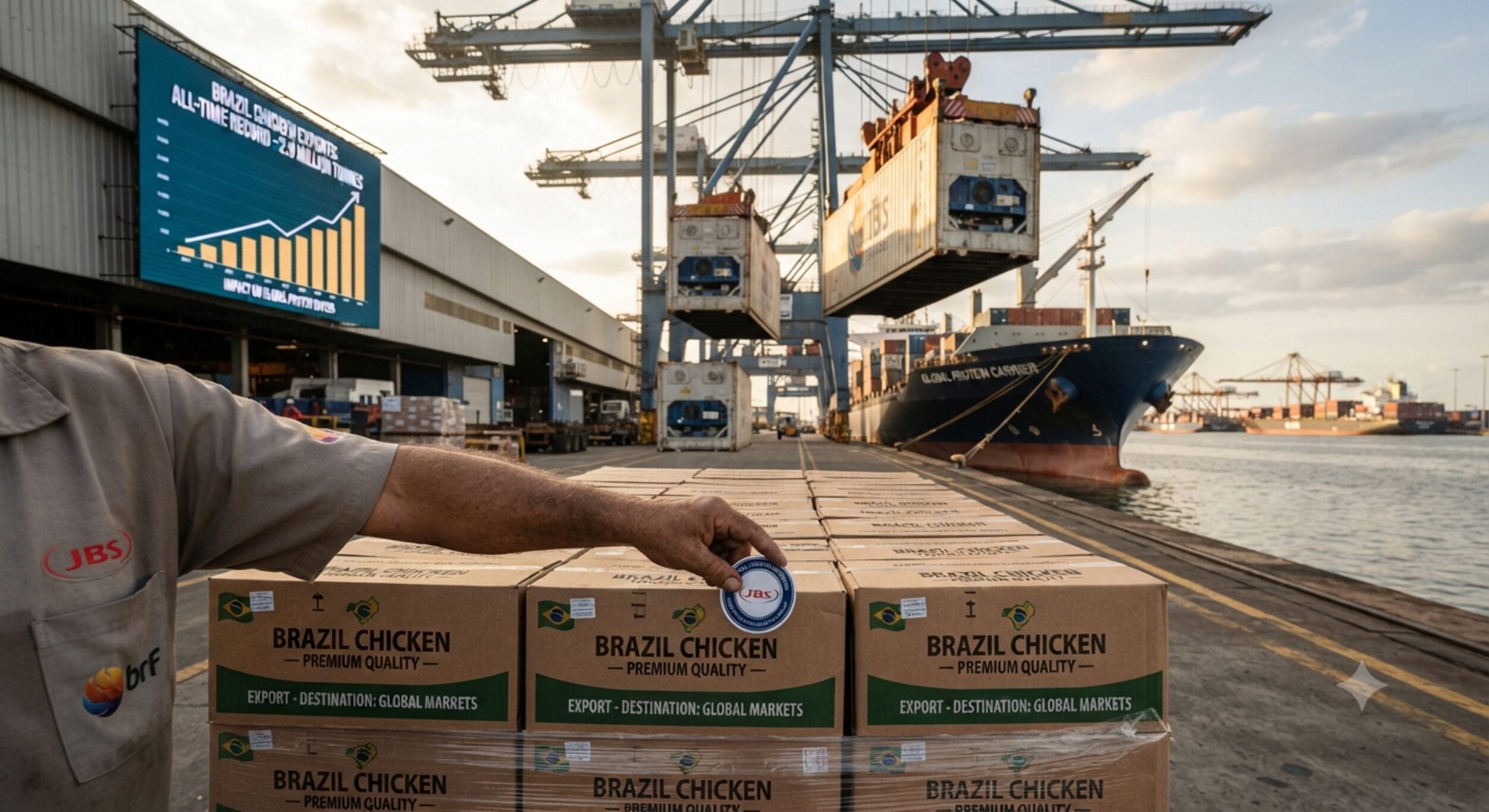

Brazil exported 2.936 million tonnes of chicken meat in the first half of 2026—the best first-half result in the history of Brazilian chicken exports—as June alone surged 40.6% year-on-year to 482,800 tonnes, signaling that Brazilian poultry is rapidly filling the global protein gap left by record-high beef prices and tightening cattle supplies.
A Historic First Half: $5.7 Billion in Revenue, Up 17%
The Brazilian Association of Animal Protein (ABPA) confirmed that H1 2026 chicken exports not only broke volume records at 2.936 million tonnes (up 12.9% from H1 2025) but also generated $5.7 billion in revenue—up 17% from $4.871 billion in the same period last year. Revenue growth outpacing volume growth is the critical signal: Brazil isn’t just shipping more chicken; it’s commanding higher prices in premium markets.
June’s numbers were particularly striking. The 482,800 tonnes shipped in a single month represents a 40.6% year-on-year increase, with revenue surging 54.7% to $985.5 million. ABPA noted that part of the high year-on-year June growth reflects a low comparison base—exports were curtailed in June 2025 following temporary restrictions after a single case of highly pathogenic avian influenza (HPAI) on a commercial farm in Brazil, since fully resolved. Even adjusting for the base effect, the underlying momentum is unambiguous.
Who Is Buying Brazilian Chicken—and Why It Matters
June 2026 destination data reveals a strategically diversified export portfolio that spans Asia, the Middle East, Africa, Europe, and Latin America:
- China: 50,100 tonnes (June’s top destination)
- Japan: 46,600 tonnes
- United Arab Emirates: 46,200 tonnes
- Saudi Arabia: 33,100 tonnes
- European Union: 28,000 tonnes (+250.7% YoY)
- South Africa: 26,300 tonnes (+946.3% YoY)
- Mexico: 25,400 tonnes (+728.8% YoY)
The triple-digit and quadruple-digit growth in South Africa, Mexico, and the EU is the headline within the headline. These aren’t marginal markets receiving overflow volumes—they’re strategic market entries that reflect deliberate commercial development by Brazilian exporters and the ABPA.
South Africa’s near-tenfold volume increase signals a major shift in sub-Saharan African protein sourcing. Brazilian chicken is displacing domestic production and regional imports as food inflation forces buyers toward the most competitive global source. Mexico’s surge reflects North American buyers rotating supply chains amid US domestic protein cost pressure. The EU’s 250.7% increase is perhaps the most strategically significant—European buyers, traditionally protective of domestic production, are importing Brazilian chicken at unprecedented volumes, signaling that domestic European poultry can’t meet demand at competitive price points.
Brazil’s Competitive Advantage: Scale, Price, and Diversification
ABPA president Ricardo Santin acknowledged the challenging operating environment: “The results of the first semester were achieved in an environment marked by geopolitical tensions in the Middle East and the logistical challenges arising from this context, especially in the maritime routes associated with the Strait of Hormuz.”
That Brazil achieved record export volumes despite Red Sea shipping disruptions, rerouted vessels, and elevated freight costs underscores the competitive cost advantage Brazilian producers maintain. Brazil’s integrated broiler production model—low feed costs (domestic corn and soybeans), large-scale processing facilities, and established cold chain logistics—allows exporters to absorb freight cost increases and still compete against domestic producers in importing markets.
The three southern Brazilian states that dominate exports reinforce this advantage. Paraná led June exports with 199,300 tonnes (41% of total), followed by Santa Catarina with 103,300 tonnes and Rio Grande do Sul with 56,700 tonnes. These states host Brazil’s most modern broiler processing infrastructure and have direct port access to Atlantic shipping routes.
The Beef Price Connection: Brazilian Chicken as the Global Protein Valve
Brazil’s record chicken exports don’t exist in isolation—they’re directly connected to the global beef price shock discussed earlier in this newsletter. With US beef and veal prices up 12% year-on-year and ground beef prices nearly double that of ground chicken, buyers across foodservice, retail, and industrial food production are actively substituting chicken for beef in menus, formulations, and procurement plans.
Brazil is the world’s most competitive chicken producer, and record H1 2026 exports demonstrate it’s fully capable of scaling supply to meet this substitution demand. For global buyers seeking cost-effective protein alternatives to beef:
- Brazilian chicken is available in volume across whole bird, breast, leg, and processed formats
- Export diversification across 120+ markets reflects deep commercial relationships and reliable supply chains
- ABPA’s market development in premium destinations (Japan, EU, South Korea) demonstrates product quality credibility beyond commodity pricing
Production and Supply Chain Implications
The regional concentration of Brazilian exports in Paraná, Santa Catarina, and Rio Grande do Sul creates both reliability and concentration risk for global buyers. These states operate within Brazil’s established southern agricultural corridor with strong biosecurity protocols, modern processing facilities, and reliable cold chain logistics.
However, the June 2025 HPAI incident and resulting temporary export restrictions remain a cautionary note. A single biosecurity event in one of these states could trigger market-specific import bans, disrupting supply to buyers who have consolidated sourcing from Brazil. Procurement teams should maintain secondary supplier relationships and monitor ABPA biosecurity updates.
Logistically, Brazil’s Atlantic export ports (Paranaguá, São Francisco do Sul, Itajaí) provide direct access to European, Middle Eastern, and Asian lanes. Red Sea disruption has extended some shipping times, but Brazilian exporters have demonstrated the ability to absorb these delays without material volume impact—a positive indicator for supply reliability.
What This Means for Procurement and Supply Chain Teams
For global food manufacturers and foodservice operators: Brazil chicken is the clearest available solution to beef price inflation. Volume is available, prices are competitive, and the product range covers processed, further-processed, and whole bird applications. Procurement teams that haven’t already evaluated Brazilian sourcing should engage ABPA-member exporters immediately.
For retail buyers: South Africa’s 946.3% and Mexico’s 728.8% import growth signal that major retail markets are pivoting to Brazilian chicken at scale. Retailers in other regions facing domestic poultry price pressure should note these market entries as proof of supply reliability and competitive pricing.
For domestic poultry producers: Brazil’s record exports create competitive pressure in every market they enter. The EU’s 250.7% growth is a direct warning to European producers: Brazilian chicken is gaining shelf and foodservice share. Domestic producers should accelerate differentiation on provenance, welfare standards, and speed-to-market—areas where Brazilian imports can’t compete.
For logistics and cold chain providers: Brazil’s export diversification creates demand for cold chain services in new markets. South Africa, Mexico, and high-growth Middle Eastern destinations require expanded cold storage, port handling capacity, and last-mile distribution—creating commercial opportunities for logistics operators positioned in those markets.
Frequently Asked Questions
Is Brazil’s chicken export record sustainable beyond 2026?
Yes, with caveats. Structural demand drivers (global beef price inflation, protein substitution, population growth in emerging markets) support continued Brazilian chicken export growth. However, sustainability depends on: (1) biosecurity—HPAI incidents can trigger rapid market bans; (2) currency dynamics—BRL appreciation vs. USD reduces Brazilian export competitiveness; (3) feed costs—domestic corn and soybean price increases reduce the cost advantage that makes Brazilian chicken globally competitive. Assuming stable biosecurity and currency, Brazil’s export trajectory suggests 2026 full-year volumes could reach 6 million tonnes, a new annual record.
How does Brazil’s chicken export growth affect domestic availability and pricing in Brazil?
Rising exports typically create upward pressure on domestic chicken prices as production is redirected to higher-value export markets. Brazilian consumers may see modest chicken price increases in H2 2026, though Brazil’s large and growing domestic flock provides meaningful buffer against export-driven price spikes. Domestic Brazilian foodservice operators should monitor pricing trends through Q3 2026.
Which markets should global buyers watch for competition with Brazilian chicken?
Thailand and Poland are the primary competitors in global chicken export markets. Thailand dominates in processed and cooked chicken for Japanese and EU markets; Poland has historically been the leading EU chicken exporter. Brazil’s 250.7% EU export growth represents direct competition with Polish processors. Thailand competes directly in Japan and the UAE. Buyers should monitor Thai and Polish production for supply and pricing signals that could affect Brazilian competitive positioning.
How should foodservice operators structure Brazilian chicken sourcing?
Establish primary supply agreements with ABPA-member processors for key volume cuts (breast fillet, leg quarter, whole bird). Maintain 15–20% secondary supplier coverage (domestic, Thai, or EU origin) as biosecurity insurance. Request certification documentation including SIF (Brazilian Federal Inspection Service) number, cold chain records, and any market-specific import compliance documents. Review contracts quarterly as Brazilian export premiums fluctuate with USD/BRL exchange rates and shipping market conditions.
Sources
| Source | URL | Details |
|---|---|---|
| Brazilian Association of Animal Protein (ABPA) | https://abpa-br.org | H1 2026 chicken export data; June destination breakdown; Ricardo Santin statement |
| The Poultry Site | https://www.thepoultrysite.com | Global Ag Media reporting; July 23, 2026; Brazil export record coverage |
| USDA Foreign Agricultural Service | https://www.fas.usda.gov | Brazil poultry production and export forecasts; competitive market analysis |
| Meat+Poultry | https://www.meatpoultry.com | Brazil HPAI June 2025 context; biosecurity protocol updates |
| SeafoodSource / Food Business News | https://www.foodbusinessnews.net | Global protein substitution trends; beef-to-chicken switching data |
| Circana | https://www.circana.com |