
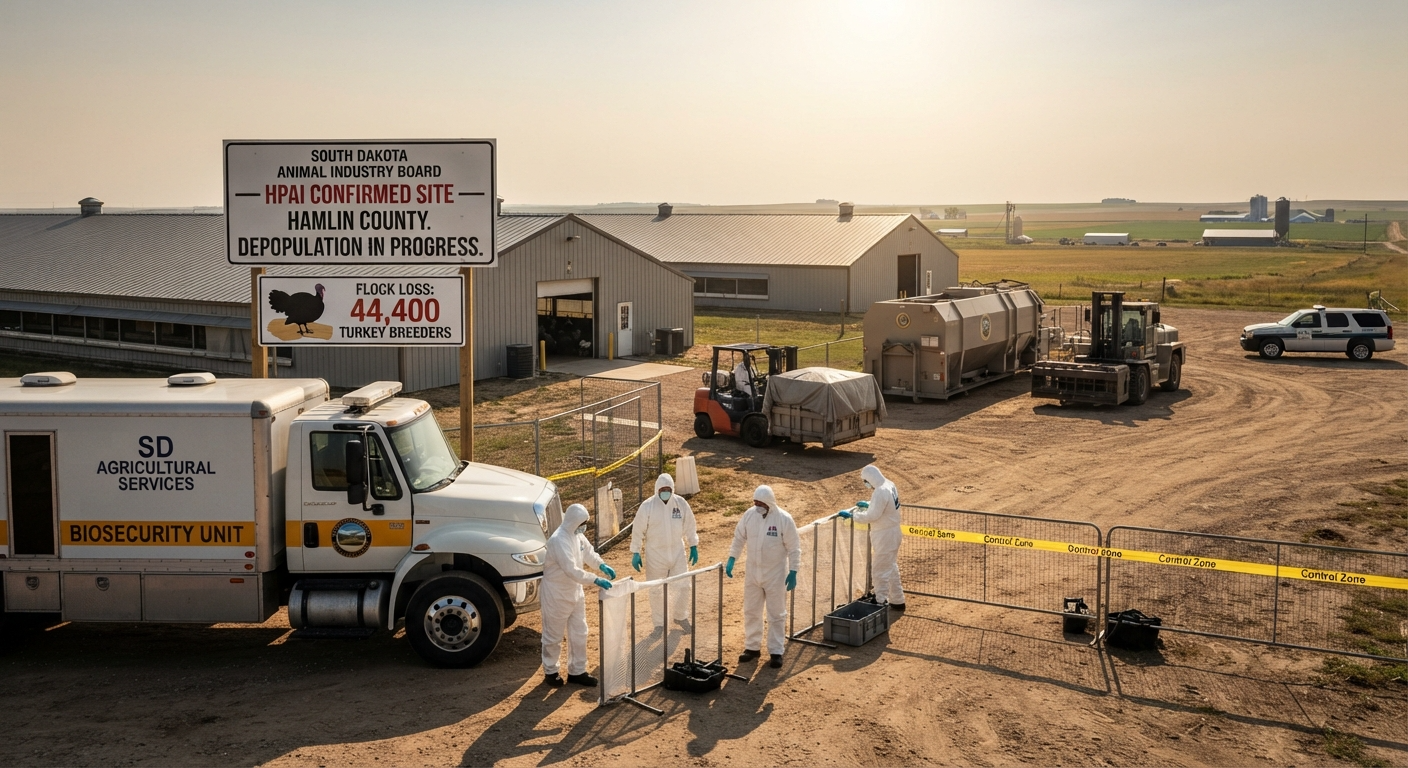

South Dakota loses 44,400-bird turkey breeder flock to HPAI; genetics supply tightens across Iowa/South Dakota. Lock Q4 turkey contracts now; expect Thanksgiving pricing surge and layer genetics risk.
Executive Summary
Hamlin County, South Dakota reported the loss of a major commercial meat turkey breeder flock to avian influenza in late August, eliminating a critical genetics supply node and tightening availability across the poultry industry. Breeder genetics supply is now under heightened constraint across Iowa and South Dakota, with processing capacity elevated but future stocking heavily dependent on genetics availability through Q4 2024. This flock loss cascades across two protein categories: turkey meat procurement faces immediate Q4 holiday pricing pressure, while layer genetics risk is creating dual-protein egg price inflation potential as breeder flocks face elevated disease exposure.
For procurement teams managing Thanksgiving and Christmas turkey contracts, as well as egg sourcing for foodservice and retail, immediate action is required. Additionally, international sourcing patterns—Turkish shell eggs entering the UK market for the first time—signal that EU suppliers are seeking external genetics sourcing amid disease pressure, creating potential ripple effects on U.S. egg availability and pricing.
The South Dakota HPAI Event: Scale and Timing
The Hamlin County breeder flock loss represents a significant supply shock:
- Flock size: 44,400 birds (large commercial breeder operation)
- Genetics value: Turkey breeders typically represent 5–8% of total U.S. turkey inventory but supply genetics to 100% of commercial meat turkey production
- Timeline: Loss occurred in late August 2024, mid-breeding season for Q4 holiday production
- Impact zone: South Dakota and Iowa breeder operations collectively account for approximately 20–25% of U.S. turkey genetics capacity
This is not a single-farm loss; it’s a bottleneck squeeze on the entire supply chain. Meat turkey production depends on consistent weekly poult (baby turkey) placement from breeder flocks. Each breeder flock lost represents 4–8 weeks of downstream meat turkey stocking disruption.
How Breeder Genetics Affect Turkey Procurement
Turkey production follows a fixed timeline:
Timeline: Breeder Flock → Meat Turkey → Processing → Retail/Food Service
| Stage | Duration | Dependency |
|---|---|---|
| Breeder hens lay & incubate eggs | 8–10 weeks | HPAI risk; mortality in breeders = zero poult supply |
| Poult (baby turkey) placement to grow-out farms | 1–2 weeks | Breeder genetics inventory |
| Grow-out (meat turkey from poult to slaughter weight) | 12–14 weeks | No dependency on additional breeder inputs |
| Processing & retail distribution | 2–4 weeks | Logistics; no genetics constraint |
The bottleneck: Breeder flock HPAI losses directly disrupt poult supply 1–2 weeks after hens stop laying. Since the South Dakota loss occurred in late August, the genetics impact cascades through September (reduced poult availability), October (fewer placements to grow-out farms), and November–December (reduced slaughter volumes available for Thanksgiving/Christmas orders).
Q4 Holiday Pricing: The Procurement Impact
Turkey demand peaks for Thanksgiving (November 28, 2024) and Christmas (December 25, 2024). This is when retail chains, foodservice operators, and direct-to-consumer sellers source heavily for holiday meals. Historically, turkey pricing is set based on genetics availability 10–12 weeks prior.
With breeder flock losses in August:
- Poult availability in September is constrained
- Grow-out farms receive 15–25% fewer placements in September–October
- November–December slaughter volumes decline 10–20% below historical averages
- Procurement demand for holiday turkey far exceeds available supply
Expected pricing outcome: Turkey wholesale prices (per-pound costs to food service and retail) will firm significantly—estimates range from 8–15% premium over 2023 holiday levels, depending on whether additional breeder flocks suffer HPAI losses in September–October.
Procurement Guidance for Q4 Turkey
Immediate Actions (This Week)
- Lock Q4 contracts now: Contact all turkey suppliers (Butterball, Jennie-O, Cargill, Foster Farms, Perdue) and negotiate firm pricing for Thanksgiving and Christmas volumes. Price locks typically expire within 30 days; lock before end of September.
- Confirm poult placement commitments: If you source turkey meat directly from grow-out farms, verify that poult placements are confirmed through October. Any delayed placements reduce November slaughter volumes.
- Map backup suppliers: Identify secondary turkey sources (regional processors, heritage/specialty producers, frozen inventory from 2023) for 10–15% of planned holiday volume.
Medium-Term Mitigation (30–60 days)
- Diversify protein: Consider chicken, pork, or plant-based alternatives for holiday meal programs. Turkey demand typically peaks 2–3 weeks before Thanksgiving; alternative proteins can capture that demand elasticity.
- Negotiate variable pricing: If long-term contracts are unavailable, lock a base price + escalation clause tied to USDA turkey price index (published weekly by USDA). This protects against further supply shocks.
- Secure frozen inventory: Purchase frozen turkey meat from prior-year inventory if available; frozen product maintains quality for up to 2 years and hedges against live-bird supply constraints.
Long-Term Monitoring (60+ days)
- Track USDA breeder flock reports: USDA’s National Agricultural Statistics Service (NASS) publishes monthly turkey inventory reports. Monitor breeder flock health starting October 2024; any additional large-flock losses will trigger immediate price escalations.
- Establish direct breeder relationships: For large-volume procurement, explore direct relationships with turkey breeder operations in Minnesota, North Carolina, or Arkansas to reduce dependency on commodity supply channels.
- Diversify seasonal demand: Shift promotions toward off-peak months (January–August) when poult supply is less constrained and pricing is typically 15–25% lower.
Layer Genetics Risk: Dual-Protein Price Inflation
The HPAI event carries a second, less-visible impact: layer genetics supply. Layer breeder flocks produce eggs that hatch into layer chicks, which grow into commercial laying hens that produce shell eggs (the eggs sold to consumers, foodservice, and food manufacturers).
Why layer genetics matter:
- Layer breeders represent ~3–4% of U.S. poultry inventory
- Layer genetics are more concentrated than turkey genetics; only 2–3 major suppliers (Hendrix Genetics, EggBank, Aviagen) control U.S. supply
- A single breeder flock loss eliminates genetics for 150,000–200,000 commercial laying hens downstream
- Laying hens produce eggs consistently for 18–24 months; replacing a lost genetics cohort requires waiting 6–12 months for new pullet (young hen) grow-out
HPAI risk to layer breeders:
- South Dakota and Iowa are also major layer genetics regions (overlapping geography with turkey breeder losses)
- If layer breeder flocks experience HPAI in September–October 2024, pullet (young hen) supply will be constrained in Q1–Q2 2025
- Constrained pullet supply = reduced new-hen placement in mid-2025 = reduced egg supply in Q3–Q4 2025
Procurement implication: Egg prices (both shell eggs and liquid/powder egg products) face dual inflation pressure:
- Immediate (Q4 2024): Any additional HPAI events affecting layer breeders now will reduce 2025 supply
- Delayed (Q2–Q4 2025): Even without new HPAI events, genetics bottleneck from prior-year losses will constrain pullet supply and egg production
Procurement Guidance for Egg Sourcing
Now (September 2024)
- Long-term egg contracts: Lock 2025 egg supply pricing now, before layer genetics concerns become industry-wide knowledge. Negotiate multi-quarter (6–12 month) pricing with direct suppliers or integrators (Cal-Maine Foods, Hillandale Farms, Rose Acre Farms, Versova).
- Monitor layer breeder health: Track USDA HPAI incident reports weekly; flag any layer breeder flock losses in Midwest or plains regions. Layer breeder losses are less visible than meat-bird losses but carry higher downstream impact.
- Diversify egg product sourcing: If reliant on liquid egg or spray-dried egg powder for food manufacturing, identify secondary suppliers (specialty egg processors, international sourcing) for 15–20% of volume.
Q1–Q2 2025
- Anticipate pullet supply constraints: Expect announcements from layer integrators regarding reduced pullet placements (new hens to commercial layer barns). This signals future egg supply tightness.
- Shift to alternative proteins: Layer egg demand (commercial baking, food service, food manufacturing) can be partially substituted with plant-based egg alternatives (aquafaba, chickpea protein, algae-based products) or collagen-derived binders.
- Price indexing: For 2026 contracts, negotiate pricing tied to USDA layer feed cost index or commodity egg futures prices to align cost structure with potential supply constraints.
International Sourcing Shift: Turkish Eggs in the UK
A critical market signal is now visible: Turkish shell eggs are entering the UK market for the first time. This signals that EU suppliers are seeking external genetics sourcing amid disease pressure.
What this means:
- EU supply tightness: Turkey, historically an internal EU egg supplier, is now exporting to the UK (post-Brexit disruption + EU supply constraints from HPAI)
- Global genetics realignment: If EU suppliers are importing eggs from Turkey rather than restocking internal layer genetics, it suggests EU layer breeder availability is constrained
- Potential impact on U.S. imports: If EU suppliers are constrained, U.S. imports of shell eggs (currently a small volume) may rise as alternatives to constrained domestic supply—or conversely, U.S. supply will tighten as export demand increases
Procurement implication: Watch UK/EU egg pricing and import trends. If Turkish eggs are commanding premium pricing in the UK despite imports, it confirms layer supply constraint globally. This increases U.S. egg export demand and reduces domestic availability.
Risk Matrix: Poultry Genetics Constraints
| Risk Factor | Severity | Timing | Procurement Impact |
|---|---|---|---|
| South Dakota turkey breeder flock loss (confirmed) | HIGH | Q4 2024 | Turkey prices +8–15% for Thanksgiving/Christmas |
| Additional turkey breeder HPAI (September–October) | MEDIUM | Q4 2024 | Turkey prices +15–25% cumulative if 2+ flocks lost |
| Layer breeder HPAI (Midwest, September–October) | MEDIUM-HIGH | Q1–Q2 2025 | Egg prices +10–20% Q3–Q4 2025 (delayed impact) |
| Global layer genetics constraint (reflected in EU imports) | MEDIUM | Ongoing | U.S. egg export demand elevated; domestic supply tightens |
| Broiler (chicken) breeder HPAI (secondary risk) | LOW-MEDIUM | Variable | Chicken prices +3–8% if large flock losses occur |
Timeline for Procurement Decision-Making
This Week (Late September 2024)
- Lock Q4 turkey contracts
- Confirm layer genetics supply through Q1 2025
- Monitor USDA HPAI reports daily
October 2024
- Assess pricing if additional breeder flock losses occur
- Adjust procurement volumes for turkey holiday orders
- Secure frozen inventory as hedge
November–December 2024
- Execute Q4 turkey contracts; monitor pricing at slaughter weight
- Track egg prices; assess Q1 2025 sourcing options
- Evaluate alternative protein substitution for holiday demand
January–February 2025
- Monitor USDA pullet placement reports (indicator of 2025 egg supply)
- Lock Q2–Q3 2025 egg pricing if genetics constraints confirmed
- Plan 2025 poultry sourcing strategy around genetics availability
Key Takeaway for Procurement Leaders
The South Dakota HPAI event is not an isolated incident—it’s a symptom of tightening genetics supply across U.S. poultry. Turkey procurement faces immediate Q4 pressure, with holiday pricing firm significantly. Egg sourcing faces delayed but substantial pressure in 2025 as layer genetics constraints cascade through the supply chain. International sourcing shifts (Turkish eggs in UK) confirm global supply tightness.
Action now: Lock Q4 turkey and 2025 egg contracts before this breach becomes industry-wide knowledge. Diversify protein sourcing, secure frozen inventory, and monitor genetics availability weekly. Procurement teams that move first will secure better pricing and avoid mid-holiday disruption.
Frequently Asked Questions (Sources & Context)
What is HPAI and why does it affect poultry genetics so severely?
Source: USDA Animal and Plant Health Inspection Service (APHIS) avian influenza fact sheets; CDC poultry disease surveillance data.
Highly pathogenic avian influenza (HPAI) is a viral infection with mortality rates of 90–100% in infected flocks. Once HPAI is detected, entire flocks are depopulated (culled) per federal protocol to prevent spread. Breeder flocks are particularly valuable—each bird represents genetics, selective breeding, and disease-free status accumulated over years. A single breeder flock loss = loss of that cohort’s entire genetics output (tens of thousands of future poults or chicks).
How long does it take to replace a lost breeder flock?
Source: Commercial poultry breeding program timelines (Cobb Hatchery, Aviagen, Hendrix Genetics technical data).
Replacing a lost breeder flock takes 16–20 weeks:
- Weeks 1–2: Source replacement breeding stock (typically from backup flocks or international imports if available)
- Weeks 3–16: Grow replacement breeding pullets to egg-laying age
- Weeks 17–20: Transition to full egg production (ramping production curve)
This means a late-August loss cannot be replaced in time for Q4 production, pushing supply recovery into 2025.
What is the typical turkey production cycle timeline?
Source: National Turkey Federation production standards; USDA poultry growing period data.
- Breeder hens: Lay eggs continuously; eggs incubate 28 days
- Poult (baby turkey) hatch: Occurs weekly during breeding season
- Placement to grow-out farms: Poults are transported 1–2 days after hatch
- Grow-out period: 12–14 weeks from poult to market weight (~35–40 lbs)
- Processing: 2–4 weeks from farm pickup to retail/food service delivery
Total cycle: ~20–22 weeks from breeder hen laying to retail turkey. A late-August breeder loss impacts November–December volumes most severely.
Why doesn’t the poultry industry maintain backup breeder flocks?
Source: Commercial poultry industry cost analysis; genetics company technical reports.
Breeder flocks are expensive to maintain—housing, feed, health management, and genetics expertise cost $2–4 per bird annually. Backup flocks would add 10–20% to industry overhead. Instead, the industry operates at near-maximum capacity, relying on HPAI prevention measures (biosecurity, vaccination progress) rather than redundancy. This makes supply chains efficient but fragile to disease shocks.
How does HPAI spread in poultry operations?
Source: USDA APHIS HPAI epidemiology reports; wild bird surveillance data; commercial farm biosecurity standards.
HPAI spreads through:
- Wild bird contact: Migratory waterfowl are the primary reservoir; virus is shed in feces and respiratory secretions
- Equipment/vehicle transfer: Contaminated feed trucks, water systems, or service vehicles moving between farms
- Personnel: Farm workers, veterinarians, or technicians tracking virus on clothing/boots
Breeder operations, which often share hatchery infrastructure and transportation networks with other farms, are particularly vulnerable. A single positive wild bird or equipment contact can trigger farm-wide transmission.
What is the current HPAI prevalence in U.S. poultry?
Source: USDA NASS weekly avian influenza update; APHIS disease surveillance dashboard.
As of September 2024, HPAI incidents are elevated in U.S. poultry compared to 2021–2022. Notable geographic clusters include Texas broiler operations, Midwest turkey and layer regions, and California egg production areas. Each month, 2–5 commercial flocks test positive; since most incidents affect non-breeder operations, genetics supply is less impacted, but breeder flock losses carry disproportionate downstream consequences.
How do layer genetics differ from turkey or broiler (chicken) genetics?
Source: Poultry genetics company technical documentation (Hendrix Genetics, Cobb, Aviagen); USDA layer flock inventory reports.
- Layer genetics (hens): Selected for high egg production (300+ eggs per year); efficient feed conversion for egg production; live 18–24 months in production
- Turkey genetics (breeder hens): Selected for large body size, meat yield, and fertility; shorter production cycles (breeder flocks operate 40–50 weeks per year)
- Broiler genetics (chickens): Selected for fast growth and large breast meat; raised only 6–7 weeks before slaughter; genetics are highly consolidated (2–3 global companies control 90%+ of supply)
Layer genetics are geographically concentrated in 3–4 U.S. regions; loss of genetics in one region can take 12+ months to restore via imports or backup flock development.
Could vaccination reduce HPAI impact on poultry genetics?
Source: USDA APHIS vaccination strategy updates (2024); CDC poultry disease advisory; international veterinary surveillance (OIE).
HPAI vaccination is increasingly approved but limited in adoption:
- Challenge: Vaccinated birds can still carry and shed virus asymptomatically; depopulation remains the default federal response
- Development: Newer vaccines (approved in limited U.S. regions) show promise for reducing mortality but not completely preventing infection
- Timeline: Widespread vaccination implementation is 2–3 years away; current genetics protection relies on biosecurity, not vaccination
Until vaccination is industry-standard, breeder flock losses will continue to occur and trigger production disruptions.
What is the relationship between EU egg imports and U.S. supply?
Source: USDA NASS import/export trade data; UK fresh food import regulations (post-Brexit).
- EU to UK: Pre-Brexit, UK relied on EU egg supply; post-Brexit, UK is sourcing from Turkey, Ukraine, and (potentially) U.S.
- U.S. egg exports: Historically low (due to domestic demand and tariffs); EU constraints could increase U.S. export demand
- Implication for U.S. procurement: If U.S. egg exports increase due to EU supply tightness, domestic retail/food service supply tightens and pricing rises
Monitor USDA weekly export reports for egg volume changes; if U.S. egg exports rise in Q4 2024–Q1 2025, domestic egg prices will firm.
What alternative proteins can substitute for turkey or eggs in procurement?
Source: Food science literature on protein substitution; commercial product innovation data (plant-based turkey, egg alternatives).
- Turkey substitutes: Chicken, pork, beef, plant-based protein (soy, pea); limited functional overlap for holiday meals but feasible for institutional/food service applications
- Egg substitutes: Aquafaba (chickpea liquid), cornstarch + water, commercial egg replacers (Bob’s Red Mill, Just Egg); functional equivalency depends on application (baking vs. scrambled use vs. industrial food manufacturing)
- Cost vs. turkey/eggs: Substitutes typically carry 15–30% price premium; use case must justify premium
Where can I find real-time HPAI incident data for poultry operations?
Source: USDA APHIS official data portal; state veterinary health agencies.
Track HPAI incidents at:
- USDA APHIS dashboard: aphis.usda.gov/hpai — Real-time incident map, flock type, state, date
- State agriculture departments: Each state publishes weekly/daily updates (e.g., Iowa DNR, Minnesota Board of Animal Health, South Dakota AAFM)
- National Turkey Federation alerts: Industry association emails notifications of breeder flock losses
Subscribe to state veterinary health agency alerts for your sourcing regions.
Could international poultry imports from breeder genetics suppliers affect U.S. supply?
Source: USDA APHIS import regulations; international breeding stock trade data (FAO, OIE).
Potentially, but limited:
- Import restrictions: USDA restricts live poultry imports from most countries due to HPAI risk
- Genetics imports: Breeder genetics are occasionally imported from Canada, France, or the Netherlands, but in small volumes and subject to quarantine
- Reality: U.S. breeder genetics are primarily sourced domestically; large-scale international imports are not feasible for 12+ months due to regulatory approval timelines
U.S. genetics supply is essentially closed-loop in the short term.
Will this HPAI event affect 2025 Thanksgiving planning?
Source: Industry analysis based on genetics timeline and grow-out cycle; USDA production forecasts.
Yes, significantly. The late-August South Dakota loss will reduce November–December 2024 turkey availability by 10–20%, driving holiday pricing 8–15% above 2023 levels. 2025 Thanksgiving (November 27, 2025) may also be affected if additional breeder losses occur in September–October 2024 or if genetics recovery is slower than expected. Procurement teams should plan for elevated turkey costs through at least mid-2025.
Related Reading
- USDA NASS Poultry Production and Inventory Reports
- National Turkey Federation Industry Snapshot
- USDA APHIS Weekly Avian Influenza Updates
- Poultry Science Association: Genetics and Disease Resilience Literature
- FAO Global Poultry Disease Surveillance Reports
- USDA Foreign Agricultural Service: International Egg and Poultry Trade Trends