
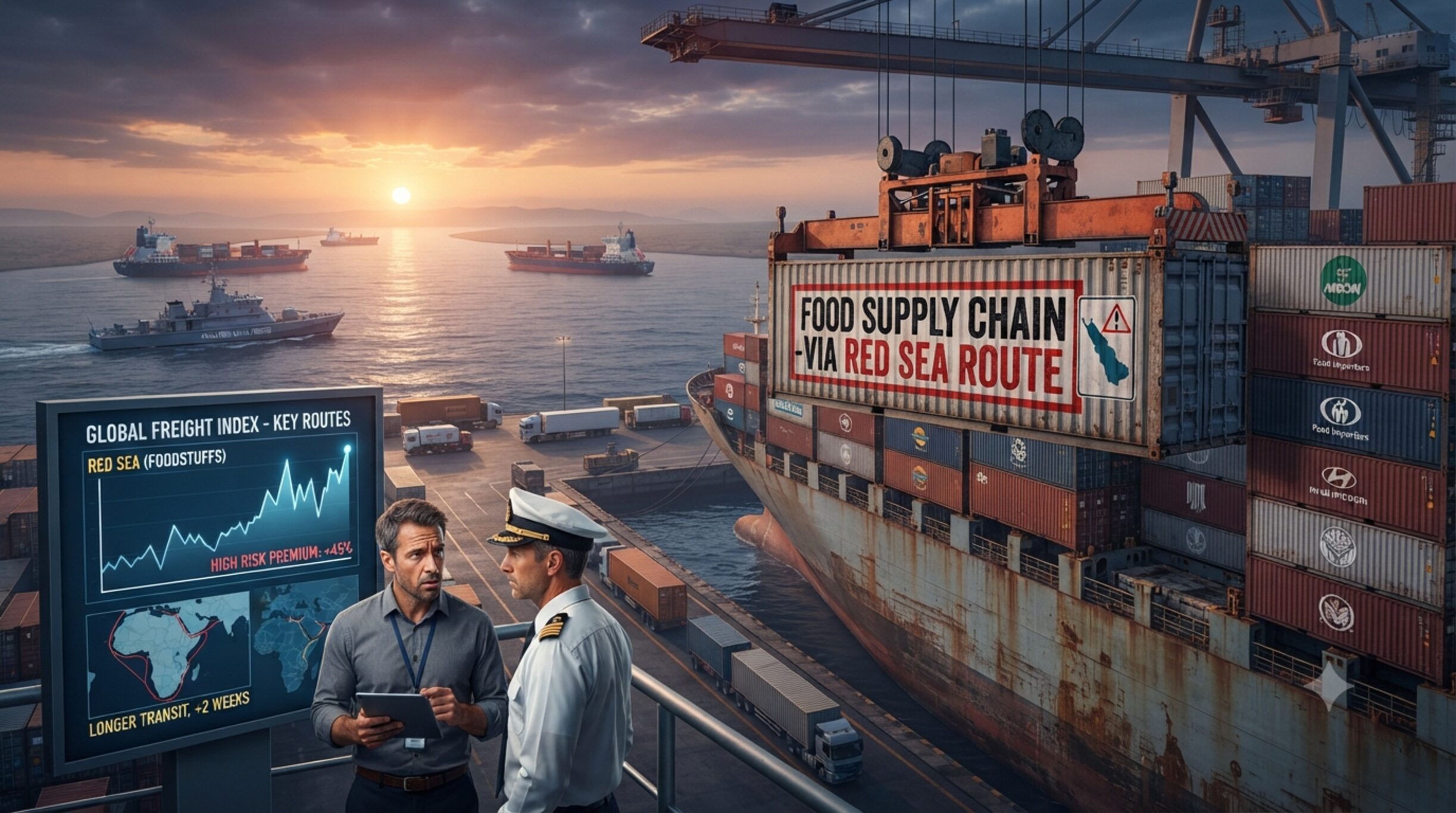

Red Sea shipping remains unpredictable despite carrier returns to Suez, keeping war risk premiums, surcharges and food freight costs elevated.
A new industry reader poll has landed on a verdict that will surprise nobody moving cargo through the corridor: the Red Sea is unpredictable. “Unpredictable” took the largest share of responses, “still too risky” came second, and the two constructive options — “stable but fragile” and “recovering” — trailed well behind.
Sentiment polls are soft data. This one happens to match the hard data closely, and for food importers running Asia–Europe and Asia–Mediterranean lanes, the gap between headline carrier announcements and actual routing reality is where the cost sits.
Sentiment tracks the traffic
Before the crisis began in late 2023, the Suez Canal handled roughly 80 container ships a week. By January 2026 that had recovered to around 26. BIMCO put transits down about 60% at the start of the year, and while war risk premiums have softened from their peaks, insurers still classify the corridor as high risk.
The commercial incentive to return is real and large. The Cape of Good Hope detour adds roughly 3,500 nautical miles and 10 to 14 days on Asia–Europe voyages, forcing carriers to deploy additional vessels per service to hold weekly frequency. Cape routings currently absorb around two million TEU of effective global capacity — an estimated 8% reduction in usable fleet.
That is why carrier moves toward Suez have moved share prices. When Maersk and Hapag-Lloyd signalled renewed confidence in early July, their shares fell on the expectation that returning capacity would push freight rates down.
The stop-start pattern is the real problem
The corridor’s history over the past eighteen months explains the reader caution better than any single incident.
The Gemini Cooperation partners resumed limited Red Sea transits in February 2026, then suspended almost immediately when US–Iran hostilities escalated and Houthi attacks resumed at the end of that month. Most mainline services reverted to the Cape. Maersk reportedly absorbed a nine-figure loss in its ocean division for the final quarter of 2025 while whipsawing between the two routings.
On 6 July the same partners announced a second attempt — a single Asia–Mediterranean–Turkey service shifted back to Suez, with a transit expected around 24 July. Both have been explicit that this is incremental and neither has committed to a broader timeline. Hapag-Lloyd remains the more conservative of the two; ZIM has said it is still waiting on insurance clearance before considering any return.
The security backdrop is genuinely improved but thin. A US–Iran ceasefire memorandum consolidated on 14 June has held. On 5 July, a cargo vessel reported coming under attack near Al Hudaydah. Both facts are true at once, which is precisely the condition readers described as unpredictable.
CMA CGM has moved furthest, with three services routed via Suez including a full INDAMEX loop connecting India and Pakistan with the US East Coast, cutting round-trip time by around two weeks.
Costs are rising on both routes
The uncomfortable position for shippers is that neither routing is getting cheaper.
The Suez Canal Authority raised temporary transit surcharges from 15 July across most vessel classes, with dry bulk carriers facing the steepest increase. Carriers do not absorb canal charges; they reappear as war risk and peak-season surcharges on booking sheets. Meanwhile the Cape routing carries its own bunker and vessel-deployment cost, and the Strait of Hormuz situation has added a second regional chokepoint to the risk picture rather than replacing the first.
The result is a widening gap between quoted base rates and invoiced all-in cost — the line item where procurement teams are most often caught out.
What it means for buyers and procurement teams
Do not build 2027 landed-cost models on a Suez return. The base case should be Cape routing with optional Suez upside. One test service is not a network shift, and the threshold for abandoning the route again is lower now that the industry has proven it can operate around Africa.
Audit all-in freight, not base rates. War risk surcharges, emergency cost recovery charges and BAF adjustments are where the volatility now lives. Contracts indexed only to base rate leave the exposure with you.
Keep transit buffers wide on temperature-controlled cargo. Reefer product on a service that reroutes mid-voyage faces both schedule and shelf-life risk. Fourteen extra days is a floor, not a ceiling, once port congestion is factored in.
A genuine return is a buyer’s market event. If two million TEU flows back into an already oversupplied market, spot rates fall further. That argues for shorter contract tenors on Asia–Europe lanes right now, not annual lock-ins.
Watch European port capacity. Faster arrivals into Rotterdam and the North European hubs during a transition can produce congestion that eats the transit-time saving. Monitor destination terminal conditions alongside routing announcements.
Related
FAQ
Is the Red Sea safe for shipping again in 2026?
Not reliably. Attack frequency is well below its peak and a US–Iran ceasefire has held since mid-June, but an incident was reported near Al Hudaydah on 5 July and insurers still treat the corridor as high risk. Carriers are testing individual services rather than returning networks.
How much does the Cape of Good Hope detour add?
Roughly 3,500 nautical miles and 10 to 14 days on Asia–Europe voyages, though port congestion frequently pushes the real figure higher. It also requires extra vessels per service to maintain weekly frequency, tying up around two million TEU of global capacity.
Will a Suez return lower food freight rates?
Probably, but not immediately. Releasing Cape-absorbed capacity would add supply to an already oversupplied market and pressure spot rates downward. Offsetting that, Suez Canal surcharges rose on 15 July and war risk cover remains expensive, so the saving reaches shippers only partially.