
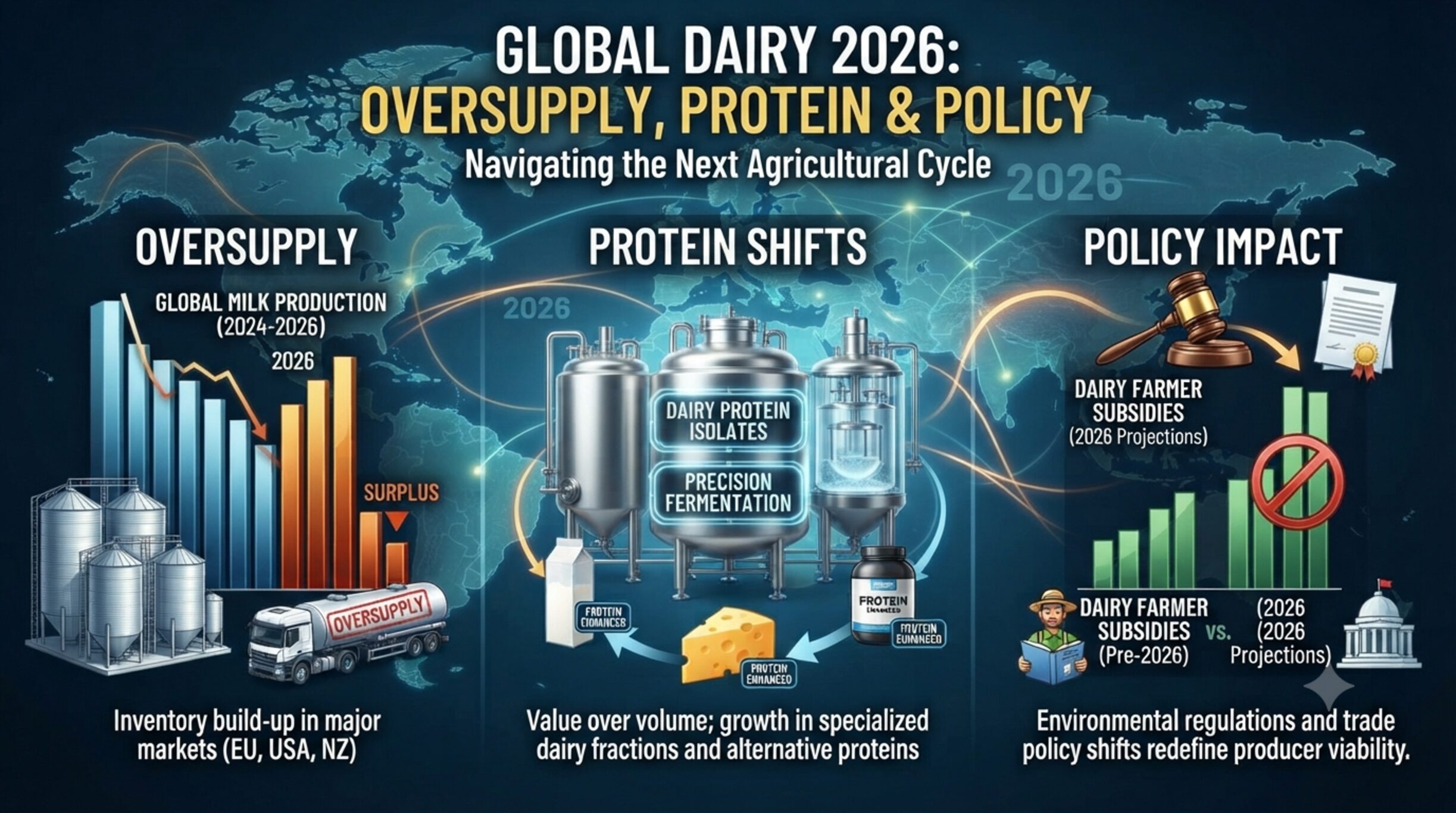

Global dairy is oversupplied, prices have slid and protein is scarce. Inside the full 2026 supply, demand, trade, company and technology picture.
The state of play
Dairy in mid-2026 is a market of two halves, and the split runs straight through the milk itself.
On the commodity side, the world made too much milk. Every major exporting region except the EU pushed volume higher through the first half, buyers stepped back, and the Global Dairy Trade index gave back most of a spectacular first-quarter rally. On the protein side, the picture is inverted: whey is genuinely short, high-protein retail is the fastest-growing thing in the dairy case, and processors are racing each other to pull more value out of the same milk pool.
That divergence — cheap fat and powder, expensive protein — is the single most important structural fact for anyone buying, selling or processing dairy this year.
The 21 July GDT auction gave the market its first lift since the second event in May, with the index up 1.5% across 167 participating bidders and 117 winners. It was a stabilisation, not a turn.
Table of Contents
Supply: everybody grew, and it showed
United States. June milk production hit 18.93 billion pounds, up 2.4% year on year, per USDA NASS. Second-quarter output totalled 60.2 billion pounds, also up 2.4%, following a 3.1% first quarter. Output rose in 22 of the 24 reporting states — only Washington and Virginia fell. The national herd averaged 9.67 million head in Q2, 192,000 more than a year earlier. Texas was up 4.9%, Kansas an extraordinary 16.7%.
European Union. The EU was the one region that ran hot early and cooled fast. Q1 deliveries were up 4.6% year on year and January–April up 4.2%, but April growth had already slowed to 2.7% and the European Commission expects limited growth in the second half. The herd continues its structural decline, down roughly 0.7–0.9% in 2026, with yield gains doing the heavy lifting.
New Zealand. Close to a record year. May output reached 1.02 million tonnes, up 3.6%, with milk solids up 5.0% to 108.7 million kg. Full-year production is forecast at around 22.1 million tonnes, above 2025’s 21.93 million and the highest since 2018 — achieved with a materially smaller herd.
South America. Argentina is the standout, up around 4% to a record ~12 million tonnes on good pasture, cheap feed and productivity gains. Brazil’s expansion is slowing, with a second-half decline expected.
Australia. A modest recovery to about 8.6 million tonnes, up 1.8%, on better pasture, firm farmgate prices and lower grain costs.
The long view. India remains the world’s largest producer by a wide margin at 247.87 million tonnes in 2024–25, up 3.58%, and roughly a quarter of global output — though almost entirely consumed domestically. Global milk production sits near 993 million tonnes.
RaboResearch’s read is that global milk volumes rise about 1% in 2026, down sharply from 3.1% in 2025, peaking in Q2, flattening in Q3 and declining in Q4. If that holds, the supply overhang is a first-half problem working its way through a second-half market.
Prices: the round trip
The 2026 price arc has been dramatic. The index opened the year with a 6.3% jump, then strung together five consecutive gains to peak around $4,301/tonne in early March. It has been unwinding ever since. Fonterra noted that prices across the reference products underpinning its farmgate calculation fell 11% between late May and mid-July.
GDT, 21 July 2026 (average winning prices, USD/tonne):
| Product | Price | Change |
|---|---|---|
| Anhydrous milkfat | $6,405 | +1.1% |
| Butter | $5,303 | −0.6% |
| Buttermilk powder | $4,737 | +10.5% |
| Mozzarella | $3,940 | +1.3% |
| Cheddar | $3,586 | −6.5% |
| Whole milk powder | $3,486 | +1.6% |
| Skim milk powder | $3,234 | +2.8% |
| Lactose | $1,721 | +2.0% |
United States (CME, week ending 17 July): Grade AA butter closed at $1.5900/lb, cheddar blocks at $1.6275 and barrels at $1.6125, Grade A nonfat dry milk at $1.4700 and extra grade dry whey at $0.6950. USDA has cut its 2026 all-milk price forecast to $20.00/cwt, with Class III and Class IV forecasts both lowered on continued strong milk supply growth. The May all-milk price was $21.30 and the milk-feed ratio 2.21.
Europe. March farmgate averaged 43.1c/kg, down 1.9% on the month and 19% year on year, with April estimated at 42.9c. The year-on-year declines in some member states have been brutal: Belgium and Lithuania around −30%, Denmark −29%, the Netherlands and Germany −27%. Only Spain, Finland, Malta and Cyprus were above year-ago levels.
The butter anomaly worth acting on. GDT butter at $5,303/tonne equates to roughly $2.40/lb. CME AA butter is at $1.59/lb. Even allowing for the differences in terms, specification and contract timing, that is an unusually wide transatlantic spread — and it is not mirrored in cheese, where GDT cheddar at $1.63/lb sits almost exactly on top of CME blocks. For anyone with the flexibility to switch butterfat origin, US-origin butter and AMF are currently the cheapest fat in the world by a considerable margin.
Demand: China is now a swing buyer, not the market
The most consequential demand shift of the decade is close to complete. China’s domestic production is flat at around 41.5 million tonnes, and USDA has cut its calendar-year whole milk powder import forecast to 325,000 tonnes — a 22% downward revision. Weak retail demand, a cooling economy and a falling birth rate have hollowed out the powder and infant-formula pull that drove the market for fifteen years.
What remains is more selective and higher-value: cheese, butter and whey, pulled by foodservice, bakery and premium applications where domestic product cannot compete on quality or volume. China still takes 36–40% of New Zealand’s total dairy exports. But it now buys opportunistically rather than structurally.
That has pushed exporters toward secondary destinations. Southeast Asia is the clearest growth story — Singapore, Vietnam, Sri Lanka, Thailand, Malaysia and Indonesia are all absorbing more, and Indonesia alone still imports 75–80% of its consumption. Japan and South Korea are driving cheese; South Korea has been the single biggest growth market for US cheese this year.
Africa and NENA remain price-and-finance sensitive. Algeria is the anchor buyer for Uruguayan and much European powder — it takes roughly half of Uruguay’s WMP — but new import regulations introduced in 2025 look set to cap its volumes. West Africa remains dominated by fat-filled milk powder, which is roughly two-thirds of the region’s dairy imports. African milk production has grown 17% over a decade to 53.2 million tonnes, but the continent still produces just 5% of world milk while holding 20% of global cattle, which keeps import dependence structurally high.
The whey squeeze: dairy’s tightest market
While powder buyers enjoy a buyer’s market, protein buyers are in the opposite position. Whey is short and getting shorter.
US production has essentially been absorbed by domestic demand and is largely unavailable to the international market. Buyers are turning to Europe, where it is unclear the supply base can take the strain. Alexander Anton of the European Whey Processors Association expects the market to stay tight near-term, easing only as new processing capacity comes online — and to remain structurally firm even then.
A significant and under-appreciated driver is GLP-1 medication. In the US, whey protein is frequently recommended alongside GLP-1 drugs to preserve lean mass, and the sheer scale of adoption has fed directly into ingredient demand. This is a demand source that did not exist five years ago and shows no sign of reversing.
The knock-on is visible in the export data: US commodity whey exports are growing strongly while WPC80+ volumes are down year to date, as processors prioritise the more lucrative domestic market.
Substitution options. Milk protein concentrates and isolates cover most whey applications and actually outperform on heat stability in the pH 6.5–7.0 range, which suits UHT ready-to-drink. Two caveats: milk proteins lose solubility below pH 6.0, so they will not work in highly acidic clear beverages, and they bind more water, developing more viscosity. Casein-based ingredients work for water binding and emulsification depending on application. No single substitute replicates the full functional set — protein, solubility across a wide pH range, emulsification, gelation, foaming and browning.
Protein is where the growth is
US retail data from Circana puts protein-claim dairy at $10.4 billion within a $104 billion market — but the growth differential is the story. Products carrying protein call-outs grew 13.7% in value and 7.5% in volume over the past year, against 2.0% and 0.3% for dairy overall.
By category: protein yogurt up 23.2% value and 16.8% volume; cottage cheese with protein claims up 18.1% and 14.6%; and high-protein milk up 7.7% value and 1.2% volume, reversing a decades-long fluid milk decline. The competitive stakes are high enough that Danone has taken Chobani to court over protein claims.
The trend is not US-only — Europe, Australia and parts of Asia are all seeing protein function as a premiumisation platform rather than a sports-nutrition niche.
Cheese: everyone pivoted, and the market split in two
Every major exporter has routed milk toward cheese. Global cheese trade is up around 40% since 2017. US cheese exports are running 25.1% ahead year to date at nearly 238,000 tonnes, with rolling twelve-month volumes at a record ~660,000 tonnes. New Zealand is heading for a record ~425,000–430,000 tonnes and Australia for its strongest cheese export year since 2008 at ~175,000 tonnes.
The obvious expectation would be a price collapse. What has actually happened is a split.
Cheddar — made everywhere, and heavily capacity-invested in the US — is down 6.5% over twelve months with no shortage in sight. Mozzarella, dominated by EU production, is up 1.3% after heatwaves cut milk supply in France, Germany and the UK. In the UK, the June heatwave produced what analysis by the Energy and Climate Intelligence Unit called an unprecedented decline: a single-day drop of 4.3% and roughly 16.5 million pints lost over nine days.
The result is a genuine market inversion. Mozzarella at €3,448/tonne is now more expensive than cheddar at €3,138/tonne. Rabobank’s Tom Booijink notes that “Cheddar normally commands a premium over mozzarella, which is now totally opposite” — the last comparable episode in the EU was 2019.
Expect this polarisation to widen. EU milk deliveries face a difficult Q4 comparison against a 6% gain last year, with fewer cows, farmgate prices roughly 30% below year-ago levels and rising diesel and fertiliser costs leaving little incentive to push volume.
Companies: the biggest reshuffle in years
Two transactions have redrawn the industry map in 2026.
Fonterra–Lactalis. Fonterra completed the sale of its Mainland Group — global consumer brands, Oceania foodservice and ingredients, Sri Lanka foodservice, and the MEA foodservice business — to Lactalis at the end of March, for around NZ$3.845 billion. Fonterra retained the Anchor brand in Greater China. Farmer shareholders received a NZ$3.2 billion capital return at NZ$2.00 per share. Critically for buyers, the deal came with a ten-year raw milk supply agreement and a six-year global supply agreement covering ingredients and bulk cheese. Fonterra is now a pure-play B2B ingredients and foodservice business under NZMP and Anchor Food Professionals, with Richard Allen taking over as CEO on 1 May.
Arla–DMK. Completed 1 June, creating Europe’s largest dairy cooperative: around 11,200 farmer owners, 28,800 employees across seven countries, an annual milk pool of 19.4 billion kg and pro forma revenue above €20 billion. Peder Tuborgh is CEO, Jan Toft Nørgaard chair, and DMK’s Ingo Müller runs post-merger integration. The stated priorities are advanced whey ingredients and branded products — which tells you where the enlarged group thinks the margin is.
The wider picture. Lactalis remains the clear number one, the first company to pass $30 billion in dairy revenue, and has kept buying — including Agropur’s fine cheese division in Canada, announced in July. Rabobank had already flagged 2026 as a shake-up year, with the FrieslandCampina–Milcobel merger, Yoplait’s integration into Lactalis and Sodiaal, and Unilever’s ice cream divestment all in train. FrieslandCampina’s own results reflect the squeeze, with profits down sharply as higher volumes failed to offset margin compression. Operational risk is also on the agenda: fairlife suspended US production temporarily in July following a ransomware event.
Trade policy: the friction is real
China–EU. After an investigation running since August 2024, China imposed final anti-subsidy duties on EU cream and cheese effective 13 February 2026, in place until 2031. Rates were negotiated down substantially from preliminary levels of 21.9–42.7% to between 7.4% and 11.7%, with 51 companies at 9.5%. These sit on top of existing duties of roughly 8% on cream and 15% on cheese. The EU ships around 30,000 tonnes of cheese and 100,000 tonnes of cream to China annually, so the commercial impact is meaningful without being fatal.
Elsewhere. The US signed trade agreements with Argentina and Ecuador that USDEC and NMPF expect to improve export access. EU–Mercosur remains the significant open item, with implications for South American cheese access into Europe. Colombia has moved on additional tariffs against US milk powder.
Innovation and technology
Precision fermentation has moved from pitch deck to purchase order. Lactoferrin is the breakout ingredient. Conventionally it is extracted from whey at roughly 1% of whey proteins, making it costly and wasteful. Precision fermentation removes that constraint entirely.
The commercial landscape as of July 2026: TurtleTree secured the first FDA GRAS “no questions” letter in 2025 and has now partnered with Novonesis to scale for early-life nutrition. All G received its FDA letter in April 2026. Vivici — founded by Fonterra and dsm-firmenich — reached self-affirmed GRAS in February, launched commercially in the US, has started EU approval, and won a €12.5 million European Innovation Council grant in June. On human lactoferrin, Nestlé partnered with Helaina in June to scale Effera, with PFx Biotech in Portugal and a QUT–Eclipse Ingredients collaboration in Australia also pushing toward commercialisation. Fortune Business Insights forecasts the lactoferrin market at $810 million by 2034.
Elsewhere in the space, Plantopia raised $9 million in July to commercialise oat-grown casein — worth watching as an alternative route to dairy proteins that sidesteps fermentation economics entirely.
On-farm. USDA’s Economic Research Service published new work (ERR-356) finding that robotic milking, or the use of two or more precision technologies, raises US dairy net returns by 13% on average. Adoption is now highest among mid-sized herds — 13% of farms with 150–499 head were using robotic milking as of 2021. Globally there are more than 25,000 automatic milking systems in operation, and the robotic milking market alone exceeds $5.7 billion. Methane-reducing feed additives are showing 25–35% reductions per cow in trials and on-farm use. AI camera systems for body condition scoring, lameness detection and individual animal ID are the fastest-growing category, with trials showing above 94% accuracy on individual identification.
The consistent message from the 2026 technology cycle is that the hype phase is over. Buyers are demanding ten-year ROI cases, and data integration — not hardware — is the binding constraint.
In-plant. With whey short and capacity tight, the highest-return engineering projects this year are debottlenecking existing whey streams rather than greenfield expansion. Membrane optimisation, improved fractionation yield and better utilisation of existing dryers are where processors are finding capacity without capex.
What this means for buyers
Fat is cheap and mispriced across regions. Butterfat is the clearest opportunity in the market. Check US-origin butter and AMF against your current Oceania or EU positions — the spread is unusually wide and may not persist.
Cover protein, not powder. WMP, SMP and NFDM are in a buyer’s market with ample supply and soft demand; there is no case for extending cover far out. Whey, WPC80+, MPC and lactoferrin are the opposite. If you have 2027 protein requirements, contract them now and expect to pay for security of supply rather than price.
Reformulate before you panic-buy whey. MPC/MPI substitution is viable in most applications outside low-pH clear beverages. Get your technical team to run the swap now rather than when the shortage bites harder.
Cheddar buyers have leverage; mozzarella buyers do not. Push hard on cheddar and cheddar-type contracts into Q4. On EU-origin mozzarella and pizza cheese, secure volume early — heat-driven EU supply weakness plus firm demand is a poor combination for late buyers.
Re-check landed cost on EU cheese and cream into China. The 7.4–11.7% duties are locked in until 2031. Where your competitors are re-routing to New Zealand, Australian or US origin, model the same.
Watch the weather, not just the balance sheet. A strengthening El Niño is the single largest upside risk to prices through into 2027. Fonterra has explicitly flagged it as the wildcard on New Zealand pasture. Ironically, the co-op’s own downside protection may end up being a drought.
Fonterra’s counterparty profile has changed. If you bought consumer or foodservice product from Fonterra, your counterparty is now Lactalis. If you buy ingredients, you are dealing with a more focused, more B2B-oriented Fonterra with more R&D capital pointed at ingredients.
Related
Watch list for H2 2026
- Whether RaboResearch’s forecast Q4 global production decline actually materialises — it is the main bull case for prices
- New Zealand’s spring peak against El Niño
- Whether Fonterra revises its 2026/27 forecast again; it sits at $9.25/kgMS with a wide $8.00–$10.50 range and very little of the FY27 book contracted
- EU Q4 deliveries against a tough 6% year-ago comparison
- China’s Q3 import volumes, particularly cheese and whey
- The Rabobank Global Dairy Top 20, due late August, which will show the Lactalis, Arla and Fonterra reshuffle for the first time
- Whether EU lactoferrin approvals start landing, which would open a second major market for precision-fermented protein
Sources
- Global Dairy Trade — auction results, 21 July 2026
- Cheese Reporter — GDT auction analysis and USDA milk production reporting, July 2026
- USDA NASS — Milk Production report, June 2026
- USDA AMS Dairy Market News — weekly CME cash markets, July 2026
- USDA Foreign Agricultural Service — Dairy: World Markets and Trade; EU and China GAIN reports
- USDA Economic Research Service — Precision Dairy Farming, Robotic Milking, and Profitability in the United States (ERR-356)
- Fonterra Co-operative Group — 2026/27 farmgate milk price revision and Mainland Group completion announcements
- European Commission / AHDB — EU milk deliveries, farmgate prices and short-term outlook
- Agriland — GDT and EU dairy market reporting
- DairyReporter — Big 7 exporter analysis, cheese price outlook, whey shortage, high-protein dairy and precision-fermented lactoferrin coverage
- RaboResearch — global milk supply forecasts and Global Dairy Top 20
- Arla Foods / DMK Group — merger completion announcements
- Caixin Global — China anti-subsidy duty ruling on EU dairy
- Circana — US retail protein-claim dairy data
- FAO — Food Outlook, global milk production
- India Ministry of Fisheries, Animal Husbandry & Dairying — Basic Animal Husbandry Statistics 2025
- IFCN — Global Dairy Tech Briefing 2026
- Energy and Climate Intelligence Unit — UK heatwave milk supply analysis