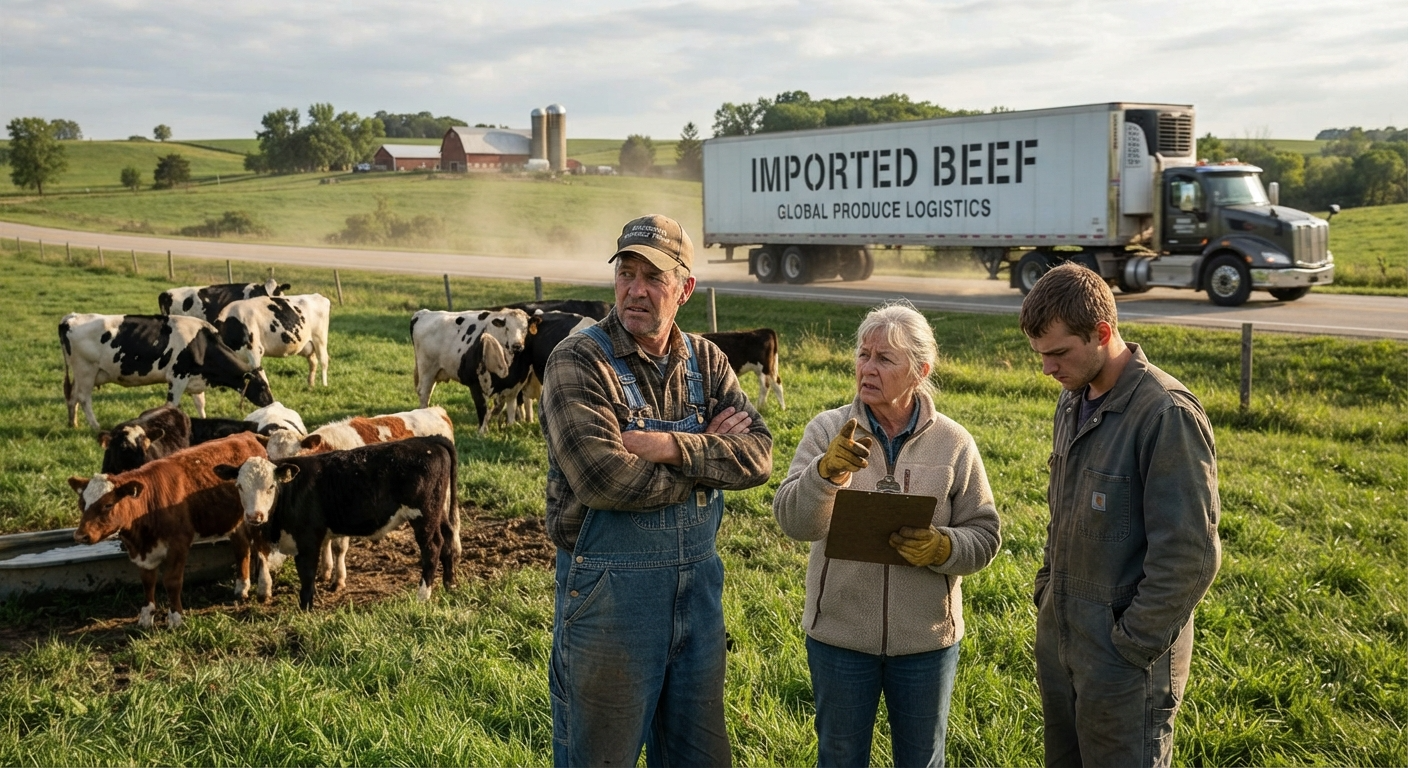

Wisconsin dairy farmers are watching their beef income stream shrink as the federal government prepares to flood the market with tariff-free beef imports, threatening a crucial revenue diversification strategy that has become worth nearly $1,000 per animal.
The Perfect Storm: How Dairy Farms Became Beef Operations
The diversification into beef production wasn’t a long-term vision—it was economic survival. Over the past four years, Wisconsin dairy farmers shifted from treating beef sales as a minor revenue line (6-8% of gross income) to a critical profit center (12-16% in 2026). That transformation didn’t happen by accident. It happened because margins on milk have been notoriously unstable, while secondary revenue from selling dairy cow culls and beef-cross calves provided predictable cash flow.
Between 2.4 and 2.9 million dairy cows are marketed into the beef supply chain annually in the U.S. alone—representing roughly 25-30% of the typical dairy herd’s natural turnover. For Wisconsin farms, this means:
- 2-3 additional revenue streams from genetics and breeding (beef semen sales up 37% of total domestic semen sales)
- Premium pricing on replacement strategies that prioritize beef characteristics
- Flexible cash management during periods of milk price volatility
Now, that strategy faces a structural threat.
The Tariff-Free Import Factor: A Market-Shifting Policy
The White House’s announcement of a 300,000-ton tariff-free beef import program represents the largest unilateral shift in U.S. beef market dynamics in a decade. Unlike previous trade agreements, this policy removes the tariff floor that has traditionally protected domestic beef producers from price compression.
What does that mean in practice? Within two weeks of the announcement, national cow beef prices—the metric that matters most to dairy farmers—fell approximately 5%. That may sound modest until you run the math across 2.4 million dairy cows entering the market annually.
At current culling and turnover rates, a 5% price decline translates to $50-70 per cow in lost revenue on a $1,000-per-animal market. Scale that across a typical Wisconsin herd of 200-500 dairy cows in annual turnover, and the impact ranges from $10,000 to $35,000 per year.
Why Beef Has Become Non-Negotiable for Dairy Economics
The shift to beef-heavy genetics in dairy herds wasn’t just a revenue play—it was a capitalization strategy. Farmers invested in:
- Genomic testing to identify beef-cross breeding opportunities
- Semen inventory (37% now beef-focused genetics)
- Supply contracts with beef processors and distributors
- Herd structure redesigns to maximize beef-saleable animals
These investments were based on a single assumption: that beef prices would remain stable or rise. The tariff-free import plan breaks that assumption.
The Ripple Effect: Beyond Price per Pound
Price compression is the obvious concern, but the tariff policy creates secondary impacts:
1. Genetic Strategy Instability
Farmers who invested in beef-cross genetics face lower returns on those investments. The economic calculus that justified breeding for beef characteristics no longer pencils out at imported beef prices.
2. Processor Competition
The 300,000-ton influx creates excess processing capacity and buying power concentration. Smaller dairy farms lose negotiating leverage when processors can source cheap beef from imports rather than negotiate premiums with local suppliers.
3. Herd Turnover Timing
Higher culling ages may become economically rational—if farmers can’t sell culled cows for premium prices, keeping marginal producers longer to spread fixed costs becomes attractive. This shrinks the supply of dairy cows entering the beef market, further destabilizing pricing.
4. Cash Flow Compression
With both milk prices volatile and beef revenue declining, dairy farms lose the hedging benefit that secondary income streams provide. Debt service becomes riskier when revenue streams narrow.
What Wisconsin Farmers Are Actually Facing
The data suggests this is not a hypothetical risk:
- Beef as percentage of dairy gross revenue has doubled in 4 years (6-8% → 12-16%)
- The tariff announcement created immediate market reaction (5% price decline in 14 days)
- No policy adjustment window exists—imports begin upon implementation
- Domestic beef producers already squeezed by existing oversupply and input costs
For a Wisconsin dairy farm grossing $3-4 million annually, a 12-16% revenue stream that shrinks 5-10% due to import competition represents $20,000-50,000 in lost income annually.
Strategic Options for Dairy Farmers
While the tariff policy is beyond individual farm control, dairy producers have limited leverage:
Immediate Actions
- Lock in pricing on culled cows via forward contracts before import volumes increase
- Diversify genetics away from heavy beef-focus if breeding investments haven’t matured
- Adjust herd turnover timing to spread risk across multiple market cycles
Medium-Term Adjustments
- Increase milk production efficiency to compensate for beef revenue losses
- Explore direct marketing of beef cattle and cuts to reduce processor dependency
- Invest in herd health to extend productive lifespan and reduce turnover percentages
Longer-Term Considerations
- Shift commodity focus entirely—some farms may exit beef genetics entirely and focus on milk-only economics
- Consolidation opportunities—larger operations have better negotiating power with processors
- Value-added beef production—premium grass-fed or antibiotic-free beef may hold margin advantage against commodity imports
The Broader Wisconsin Agricultural Picture
Wisconsin’s dairy farmers don’t exist in isolation. The state produces 11-13% of U.S. milk supply and has been a laboratory for diversification strategies. If tariff-free beef imports destabilize dairy farm economics:
- Consolidation accelerates—marginal farms fold or merge with larger operations
- Herd sizes shift—economies of scale favor larger, more capital-intensive operations
- Rural economic impact spreads—dairy farms support equipment dealers, veterinarians, feed suppliers, and breeding stock vendors
- Supply chain vulnerability increases—fewer, larger farms reduce resilience in disease outbreak scenarios
The Timeline: When Will Farmers Feel the Full Impact?
Current market signals suggest:
- Weeks 1-4: Price discovery and market reaction (already occurring)
- Months 2-6: Processor inventory management and domestic supply decisions
- Months 6-12: Herd structure adjustments and breeding strategy changes
- Year 2+: Long-term impact on Wisconsin dairy expansion and investment
The 5% decline in cow beef prices observed in the first two weeks is likely a floor, not a ceiling. As import volumes ramp, competitive pressure will intensify.
FAQ: Understanding the Tariff-Free Beef Import Policy
Q: What is the actual size of the 300,000-ton beef import program? A: The White House announced authorization for tariff-free beef imports at a volume of 300,000 tons annually. For context, total U.S. beef consumption is approximately 27 million tons, so imports represent roughly 1.1% of total supply. However, the impact on the dairy cow beef market segment is disproportionately large because dairy cows are a discrete category, not commodity beef.
Q: How quickly will these imports reach U.S. markets? A: Tariff removal can occur within weeks of policy announcement. Sourcing, shipping, and processing timelines mean observable market impact within 2-4 weeks—which was already visible in the 5% price decline recorded.
Q: Will this policy apply to all beef imports or just beef from specific countries? A: The announcement specifies tariff-free treatment, which typically applies to designated origin countries. Details on country-of-origin restrictions were not fully clarified in the initial announcement.
Q: How do beef prices for dairy cows differ from commodity beef prices? A: Dairy cows (culls and older animals) have lower meat yield and quality than cattle bred specifically for beef. They command a discount to commodity beef prices—typically 15-25% lower. This makes them more sensitive to import competition because they’re price-sensitive commodities already.
Q: Can Wisconsin dairy farmers do anything to offset this income loss? A: Yes—the main levers are: (1) locking in forward contracts on culled cow sales, (2) diversifying genetics away from beef-heavy breeding if investment timeline allows, (3) increasing milk production efficiency, and (4) exploring direct-to-consumer beef marketing to capture processor margins.
Q: Will other states’ dairy farmers be affected the same way? A: Yes. Wisconsin has among the highest concentrations of dairy farming in the U.S., but the impact applies to all dairy-producing regions. Idaho, California, New York, and Texas dairy producers face identical market pressures.
Q: Is there a timeline for policy reversal or adjustment? A: Policy reversal depends on political factors beyond commodity market dynamics. Farmers should plan assuming the tariff-free import policy remains in effect long-term rather than betting on policy reversal.
Q: What’s the difference between tariff-free and tariff-reduced beef imports? A: Tariff-free means 0% duty on import. This removes the cost floor that tariffs provided. Tariff-reduced (e.g., 10% instead of 25%) would still compress prices but provide some domestic protection. Tariff-free imports have maximum downward price impact.
Q: Are there federal programs to offset dairy farm income loss? A: As of this writing, no specific dairy beef support programs have been announced to offset tariff policy impacts. Farmers should monitor USDA announcements for Commodity Credit Corporation (CCC) programs that might provide price support or direct payments.
Q: Will beef semen sales decline as farmers shift genetics? A: Likely yes. If the economic return on beef-cross calves declines, farmers will reduce beef semen purchases and shift back to milk-focused genetics. This will pressure domestic beef semen companies.
Sources & Publication Note: This analysis synthesizes reporting from Spectrum News (August 31, 2026) and general agricultural economics. Current USDA milk production data, cattle inventory statistics, and tariff policy documentation are publicly available through the USDA NASS and USTR websites.