
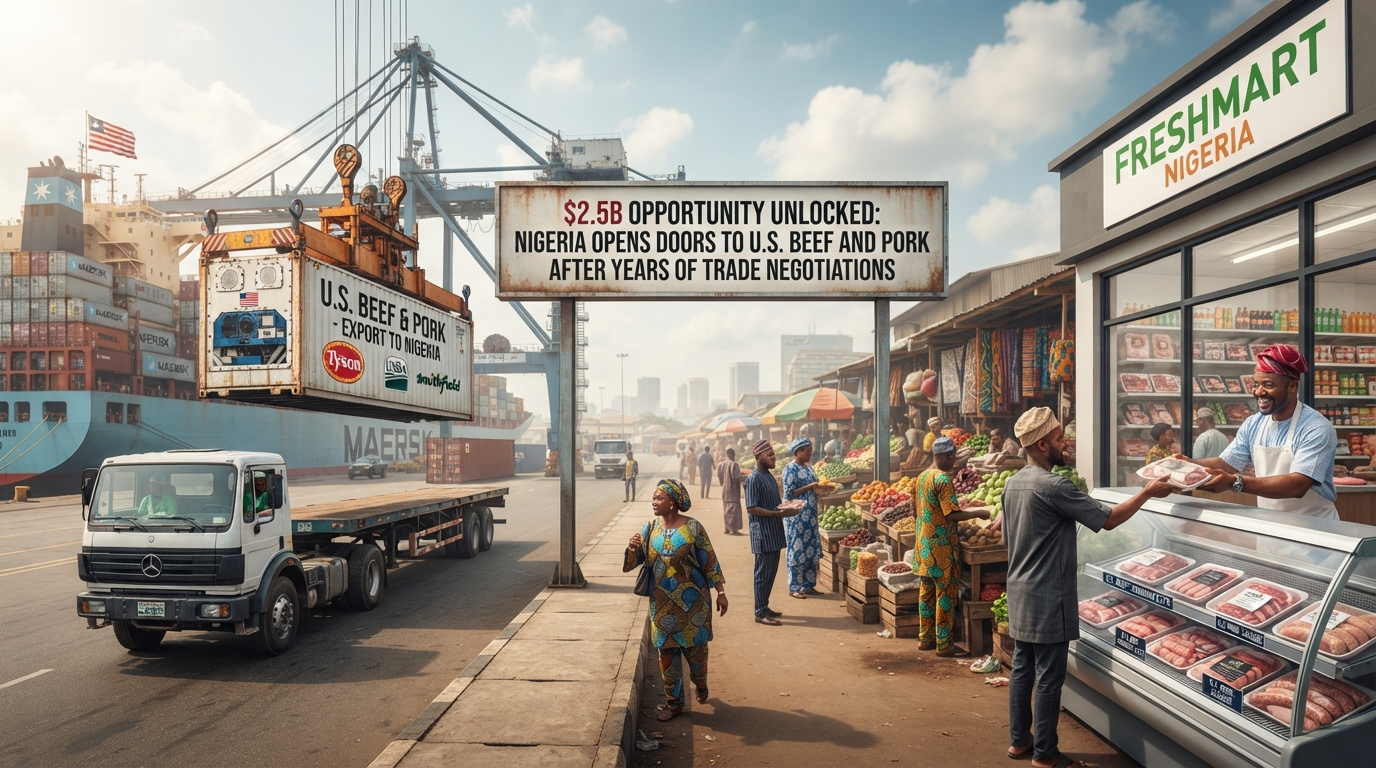

Nigeria’s Ministry of Presidency, Ministry of Livestock, and Ministry of Trade have approved market access for a wide range of U.S. beef and pork products, creating a major export opportunity for American producers targeting Africa’s third-largest economy with a population of 240 million—but challenges remain in building local market foothold against entrenched competitors and cultural barriers.
The Breakthrough: What Changed?
After years of diplomatic negotiations coordinated by the USDA’s Foreign Agricultural Service, Nigeria has fundamentally shifted its import policy on American red meat. The USDA Export Library now states that U.S. beef and pork products can be exported to Nigeria unless specifically excluded—a complete reversal from the previous restrictive regime that only allowed limited processed meat items.
The New Rules: What’s In and What’s Out
Now Eligible for Export:
- All fresh and processed beef cuts
- All pork cuts (except bone-in hams)
Still Excluded:
- Beef offal and pork offal
- Bone-in hams
- Smoked, dried, and cured beef products
- Smoked, dried, and cured pork products
While some product categories remain restricted, the shift from “only these items are allowed” to “everything is allowed except these items” represents a dramatic expansion of market access—approximately 85-90% of U.S. beef and pork product categories that American producers typically export are now eligible for Nigeria.
Why This Matters: The Scale of Opportunity
Nigeria isn’t just another emerging market—it’s a cornerstone opportunity in sub-Saharan Africa.
The Numbers Behind Nigeria
- Population: 240 million—the sixth-largest population globally, by far the largest in Africa
- Economic rank: Third-largest economy in Africa behind South Africa and Egypt
- Growing middle class: Rising urbanization, increasing disposable incomes, and changing consumer preferences toward protein
- Government commitment: The Government of Nigeria signed a $2.5 billion memorandum of understanding with JBS to construct six commercial-scale processing plants (three poultry, two beef, one pork)
Strategic Context
This isn’t a random policy change. The Nigerian government is actively building livestock processing infrastructure and modernizing its livestock sector—signaling serious commitment to expanding meat consumption and imports to supplement domestic production.
USMEF CEO and President Dan Halstrom called it “an important breakthrough in a market that holds excellent long-term potential for the US red meat industry.”
Understanding the Nigerian Meat Market
To appreciate the opportunity, one must understand Nigeria’s unique meat consumption patterns—shaped by religion, culture, wealth distribution, and supply chain infrastructure.
Beef Dominates (but with constraints)
Beef is the predominant meat choice in Nigeria, consumed in multiple forms:
- Asun (grilled beef)
- Kilishi (seasoned dried beef)
- Suya (barbequed beef)
- Sausage (ground beef products)
- Minced products
Demand for beef is “ever on increase with increase in population,” according to agricultural research—but supply has become a critical constraint. Much Nigerian beef is sourced through cross-border trade with Niger and Chad, which has become increasingly disrupted by insecurity in the Middle Belt.
This supply disruption created the market opportunity that U.S. exporters are now entering.
Pork: The Emerging Niche
Pork consumption in Nigeria is significantly lower than beef or chicken but represents an important growth segment:
Current consumption reality: Per capita pork consumption is estimated at only 1.47 kg annually—well below the West African average of 2.96 kg. Pork is the least consumed source of animal protein in the country.
Why the low consumption: Islamic predominance in Nigeria’s three northern geopolitical zones limits pork demand across roughly 50% of the country. Islam’s dietary restrictions prohibit pork consumption.
Where pork thrives: Most pork production and consumption is concentrated in the southwest and among Christian communities in the north. Pork products in demand include lard, sausages, ham, and bacon.
Growth trajectory: The pork segment is emerging as the fastest-growing meat category in Africa, recording a projected compound annual growth rate (CAGR) of 7.2% from 2025 to 2033. Nigeria, as Africa’s largest swine producer with approximately 9 million head, is positioned to capture significant value if import competition spurs local production efficiency and foodservice innovation.
Chicken: The Baseline
Poultry captures an estimated 47.3% share of African meat consumption—the largest product segment. In Nigeria specifically, chicken consumption is significant due to:
- Affordability and short production cycle of broilers
- Religious neutrality (acceptable across Muslim, Christian, and indigenous frameworks)
- Urban demand for quick-cook proteins
Chicken remains the most accessible protein for lower-income consumers, limiting per capita consumption of beef and pork.
The Supply-Demand Dynamic
Here’s the contradiction shaping the market opportunity:
Current market: Nigerian meat consumption is projected to decline to approximately 1.3 million metric tons by 2028, down from 1.4 million metric tons in 2023—a decline driven by affordability constraints and limited consumer purchasing power.
Production reality: Nigeria’s meat production is anticipated to grow to 1.6 million metric tons by 2028, creating a supply surplus of approximately 300,000 metric tons annually by 2028.
This paradox explains why Nigeria would open to imports: domestic production is growing, but it’s not matching quality, safety, or processing standards that modern food retailers and export markets demand. JBS’s $2.5 billion investment signals that the opportunity lies not in replacing local production, but in modernizing the supply chain and capturing higher-end market segments.
The Competitive Landscape: Who U.S. Exporters Face
Opening the Nigerian market doesn’t mean guaranteed success. U.S. exporters enter a market with established competitors and deeply embedded supply chains.
Domestic Production Barriers
- Local production dominance: Small-scale farmers dominate Nigerian livestock production. These operators have relationships, cultural acceptance, and cost advantages in local markets
- Infrastructure challenges: Limited cold chain logistics, refrigerated transport, and retail infrastructure favor nearby suppliers (regional neighbors) over intercontinental imports
- Pricing dynamics: Local beef costs are lower per unit weight due to regional supply chains and lower domestic labor/infrastructure costs
- Halal certification: A significant portion of the market requires halal certification, which requires specialized slaughter facilities and certification processes
Regional Competitors
- Niger and Chad: Traditional beef suppliers via cross-border trade; supply disruptions create opening for U.S. imports, but also drive prices higher when supply is tight
- Cameroon and other neighbors: Regional livestock and meat exports to Nigeria continue despite quality variability
- South Africa and Egypt: More developed export infrastructure; higher price points but established reputation among upscale retailers and foodservice operators
Emerging Opportunity: Food Service and Retail Modernization
The real opening comes from Nigeria’s modernizing food service and retail sectors:
- International food chains: McDonald’s, KFC, major supermarket chains are expanding in Nigeria and prefer standardized, quality-assured beef and pork
- Urban middle class: Growing professional class in Lagos, Abuja, and other major cities seeks premium meat products and is willing to pay for food safety certification
- Food safety standards: International retailers require documented traceability, cold chain integrity, and inspection credentials—where U.S. products have marked advantage
- Export-oriented processors: JBS’s planned $2.5 billion investment in Nigerian processing capacity signals that international standards and efficiency are coming to the market
The Market Access Journey: Two Years of Diplomacy
This breakthrough didn’t happen overnight. It required sustained diplomatic engagement and strategic messaging.
The Approach
USMEF Africa Representative Matt Copeland described the engagement strategy: “We led a roundtable discussion organized by FAS Lagos. They facilitated us speaking to the Ministry of the Presidency, Ministry of Livestock and Ministry of Trade, and we could explain that the U.S. offers this unmatched quality, and at the same time sustainable, incredible source of safe production, and that’s a challenge sometimes in African supply chains.”
The Pitch
The core message resonated with Nigerian policymakers: U.S. beef and pork products offer qualities that local supply chains struggle to provide—consistent quality, documented safety records, sustainable production practices, and supply reliability.
This addressed a real pain point in the Nigerian market: sporadic supply disruptions from regional sources and quality inconsistency that undermines retail and foodservice expansion.
Government Support
The U.S. Department of Agriculture’s Foreign Agricultural Service was critical to the opening. FAS identified the right Nigerian stakeholders, arranged appropriate forums, and provided legitimacy to U.S. exporters’ participation.
USMEF acknowledged: “USDA FAS gave us the absolute best chance with giving us the right audiences as well as just meeting the right people.”
What This Doesn’t Mean: Realistic Expectations
While the opening is significant, market observers are tempering expectations about immediate volume growth.
The Challenges Ahead
USMEF CEO Halstrom was explicit: “There are certainly challenges that must be overcome, and it will take some time to gain a foothold in the Nigerian retail and foodservice sectors.”
Specific obstacles include:
- Pricing sensitivity: U.S. products typically command 20-40% premiums over regional alternatives. For a market where per capita meat consumption is constrained by purchasing power, premium pricing is a significant barrier
- Logistics and shipping: Transatlantic shipping adds time, cost, and risk to live shipments. Refrigerated container capacity between U.S. and Nigeria is limited
- Trade financing: Establishing letters of credit, payment terms, and financing for Nigerian importers requires credit infrastructure that many smaller importers lack
- Regulatory familiarity: Nigerian importers and retailers are unfamiliar with U.S. product specifications, labeling, and quality requirements
- Muslim market penetration: Reaching the 50+ million Muslims in northern Nigeria with pork is impossible; beef access requires halal certification
- Entrenched relationships: Existing suppliers have relationships with butchers, street meat vendors, small restaurants, and informal food networks that dominate rural consumption
Near-term Reality
Initial volumes will likely come from:
- Modern retail chains (Shoprite, Lekki supermarkets)
- International hotels and restaurants
- Expat communities preferring U.S. brand/quality
- Premium segments in Lagos and Abuja
For supply chain managers, this means the market will grow, but not overnight. It will likely follow a typical pattern: premium segment penetration first, then gradual expansion as local importers build expertise and supply chains optimize.
Strategic Implications for U.S. Exporters
The market access opening creates several distinct opportunities:
For Large Integrated Producers (Tyson, Cargill, Pilgrim’s Pride)
- Scale: Can establish dedicated Nigerian import/distribution channels
- Risk tolerance: Can absorb start-up losses while building market presence
- Product portfolio: Can position value-added products to upscale retail and foodservice
- Financing: Can manage international trade financing and credit risk
For Mid-sized Exporters and Brokers
- Niche positioning: Can focus on specific product categories (e.g., ground beef for foodservice, premium cuts for retail)
- Partnership: Can partner with established Nigerian distributors rather than build independent distribution
- Timing: Can wait for market development before committing significant capital
For Commodity Beef and Pork Producers
- Limited direct benefit: May see modest benefit through higher export volumes, but pricing leverage remains limited
- Medium-term advantage: If Nigerian market grows as projected, increased demand supports commodity prices
The Timing: Why Now?
Three factors converged to create this market opening in 2026:
1. Supply Disruption from Insecurity
Beef supplies from Niger and Chad have become increasingly unreliable due to Middle Belt insecurity. This created genuine supply pressure that Nigerian policymakers needed to address. U.S. product stability and reliability became strategically attractive.
2. Government Livestock Modernization Initiative
The Government of Nigeria’s $2.5 billion investment in processing infrastructure signals serious commitment to livestock sector development. This creates ecosystem opportunity: if modern processing capacity is being built, it requires access to quality raw materials—imports can help bridge while local production scales.
3. Emerging Middle Class Demand
Rising urbanization and disposable incomes are driving demand for premium meat products. International retailers entering Nigeria need reliable, quality-assured suppliers. U.S. products meet this requirement in a way regional suppliers inconsistently deliver.
The Broader Context: African Trade Strategy
Nigeria’s market opening fits into a broader pattern of U.S. agricultural diplomacy in Africa.
The Strategy
The U.S. Trade Representative and USDA have made African market access a strategic priority, viewing the continent as a critical emerging market for agricultural products as:
- Populations grow (projected +500 million people by 2050)
- Incomes rise (middle class expanding rapidly)
- Urbanization accelerates (shifting from subsistence to purchased protein)
Nigeria, as Africa’s largest economy and most populous nation, is a flagship market. Opening it to U.S. beef and pork signals broader commitment to African agricultural trade.
Other Markets in the Pipeline
The success in Nigeria may create momentum for similar openings in other African nations. Neighboring countries watch market developments carefully. If U.S. beef and pork succeed in Nigeria, other African governments may follow suit.
Supply Chain Implications for Procurement
Immediate (Next 6-12 months)
- Volume impact: Limited. Initial exports likely in low hundreds of metric tons
- Pricing: Premium positioning; unlikely to affect global or U.S. commodity prices
- Sourcing opportunity: Exporters beginning to develop Nigeria relationships; can create supply chain partnerships
Medium-term (12-24 months)
- Volume growth: As retail and foodservice channels develop, volumes could reach thousands of metric tons annually
- Market development: Competition from U.S. exporters may drive quality improvements and pricing among regional suppliers
- Logistics: Specialized refrigerated container shipping may develop between U.S. and West Africa
Long-term (2-5 years)
- Meaningful volumes: Nigeria could absorb 50,000-100,000+ metric tons of U.S. beef and pork annually if modern retail and foodservice sectors expand as projected
- Premium market dynamic: U.S. products likely remain in premium segment rather than competing on commodity basis
- Regional hub: Lagos could become a hub for U.S. meat exports to West African region
The Bottom Line
Nigeria’s market opening is a significant trade victory for U.S. agriculture—but a gradual one. The opportunity is real, the long-term potential is substantial, and the timing capitalizes on genuine supply disruptions and market modernization.
However, realistic expectations matter: this is an emerging opportunity, not an immediate blockbuster. Building market presence in Nigeria will require patient capital, local expertise, and strategic partnerships.
For supply chain managers tracking the pork and beef markets, Nigeria represents a developing opportunity to monitor—not a game-changer for commodity pricing in the near term, but a potential source of incremental export demand growth as the market develops.
The key question for U.S. exporters: Are they willing to invest in market development for a payoff that likely materializes over 3-5 years rather than 3-5 months?
SOURCES
- Pork Business: “Market Access Breakthrough: Nigeria Opens Doors to U.S. Pork and Beef”
- National Hog Farmer: “U.S. red meat gains expanded Nigeria market access”
- USMEF (U.S. Meat Export Federation): “Nigeria Now Open to a Wide Range of U.S. Red Meat Products”
- Meat+Poultry: “Nigeria opens market to more US beef, pork”
- The National Provisioner: “Nigeria opens market to more US beef and pork products”
- Western Livestock Journal: “Nigeria now open to more red meat products”
- KMA Land: “Nigeria now open to receive U.S. red meat exports”
- Iowa Agribusiness Radio Network: “Nigeria now open to receive U.S. red meat exports”
- USDA Foreign Agricultural Service: “Planned Livestock Sector Reforms Could Lead to Trade Opportunities”
- Market Data Forecast: “Africa Meat Market Size, Share, Growth & Trends Report 2034”
- Statista: “Meat – Nigeria Market Analysis”
- ReportLinker: “Nigeria Meat Industry Outlook 2024-2028”
- 6W Research: “Nigeria Meat Market (2025-2031) Forecast & Analysis”
- 6W Research: “Nigeria Pork Meat Market (2025-2031) Trends, Outlook & Forecast”
FREQUENTLY ASKED QUESTIONS
Q: What products can now be exported from the U.S. to Nigeria?
A: All beef cuts and all pork cuts (except bone-in hams) can now be exported. Fresh and processed varieties are eligible unless they fall into excluded categories.
Q: What products are still excluded from the Nigerian market?
A: Beef and pork offal, bone-in hams, and smoked, dried, and cured beef and pork products remain excluded from export to Nigeria.
Q: How significant is this change from the previous policy?
A: Extremely significant. Nigeria previously only accepted a limited number of processed meat items. The new policy shifts from a “whitelist” (only these approved items) to a “blacklist” (everything except these excluded items) approach—expanding eligible products by approximately 85-90%.
Q: How long did it take to achieve this market access?
A: Years of diplomatic negotiations coordinated by USDA’s Foreign Agricultural Service. USMEF representatives led roundtable discussions with Nigeria’s Ministry of Presidency, Ministry of Livestock, and Ministry of Trade over the past couple of years.
Q: What is Nigeria’s significance as a market?
A: Nigeria has the world’s sixth-largest population at 240 million people and is the third-largest economy in Africa. It represents one of the most significant growth markets on the continent.
Q: What is Nigeria’s current meat consumption pattern?
A: Beef is the most consumed meat, followed by poultry. Pork is the least consumed source of animal protein, with per capita consumption of only 1.47 kg annually (below the West African average of 2.96 kg).
Q: Why is pork consumption low in Nigeria?
A: Islam’s predominance in Nigeria’s three northern geopolitical zones limits pork demand. Islamic dietary law prohibits pork consumption. Most pork production and consumption is concentrated in the southwest and among Christian communities.
Q: Is there potential for pork growth in Nigeria?
A: Yes. The pork segment is emerging as the fastest-growing meat category in Africa, projected to grow at 7.2% CAGR from 2025-2033. Nigeria, as Africa’s largest swine producer with 9 million head, is positioned to capture significant value.
Q: What role did the Government of Nigeria play in this opening?
A: The government is actively modernizing the livestock sector, including a $2.5 billion memorandum of understanding with JBS to construct six commercial-scale processing plants. This signals commitment to expanding meat consumption and modernizing supply chains.
Q: Who are U.S. exporters competing against?
A: Primarily regional suppliers from Niger, Chad, Cameroon, and other neighbors who have established supply chains and cost advantages. South Africa and Egypt have more developed export operations targeting premium market segments.
Q: What market segments offer the best opportunity for U.S. products?
A: International food chains (McDonald’s, KFC), modern retail chains (Shoprite), upscale hotels and restaurants, and expat communities preferring U.S. quality standards. These segments prioritize food safety certification and consistent quality over commodity pricing.
Q: Is halal certification required for beef exports to Nigeria?
A: Not legally required by the Nigerian government, but essential for penetrating the 50+ million Muslim population in northern Nigeria. U.S. exporters entering the premium segment (international chains, upscale retail) can succeed without halal certification initially.
Q: What is Nigeria’s current meat production versus consumption?
A: Nigeria’s meat production is growing faster than consumption. Production is projected to reach 1.6 million metric tons by 2028, while consumption is projected to decline to 1.3 million metric tons—creating a surplus that explains why production efficiency and modernization are priorities.
Q: What logistics challenges do U.S. exporters face?
A: Transatlantic shipping adds time, cost, and risk. Refrigerated container capacity between U.S. and Nigeria is limited. Cold chain logistics and storage infrastructure within Nigeria remain underdeveloped, particularly outside major cities.
Q: What trade financing challenges exist?
A: Establishing letters of credit and payment terms for Nigerian importers requires credit infrastructure that many smaller importers lack. This favors large integrated producers and established importers who can manage international financing.
Q: When will meaningful export volumes materialize?
A: Initial volumes (hundreds of metric tons) will come within 6-12 months from retail and foodservice channels. Meaningful volumes (thousands to tens of thousands of metric tons annually) likely require 2-5 years of market development.
Q: What is the realistic long-term market size for U.S. exports?
A: Analysts project potential for 50,000-100,000+ metric tons of U.S. beef and pork annually within 5 years if modern retail and foodservice sectors expand as projected. This would place Nigeria among significant African markets for U.S. exports.
Q: How does Nigeria’s opening fit into broader U.S. African strategy?
A: Nigeria is a flagship market in broader U.S. agricultural diplomacy targeting Africa. The continent’s growing population, rising incomes, and urbanization represent critical emerging markets. Success in Nigeria signals commitment and may prompt similar openings in other African nations.
Q: Will this market opening affect global beef and pork prices?
A: Unlikely in the near term. Nigerian volumes will be modest (thousands of metric tons annually) compared to global beef and pork production (tens of millions of metric tons). Over 5+ years as volumes grow, modest price support is possible in premium segments.
Q: What is USMEF’s role?
A: USMEF (U.S. Meat Export Federation) led diplomatic engagement, coordinated negotiations with Nigerian government ministries, and was instrumental in securing market access. USMEF continues representing member exporters in developing Nigerian market relationships.
Q: Are there risks to this market opening?
A: Primary risks include: slower-than-expected market development due to cultural factors and pricing sensitivity; logistics challenges undermining product quality; political changes in Nigeria affecting policy; competing regional suppliers improving quality; and local production scaling faster than exports develop.
Q: What should supply chain managers monitor?
A: Track initial export volumes from major U.S. producers; monitor Nigeria’s retail and foodservice sector expansion; watch for competitor activity (regional suppliers and other countries); monitor logistics developments between U.S. and West Africa; follow government of Nigeria’s livestock modernization progress.
Q: Is this a buying opportunity for Nigerian importers?
A: Yes, but with caveats. U.S. products offer quality and safety advantages that support premium positioning, but pricing will initially be 20-40% higher than regional alternatives. Importers should expect to build market presence gradually rather than immediately displace regional suppliers.