
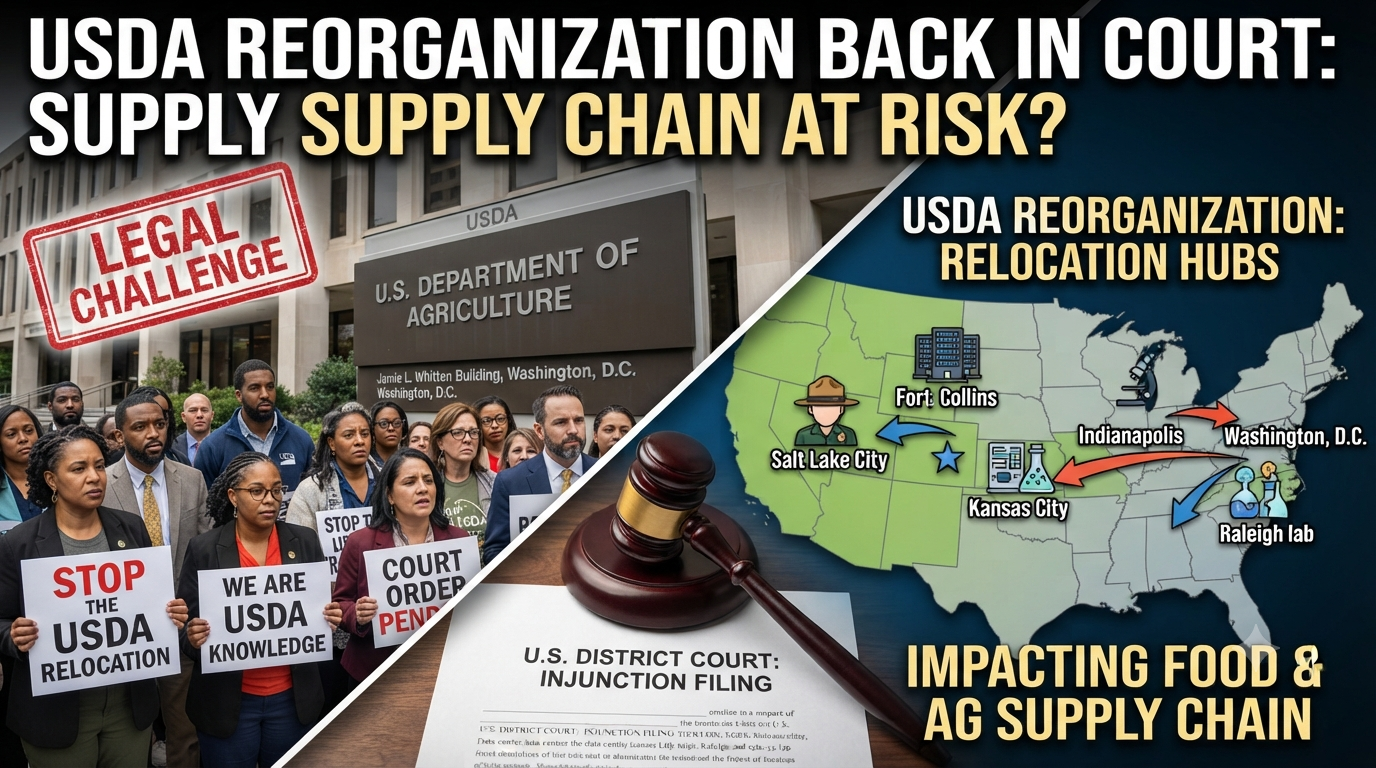

A coalition of federal employee unions, nonprofits, and local governments is asking a California judge to freeze the sweeping U.S. Department of Agriculture’s USDA reorganization before it goes any further. The filing, lodged in San Francisco federal court, is the latest round in a legal fight that has been running since early 2025 — and it lands at a moment when USDA has already announced where thousands of jobs are headed and started moving people out the door.
For an industry that leans on USDA every day — food safety inspection, export certification, crop and price data, nutrition assistance spending — this isn’t just a Washington personnel story. It’s a supply chain and data-reliability story.
Table of Contents
What’s Actually Being Asked of the Court
The plaintiffs, led by the American Federation of Government Employees (AFGE) and the American Federation of State, County and Municipal Employees (AFSCME), filed a second supplemental complaint and a motion for a preliminary injunction on July 1, 2026. It’s part of the long-running case AFGE, AFL-CIO v. Trump in front of U.S. District Judge Susan Illston in the Northern District of California.
The ask is broad: block USDA from reorganizing or downsizing any agency or sub-agency, stop any further relocation notices from going out, and prevent the department from separating employees who have already turned down a move. The plaintiffs argue the plan is arbitrary, exceeds USDA’s statutory authority, and — critically — defies a direct instruction from Congress.
That last point is the crux of the case. USDA had originally asked Congress to fund and authorize this restructuring through the fiscal year 2026 budget process. Congress said no, and went further, writing language into the FY2026 spending bill that bars USDA from using appropriated funds to relocate, reorganize, or eliminate offices without separate congressional approval. Plaintiffs say USDA is moving ahead anyway.
Judge Illston has history here. In May 2025, she issued a preliminary injunction covering 21 federal agencies, including USDA, finding the administration’s original workforce-reduction executive order likely oversteps presidential authority without Congress’s cooperation. That order has since been narrowed and challenged up through the Ninth Circuit and the Supreme Court, with the litigation now effectively fractured across multiple fronts — this new USDA-specific filing is one of them.
How Big Is This Reorganization, By the Numbers
USDA’s restructuring isn’t a single memo — it’s been rolled out agency by agency since Secretary Brooke Rollins issued a department-wide reorganization directive in July 2025. Taken together, the plan touches roughly 2,500 to 2,600 Washington-area employees, who are being told to relocate to one of five newly designated hub cities — Kansas City, Raleigh, Indianapolis, Fort Collins, and Salt Lake City — or leave their jobs.
The department’s original 2025 restructuring plan called for cutting total staff by 23%, or by roughly 31% once food-safety and inspection roles are factored in. Congressional Research Service figures cited in coverage of the case show USDA’s overall workforce falling from around 91,000 employees in fiscal 2025 to roughly 71,000 by February 2026 — a trajectory unions say is being driven as much by relocation-triggered resignations as by formal layoffs. Internal planning documents cited in the litigation reportedly acknowledge that the department expects large numbers of staff to decline reassignment, and that this attrition is being counted toward its reduction targets.
Where the Jobs Are Actually Moving
The reorganization plan spans several major USDA components, each with its own relocation footprint:
- Food Safety and Inspection Service (FSIS): About two-thirds of FSIS’s National Capital Region staff — roughly 200 positions — are relocating to a new National Food Safety Center in Urbandale, Iowa, and a new Science Center in Athens, Georgia, with a smaller international-coordination presence in Fort Collins. USDA maintains this doesn’t touch frontline inspectors, who make up about 85% of FSIS’s workforce and operate across more than 6,800 regulated meat, poultry, and egg establishments.
- Research, Education and Economics (REE): The Economic Research Service and National Institute of Food and Agriculture are relocating to Kansas City — echoing a 2019 move under the first Trump administration that both agencies are still recovering from. The National Agricultural Statistics Service is shifting positions toward St. Louis, and the Agricultural Research Service is decommissioning its Beltsville Agricultural Research Center in Maryland, dispersing research programs nationally.
- Forest Service: Headquarters is relocating to Salt Lake City, all nine regional offices are closing, and the agency is shifting to a 15-office, state-director model, with research consolidated in Fort Collins.
- Food and Nutrition Service (FNS): Being rebranded the Food and Nutrition Administration, with SNAP administration moving to Indianapolis, Child Nutrition Programs to Dallas, and retailer operations split across Atlanta, Los Angeles, Dallas, and New York.
Why the Unions Say This Will “Gut” the Agency
The unions’ central argument isn’t just legal — it’s operational. They point to the department’s own 2019 experience: when USDA moved ERS and NIFA staff to Kansas City under the first Trump administration, both agencies lost more than half their workforce to attrition, and research output measurably declined for years afterward. A more recent AFGE survey found that roughly three-quarters of USDA researchers said they would not relocate to keep their jobs — almost identical to the attrition rate seen in 2019.
The plaintiffs argue that losing that much institutional knowledge at once would hit programs people don’t think about until they’re gone: timely disaster loan processing for farmers, SNAP administration for the roughly one in four Americans who touch the program annually, and the economic and statistical data — crop forecasts, farm income estimates, food price indices — that underpins planning across the entire agriculture and food sector.
What It Means for Food and Beverage Companies
This is the part that matters most for ESSFeed readers, even if the headline is about federal employment law:
- Trade and export data risk. ERS and NASS produce much of the economic and statistical data that trading desks, procurement teams, and commodity buyers use for forecasting. A repeat of the 2019 attrition pattern means slower, thinner, or less reliable data releases during the transition window.
- Food safety inspection continuity. USDA insists frontline FSIS inspectors are untouched, but the administrative, technical, and training functions moving to Iowa and Georgia support those inspectors. A rocky transition there has knock-on effects for establishment audits, export certifications, and recall coordination.
- SNAP as a demand signal. SNAP benefits flow directly into grocery and food retail spending. Administrative disruption at the newly renamed Food and Nutrition Administration is a variable worth watching for retailers and CPG companies with exposure to lower-income consumer spending.
- Farm program service gaps. Disaster loan processing and other Farm Service Agency functions have already shown signs of strain during earlier phases of federal workforce reductions, with direct consequences for planting-season decisions upstream in the supply chain.
What Happens Next
Judge Illston has not yet ruled on the preliminary injunction motion. Given her prior rulings in this same case, a decision — one way or another — is likely in the coming weeks, though the broader litigation, including potential appeals to the Ninth Circuit and possible Supreme Court intervention, could stretch on for months. In the meantime, USDA has said it intends to vacate its South Building by the end of 2026 and continues to notify individual mission areas of their move timelines, meaning relocation decisions are proceeding on the ground even as the legal question remains open.
Related
FAQ
Is USDA actually cutting jobs, or just relocating them?
Both, functionally. USDA and Secretary Rollins have described this as a relocation and modernization effort rather than a reduction in force. But unions point to the department’s own internal planning documents, which reportedly anticipate that a large share of employees will decline to relocate — meaning the relocation program produces workforce cuts even without a formal layoff order.
Will this affect meat, poultry, and egg inspections?
USDA says no — frontline FSIS inspectors, who make up about 85% of the agency’s food-safety workforce, are not part of the relocation. What is moving is the administrative, scientific, and training infrastructure that supports those inspectors, based out of new hubs in Iowa and Georgia.
Why can USDA reorganize if Congress said not to?
That’s the core legal dispute. Congress included language in the FY2026 appropriations bill barring USDA from using funds to relocate or reorganize offices without further approval. USDA has argued its actions fall within existing executive authority; the unions argue this directly defies Congress’s instruction, which is the basis for the current injunction request.
What are the five USDA hub cities?
Based on USDA’s July 2025 reorganization memo, the primary hub locations are Kansas City (Missouri), Raleigh (North Carolina), Indianapolis (Indiana), Fort Collins (Colorado), and Salt Lake City (Utah), with different mission areas assigned to different hubs depending on function.
Has this happened before?
Yes. In 2019, under the first Trump administration, USDA relocated the Economic Research Service and National Institute of Food and Agriculture to Kansas City. Both agencies lost more than half their staff to attrition, and research output declined for years afterward — a precedent unions are citing directly in the current case.
When will the court decide?
No ruling date has been set as of this writing. Judge Illston has ruled relatively quickly on prior motions in this case, so a decision on the preliminary injunction is plausible within the coming weeks, though appeals are likely regardless of the outcome.