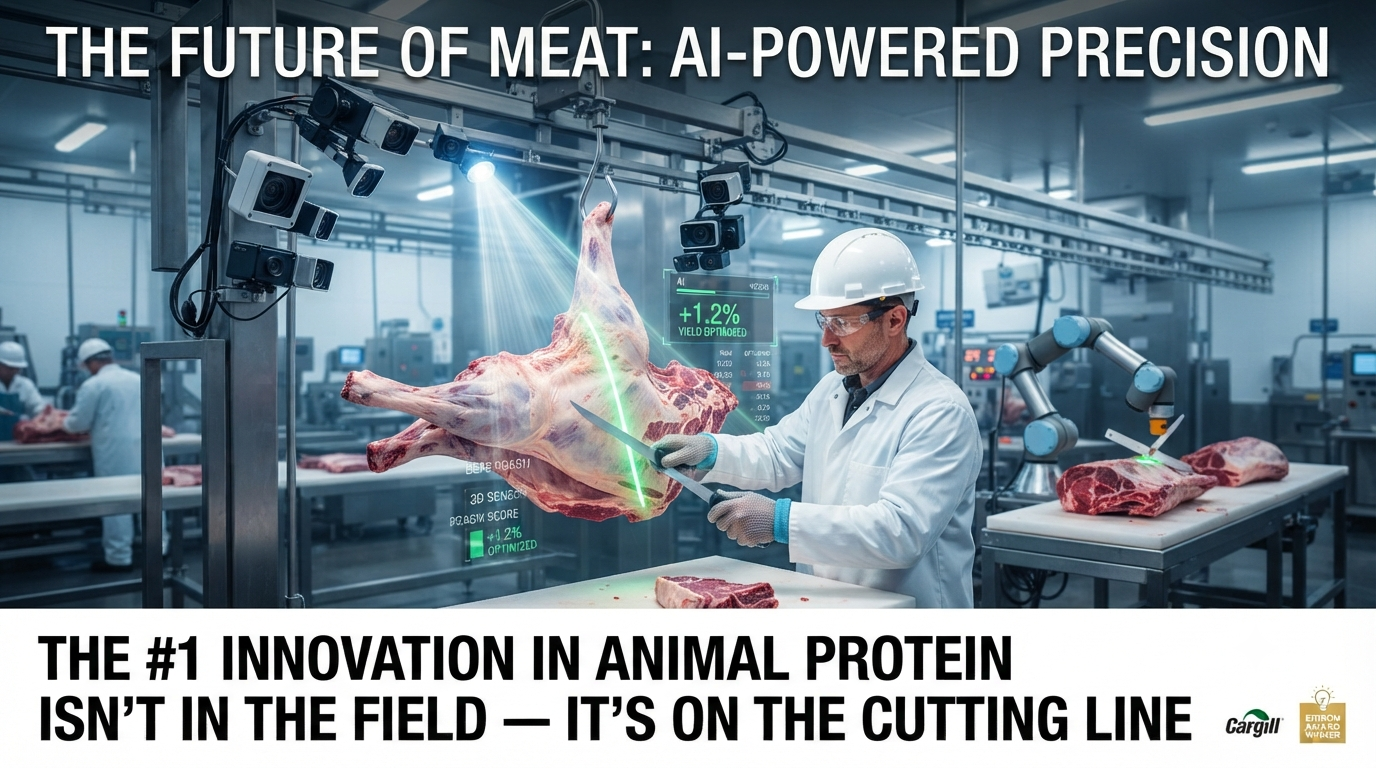

While most agtech headlines chase robots and gene editing out on the farm, the most consequential innovation in animal protein right now is happening somewhere much less glamorous: the cutting line inside the processing plant.
The innovation is AI-powered computer vision for carcass yield optimization — camera and sensor systems that scan every carcass in real time, then guide human cutters or robotic blades to recover more usable meat from each animal than manual cutting ever could.
It isn’t flashy. But at a moment when beef and pork supplies are contracting for the first time in six years, it may be the single highest-leverage technology in the entire protein sector today.
Table of Contents
Why This Beats Every Other Contender
Robotics, biologicals, and gene editing all matter — but none of them solve the problem processors are facing right now: there simply aren’t enough animals moving through the system. The US cattle herd recently hit its lowest level in 70 years, and global beef and pork production is contracting for the first time in six years.
When you can’t increase supply, the only lever left is extracting more value from the supply you already have. That’s exactly what AI vision systems are built to do — and the results are already showing up on the bottom line, not just in pilot programs.
How It Actually Works
Each carcass passes under a camera or 3D imaging system that builds a detailed model of its individual geometry — length, width, muscle structure, even subtle variations invisible to the naked eye. From there, the system does one of two things:
Guides human cutters — Workers get real-time visual feedback showing exactly where more meat can be recovered, correcting technique in the moment rather than after the fact.
Directs robotic blades — More advanced systems dynamically adjust cutting pressure, blade angle, and pressure point based on that specific carcass, handling tasks like chine-bone removal, pelvic bone detection, and shoulder blade cuts with a level of precision that’s difficult to sustain manually across an eight-hour shift.
Some platforms take it a step further, using AI-powered sorting to predict a carcass’s total cutout value and route different sections to the products and customers where they generate the most revenue — turning cutting decisions into a value-optimization problem, not just a mechanical one.
The Numbers Behind the Hype
This isn’t a distant, speculative innovation — it’s already deployed at scale by the biggest names in the industry:
- Cargill’s proprietary vision system, CarVe, measures red meat yield in real time and has been rolled out across multiple processing plants after a successful pilot, winning a 2026 Edison Award for its impact on efficiency and waste reduction.
- Early results from Cargill’s system show yield gains of roughly 1% — a figure that sounds small until you consider that a single percentage point improvement can translate into hundreds of millions of additional pounds of beef reaching the market each year.
- Broader industry data shows yield optimization and precision cutting can improve recovery per carcass by 1–3%, worth millions in value for large-scale operations.
- Some specialized platforms report even larger gains: customers report over 50% relative margin gains from better carcass utilization when AI-driven sorting and cutting is combined with dynamic production planning.
- In some poultry and beef applications, AI-powered vision systems have helped reduce discard levels by as much as 40%.
- JBS USA has partnered with Völur, an AI-focused protein optimization company, specifically to improve processing decisions across its operations.
Why It’s Solving the Exact Problem the Sector Has Right Now
This technology is landing at a uniquely well-timed moment. Global animal protein production is undergoing a genuine structural shift in 2026 — beef and pork output is contracting for the first time in six years, driven by herd cycles, disease pressure, and tightening supply.
For processors like Cargill, Tyson, and JBS, that means the traditional growth lever — simply processing more animals — isn’t available right now. Yield optimization is one of the only remaining paths to protecting margins and maintaining output in a supply-constrained market. That’s precisely why major processors are moving this technology from pilot to full production deployment rather than treating it as an experimental side project.
Beyond the Cutting Line: Where Else This Is Spreading
AI vision isn’t limited to yield recovery. The same underlying technology is being extended across the plant floor:
Quality grading — Computer vision models can grade carcasses with consistency matching official grading standards, reducing variability between shifts and locations.
Food safety and compliance — Vision systems flag foreign materials, hygiene issues, and packaging compliance problems in real time, reducing recall risk and supporting traceability requirements.
Predictive maintenance — Machine learning models analyze vibration, temperature, and equipment signals to flag mechanical issues before they cause line stoppages.
Workforce and scheduling optimization — AI platforms are increasingly used to model staffing needs against order volume, line speed, and labor availability, addressing chronic labor shortages in processing plants.
The Bottom Line
The most important innovation in animal protein today isn’t happening in a lab or on a farm — it’s happening on the kill floor and the boning line, where AI-guided vision systems are quietly squeezing more usable protein out of every single animal processed. In a year where global meat supply is contracting for the first time in six years, that kind of yield recovery isn’t just an efficiency upgrade — it’s becoming one of the only reliable ways processors can protect margins and keep enough product moving through the supply chain.
FAQ
What is the biggest innovation in animal protein processing right now?
AI-powered computer vision systems that scan carcasses in real time and guide precision cutting to maximize meat yield are widely regarded as the most impactful current innovation in animal protein processing, given how directly they address today’s tightened meat supplies.
How much extra yield can AI vision systems generate?
Reported gains vary by system and application, ranging from roughly 1% yield improvement in large-scale beef processing to as much as 40% reductions in discard rates and over 50% relative margin gains in specialized sorting and planning applications.
Which companies are using AI vision technology in meat processing?
Cargill, Tyson, and JBS are among the largest processors publicly deploying AI vision and yield-optimization technology, with Cargill’s CarVe system and JBS’s partnership with AI company Völur among the most visible examples.
Why does yield optimization matter so much right now?
Cargill, Tyson, and JBS are among the largest processors publicly deploying AI vision and yield-optimization technology, with Cargill’s CarVe system and JBS’s partnership with AI company Völur among the most visible examples.
Why does yield optimization matter so much right now?
Global beef and pork production is contracting for the first time in six years due to herd cycles and tight cattle supplies, including a US cattle herd at its lowest level in 70 years. With animal supply constrained, extracting more usable meat from each carcass is one of the few remaining ways processors can protect output and margins.
Is this technology only used for cutting and yield?
No. The same AI vision infrastructure is increasingly used for quality grading, food safety and contamination detection, predictive equipment maintenance, and workforce scheduling across processing plants.