
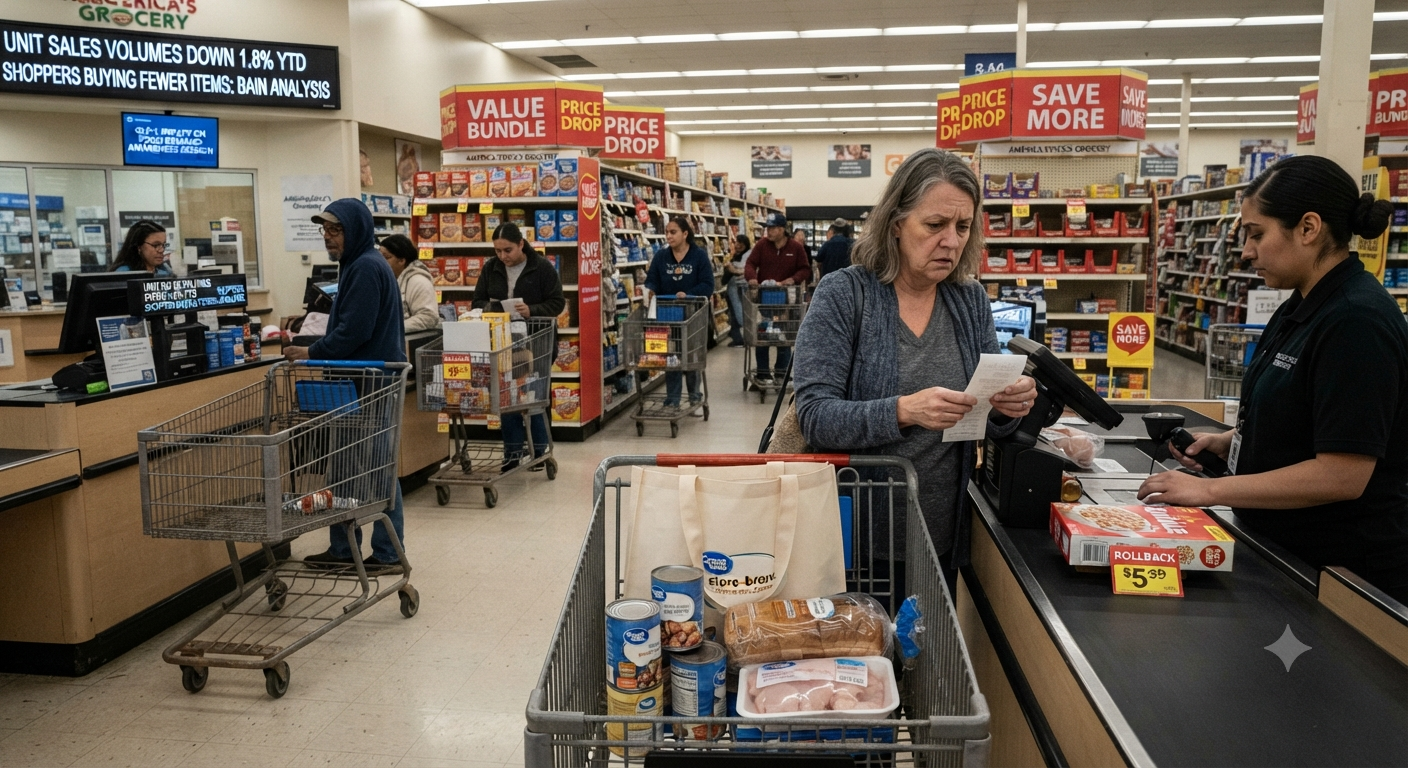

Grocery sales are falling as US unit volumes drop 1.8% and shoppers buy fewer items. Bain says the slowdown has entered a decisive new phase.
For three years, inflation did the grocery industry a favour: rising prices kept sales figures growing even as shoppers quietly bought less. That cover is now gone. According to a new Bain & Company analysis of NielsenIQ data, the US grocery slowdown has entered a decisive new phase — unit sales have stepped down sharply since February, falling around 2% year-on-year in most months through June, consistently across every US region. In June alone, units sold fell 1.8% versus a year earlier, a near two-percentage-point deterioration in twelve months. With prices still climbing only 2–3% annually, weakening volumes are now outweighing inflation and pulling total grocery sales lower.
Why Grocery Sales Are Falling
Bain’s analysis finds no single shock to blame — rather, steadily building pressure on households that intensified in 2026. Grocery prices have risen a cumulative 33% since 2019, gas prices jumped 20% in March, disposable income growth is slowing, and cuts to SNAP benefits in late 2025 followed by tighter eligibility rules squeezed lower-income households hardest.
The behavioural response is stark. In Bain’s latest consumer pulse survey, 80% of Americans said they are trying to spend less and 28% are actively cutting back on groceries. Among those trimming their bills, 56% are trading down to cheaper brands, 49% are simply buying fewer items, and 44% are leaning harder on coupons and promotions. Two structural factors compound the squeeze: online grocery shoppers typically build smaller baskets, and rising GLP-1 weight-loss drug adoption is reducing food demand outright, with 30–40% of users actively cutting grocery purchases.
Grocery Sales Have Become a Share Game
With real growth flat to negative, Bain concludes grocery retailing is now a market-share battle — and leaders are pulling away from laggards. Value players — discounters, dollar stores, mass merchants and club retailers — appear to be gaining trips as shoppers trade down, and 22% of shoppers say they are exploring more retailers in search of better deals. But even the winners aren’t insulated: people are buying less overall, pointing to a drawn-out stretch of soft volumes for everyone until macro conditions improve.
The industry response is already visible. Walmart announced summer price cuts on beef, ice cream and other items, including products from PepsiCo, Coca-Cola and its own Great Value private label, while Kroger has leaned into value promotions. As one analyst put it, grocers are pushing suppliers to reduce prices where possible — the entire industry is trying to get back to unit growth, not just dollar growth.
Implications for Buyers and Procurement Teams
- Suppliers and manufacturers selling into US retail should expect intensified price-down pressure and promotion demands through H2 2026; build promotional funding into 2027 planning rather than treating it as an exception.
- Private label is the structural winner of trade-down. Branded suppliers should defend the SKUs shoppers actually price-check and consider private-label manufacturing capacity as a hedge.
- Volume-based contracts and forecasts need revisiting: a 2% unit contraction across all regions means category plans built on flat-to-positive volume assumptions are already stale.
- Exporters into the US market should note the shift favours value formats — route-to-market via discounters, clubs and mass channels is gaining reach faster than traditional supermarkets.
- Watch SNAP policy and gas prices as leading indicators. Both moved the needle on grocery demand this cycle and both are politically live heading into US elections.
FAQ
Why are US grocery sales falling in 2026?
Cumulative grocery inflation of 33% since 2019, a 20% jump in gas prices, SNAP benefit cuts and slowing income growth have pushed shoppers to buy fewer items — unit sales fell 1.8% year-on-year in June, and price increases of 2–3% can no longer offset the volume decline.
Which retailers are winning as grocery sales decline?
Value-oriented players — discounters, dollar stores, mass merchants and club retailers — are gaining shopper trips as consumers trade down, though Bain notes even they face declining overall unit demand.
What does the grocery sales slowdown mean for food suppliers?
Retailers like Walmart and Kroger are pressing suppliers for price cuts and heavier promotions to restore unit growth, while private label expansion accelerates — suppliers should expect margin pressure and sharpen pricing on high-visibility products.
Sources
- Bain & Company — US grocery slowdown analysis with NielsenIQ
- CNBC — exclusive report on unit sales data and retailer responses
- Supermarket News — consumer survey findings and Consumer Health Index
- The Shelby Report — regional breakdown and analyst commentary
- PR Newswire — Bain & Company press release