
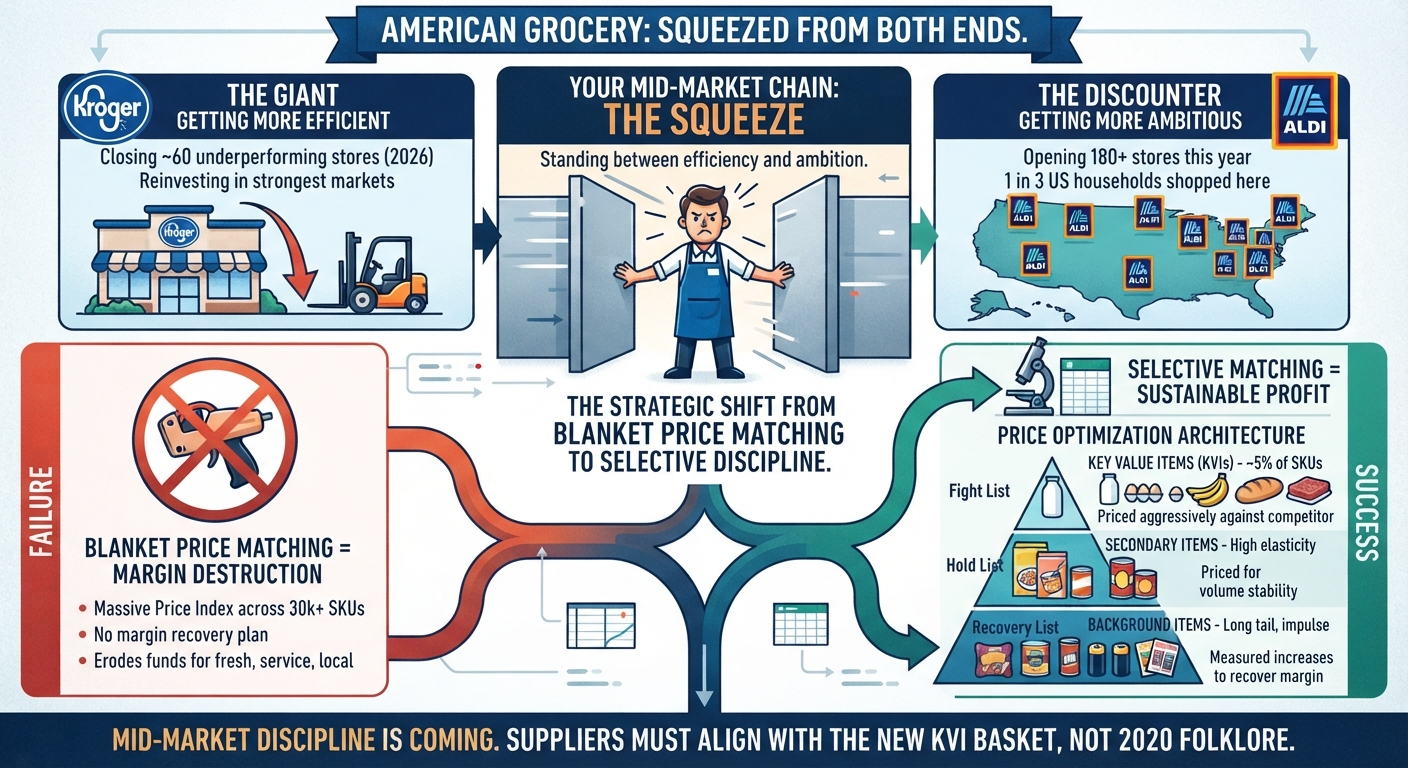

American grocery is being squeezed from both ends at once. Kroger is closing roughly 60 underperforming stores through the end of 2026 while reinvesting in its strongest markets. Aldi is opening more than 180 stores this year alone, on its way to nearly 2,800 US locations, and reports that one in three American households shopped there last year. If you run a regional or mid-market grocery chain, you are standing between a giant getting more efficient and a discounter getting more ambitious.
The instinctive response is to defend on price everywhere. It is also the fastest way to destroy the margin that funds everything that actually differentiates you: fresh, service, local assortment, community trust. Blanket price matching is not a strategy. It is a slow-motion concession that you have no strategy.
The insight for suppliers: The big chains are not competing on price everywhere either. Once you understand how pricing actually works inside a major chain, you start to see where wholesale relationships will tighten—and where they won’t.
What Price Optimization Actually Looks Like Inside a Big Chain
From the outside, a national chain’s pricing looks like brute force: everything cheap, all the time. From the inside, it is the opposite of brute force. It is surgery.
Every large chain runs some version of the same architecture:
- Key Value Items (KVIs)—a small set of items where shoppers genuinely know the price—are priced aggressively against named competitors, sometimes at zero or negative margin.
- Secondary items are priced by elasticity: how much volume do we lose if this price moves up? For most assortment, the honest answer is ‘very little’—that is where the margin given away on KVIs is quietly earned back.
- Zone pricing applies different price levels by market depending on who you face across the street.
Two details from inside those systems matter most:
- The aggressive list is small. In a store carrying 30,000+ SKUs, the set of items priced to fight was rarely more than a few hundred per category cluster—a low single-digit share of the assortment.
- Nobody matched everyone. Every price index was defined against a specific competitor in a specific zone. The idea of being ‘the cheapest in the market’ across the board exists in advertising copy, not in the pricing engine.
The systems that run this are expensive. The logic is not. The logic fits in a well-organized spreadsheet, and disciplined mid-market grocers can execute most of its value with a fraction of the tooling.
Supply Chain Signal: When mid-market retailers finally implement this discipline, they stop accepting margin compression on everything. They get selective. This is where wholesale relationships tighten—because retailers stop taking every promotional allowance and start asking harder questions about cost structure.
Your Shoppers Judge You on a Basket, Not a Catalog
The entire approach rests on one empirical fact: shoppers do not hold 30,000 prices in their heads. They hold a basket—milk, eggs, bananas, bread, ground beef, diapers, their brand of coffee—and they extrapolate your entire store’s value from it.
McKinsey’s research on price perception shows that KVIs represent roughly 15 to 25 percent of a category’s sales, and documents retailers that rebalanced prices around perception drivers gaining one to two percentage points of margin with steady or even growing volume.
What this means for wholesale: A retailer that was donating margin on 3,000 SKUs is about to stop. They are going to be selective. Your category might be in the fight list. Or it might not. Either way, the conversation is about to change.
The Inflation Years Rewrote the KVI Basket
A warning before you dust off your KVI list: if it was written before 2020, it is describing a shopper who no longer exists.
Through the inflation years, price awareness spiked on items that were previously background noise. Eggs became a lightning rod—an item whose price swings made national news is now a perception driver whether you like it or not. Cooking oil, butter, and coffee moved the same direction.
At the same time, shoppers traded down at historic scale. US private label sales hit a record $282.8 billion in 2025, growing faster than national brands. A shopper who switched to private label eggs and pasta during 2022-2023 now knows those prices, not the national brand’s.
The practical consequence: The KVI basket is no longer stable enough to set annually. Re-derive it at least quarterly from your own data using penetration (what share of baskets contain the item), frequency (how often it is bought), and switching behavior (does volume move when your gap to a competitor widens).
Wholesale Impact: If your product was KVI in 2022 but isn’t anymore, you need to know this. Retailers are about to find out. And if your product used to carry margin recovery but is now being questioned, that conversation is coming to your door.
Selective Matching: The Actual Playbook
Here are five rules for selective-matching discipline in any mid-market chain today:
1. Choose Your Competitor Per Zone, Not Per Press Release
Your real competitor is the store your shopper would drive to next, not every banner in the metro area. When a nearby Kroger banner closes—and about 60 will by the end of 2026—your competitive set in that zone literally changes overnight. Reprice against who is actually there.
2. Hold KVIs Within a Deliberate, Visible-Difference Threshold
Shoppers do not switch stores over cents; they switch over gaps they can name in conversation. Against a comparable supermarket, that means matching or staying within a small index on the true KVI list—and doing it consistently, because perception is built by repetition, not by one hot week.
3. Do Not Chase the Discounter to Parity
Aldi’s model—a limited assortment that is roughly 90 percent private label, minimal labor, small boxes—produces a cost structure a full-service grocer cannot and should not imitate. Chasing it to price parity is arithmetic suicide. The goal against a hard discounter is a contained, managed gap on overlapping staples, funded by everything the discounter structurally cannot offer: depth of assortment, fresh and prepared food, service, and one-stop convenience.
4. Recover Margin Deliberately in the Back-Basket
Selective matching only works if the other side of the ledger is managed with the same discipline. Long-tail, impulse, and convenience items carry the recovery. Big chains use elasticity models; a mid-market grocer gets most of the effect with simple role-based rules—background items take measured increases, tested category by category.
5. Put Guardrails and Explanations on Everything
Cost floors, maximum step sizes, and a plain-language reason for every price position. If a category manager cannot explain a price to a customer or a buyer, it will not survive contact with either. Explainable beats optimal-but-opaque every time in a mid-market organization.
Why Suppliers Should Care: Rule 5 is where wholesale relationships get tested. Retailers are about to ask suppliers harder questions about cost structure, margin contribution, and why a product is positioned the way it is. Have your story ready. “That’s what it costs” is no longer an answer.
The Mistakes I Keep Seeing
The same failure patterns show up in nearly every mid-market pricing review:
- Matching a national chain’s advertised program item-for-item, chain-wide, when the national chain itself is only fighting in selected zones.
- Treating the KVI list as folklore—a list a merchandising VP wrote years ago that no data has touched since.
- Tunnel vision on a single competitor while the shopper’s real alternative changed.
- Cutting KVIs with no margin-recovery plan on the back-basket, which turns a pricing strategy into a profit leak.
- Leaning on ever-deeper weekly promotions instead of base-price discipline, which trains cherry-pickers while everyday price perception quietly erodes.
None of these are technology failures. They are discipline failures, and discipline is free.
A 90-Day Version You Can Run Now
Days 1-30: Derive KVI candidates from your POS or loyalty data using penetration, frequency, and switching. Validate the top items per category with store managers—they know what shoppers quote at the register. Map your true competitor set zone by zone, including any nearby stores slated to close.
Days 31-60: Set index targets by item role—fight on KVIs, hold on secondary items, recover on background items. Put cost floors and step-size guardrails in writing. Reprice the back-basket first so the recovery is banked before the investment.
Days 61-90: Measure what actually matters. Track your KVI price index against each zone’s primary competitor, category margin mix rather than blended margin alone, and—if you can—a simple shopper price-perception survey. Perception is the scoreboard; margin mix is the fuel gauge.
Consolidation puts shoppers in motion, and shoppers in motion re-choose their primary store. Every closed store nearby is a one-time chance to win households for years—not by being blindly cheaper than a discounter, but by being trustworthy on the basket they know and better at everything else. You do not need a national chain’s budget to do this. You need their discipline, applied to a few hundred items that decide what your shoppers believe about all the rest.
The Wholesale Takeaway: Mid-market retailer discipline is coming. When it does, suppliers will be sorted into three buckets: those on the fight list (aggressive price defense), those on the hold list (stable pricing), and those on the recovery list (margin opportunity). Which category is your product in today? Which should it be in? And have you talked to your retail partners about it? Because they are about to get serious about the answer.
About Maxim Morozov – https://www.linkedin.com/in/maksimmoroz/
Maxim Morozov, PhD, is the founder of Retailgrid (retailgrid.io), an AI-powered pricing and assortment platform for SMB and mid-market retailers. He previously built retail price optimization for major chains at DemandTec and worked in retail measurement and analytics at Nielsen. He brings hands-on experience from inside the pricing engines of some of the world’s largest grocery chains—and understands exactly where the pressure on wholesalers is about to accelerate.