
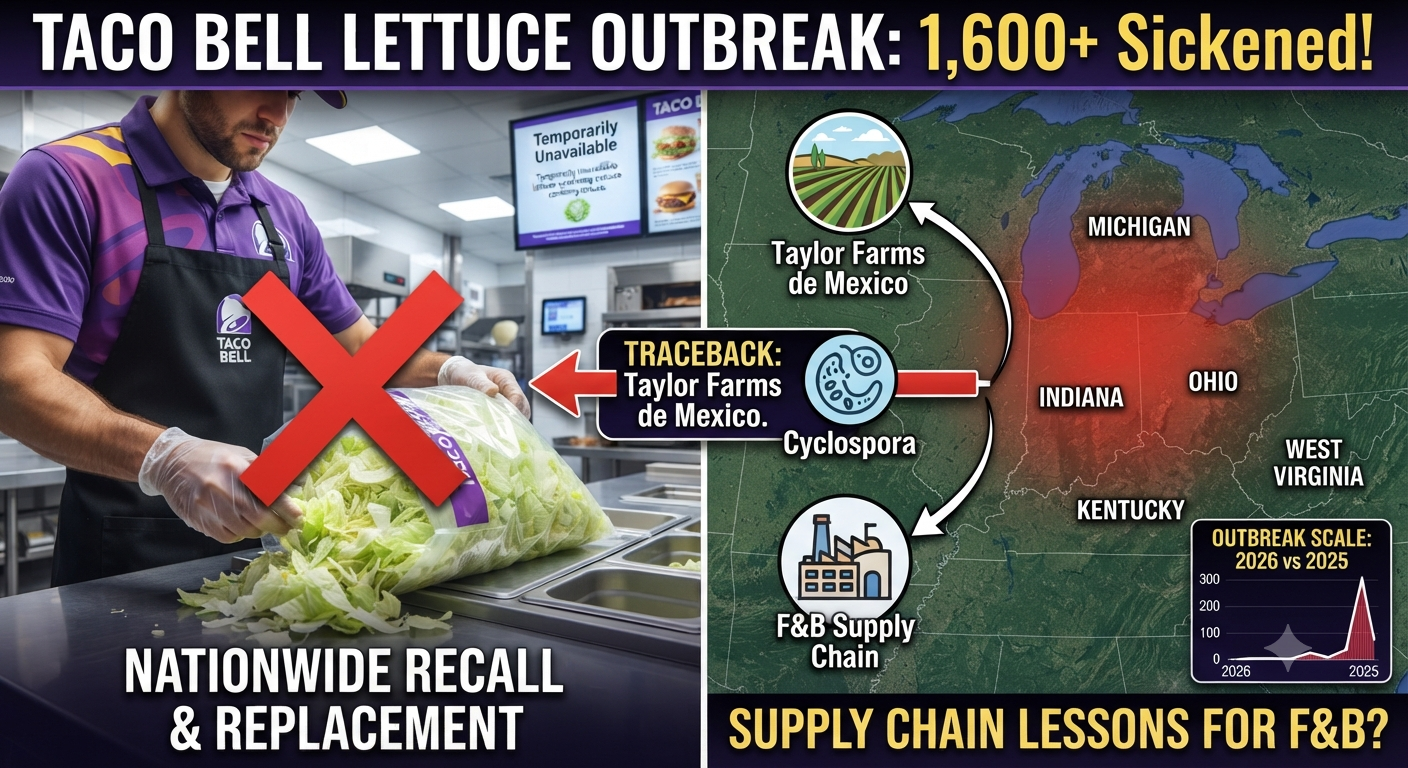

The Taco Bell lettuce outbreak has sickened 1,600+ people across five states, with Taylor Farms lettuce from Mexico traced as the source. What now?
The biggest food safety story in US foodservice this year escalated dramatically on Friday. The FDA’s traceback investigation into a multistate cyclosporiasis outbreak identified a single supplier — Taylor Farms de Mexico — as the source of shredded iceberg lettuce served at Taco Bell locations in Indiana, Kentucky, Michigan, Ohio and West Virginia. The CDC has confirmed 1,645 domestic cases, with more than 5,100 further cases awaiting confirmation and total possible cases now at 6,745 — against just 2,700 cases in all of 2025. Taco Bell says it completed removal of the affected Taylor Farms lettuce from all restaurants as of July 17 and has pulled the ingredient from its supply chain nationwide, replacing it within 24 hours.
How the Taco Bell Lettuce Outbreak Unfolded
Cyclosporiasis — a parasitic intestinal illness causing weeks of severe diarrhea — surges every summer, but this season is far beyond normal, driven largely by the outbreak cluster in Michigan and neighbouring states; Michigan alone has reported over 5,000 confirmed cases. Early in the outbreak, Taco Bell locations in the Detroit area pulled lettuce, cilantro, onion, pico de gallo and guacamole from menus as a precaution.
The FDA’s traceback then narrowed the source to a single supplier of Mexican-grown shredded iceberg lettuce. Taylor Farms — the Salinas, California giant that supplies several major US restaurant chains — responded by voluntarily removing all iceberg lettuce sourced from central Mexico from the US market, stressing that no Taylor Farms branded retail salad kits contain iceberg lettuce. The CDC warns case numbers will likely keep rising due to a six-week lag between illness onset and reporting.
Market Fallout: One Supplier, Many Casualties
The financial contagion spread well beyond Taco Bell. Parent company Yum Brands saw its stock sink nearly 7% over five days, while chains with heavy fresh-lettuce exposure were punished on association alone — Sweetgreen plunged nearly 13% during the week and Cava fell more than 3%. Both rebounded sharply on Friday (Sweetgreen up more than 17%) once the CDC made clear their ingredients were not implicated. Analysts expect Taco Bell itself to recover quickly, noting that prior food safety incidents at major chains produced only temporary sales dips — but the episode shows how a single ingredient from a single supplier can move billions in market value across an entire sector in days.
Implications for Buyers and Procurement Teams
- Single-supplier concentration on high-risk fresh produce is the core lesson. Operators should map which fresh ingredients flow from one packer or one growing region and build qualified alternates before an outbreak forces a scramble.
- Speed is now the standard: Taco Bell removed and replaced a nationwide ingredient within 24 hours. Procurement teams should test whether their own supply chains could execute a same-week ingredient swap at scale.
- Traceability paid off — the FDA isolated one supplier and one origin quickly, which protected uninvolved chains. Suppliers without lot-level traceability will increasingly be uninsurable risks for major foodservice accounts.
- Origin risk is back on the agenda. Central Mexico supplies a large share of US winter and summer leafy greens; buyers should review origin diversification and seasonal sourcing overlap for leafy categories.
- Reputational contagion is real: Sweetgreen lost 13% without any implicated product. Fresh-forward operators need outbreak communication plans that establish distance fast when a category — not their brand — is in the headlines.
FAQ
What caused the Taco Bell lettuce outbreak?
The FDA traced a multistate cyclosporiasis outbreak to a single supplier, Taylor Farms de Mexico, which provided shredded iceberg lettuce to Taco Bell locations in Indiana, Kentucky, Michigan, Ohio and West Virginia.
Is Taco Bell safe to eat now?
Taco Bell says it completed removal of the affected Taylor Farms lettuce from all restaurants as of July 17 and removed the ingredient from its supply chain nationwide, replacing it with alternative supply.
How big is the 2026 cyclosporiasis outbreak?
The CDC has confirmed 1,645 domestic cases with over 5,100 more awaiting confirmation — about 6,745 possible cases so far in 2026, versus 2,700 in all of 2025 — and warns numbers will rise due to a six-week reporting lag.
Sources
- CDC — outbreak case counts and traceback confirmation
- FDA — supplier identification and consumer advisory
- CNBC — market impact on Yum Brands, Sweetgreen and Cava
- CBS News — Taylor Farms de Mexico identification and company statements
- NPR — supply chain removal timeline
- Forbes — state-level case data and menu removals