
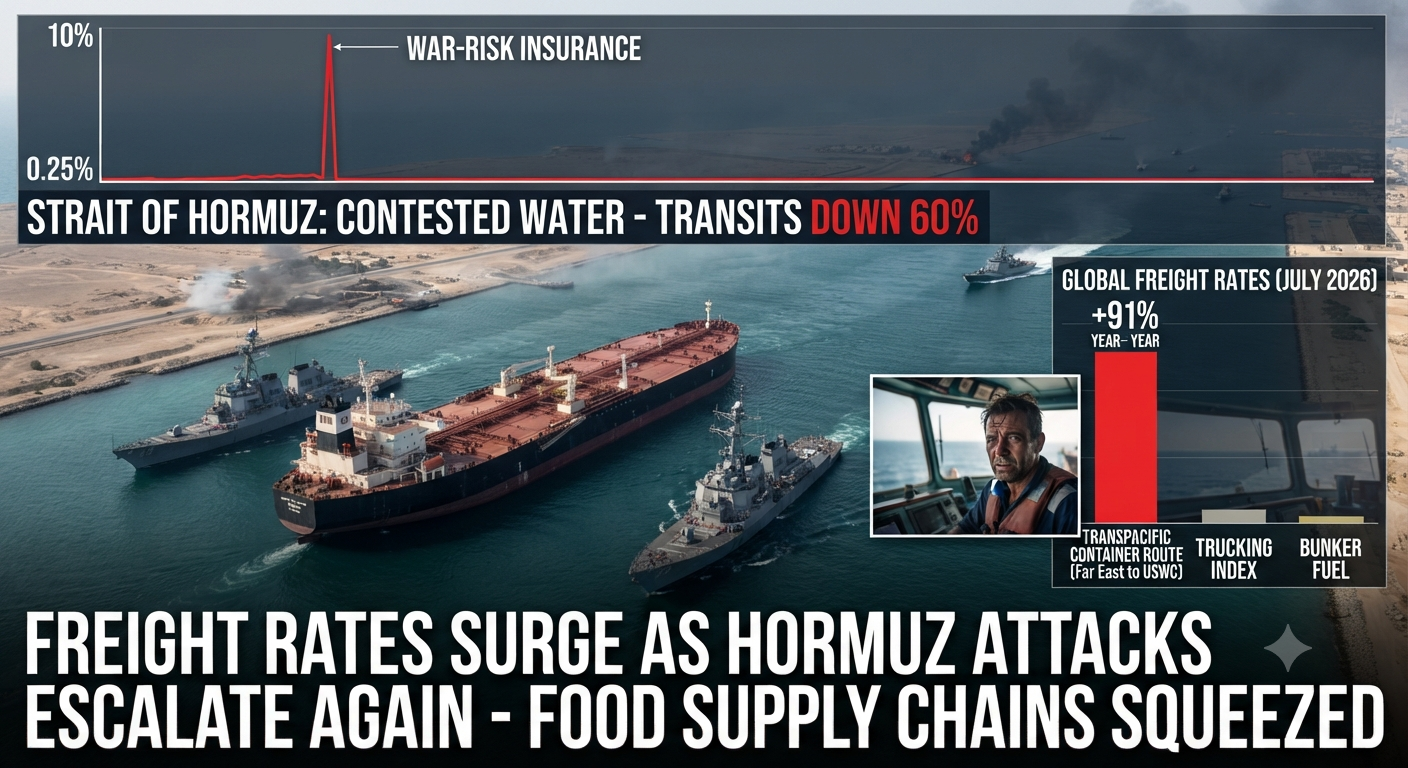

Freight rates are surging as fresh tanker attacks near the Strait of Hormuz push war-risk insurance to 10% of hull value and squeeze food supply chains.
The world’s most dangerous shipping chokepoint got more dangerous again this weekend. Three more tankers came under attack near the Strait of Hormuz in the latest escalation of the US–Iran conflict, with the US launching fresh strikes on Iran on Saturday after two American vessels were hit. For food and beverage supply chains, the fallout is no longer confined to oil markets: freight rates, fuel surcharges and insurance premiums are climbing across ocean trade lanes worldwide, and the cost wave is arriving in landed prices for everything from packaging resins to refrigerated cargo.
Insurance Costs Explode as the Strait Becomes Contested Water
The starkest number in shipping right now is insurance. War-risk premiums for Hormuz transits have surged to between 3% and 10% of hull value, up from 0.25% before the conflict — meaning a $100 million tanker now faces premiums of $3–10 million per voyage versus roughly $250,000 previously. Iran’s resumption of tanker attacks, including strikes on two UAE supertankers that killed a sailor, has sharply reduced strait crossings, and around 6,000 seafarers are trapped in the region as the IMO works to evacuate stranded vessels.
Security analysts note that if cruise missiles can accurately hit large tankers inside Omani waters at the strait’s southern edge, geography no longer offers vessels meaningful protection — the strait has effectively become contested water from shore to shore. Vessel transits have collapsed from a pre-crisis baseline of 88 per day to the mid-30s and lower, and average daily rates to load a ship inside the Gulf have jumped toward $300,000 from below $200,000.
Freight Rates Ripple Across Every Trade Lane
The crisis is not staying in the Gulf. Container lines are successfully passing along fuel costs inflated by the effective closure of the strait, pushing spot container freight rates higher globally. Transpacific rates from the Far East to the US West Coast are running roughly 91% above year-ago levels, compounded by tariff-driven front-loading — June US containerized imports hit 2.40 million TEUs, up 8.2% year-on-year, with imports from China up 27.4%. Peak season surcharges have begun on eastbound transpacific services.
There is one faint positive: spot rates on major Far East trades flattened briefly in early July as carriers added capacity, though analysts warned further mid-July increases were coming and the latest attacks threaten even that fragile stabilisation. Overland, the pressure is stacking too — US truckload and LTL rate indexes hit new highs in Q2 2026, with rate-per-mile up 10.1% year-on-year and projected to rise 11.7% in Q3, while Brent crude has pushed above $86 a barrel.
Implications for Buyers and Procurement Teams
- Budget for sustained freight inflation into Q4: fuel surcharges, war-risk premiums and peak season surcharges are compounding, and none has a near-term de-escalation catalyst.
- Food importers relying on Gulf-transiting cargo — fertiliser, resins for packaging, Middle East-bound perishables — should requote lanes now and confirm carriers’ war-risk cost pass-through clauses before they invoice retroactively.
- Cold chain operators face a double hit: bunker fuel costs plus diesel-linked reefer and trucking surcharges. Lock refrigerated capacity early for Q4 rather than riding spot.
- Contract shippers should scrutinise force majeure and rerouting clauses; carriers avoiding the Gulf entirely will add transit days that matter for shelf-life-sensitive cargo.
- Watch the combined chokepoint risk: with the Black Sea corridor also disrupted, two of the world’s critical trade arteries are impaired simultaneously — diversify routings and origins where alternatives exist rather than optimising for cost alone.
FAQ
Why are freight rates rising in July 2026?
Escalating attacks on tankers near the Strait of Hormuz have driven war-risk insurance to as much as 10% of hull value, collapsed strait transits, and inflated fuel costs that container lines are passing through globally — on top of tariff-driven import front-loading and peak season surcharges.
How much have shipping insurance costs increased?
War-risk premiums have risen from about 0.25% of hull value before the conflict to between 3% and 10% — a $100 million vessel now pays $3–10 million per transit versus roughly $250,000 previously.
What does the Hormuz crisis mean for food supply chains?
Higher landed costs across the board: elevated container rates (transpacific spot rates up ~91% year-on-year), diesel-linked trucking and cold chain surcharges, longer transits from rerouting, and knock-on exposure for fertiliser and packaging inputs shipped through the Gulf.
Sources
- gCaptain — tanker attacks and US strikes coverage
- The National — war-risk insurance premium data and IMO response
- Lloyd’s List — container rate pass-through analysis
- Xeneta / SeafoodSource — transpacific spot rate trends
- FreightWaves — US truckload and LTL rate indexes
- IMF PortWatch / Outlook India — Hormuz transit volume data
- Gulf News / Kpler — VLCC rate movements and rerouting trends