
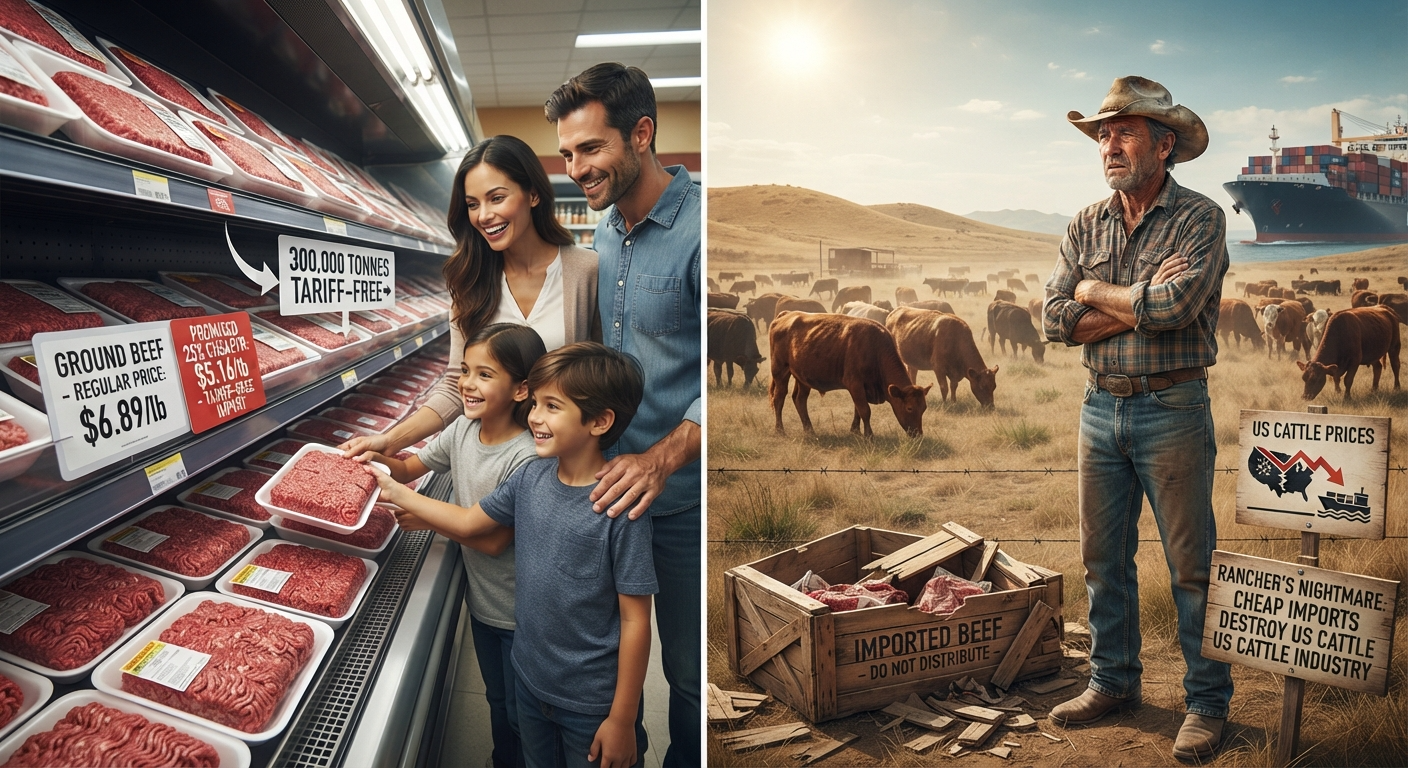

Trump’s plan to import 300,000 tonnes of tariff-free beef promises 25% cheaper ground beef, but US cattle ranchers say it could destroy the industry and backfire spectacularly.
Table of Contents
What Is Trump’s Ground Beef Import Plan?
On Friday, August 21, 2026, President Donald Trump announced a controversial move designed to tackle soaring beef prices that have frustrated American consumers. The plan allows up to 300,000 metric tons of ground beef to be imported into the United States completely tariff-free for the next 90 days. This is an extraordinary amount—representing nearly 15% of total US beef imports based on recent data.
According to Trump’s announcement on Truth Social, participating importers have committed to selling this beef at 25% below current market prices. The stated goal is straightforward: dramatically reduce what Americans pay for ground beef at the grocery store while simultaneously creating space for domestic cattle producers to rebuild their herds.
The timing of this announcement is significant. Ground beef prices have climbed to record highs, with consumers now paying approximately $6.89 per pound on average, up from $5.55 when Trump took office in January 2025. For working families, these prices represent a genuine squeeze on household budgets, and Trump’s move directly targets this cost-of-living concern ahead of the crucial November midterm elections.
Why Are Ranchers Outraged?
Despite Trump’s best intentions, his beef import plan has triggered a firestorm of opposition from the very industry it was designed to help—America’s cattle ranchers. The response has been swift, unified, and scathing.
The National Cattlemen’s Beef Association (NCBA), representing tens of thousands of American cattle producers, issued a statement expressing their disappointment, stating that flooding the market with government-subsidized, below-market beef is not the way to rebuild the American cattle herd. Colin Woodall, the NCBA’s chief executive officer, pointed out that cattle markets immediately turned sharply lower following the announcement, directly harming farmers and ranchers at a critical time of year.
Key Concern: This 90-day period is crucial for cattle producers making decisions about their herds. Discounted foreign beef sends the wrong market signal—it undermines the confidence producers need to justify retaining breeding cattle and investing in herd expansion.
The opposition extends beyond industry groups. Several Republican senators with strong ranching constituencies have also criticized the plan, including South Dakota Senate Majority Leader John Thune, who represents a beef-producing state with four times as many cattle as people. Montana Senator Tim Sheehy similarly warned about the hardships American cattle farmers would face.
Industry critics argue that the plan throws “cold water on the prospect of herd expansion” and sacrifices long-term stability for short-term political messaging. The US Cattlemen’s Association (USCA) went further, stating there is no clear evidence that increasing beef imports in this manner will actually lower retail prices for consumers.
Will It Actually Lower Beef Prices?
This is the fundamental question at the heart of the controversy. While Trump promises 25% discounts, industry experts and analysts remain skeptical about whether these savings will reach consumers’ grocery store shelves.
The concern centers on how the US food supply chain actually works. Ground beef sold at retail isn’t determined solely by the price of imported wholesale beef. Retailers, distributors, and processors all take their margins along the supply chain. Even if foreign beef enters the US market at steep discounts, there’s no guarantee these savings translate into equally steep discounts at checkout.
Additionally, critics point out that flooding the market with below-market-priced beef creates artificial market conditions. Rather than allowing natural supply and demand to determine prices, government intervention distorts market mechanisms. This approach has never proven particularly effective at achieving long-term, sustainable price reductions.
Some analysts believe the real impact may be far more limited than advertised. If the plan actually does result in modest price decreases—perhaps 5-10% rather than the promised 25%—it may prove insufficient to justify the damage done to domestic producers.
How Will This Affect Global Beef Markets?
While the plan creates problems for American ranchers, it creates opportunities for some international competitors. Global Agritrends analyst Simon Quilty identified Brazil as perhaps “the only winner” from Trump’s announcement, given that Brazil currently faces a 26.4% tariff on its beef exports.
Australia, by contrast, faces a potentially damaging scenario. The country already exports beef to the US tariff-free and currently supplies about 75% of its annual quota allocation. With foreign beef flooding the US market at discounted prices, Australian lean beef prices are expected to decline due to market saturation. This creates a lose-lose situation for Australian exporters—they’re already shipping at competitive rates, and now they face pressure from even cheaper imports.
The report prepared by Steiner Consulting Group for Meat and Livestock Australia warns that Australian lean beef prices are “likely to be negatively impacted” as the removal of tariffs gives South American suppliers more flexibility to offer discounts and compete for business. This saturation effect will “significantly distort the market” and leave beef producers on the losing side.
The US Cattle Herd Crisis
Understanding the context behind beef prices requires acknowledging the underlying crisis in America’s cattle industry. The US cattle herd has declined to its lowest level since the 1950s, with current inventory at approximately 86.2 million head as of January 2026.
Alarming Statistic: Fifty-five percent of US cattle country remains in drought, severely limiting forage availability and driving up input costs for ranchers attempting to maintain breeding stock.
Years of drought, wildfires, and high input costs have devastated producers. Many have been forced to sell off breeding stock rather than retain heifers for herd expansion. This supply constraint is the primary reason beef prices have climbed to record levels—it’s simple economics. With fewer cattle being produced, prices naturally rise.
The irony is that high prices were finally sending the right market signal to producers: maintain and expand your herds because strong demand will reward your investment. Introducing cheap foreign beef undermines this crucial market signal at precisely the wrong moment, when the herd needs to expand to normalize supply and eventually moderate prices naturally.
Economic Effects on American Farmers
The economic implications for American cattle farmers are deeply troubling. When producers were beginning to see light at the end of a long, dark tunnel—after years of losses and weather-related catastrophes—this policy threatens to extinguish that hope.
Cattle farming is a capital-intensive, long-term business. A cow requires approximately two years to produce beef for market. Investment decisions made today won’t yield results for 24-30 months. Producers must have confidence in future prices to justify current expenses. Discounted foreign beef erodes that confidence.
The NCBA outlined specific concerns: the policy creates “long-term harm to family farms and ranches, domestic beef production, and the stability of the US cattle industry.” Rather than helping ranchers, it undercuts their ability to invest in expansion during a critical rebuilding period.
For small and mid-sized cattle operations struggling with debt and input costs, this announcement could prove devastating. Without the confidence that prices will remain strong enough to justify investment, many producers may abandon expansion plans or, worse, continue herd reduction.
Sources & References
| Source | URL | Publication Date |
|---|---|---|
| ABC Landline – Donald Trump’s plan to import more beef faces backlash from US cattle industry | https://www.abc.net.au/news/rural/landline/ | August 21, 2026 |
| Northern Ag Network – Trump Proposes Lifting Tariff Rate Quota on 300,000 Metric Tons of Beef Imports | https://www.northernag.net/trump-proposes-lifting-tariff-rate-quota-on-300000-metric-tons-of-beef-imports/ | August 23, 2026 |
| Beef Central – Trump announces 90-day tariff-free ground beef imports, designed to curb US meat prices | https://www.beefcentral.com/news/trump-announces-90-day-tariff-free-ground-beef-imports-designed-to-curb-us-meat-prices/ | August 22, 2026 |
| CNBC – Trump to allow import of 300,000 metric tons of ground beef without tariff | https://www.cnbc.com/2026/08/21/trump-ground-beef-import-tariff.html | August 21, 2026 |
| Newsweek – Donald Trump’s Beef Import Plan Sparks Backlash From Republicans | https://www.newsweek.com/donald-trump-beef-import-plan-republican-backlash-12353995 | August 21, 2026 |
| Al Jazeera – Trump waives ‘out-of-quota’ beef tariffs for 90 days to lower prices | https://www.aljazeera.com/news/2026/8/21/trump-waives-out-of-quota-beef-tariffs-for-90-days-to-lower-prices | August 21, 2026 |
| Fox Business – Trump allows 300,000 metric tons of tariff-free beef imports in bid to cut prices | https://www.foxbusiness.com/politics/trump-allows-300000-metric-tons-tariff-free-beef-imports-bid-cut-prices-drawing-rancher-backlash | August 21, 2026 |
| The Hill – Trump temporarily lifts ground beef import tariffs | https://thehill.com/homenews/administration/6043387-donald-trump-us-ground-beef-tariffs-higher-rate-temporary-pause/ | August 21, 2026 |
| National Provisioner – Trump announces 90-day tariff relief for ground beef imports | https://www.provisioneronline.com/articles/121097-trump-announces-90-day-tariff-relief-for-ground-beef-imports | August 21, 2026 |
| NBC News – GOP lawmakers criticize Trump’s beef import plan amid blowback from ranchers | https://www.nbcnews.com/politics/trump-administration/gop-lawmakers-ranchers-criticize-trump-tariff-beef-import-high-prices-rcna593879 | August 22, 2026 |
| Beef Magazine – Cattle group reacts to Trump’s beef import post | https://www.beefmagazine.com/market-news/cattle-group-reacts-to-trump-s-beef-import-post | August 21, 2026 |
| National Cattlemen’s Beef Association – NCBA Statement on President Trump’s Truth Social Post | https://www.ncba.org/news-media/news/details/50285/ncba-statement-on-president-trumps-truth-social-post | August 21, 2026 |
| Oklahoma Farm Report – Ag Groups React to Trump’s Beef Tariff Announcement | https://www.oklahomafarmreport.com/2026/08/21/u-s-cattlemens-association-responds-to-latest-on-beef-prices/ | August 21, 2026 |
| BizPac Review – Republican lawmakers have beef with Trump, defend ranchers over latest tariff relief | https://www.bizpacreview.com/2026/08/22/republican-lawmakers-have-beef-with-trump-defend-ranchers-over-latest-tariff-relief-1655852 | August 22, 2026 |
| Yahoo News – US beef producers warn against Trump’s ‘misguided’ plan to import Argentine beef | https://www.yahoo.com/news/articles/us-beef-producers-warn-against-154700669.html | August 22, 2026 |
| Fortune – Trump admits tariffs are a tax on America’s love for hamburgers and allows 300,000 metric tons | https://fortune.com/2026/08/21/donald-trump-tariffs-300000-tons-ground-beef-imports/ | August 21, 2026 |
| KPMG – United States increases beef import quota | https://kpmg.com/us/en/taxnewsflash/news/2026/02/united-states-increases-beef-import-quota.html | February 9, 2026 |
Frequently Asked Questions (FAQ)
❓ How much tariff-free beef will be imported under Trump’s plan?
President Trump announced that the United States will allow up to 300,000 metric tons of ground beef to be imported tariff-free for 90 days. This represents approximately 15% of total US beef imports and is a massive volume by historical standards.
❓ What percentage discount is promised for ground beef?
Trump stated that participating importers have committed to selling this imported beef at 25% below current market prices. However, industry experts question whether this discount will actually reach consumers at the retail level, given how the supply chain functions.
❓ How long will the tariff-free beef imports last?
The policy is temporary and limited to 90 days from the announcement date (August 21, 2026). This timeframe coincides with the lead-up to the November midterm elections, which critics view as politically motivated.
❓ Why are American cattle ranchers opposed to the plan?
Ranchers argue that flooding the market with discounted foreign beef sends the wrong signal to producers who are considering expanding their herds. They contend that high prices were finally incentivizing herd expansion after years of losses, and cheap imports undermine this necessary market signal. Additionally, the National Cattlemen’s Beef Association says no cow-calf producer in America asked for increased imports.
❓ What is the current state of the US cattle herd?
The US cattle herd is at its lowest level since the 1950s, with approximately 86.2 million head as of January 2026. Cattle beef cow inventory is down 8.6% since 2020. Drought, wildfires, and high input costs have devastated producers and reduced domestic beef production.
❓ How much have ground beef prices increased recently?
Ground beef prices have climbed dramatically. The price per pound was $5.55 when Trump took office in January 2025 and had risen to approximately $6.89 by July 2026—a 24% increase in just seven months. Year-over-year, ground beef prices are up 9.4-12.8% depending on the time period measured.
❓ Which countries will benefit most from this plan?
Brazil is expected to be the primary beneficiary, as Brazilian beef currently faces a 26.4% tariff on exports to the US. Australia, which already exports beef tariff-free, is expected to be negatively impacted as market saturation depresses prices for Australian lean beef exports.
❓ Has the NCBA (National Cattlemen’s Beef Association) supported the plan?
No. The NCBA issued a strong statement expressing disappointment with the plan, stating that flooding the market with government-subsidized, below-market beef is not the way to rebuild the American cattle herd. CEO Colin Woodall noted that cattle markets immediately turned sharply lower following the announcement.
❓ Are Republican politicians supporting Trump’s beef tariff plan?
No. Several Republican senators representing beef-producing states have criticized the plan, including Senate Majority Leader John Thune of South Dakota and Senator Tim Sheehy of Montana. These GOP lawmakers argue the policy harms American ranchers and their families.
❓ When will we know if the plan actually lowered beef prices?
The 90-day tariff-free import period will conclude in mid-November 2026, just after the midterm elections. It will take several weeks to months afterward to analyze whether retail prices for consumers actually decreased, and if so, by how much. Industry data typically lags real-time by several weeks.
❓ Could this policy harm food security or create trade issues?
The USCA warned that “dumping additional foreign beef” could “weaken our markets and gamble with food safety in the process.” Additionally, the policy raises trade relations concerns, particularly regarding Argentina’s historical foot-and-mouth disease issues and the significant trade imbalance between the US and Argentina ($800 million in Argentine beef imports vs. only $7 million in US beef exports to Argentina over five years).