
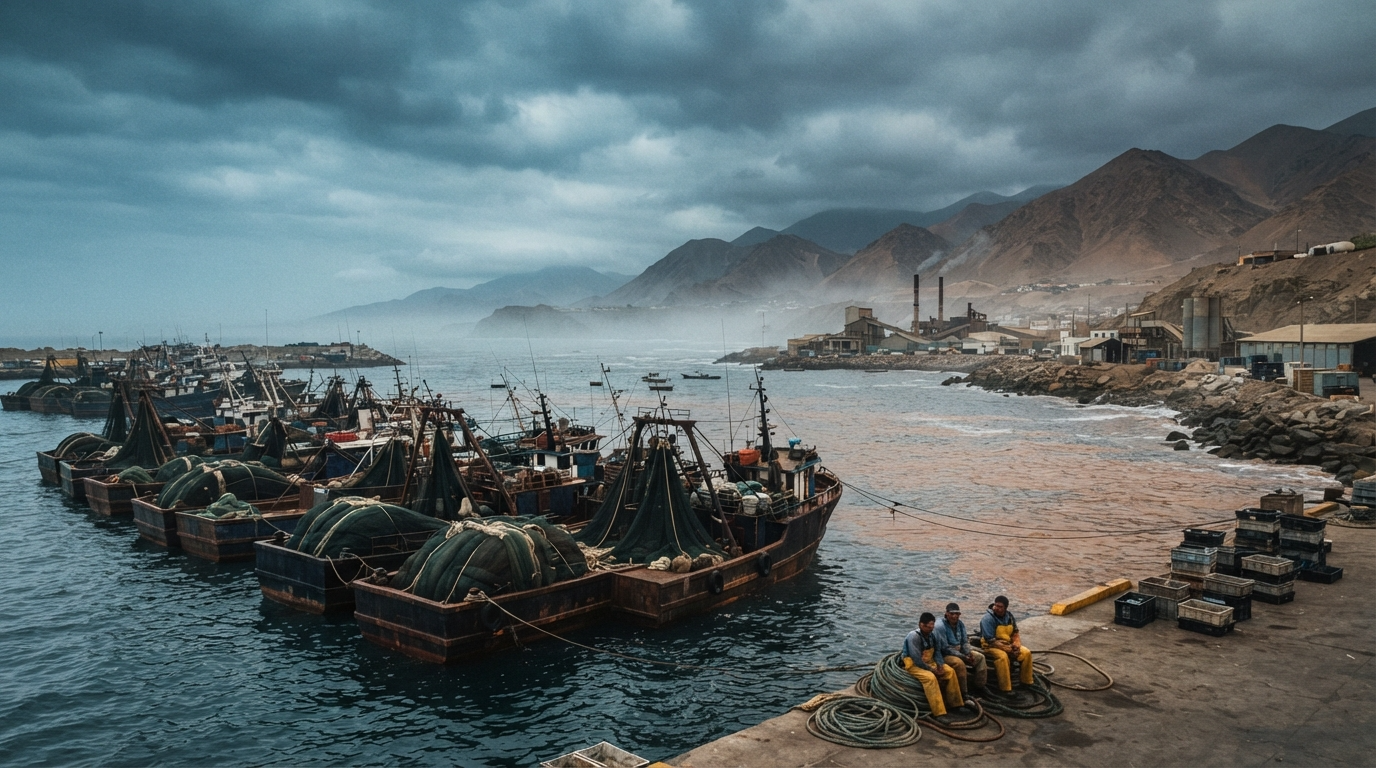

Peru declared a 120-day national emergency for fishing and aquaculture on August 24, 2026 as El Niño intensifies—fishmeal prices spike to record highs, threatening global salmon and shrimp producers.
Table of Contents
Peru’s Historic Emergency Declaration
On August 24, 2026, Peru’s government declared a 120-day national emergency for its fishing and aquaculture sectors. This is the most severe supply disruption signal for global seafood markets in 2026—and it’s sending shockwaves through every aquaculture supply chain on Earth.
The emergency declaration is not ceremonial. It signals that Peru’s government recognizes the severity of the situation and is preparing for massive economic disruption across the fishing industry. The 120-day window stretches through December 2026, encompassing the critical final quarter when global seafood demand peaks.
⚠️ CRITICAL: Peru supplies approximately 20% of the world’s fishmeal. This is not a regional issue—it’s a global supply chain emergency affecting salmon farms in Norway, shrimp farms in Ecuador, and aquaculture operations from Chile to Southeast Asia.
The declaration comes as coastal El Niño conditions intensify across the Pacific. The Peruvian Commission for the Study of El Niño (ENFEN) has maintained a “Coastal El Niño Alert” since February 2026, projecting that warm water conditions will persist until February 2027, with potential intensification to moderate levels already occurring.
This isn’t the first time Peru has faced this crisis, but the convergence of factors—record-low anchovy quotas, high juvenile catch rates, multiple fishing season suspensions, and intensifying ocean warming—suggests this could be one of the most severe disruptions since the catastrophic 2015-2016 El Niño event.
Why Coastal El Niño Destroys Anchovy Stocks
Peru’s anchovy (anchoveta, or Engraulis ringens) is the foundation of a $1-3 billion annual fishing industry. It’s also the basis for about 20% of global fishmeal production—a commodity that literally feeds the world’s farmed fish and shrimp.
But El Niño creates a perfect storm of destruction for this fishery:
- Warm Water Disrupts Upwelling: Normal coastal winds push cold, nutrient-rich water up from the deep Pacific. El Niño warmth suppresses this critical upwelling, starving the ocean of the plankton that anchovy depend on.
- Fish Migration & Dispersal: As surface waters warm, anchovy schools move deeper and/or migrate southward toward cooler waters. They become harder to locate and catch.
- Juvenile Recruitment Collapse: Warmer waters disrupt the timing between fish spawning and plankton availability—a phenomenon called “phenological mismatch.” Young anchovies starve as their food sources disappear.
- Population Vulnerability: Stressed populations with high juvenile mortality and low recruitment become extremely sensitive to fishing pressure. Quotas must be slashed to prevent fishery collapse.
This is exactly what Peru experienced in 2026. By early June, Peru’s first anchovy fishing season had landed only 471,111 metric tons out of a 1.9 million ton quota—just 24.6% of the allowed catch. More alarming: over half of that catch was juveniles, precisely what the government suspension was trying to prevent.
The 2026 quota of 1.9 million tons was already 36% lower than the 3.0 million ton quota in 2025, marking the lowest first-season quota in a decade. This foreshadows a catastrophic year for global fishmeal supply.
The Global Fishmeal Supply Crisis Unfolding NOW
The supply chain consequences are already severe and worsening daily:
Current State of Emergency:
- Global fishmeal production down approximately 40% in recent months
- Peru’s first season production collapsed due to repeated fishing suspensions
- Second anchovy season prospects uncertain pending ENFEN oceanographic assessments
- Chinese aquafeed manufacturers now turning to Vietnam and India for alternative fishmeal sources
- Supply from Northern Europe also constrained (unrelated to El Niño but adding to tightness)
- Shrimp producers use approximately 1 million tons of fishmeal annually—now facing acute shortages
IFFO (The Marine Ingredients Organisation) released a report highlighting that while fishmeal production is projected to grow 1% in 2026 (minimal growth), this assumes Peru’s second season will open and operate without major disruptions. That assumption now looks extremely optimistic given the emergency declaration and persistent warm ocean conditions.
The shortage is already forcing market behavior changes. Chinese fishmeal producers, typically suppliers to their domestic aquaculture industry, are now competing fiercely for alternative sources in Vietnam and India. This bidding war is driving prices higher globally and straining supply in countries that traditionally supplied fishmeal to Southeast Asian producers.
Fishmeal Prices Just Hit Record Highs—Here’s Why
The price trajectory tells the story of an unfolding emergency:
- October 2025: $1,626 per metric ton
- April-June 2026: Steep climb as Peru’s fishing bans extended repeatedly
- June 2026: $2,423 per metric ton
- August 2026 (current): Reports of $3,100 per metric ton—an all-time high
This represents a price increase of 75-80% year-over-year, with the steepest climb occurring in the April-June window when Peru’s repeated fishing suspensions signaled the gravity of the El Niño situation.
For aquaculture producers, these aren’t abstract numbers. Fishmeal typically comprises 40-60% of aquafeed costs for carnivorous species like salmon and marine finfish. When fishmeal prices spike $1,500+ per ton, feed costs per fish can increase 30-50%, obliterating profit margins already pressured by lower salmon prices.
Fish oil, which is produced from the same anchovy raw material, has followed a parallel trajectory. Fish oil prices are now double year-ago levels, adding further cost pressure to premium aquafeeds that depend on omega-3 content.
The situation is particularly severe for shrimp producers, who use approximately 1 million tons of fishmeal annually. The Global Shrimp Forum noted that fishmeal price increases are unprecedented in their magnitude and persistence, with prices remaining elevated “despite recovery” from the 2023 El Niño disruption—suggesting structural supply constraints rather than temporary disruption.
Which Fish Farmers Are in Trouble?
Not all aquaculture is equally affected. The supply crisis hits differently across species:
High Risk – Carnivorous Species (Fishmeal-Dependent):
- Salmon: Global production now ~1.4 million tonnes annually. Atlantic salmon in Norway and Chile face severe margin compression. Chilean salmon particularly vulnerable due to local El Niño exposure AND fishmeal input costs.
- Marine Finfish: Farmed seabass, sea bream, grouper require high fishmeal content. Mediterranean and Asian producers facing acute cost pressure.
- Shrimp: Farmed shrimp in Ecuador, Vietnam, Thailand, Indonesia use 1 million tons of fishmeal annually. Ecuador (world’s largest farmed shrimp producer) particularly exposed.
Medium Risk – Mixed Diet Species:
- Tilapia & Carp: More resilient due to shift toward plant-based protein formulations. Still face cost pressure but can absorb increases better.
Norwegian salmon producers have the best near-term resilience—they’ve already contracted supply agreements and locked in fishmeal at better rates. Chilean salmon farmers, facing both El Niño’s direct ocean impacts (warmer water stress, disease pressure) and fishmeal shortages, face a perfect storm of challenges.
Rabobank’s latest analysis projects that while Norwegian salmon biomass growth remains healthy, Chilean production will struggle. The report expects Chilean salmon output to remain tight, with cooler water following El Niño potentially improving conditions into 2027—but that’s 6+ months away.
Shrimp producers in Ecuador and Southeast Asia are in the most precarious position. The industry already experienced two volatile years (2024-2025) and was counting on 2026 to stabilize profitability. This fishmeal crisis, arriving in Q3-Q4 2026, essentially guarantees margin compression across the industry.
How Bad Is This? 2016 El Niño Comparison
To understand the severity, it’s useful to look back at the last “super” El Niño event: 2015-2016.
The 1972-1973 Precedent (Worst Case): A super El Niño caused Peruvian anchovy catches to collapse by 55% in 1972 and 51% in 1973. This decimated global aquaculture feed supplies and caused acute economic hardship across Latin America, Africa, and Asia. The consequences cascaded through global food systems for years.
The 2015-2016 Event: While not as severe as 1972-73, the 2015-2016 El Niño caused Peruvian fishmeal exports to fall to their lowest levels since 2015/16, resulting in Peru’s first season being completely cancelled in 2023 (the worst year in decades) and second season severely restricted.
The 2026 Situation (Currently Unfolding): Peru opened 2026 with only 1.9 million tons of first-season quota—36% below 2025 levels. Multiple suspensions and high juvenile catch rates suggest actual landed tonnage could be catastrophically low. A potential second season is uncertain pending ocean condition assessments.
NOAA forecasts a 63% probability that El Niño will reach “very strong” intensity (sea surface temperatures 2+ degrees Celsius above normal). The last times the Pacific reached such temperatures, Peru’s anchovy fishery collapsed.
The difference this time: global demand for aquaculture feed is structurally higher, Chinese aquaculture expansion has intensified competition for marine ingredients, and climate change may be shifting baseline conditions that favor El Niño persistence.
What Happens Q4 2026 & Q1 2027
The emergency declaration covers 120 days through December 2026. Here’s what the timeline likely holds:
- August-September 2026: Industry locks in fishmeal contracts at current elevated prices (now $2,500-$3,100/MT). Long-term contracts signed at these levels.
- October-November 2026: Operation EUREKA LXXVIII scientific survey (22 vessels) assesses second anchovy season viability. Results likely disappointing given persistent warm water.
- December 2026: Second season may open at drastically reduced quota (possibly 500,000-800,000 MT) or remain closed entirely.
- Q1 2027: If El Niño persists as forecast, fishmeal shortage deepens. Alternative sources (Vietnam, India, China) fully utilized. Prices remain elevated through Q1 2027.
- Spring 2027: Only if ocean conditions normalize will Peru’s second season open normally. Until then, structural supply deficit persists.
This timeline means that farmed salmon, shrimp, and finfish producers have no relief window through December 2026 and likely into Q1 2027. Feed costs will remain elevated, forcing producers to choose between:
- Accept margin compression (reduced profitability)
- Pass costs to consumers (raise retail seafood prices)
- Reduce production (smaller fish, early harvests, lower yields)
- Reformulate feed (substitute alternative proteins, lower product quality)
What Seafood Companies Must Do NOW
For aquaculture producers, the 120-day emergency window demands immediate action:
ACTION ITEMS (THIS MONTH):
- LOCK FISHMEAL CONTRACTS NOW – At $2,500-$3,100/MT, spot market prices are catastrophic. Long-term contracts at fixed rates are critical. Every day of delay risks locking in higher prices.
- SECURE ALLOCATION WITH SUPPLIERS – Demand guaranteed volumes. Alternative sources (Vietnam, India) are now capacity-constrained. Direct negotiations with producers + transport logistics now essential.
- EVALUATE ALTERNATIVE PROTEINS – Soy meal, insect protein (15,000 tons currently produced globally, growing to 500,000+ by 2030), algal oil, and other novel ingredients. Pilot feeds incorporating alternatives immediately.
- STRESS-TEST ECONOMICS – Model operations assuming 25-40% feed cost increases through Q1 2027. Identify break-even points and acceptable margin floors.
- COMMUNICATE WITH BUYERS – If retail prices must increase, begin conversations now before Q4 2026 peak demand season.
Companies that waited until October/November 2026 to address fishmeal supply are already at a disadvantage. Those locking in September 2026 contracts at $2,500/MT may find themselves fortunate—Q4 2026 prices could easily reach $3,500+/MT if Peru’s second season opens at severely reduced quotas.
For Chile’s farmed salmon producers, the combination of El Niño’s direct ocean effects (higher disease pressure, lower growth rates) plus fishmeal cost escalation is particularly brutal. Budget planning must assume 30-40% feed cost increases, not the 20-30% commonly discussed.
Alternative protein development is no longer optional—it’s survival strategy. Companies already investing in insect protein formulations, algal oil blends, and soy-based alternatives are positioning for future resilience. Those entirely dependent on fishmeal are betting everything on El Niño ending by Q1 2027—a risky wager.
Sources & References
| Source | URL | Publication Date |
|---|---|---|
| Undercurrent News – Peru declares national emergency for fisheries, aquaculture as El Nino worsens | https://www.undercurrentnews.com/2026/08/24/peru-declares-national-emergency-for-fisheries-aquaculture-as-el-nino-worsens/ | August 24, 2026 |
| SeafoodSource – Peru extends pause to anchovy fishing as El Niño threats continue | https://www.seafoodsource.com/news/supply-trade/peru-extends-pause-to-anchovy-fishing-as-el-ni-o-threats-continue-to-loom-large | June 1, 2026 |
| SeafoodSource – Keiko Fujimori sworn in as Peruvian president, immediately stares down El Niño threats | https://www.seafoodsource.com/news/keiko-fujimori-sworn-in-as-peruvian-president-immediately-stares-down-el-nino-threats | August 2026 |
| SeafoodSource – Peru extends anchovy fishing suspension again, threatening global fishmeal supply | https://www.seafoodsource.com/news/supply-trade/peru-extends-anchovy-fishing-suspension-again-threatening-global-fishmeal-supply | June 12, 2026 |
| Aquafeed.com – Peru launches new anchovy assessment ahead of El Niño | https://www.aquafeed.com/commodities/commodity-news/peru-launches-new-anchovy-assessment-ahead-of-el-ni%C3%B1o-2026-2027/ | August 2026 |
| Euro Weekly News – Why an anchovy shortage 8,000km away could cost Spain’s fish-lovers more | https://euroweeklynews.com/2026/08/17/why-an-anchovy-shortage-8000km-away-could-cost-spains-fish-lovers-more/ | August 17, 2026 |
| Manolina Aqua – What a Strong El Niño Means for Fish Oil and Fishmeal Prices | https://blog.manolinaqua.com/en/what-a-strong-el-ni%C3%B1o-means-for-fish-oil-and-fishmeal-prices | July 9, 2026 |
| The Week – The global anchovy crisis | https://theweek.com/environment/anchovies-production-fishmeal-peru-el-nino | July 10, 2026 |
| Bloomberg – Super El Niño Risks Emerging Markets in Asia, Africa and Latin America | https://www.bloomberg.com/graphics/2026-el-nino-forecast-impacts-emerging-markets-data/ | August 2026 |
| Kingstar Food – Canned Fish Supply 2026: Tuna, Mackerel & Sardines Under El Niño Pressure | https://www.kingstarfood.com/blog/canned-fish-supply-2026-el-nino | August 2026 |
| Aquafeed.com – IFFO: Fishmeal and fish oil output remains weak | https://www.aquafeed.com/commodities/commodity-news/iffo-fishmeal-and-fish-oil-output-remains-weak/ | August 20, 2026 |
| Rio Times – Peru’s El Nino Costero Squeezes Crops and Anchovy in 2026 | https://www.riotimesonline.com/peru-el-nino-costero-crops-anchovy-2026/ | August 2026 |
| We Are Aquaculture – Warm sea conditions force a new temporary suspension of anchovy fishing in Peru | https://weareaquaculture.com/news/fisheries/warm-sea-conditions-force-a-new-temporary-suspension-of-anchovy-fishing-in-peru | June 2, 2026 |
| SeafoodSource – Climate-driven disruption, constrained supply adding volatility to aquaculture markets in the back half of 2026 | https://www.seafoodsource.com/news/climate-driven-disruption-constrained-supply-adding-volatility-to-aquaculture-markets-in-the-back-half-of-2026 | August 2026 |
| Aquafeed.com – Global Shrimp Forum: Shrimp feed demand rises as industry looks to novel ingredients | https://www.aquafeed.com/newsroom/editors-picks/global-shrimp-forum-shrimp-feed-demand-rises-as-industry-looks-to-novel-ingredients/ | September 26, 2025 |
| The Fish Site – Positive forecasts for salmon and shrimp prices | https://thefishsite.com/articles/positive-forecasts-for-salmon-and-shrimp-prices | January 23, 2025 |
| Feed & Additive Magazine – Global aquaculture update: Strong demand amid uncertainty | https://www.feedandadditive.com/global-aquaculture-update-strong-demand-amid-uncertainty/ | February 19, 2026 |
| Future Market Insights – Marine Ingredient Scarcity, Quota Volatility, and Substitution Economics | https://www.fmiblog.com/2026/06/18/marine-ingredient-scarcity-quota-volatility-and-substitution-economics-reshape-fish-feed-pricing-patterns-in-2026/ | June 18, 2026 |
| Oceana – Overfishing and El Niño Push the World’s Biggest Single-Species Fishery to a Critical Point | https://oceana.org/blog/overfishing-and-el-nino-push-worlds-biggest-single-species-fishery-critical-point/ | February 2, 2016 |
| PreventionWeb – A ‘super’ El Niño has the power to devastate fishing | https://www.preventionweb.net/news/super-el-nino-has-power-devastate-fishing-and-leave-seals-and-sea-lions-starving | June 18, 2026 |
| Wodnesprawy – El Niño – billion-dollar losses in Peru’s fishing industry | https://wodnesprawy.pl/en/el-nino-billion-dollar-losses-in-perus-fishing-industry/ | December 21, 2023 |
Frequently Asked Questions (FAQ)
❓ What does Peru’s 120-day fishing emergency mean exactly?
Peru declared a national emergency for fishing and aquaculture on August 24, 2026, lasting 120 days (through December 24, 2026). This signals official government recognition that the fishing and aquaculture sectors face severe disruption. The emergency status allows for emergency government measures, financial support coordination, and regulatory flexibility. Most importantly, it signals to global markets that Peru’s fishmeal supply will be severely constrained through the end of 2026.
❓ Why is Peru’s anchovy fishing the most important in the world?
Peru’s anchovy fishery is the world’s largest single-species fishery, valued at $1-3 billion annually. More critically, anchovy is the main raw material for fishmeal production. Peru supplies approximately 20% of global fishmeal, which is used to feed farmed salmon, shrimp, and other farmed seafood. Roughly 50% of all global aquaculture feed depends on marine ingredients (fishmeal and fish oil). When Peru’s anchovy catch fails, global food production is disrupted.
❓ What is “coastal El Niño” and how does it destroy anchovy?
Coastal El Niño (El Niño Costero) is localized warming of Pacific waters off Peru’s coast. It disrupts the cold-water upwelling system that brings nutrient-rich water from the deep. This upwelling normally creates one of Earth’s most productive fishing grounds. When El Niño suppresses upwelling, plankton—the food base for anchovy—collapses. Simultaneously, warm water pushes anchovy deeper and/or farther south, and disrupts reproduction timing. Result: anchovy abundance crashes, recruitment fails, and the fishery must close.
❓ How much has fishmeal risen in price?
Fishmeal prices have risen 75-80% year-over-year. October 2025: $1,626/MT. June 2026: $2,423/MT. August 2026 (current): up to $3,100/MT in spot markets. This is the highest price in recorded history for fishmeal. For aquaculture producers, a 75-80% cost increase on a commodity that represents 40-60% of total feed costs translates to 30-50% feed cost increases—catastrophic for an industry operating on 15-25% profit margins.
❓ What happened to Peru’s 2026 anchovy quota?
Peru set a first-season quota of 1.9 million metric tons for 2026, down 36% from 3.0 million tons in 2025. This was already the lowest quota in a decade. By early June, after multiple fishing suspensions, Peru had landed only 471,111 MT—just 24.6% of the quota—with over 50% being juveniles (which the suspension was trying to protect). This represents a near-total collapse of first-season production compared to historical norms.
❓ When will Peru’s second fishing season open?
Unknown. Peru launched Operation EUREKA LXXVIII, deploying 22 vessels to assess anchovy stocks and oceanographic conditions. Results will determine if/when a second season opens. Given persistent warm water and the emergency declaration, the second season is likely to open at drastically reduced quota (potentially 500,000-800,000 MT) or may not open at all if ocean conditions remain unfavorable. Updates expected by October-November 2026.
❓ Which aquaculture producers are most affected?
Salmon (especially Chile) and farmed shrimp are most exposed—both highly dependent on fishmeal-based feeds. Norwegian salmon is somewhat insulated by existing contracts. Chilean salmon faces dual pressure: direct El Niño effects on ocean temperatures (disease, stress) plus fishmeal cost escalation. Shrimp producers in Ecuador and Southeast Asia face severe margin compression. Tilapia and carp are more resilient due to greater plant-based protein substitution.
❓ Will El Niño last through 2026-2027?
Yes, according to Peru’s ENFEN commission and NOAA forecasts. ENFEN projects coastal warming will persist until February 2027. NOAA puts a 63% probability that El Niño will reach “very strong” intensity (sea surface temperatures 2+ degrees Celsius above normal). The last times this occurred, Peru’s anchovy fishery experienced catastrophic collapses. This suggests fishmeal supply remains constrained through at least Q1 2027.
❓ How does this compare to 2015-2016 El Niño?
The 2015-2016 El Niño was severe but manageable. The 2026 situation may be worse. The 1972-1973 super El Niño saw Peruvian anchovy catches collapse 55-51%. Current forecasts suggest 2026 could be similarly severe. The difference: global demand for aquaculture feed is much higher now, Chinese competition for alternative sources is intense, and climate change may favor El Niño persistence. A worst-case scenario would rival 1972-1973 in severity.
❓ What should aquaculture companies do immediately?
(1) Lock fishmeal supply contracts NOW at current pricing before prices climb further. (2) Secure guaranteed volume allocations with suppliers—spot market sourcing will be impossible Q4 2026. (3) Evaluate alternative proteins (soy, insect meal, algal oil). (4) Stress-test economics assuming 25-40% feed cost increases through Q1 2027. (5) Begin conversations with buyers about potential retail price increases. Companies that wait until October 2026 will find themselves at severe disadvantage.
❓ Are there alternative proteins that can replace fishmeal?
Yes, but with limitations. Soy meal is widely available but costs less than fishmeal. Insect protein (currently 15,000 tons annually, growing to 500,000+ tons by 2030) shows promise but isn’t yet cost-competitive at scale. Algal oil is commercially viable but limited in volume (35,000 tons estimated by 2030). Novel alternatives exist but none can fully replace fishmeal as a 100% substitute. Most realistic strategy: reformulate feeds using 20-40% fishmeal replacements from alternative sources, reducing—not eliminating—marine ingredient dependence.
❓ Will seafood prices increase because of this?
Almost certainly. If aquaculture producers absorb 20-40% feed cost increases without passing costs to consumers, their profit margins evaporate. Most will raise retail prices for salmon, shrimp, and other farmed seafood in Q4 2026 and Q1 2027. Consumers should expect 10-20% price increases for farmed seafood products, potentially more in markets with limited supply diversity (high dependence on Chilean salmon or Ecuadorian shrimp).
❓ Is global food security at risk from this?
Not from actual starvation risk, but from price volatility and supply disruption in protein markets. Farmed seafood represents roughly 50% of global seafood consumption and is a critical protein source for 2+ billion people. Supply disruptions lead to price spikes that disproportionately harm low-income consumers. Additionally, if aquaculture output declines due to feed costs, demand shifts to wild-caught fisheries, which could accelerate overfishing. The 2026-2027 period is likely to create significant food price inflation in protein categories.