
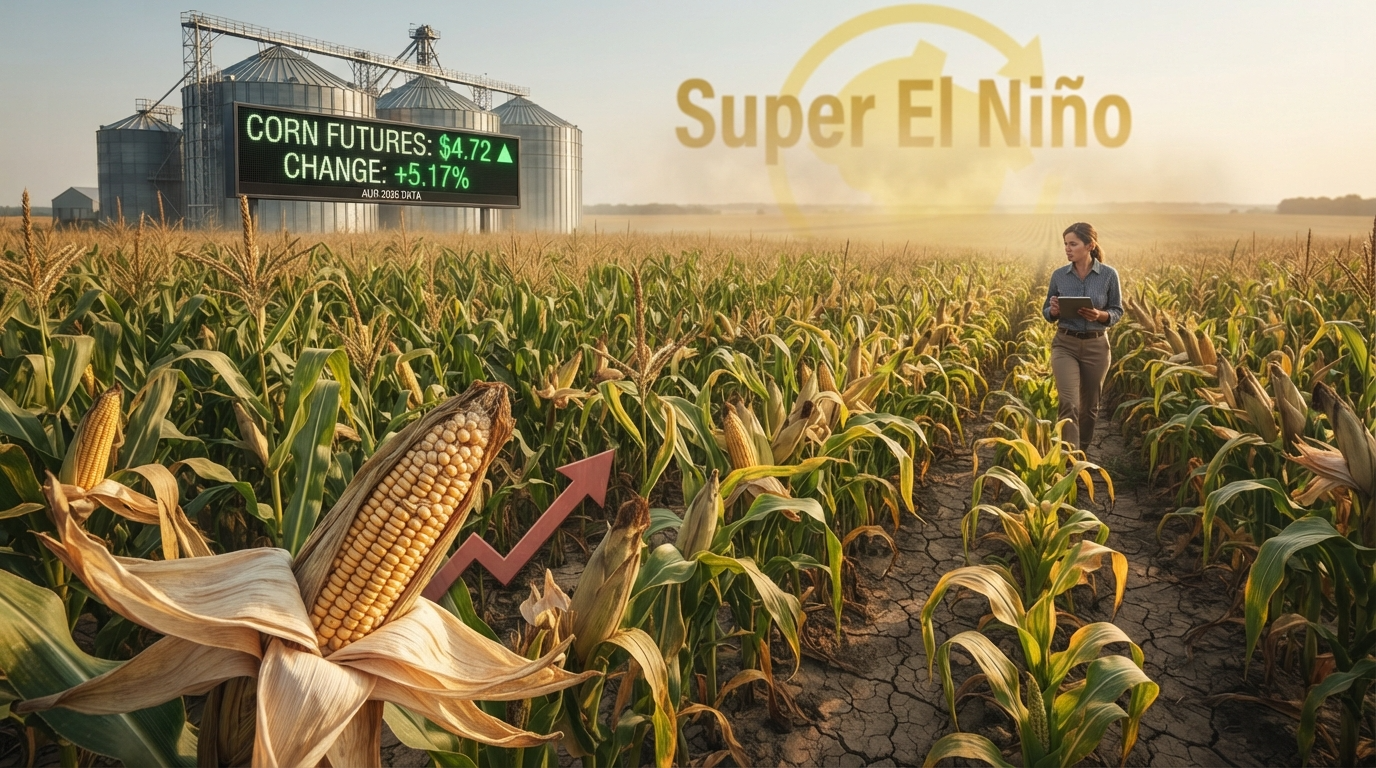

Corn prices are tightening faster than supply projections suggest, raising the risk of a sharp rally that could pressure livestock feed costs and meat sourcing budgets in the final quarter of 2026.
Supply Tightness Emerging in Plain Sight
For much of 2026, corn has traded in a $4.25–$4.50 per bushel range, a comfortable price for livestock producers and a relief for meat and dairy procurement teams after years of feed inflation. That cushion is beginning to vanish. The August USDA WASDE report revised 2026–2027 ending stocks downward to 1.653 billion bushels—a 15% drop from the prior year’s carryover—while simultaneously raising export forecasts by 75 million bushels as global demand absorbs U.S. grain more aggressively than expected.
Corn futures have rallied sharply since June, climbing to $4.66–$4.72 per bushel by mid-August, the highest price since May. Over the past 12 months, corn is up 21.73%, and in just the past month it gained 5.17%. These moves are not speculation-driven alone. Weekly U.S. corn export inspections jumped 81.7% year-over-year to 1.91 million tonnes, with Mexico, Japan, and Colombia among top buyers. U.S. cumulative corn shipments through August stand 26.1% ahead of the same period last year, underscoring structural demand that cannot be dismissed as noise.
Brazil’s second-crop corn harvest, meanwhile, was only 85% complete as of mid-August, well below the 94% average pace. The delay adds supply uncertainty in the second-largest global corn producer. Combined with tighter U.S. ending stocks and robust export demand, the fundamental picture is shifting from abundant to merely adequate.
Weather Risk Is Not Theoretical
The August USDA crop tour—the first large-scale field assessment of developing 2026 corn yields—provided early warning. Pro Farmer estimates put South Dakota corn yields at only 149 bushels per acre, down dramatically from last year’s 174 bushel forecast. Drought has stressed crops in Kansas, and heat damage continues in parts of the Corn Belt. These are not catastrophic figures, but they signal that the 180.7 bushel-per-acre national yield forecast embedded in USDA projections may be optimistic.
A Super El Niño is forming, a climate driver that historically correlates with production disruptions across key growing regions—the U.S., Argentina, and Europe. Europe suffered significant drought and a smaller corn crop in 2025, reducing exports by 700,000 metric tons and generating a localized 7.5% price gain in Q3 2025 even as global prices fell. If history repeats and another El Niño year produces crop losses across multiple regions, U.S. corn will be called upon to fill the gap—at higher prices.
Corn has traded above $8 per bushel three times in the past: 2008, 2012, and 2022. While $8 remains distant at current prices, the springboard for a rapid move is being compressed. Existing supply cushions are minimal. Export demand is unusually strong. Weather threats are escalating. The structural setup for a rally is firming.
What This Means for Feed Costs and Meat Procurement
Feed expenses represent 60–70% of operating costs in hog and poultry production and are a major component of dairy and beef profitability. A $1.00 per bushel increase in corn prices translates directly into $4.50–$5.00 per hundredweight of additional feed cost for hog producers and measurable margin pressure for beef cattle operations in feedlots.
Current USDA farm income forecasts project feed spending down 6.8% year-over-year to $65.6 billion in 2026, built on the assumption that corn prices remain near current levels ($4.40 per bushel season-average). If corn rallies to $5.00–$5.50 per bushel—a realistic scenario if weather disruptions occur in the autumn or if global demand continues to exceed supply—feed costs will rise sharply, eroding the cost advantage livestock producers are currently experiencing. That cost increase flows directly to meat and dairy procurement: higher feed costs force meat producers to either reduce margins or raise prices.
Procurement teams sourcing meat in Q4 2026 and into 2027 should monitor corn futures closely. Hedging strategies for meat contracts—locking in portion of Q4 and early 2027 sourcing at current prices before a potential rally—merit serious evaluation. The risk of a sharp feed cost spike over the next 90 days is materially higher than it was in June.
The Supply-Demand Squeeze Is Real
The narrative that U.S. corn is “abundant” because production is large deserves re-examination. Yes, the U.S. produced a record 17 billion bushels in 2025 and is forecast to harvest 16 billion bushels in 2026—the second-largest U.S. crop on record. But supply and demand operate at the margin. Demand is also rising. The USDA raised 2026–2027 corn usage projections to 16.33 billion bushels, a 75-million-bushel increase from June’s estimate, driven entirely by stronger export demand and robust ethanol usage targeting sustainable aviation fuel applications.
When supply at 16 billion bushels roughly equals demand at 16.33 billion bushels, carryover stocks shrink to 1.65 billion bushels—the tightest year-end balance in years. A 15% decline in ending stocks year-over-year is meaningful. Procurement teams accustomed to operating under ample supply conditions should shift to a tighter mental model. In a balanced market, small demand surprises or small yield misses trigger sharp price moves.
Strategic Sourcing Adjustments Now
Procurement professionals should adopt a tactical horizon of 90 days and a strategic horizon of 12 months. In the near term, monitor Pro Farmer crop tour updates, weekly corn export sales reports, and Brazilian harvest completion rates. These are real-time signals of supply flow. If export demand accelerates beyond current forecasts or if weather knocks yields below projections, corn could gap higher in a matter of weeks. Existing hedges for Q4 2026 meat sourcing—whether via futures contracts, cost-plus formulas tied to commodity benchmarks, or renegotiated supplier agreements—should be stress-tested against a $5.00 per bushel corn scenario. The cost impact on meat is quantifiable and material.
For 2027 sourcing strategy, consider diversifying protein sources or incorporating supply agreements that include force majeure clauses tied to specific corn price levels. Supplier negotiations over the next 60 days offer an opportunity to lock in price certainty before a potential autumn rally. Waiting for a dip may look prudent if prices fall further, but it also exposes the operation to the risk of a gap-move higher that closes the pricing window entirely.
FAQ
Q1: How much higher could corn prices realistically go?
Corn trades currently near $4.66–$4.72 per bushel. USDA break-even production costs sit near $5.00 per bushel for conventional U.S. corn growers. If a production shock hits (weather, geopolitical disruption to exports, or disease in major competing regions), prices could rally $0.50–$1.00 per bushel to $5.25–$5.75 within weeks. Historically, corn has moved from $4 to $6+ in a season when supply becomes materially tight. The question is not whether it can happen, but whether it will before the 2026 harvest cycle completes.
Q2: Is the end-of-season feed-cost relief permanent?
No. Feed spending is forecast down 6.8% in 2026 only because grain prices remain low. That forecast was built before recent export demand surges and supply estimate revisions. If corn prices rally, feed spending will rise sharply, eroding the 2026 cost advantage. Dairy producers are already facing tight margins despite lower feed costs—a $0.50 corn price move could swing them into loss. Hog and poultry producers have margins to cushion a move, but it will directly reduce profitability. Procurement teams should view 2026 feed-cost relief as temporary, not structural.
Q3: What should procurement do now?
Lock in Q4 2026 and early 2027 meat sourcing at current prices if possible, particularly for volume categories like ground beef, pork, and chicken. Use commodity futures, pre-negotiated cost-plus formulas, or fixed-price supplier contracts to hedge against a rally. If the market dips further, the worst outcome is that you locked in slightly higher prices than the absolute low—a small insurance cost compared to the risk of a gap-move higher that eliminates pricing power. Strategic sourcing is about managing tail risk, and the tail risk to feed costs is clearly skewed to the upside.
Sources
- USDA WASDE. “August 2026 World Agricultural Supply and Demand Estimates.” August 12, 2026.
- Pro Farmer Crop Tour. “Corn Yield Assessments, South Dakota and Corn Belt Region.” August 2026.
- ADM Investor Services. “Ag Market View, August 19, 2026.” August 19, 2026.
- USDA Economic Research Service. “Livestock, Dairy, and Poultry Outlook.” February 2026.
- USDA Farm Sector Income Forecast. “Feed Spending Projections 2026.” Economic Research Service.
- University of Illinois College of Agricultural, Consumer and Environmental Sciences. “Prospects for Swine Feed Costs in 2026.” farmdoc daily, February 13, 2026.
- USDA Agricultural Outlook Forum. “Break-Even Prices for Corn, Soybeans, and Wheat.” 2026.
- Trading Economics. “Corn Futures Price Data, August 2026.”
- Roach Ag Marketing. “August 2026 USDA Supply & Demand Analysis.” August 12, 2026.