
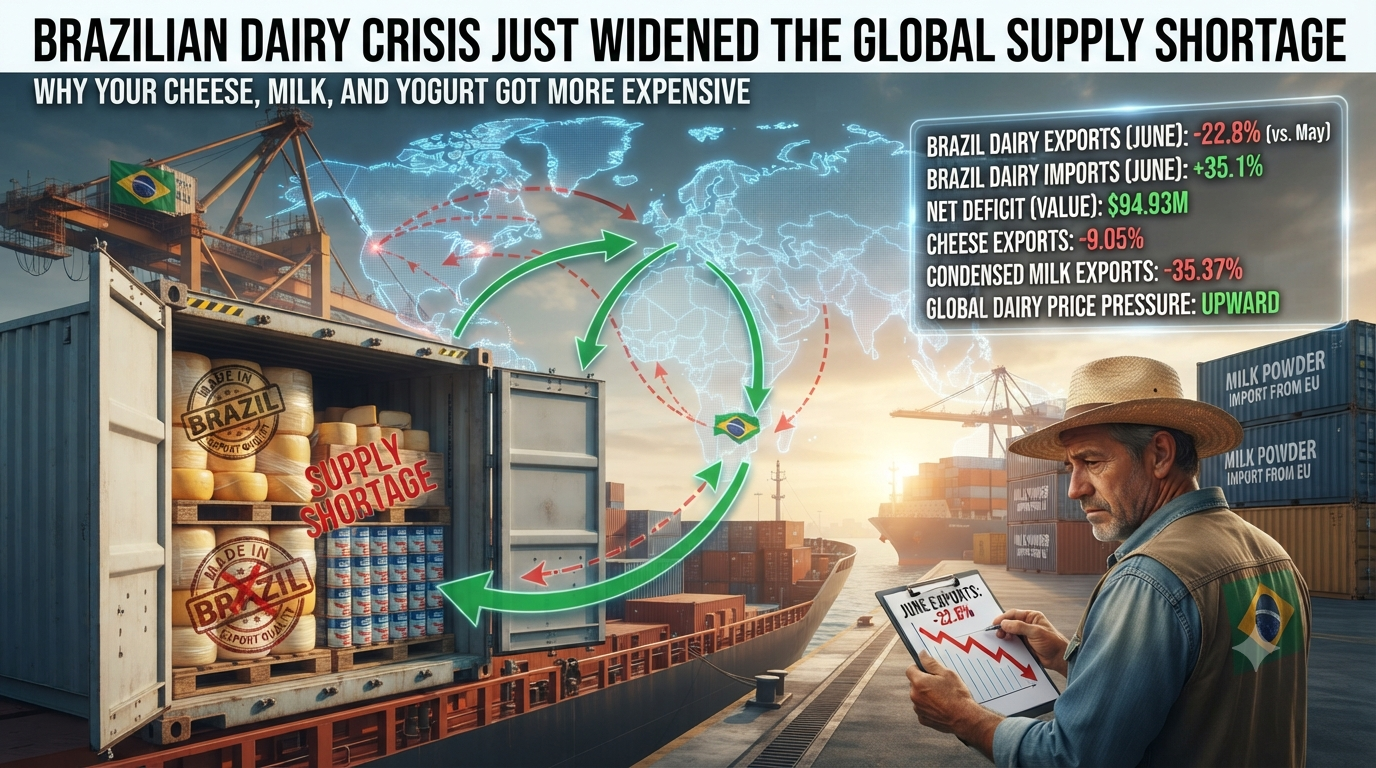

Brazil’s dairy exports collapsed 22.8% in June. With imports surging 35%, the world’s third-largest dairy producer is now a net consumer—and F&B costs are about to spike.
Brazil’s dairy industry just entered crisis mode. In June alone, Brazilian dairy exports plummeted 22.75% month-over-month to just 4.49 million liters of milk equivalent—the steepest monthly decline in recent memory. Year-over-year, the picture is even bleaker: exports down 12.92% compared to June 2025, while imports surged 35.11%.
For food and beverage professionals sourcing dairy ingredients, this Brazilian dairy crisis represents a seismic shift in global supply dynamics. When Brazil—the world’s third-largest dairy producer and a historically major exporter—pivots from supplier to importer, global dairy prices follow. And they’re already moving upward.
The Brazilian Dairy Crisis: What Went Wrong
The collapse in Brazilian dairy exports isn’t random. It reflects a combination of domestic pressure and international market weakness:
Domestic Milk Production Constraints: Brazil’s dairy herd is under stress from inflationary feed costs, unfavorable weather patterns, and rising labor expenses. Producers are holding milk for domestic consumption rather than exporting at compressed margins.
Weakening Export Prices: Global dairy commodity prices have been under pressure. Brazilian exporters face declining returns on cheese, condensed milk, and milk powder—the category’s top exports. At lower price points, the economics of export logistics no longer pencil out.
Rising Domestic Demand: Brazil’s middle class is growing, and domestic dairy consumption is rising. Manufacturers and foodservice operators inside Brazil are competing aggressively for scarce milk supply, driving up local prices and reducing available export volumes.
The result: A Brazilian dairy crisis that transforms Brazil from a reliable export partner into a net importer—a role the country hasn’t played at this scale in decades.
What Brazil’s Dairy Crisis Means for Global Supply
Here’s what’s critical to understand: Brazil doesn’t just export commodity dairy. It exports the specific products that global food manufacturers depend on.
Cheese Exports Down 9.05%: Cheese accounted for 43.9% of Brazil’s total dairy exports in June. With volumes falling to 1.97 million liters of milk equivalent and year-to-date cheese container shipments down 31.1%, global cheese supply is tightening. Top destinations—the U.S., EU, and Middle East—will face scarcity and higher prices.
Condensed Milk Exports Collapsed 35.37%: Condensed milk represented 21.9% of Brazil’s exports and fell to just 984,160 liters in June. Condensed milk is a critical ingredient in beverages, desserts, ice cream, and confectionery across Latin America and Asia. This Brazilian dairy crisis directly impacts ingredient sourcing across multiple food categories.
Powdered Milk Imports Surging: Brazil is now importing 153.38 million liters of milk equivalent in powdered milk—70.8% of its total dairy imports. This domestic deficit must be filled by competing for EU, U.S., and Oceania supplies, which will further tighten global availability.
The cascading effect: Every other dairy-importing nation is now competing for the same shrinking pool of global supply. Prices will rise. Availability will tighten. The Brazilian dairy crisis has gone global.
The Trade Deficit Explosion: Why Volumes and Dollars Tell Different Stories
Here’s a critical detail that underscores the severity of the Brazilian dairy crisis: while the trade deficit narrowed by volume (212.28 million liters of milk equivalent, down 3.7% from May), it widened in value terms to $94.93 million—up 1.2% from May.
This is the tell. Brazil is now paying more to import lower volumes of dairy. This signals:
- Desperation buying at spot market prices (not contracted, lower-cost imports)
- Willingness to pay premium prices to secure supply
- Expectation that domestic milk production will remain constrained through Q3 2026
Year-over-year, the Brazilian dairy crisis is even more stark: the volume deficit is up 31.4% compared to June 2025. Brazil is importing significantly more milk than it did a year ago, at a time when global dairy supply is already tight due to commodity inflation and trade uncertainty (recall the soybean and corn price spikes—feed costs for dairy herds are rising globally).
What This Means for Your Bottom Line
Dairy Manufacturers & Cheese Producers: If you source Brazilian cheese or condensed milk, your supply is evaporating. Existing contracts may not be renewed. Prices will jump to reflect scarcity. Diversify sourcing NOW—explore EU, U.S., and Oceania suppliers, but be aware they’re also facing demand surges as Brazil competes for their supply.
Ice Cream, Yogurt & Cultured Products Makers: Condensed milk and milk powder are foundational inputs. The Brazilian dairy crisis means ingredient costs are rising sharply. Budget for 8–12% input cost increases over the next two quarters. Review formulations—can you reduce dairy content without sacrificing texture or taste? Can you substitute with alternative bases (plant-based, coconut, oat)?
Foodservice & QSR: If your suppliers rely on Brazilian dairy ingredients (particularly for desserts, sauces, and beverages), expect menu price increases or portion adjustments. Communicate proactively with your suppliers. Lock in pricing for Q3/Q4 deliveries before the Brazilian dairy crisis drives further scarcity.
Beverage Companies: Condensed milk is a key ingredient in ready-to-drink coffee beverages, sweetened condensed milk drinks, and regional specialty beverages. With Brazilian exports down 35%, substitute ingredients or regional sourcing strategies must be activated immediately.
Distributors & Wholesalers: Stock dairy ingredients aggressively while available. Monitor Brazilian export data weekly via Secex (Brazilian Trade Ministry). The Brazilian dairy crisis will create supply shocks—early preparation protects margins and customer relationships.
Broader Context: The Brazilian Dairy Crisis Isn’t Isolated
The Brazilian dairy crisis coincides with tightening global commodity markets. Recall the soybean and corn price spikes earlier this month—feed costs for dairy herds are rising worldwide. Add tariff uncertainty from USMCA (U.S.-Mexico-Canada trade tensions) and you have a perfect storm:
- Feed costs up (soybeans, corn)
- Milk prices rising globally
- Brazil constrained domestically
- Global dairy supply tightening
- Shipping and logistics costs elevated
For F&B professionals, the message is clear: dairy costs are moving higher across all categories. The Brazilian dairy crisis is the catalyst, but the underlying drivers are structural.
FAQ
Q: How long will the Brazilian dairy crisis last?
A: Likely through Q4 2026 at minimum. Dairy herd rebuilding takes 12–18 months. Feed cost pressures won’t ease until commodity prices stabilize. Expect tight Brazilian dairy supply through 2027. Plan accordingly for ingredient sourcing.
Q: Will dairy prices spike immediately, or is there a lag?
A: 3–6 week lag typically. Suppliers replenish inventory at new market prices, then pass through increases. If you haven’t locked in dairy prices for Q3/Q4, do it this week. The Brazilian dairy crisis is accelerating procurement cycles.
Q: Should I switch away from Brazilian dairy suppliers?
A: Not necessarily abandon them, but diversify. EU cheese, U.S. milk powder, and Oceania butter are alternatives—though they’re also facing demand surges. The safer play is a 60/40 split: 60% alternative sourcing, 40% Brazilian (for specific products where substitution is difficult). This de-risks the Brazilian dairy crisis impact.
Q: What’s the outlook for global dairy prices?
A: Upward pressure through 2027. The Brazilian dairy crisis is one factor; global feed inflation, climate variability, and geopolitical trade tensions are others. Budget for 5–10% dairy input cost inflation over the next 12 months.
Q: Are there opportunities in the Brazilian dairy crisis?
A: Yes—for innovation-focused brands. Dairy shortages create openings for alternative proteins, plant-based dairy products, and synthetic dairy ingredients. Brands that pivot to alternatives during the Brazilian dairy crisis may capture permanent market share.
Q: Which dairy categories are most at risk?
A: Cheese (down 9%), condensed milk (down 35%), and milk powder (imports up 70% of total). If your products depend on these ingredients, prioritize supply chain diversification immediately.
Sources
- Secex (Brazilian Ministry of Economy – Trade Data): https://www.gov.br/produtividade-e-comercio-exterior/pt-br
- Cepea (Center for Advanced Studies in Applied Economics) – Dairy Trade Analysis: https://www.cepea.org.br
- Datamar – Container Shipment Data & Trade Intelligence: https://www.datamar.com
- FAO (Food and Agriculture Organization) – Global Dairy Market Monitor: https://www.fao.org/documents/card/en/c/CA9735EN/
- USDA Foreign Agricultural Service – Brazilian Dairy Sector Report: https://www.fas.usda.gov