
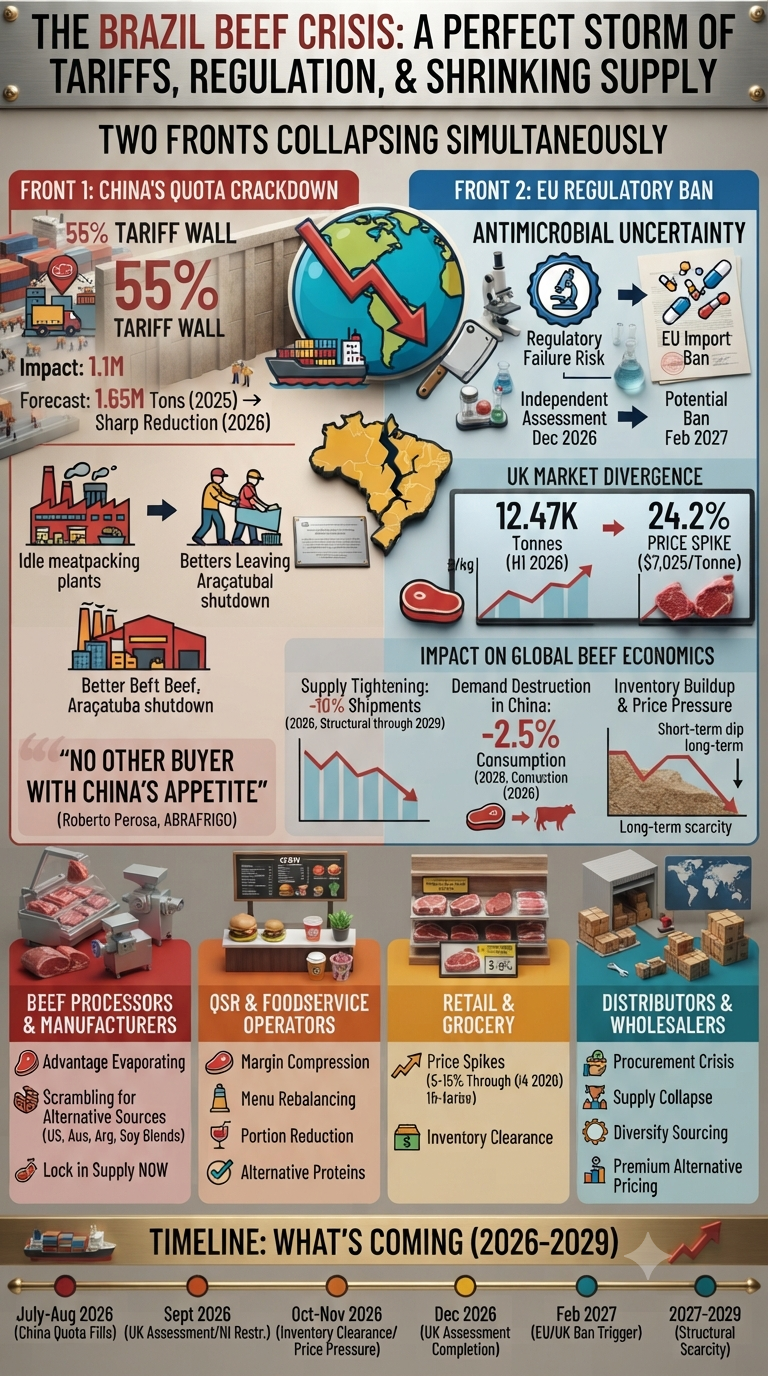

China just slammed the brakes on Brazilian beef imports with a punishing 55% tariff. Meanwhile, the EU is banning Brazilian beef over antimicrobial concerns. For meatpacking, QSR, and F&B, the Brazil beef crisis means higher costs and shrinking supply.
Brazil’s beef industry is in crisis. China’s beef import quota is triggering a 55% tariff on excess shipments, with processors left with fewer options for shipments that would normally head to China—the country’s largest overseas market. Simultaneously, the South American country faces a risk of being shut out of the European market over antimicrobial control failures. For food and beverage professionals sourcing beef, this Brazil beef crisis represents a perfect storm: demand destruction in the world’s largest beef buyer, regulatory barriers in Europe, and a UK market in limbo. The cascading effects will ripple through global beef pricing, procurement strategy, and menu costs through 2027.
The Brazil Beef Crisis: Two Fronts Collapsing Simultaneously
Front 1: China’s Quota Crackdown — A 55% Tariff Wall
Brazil’s 1.1 million ton beef quota to China is filled, triggering a 55% tariff on any excess shipments. To contextualize the damage: Brazil shipped about 1.65 million tons of beef to China in 2025, and forecasts point to a sharp reduction in 2026. This represents a structural collapse in Brazil’s primary export outlet.
The Brazil beef crisis isn’t accidental. China imposed an added 55% tariff on beef imports that exceed quota levels from key suppliers including Brazil, Australia and the U.S. in a move to protect its domestic cattle industry. The message is clear: China is retreating from imported beef to protect domestic producers, and Brazil is bearing the brunt.
The immediate impact is devastating. Brazilian meatpackers in several states are preparing to place employees at some plants on mandatory leave from July, as they anticipate the imminent exhaustion of China’s annual tariff-rate quota for beef imports from Brazil. Better Beef is halting production at its Araçatuba unit, while Iguatemi Beef is placing 650 of 850 employees on mandatory leave. This Brazil beef crisis is forcing factory shutdowns across the country.
Why can’t they pivot to other markets? There is no other buyer that can absorb those volumes. Roberto Perosa, president of the Brazilian Association of Meat Exporting Industries, put it bluntly: “There is no other buyer with China’s appetite.” This is the critical constraint: China represents 40%+ of Brazil’s beef exports, and no alternative market can replace that volume.
Front 2: EU Regulatory Ban — Antimicrobial Uncertainty
While China strangles supply with tariffs, the EU is taking a regulatory approach. The UK, however, is buying Brazil time. According to the UK Department for Environment, Food and Rural Affairs (Defra), the British government will conduct its own independent assessment of Brazil’s antimicrobial control system by December 2026. If Brazil fails to provide required assurances on antimicrobial drug traceability, imports will be banned beginning in February 2027.
The catch: Northern Ireland will still face restrictions beginning in September 2026, since it shares a land border with Ireland (an EU member). And once the UK aligns its phytosanitary agreement with the EU—expected sometime in 2027—the UK will follow the bloc’s stricter antimicrobial rules anyway.
This Brazil beef crisis adds regulatory uncertainty to an already tight supply picture. Even if China quota relief comes (unlikely), regulatory barriers in Europe create a ceiling on recovery potential.
What This Means for Global Beef Pricing and Supply
The Brazil beef crisis is reshaping global beef economics in real time:
Supply Tightening: Overall Brazilian beef shipments are anticipated to fall by roughly 10% this year. This isn’t a temporary adjustment—it’s structural. The measure takes effect on January 1 for three years, with the total quota set to increase annually. Brazil’s beef supply to global markets will be constrained through 2029.
Demand Destruction in China: China’s consumption of beef also is slowing after decades of exponential growth. Beef consumption in the Asian nation is set to drop about 2.5% in 2026 to 11.29 million tons. This isn’t quota-driven scarcity—this is actual weakening demand as Chinese consumers cut spending on premium foods amid economic slowdown.
Inventory Buildup and Price Pressure: Iguatemi Beef has built up inventories to increase sales from July to other markets, including the United States, the Middle East, the United Kingdom and Brazil. When Brazilian exporters flood alternative markets with excess inventory, they depress prices temporarily. However, this demand shift is unsustainable—once the inventory clears, scarcity will drive prices upward.
UK Market Divergence: The UK is a high-value outlier. Although UK import volumes are modest compared to China, Brazil exported 29,980 tonnes of beef to the UK in 2025. In the first half of 2026, exports totaled 12,470 metric tonnes, down 2.9% from the same period a year earlier, yet the average price paid by British buyers rose 24.2% year over year to $7,025 per tonne. The UK is paying premium prices for access—a signal of scarcity in high-value markets.
The Brazil Beef Crisis Impact on F&B Value Chain
Beef Processors & Manufacturers: The Brazil beef crisis forces immediate strategic decisions. If you depend on Brazilian beef as a cost lever, that advantage is evaporating. For the 2026 quota, cargoes that left Brazil in late 2025 and reached China only in early 2026 were counted—meaning Brazil’s quota fill-rate accelerated faster than anticipated. Suppliers are now scrambling to secure alternative beef sources (U.S., Australia, Argentina) or ingredient substitutes (soy protein, plant-based blends). Lock in supply contracts NOW before prices spike further. Farm Progress
QSR & Foodservice Operators: Beef-heavy menus face margin compression. The Brazil beef crisis means your suppliers are paying more for beef (and competing for reduced supply), which will be passed through to you within 4–8 weeks. Menu engineering is urgent: Can you reduce beef portions? Introduce more plant-based or poultry options? Bundle beef with lower-cost proteins? The Brazil beef crisis demands portfolio rebalancing.
Retail & Grocery: Premium beef cuts and Brazilian-origin products will see price spikes. Budget for 5–15% beef price increases through Q4 2026 as inventory clears and supply tightens. Ground beef, which can absorb lower-grade cuts, may see more moderate increases. The Brazil beef crisis hits premium retail harder than value segments.
Distributors & Wholesalers: Your procurement teams face a critical window. Brazilian beef availability is collapsing. Alternative sources (U.S., Australia, Argentina) are now pricing at a premium due to sudden demand surge from displaced Brazilian buyers. Diversify NOW. Consider longer-term contracts with U.S. and Australian suppliers, accepting higher fixed prices to hedge against the Brazil beef crisis volatility. Working capital management is critical—inventory turns may slow as supply tightens.
Animal Feed & Rendering: The Brazil beef crisis is reducing slaughter volumes, which means less offal, rendering materials, and feed byproducts for the circular economy. This downstream scarcity may create opportunities for feed additives and alternative protein sources.
Timeline: What’s Coming
July–August 2026: China’s quota fills completely. Brazilian meatpackers shift volumes to alternative markets (U.S., Middle East, UK, domestic). Spot prices for Brazilian beef weaken temporarily as inventory floods secondary markets.
September 2026: UK antimicrobial assessment deadline approaches. Northern Ireland faces EU restrictions. Uncertainty persists—do UK buyers hedge by sourcing from EU or wait for December assessment?
October–November 2026: Inventory clearance ends. Secondary market absorption stabilizes. U.S., Australian, and Argentine beef supplies tighten further as demand from Brazilian buyer displacement persists.
December 2026: UK completes antimicrobial assessment. If Brazil passes, UK remains open (though uncertainty remains on final alignment with EU rules). If Brazil fails, February 2027 ban triggers.
February 2027: EU ban on Brazilian beef imports takes effect (if not already). UK ban also triggers if Brazil fails assessment. Global beef supply tightens further. Prices spike across all origins.
2027–2029: Three-year China quota system keeps Brazilian supply suppressed. Global beef markets remain tight. Alternative proteins and plant-based options gain permanent share in foodservice and retail.
FAQ
Q: Will Brazilian beef prices drop because China’s quota filled?
A: Temporarily, yes—as Brazilian exporters flood secondary markets with inventory. But this is a short-term reprieve. Once inventory clears (4–8 weeks), supply tightens structurally, and prices will rise above current levels. The Brazil beef crisis is just beginning.
Q: Can Brazil export to other markets instead of China?
A: In theory, yes. In practice, no. There is no other buyer with China’s appetite. The U.S., EU, Middle East, and UK combined don’t buy enough volume to absorb Brazil’s excess supply. Some will be redirected domestically (supporting local QSR and retail), but the Brazil beef crisis means structural over-supply relative to export demand. The AgriBiz
Q: Should I lock in beef prices now before they spike?
A: Yes. This is urgent. Spot prices may seem weak due to inventory flooding, but contract prices for Q4 2026 and 2027 will reflect future scarcity. Lock in supply agreements with U.S., Australian, and Argentine suppliers immediately. The Brazil beef crisis makes 2027 pricing a guessing game—secure commitments now.
Q: What’s the impact on beef prices globally?
A: U.S. beef will see moderated increases (3–8%) as Brazilian displacement creates competition, but global supply tightening (Brazil down, China demand weakening, EU restrictions) will push prices higher. Budget for 8–12% beef cost inflation through 2027. The Brazil beef crisis is a global phenomenon.
Q: Is plant-based or alternative protein an immediate lever?
A: Yes, strategically. The Brazil beef crisis creates demand for alternatives. If your product can tolerate a 20–30% soy or plant-based blend without taste/quality degradation, test it now. Consumers may accept it at unchanged prices, giving you margin relief as beef costs rise.
Q: When will the Brazil beef crisis resolve?
A: The China quota system runs for three years (2026–2029). Chinese domestic beef production will need to improve meaningfully to reduce import quotas—unlikely in this timeframe. Expect structural supply constraints through 2029. The EU antimicrobial issue may resolve by 2027 (if Brazil complies), creating some relief, but China remains the bottleneck.
Q: Should I reduce my reliance on Brazilian beef suppliers?
A: Strategically, yes. The Brazil beef crisis exposes structural vulnerability—over-reliance on a single supplier vulnerable to quota systems and regulatory bans. Diversify to U.S., Australia, Argentina, and emerging suppliers (Uruguay, Paraguay). The Brazil beef crisis is a wake-up call on supply chain concentration risk.
Sources
- Bloomberg – “China’s Beef Curbs Start Rippling Across Brazil Meat Industry” (July 16, 2026): https://www.bloomberg.com/news/articles/2026-07-16/china-s-beef-curbs-start-rippling-across-brazil-meat-industry Datamar
- UK Department for Environment, Food and Rural Affairs (Defra) – Antimicrobial Assessment Protocol: https://www.gov.uk/defra
- DatamarNews – “Brazilian Meatpackers Halt Output as China Beef Quota Nears Limit” (July 2026): https://datamarnews.com/noticias/brazilian-meatpackers-halt-output-as-china-beef-quota-nears-limit/ Farm Progress
- Reuters – “China Imposes Curbs on Beef Imports to Protect Domestic Industry” (December 31, 2025): https://www.reuters.com
- Brazilian Ministry of Agriculture – Antimicrobial Control System (July 1, 2026): https://www.gov.br/agricultura
- USDA Foreign Agricultural Service – Global Beef Market Outlook: https://www.fas.usda.gov
- Market Briefs – “Brazil Beef Exports Face China Quota Crisis”: https://www.briefs.co/news/brazil-s-beef-exports-face-china-quota-barrier/ The AgriBiz